
Sinus lift surgery in Vietnam may be recommended for patients who need dental implants in the upper back jaw but do not have enough bone beneath the maxillary sinus. The procedure raises the sinus membrane and creates additional space for bone graft material, helping develop sufficient bone for future implant placement.
This situation is particularly common when upper molars or premolars have been missing for a long time. Bone can gradually shrink after tooth loss, while the maxillary sinus may expand downward, leaving insufficient vertical bone height for conventional implant placement.
For international patients considering dental implants in Vietnam, a sinus lift can affect the total treatment cost, healing period and number of trips required. Some patients can have the sinus augmentation and implant performed during the same appointment, while others need several months of bone healing before the implant can be placed.
This guide explains the cost of sinus lift surgery in Vietnam, open and closed techniques, bone graft materials, recovery, implant timing, possible complications and practical considerations for patients travelling overseas for treatment.
Quick Navigation
Sinus Lift Surgery in Vietnam: Quick Overview
| Item | Typical Information |
|---|---|
| Main purpose | Increase bone height beneath the maxillary sinus for dental implants |
| Treatment area | Posterior upper jaw, usually molar and premolar regions |
| Assessment | Dental examination, X-ray and usually CBCT |
| Main approaches | External/lateral sinus lift and internal/crestal sinus lift |
| Bone graft | Commonly used to create additional bone beneath the sinus membrane |
| Implant timing | Same procedure in selected cases or after graft healing |
| Healing period | Several months; depends on procedure and graft volume |
| Anaesthesia | Usually local anaesthesia |
| Hospital stay | Normally not required for routine procedures |
| Travel planning | May require more than one trip if treatment is staged |
The final treatment approach depends on the amount of existing bone, sinus anatomy, implant stability and the clinician’s assessment.
What Is Sinus Lift Surgery?
A sinus lift, also known as sinus augmentation or sinus floor elevation, is a surgical procedure used to increase the amount of bone in the posterior upper jaw.
The roots of the upper molars and premolars are located close to the maxillary sinuses. After these teeth are lost, two processes can reduce the amount of bone available for dental implants:
- the jawbone may gradually resorb after tooth loss;
- the sinus cavity may enlarge downward into the area previously occupied by bone.
When insufficient bone remains, placing a standard dental implant may not provide adequate support.
The American Academy of Periodontology explains that sinus augmentation raises the sinus floor and promotes development of bone for dental implant placement in the upper posterior jaw.
During sinus lift surgery in Vietnam, the surgeon carefully elevates the sinus membrane and places graft material beneath it. The graft then provides a framework for bone formation and can eventually create sufficient vertical height for an implant.
Why Is a Sinus Lift Needed Before Dental Implants?
Not every upper-jaw implant requires a sinus lift.
The procedure is considered when there is not enough residual bone between the crest of the jaw and the floor of the maxillary sinus to support the planned implant.
Common reasons include:
- upper molars or premolars missing for many years;
- natural enlargement or downward expansion of the sinus;
- periodontal bone loss;
- previous tooth infection;
- bone loss following extraction;
- naturally limited posterior maxillary bone height;
- previous implant or graft failure.
The American Academy of Periodontology identifies the upper back jaw as one of the more challenging areas for implants because bone quantity and quality may be limited and the sinus is nearby.
If you need only one implant in this area, our guide to a single tooth implant in Vietnam explains the broader treatment sequence, costs and possible additional procedures.
How Dentists Determine Whether You Need a Sinus Lift
Before recommending sinus lift surgery in Vietnam, the dentist or implant surgeon should assess both the available bone and the sinus anatomy.
Clinical Examination
The dentist evaluates:
- the missing-tooth area;
- gum condition;
- ridge shape;
- neighbouring teeth;
- bite;
- signs of infection;
- periodontal health.
Clinical examination alone cannot accurately measure the remaining bone beneath the sinus.
Panoramic X-Ray
A panoramic dental X-ray provides an overview of the upper jaw and maxillary sinuses.
It can show the approximate relationship between the sinus floor and the proposed implant site but provides only two-dimensional information.
CBCT Scan
Cone Beam Computed Tomography, or CBCT, is particularly useful when planning sinus lift and implant surgery.
It can help the clinician evaluate:
- residual bone height;
- ridge width;
- sinus floor position;
- sinus shape;
- membrane and sinus anatomy;
- septa inside the sinus;
- nearby anatomical structures;
- proposed implant position.
CBCT-based planning can also help determine whether a less invasive internal sinus lift may be possible or whether a lateral-window procedure is more appropriate.
Open vs Closed Sinus Lift Surgery
There are two main approaches to sinus augmentation.
Open Sinus Lift: Lateral Window Technique
An open or external sinus lift is generally used when a more substantial increase in bone height is required.
The surgeon makes an incision in the gum and creates a small opening in the lateral wall of the maxilla. Through this window, the sinus membrane is gently elevated and bone graft material is placed beneath it.
The area is then closed with sutures.
Cambridge University Hospitals describes the external approach as creating a window in the bone, lifting the sinus lining and placing bone graft underneath.
An external sinus lift can provide a larger volume of augmentation but is usually more involved than an internal approach.
Closed Sinus Lift: Internal or Crestal Approach
A closed sinus lift is performed through the implant preparation site rather than through a separate lateral window.
The surgeon prepares the implant site from the crest of the jaw, carefully elevates the sinus floor and adds graft material beneath the membrane.
Cambridge University Hospitals notes that an internal approach can be performed together with implant placement when only a relatively small increase in bone height is required.
Because the procedure is less extensive, postoperative discomfort may be lower in appropriate cases.
Which Technique Is Better?
Neither procedure is universally “better.”
The appropriate technique depends on:
- residual bone height;
- amount of augmentation required;
- sinus anatomy;
- membrane condition;
- implant stability;
- surgeon’s treatment plan.
A CBCT scan is therefore important before choosing the surgical approach.
Sinus Lift Surgery Procedure: Step by Step
Although treatment varies between patients, sinus lift surgery in Vietnam commonly follows several stages.
Step 1: Consultation and Imaging
The dentist reviews:
- dental history;
- medical history;
- medications;
- smoking or nicotine use;
- previous implant treatment;
- X-rays or CBCT images.
For international patients, existing scans may sometimes be reviewed before travel, although new imaging may still be required after arrival.
Step 2: Local Anaesthesia
Routine sinus lift surgery is usually performed under local anaesthesia.
More complex cases may involve additional sedation depending on the provider, patient and procedure.
Step 3: Accessing the Sinus
For an external sinus lift, the surgeon exposes the lateral wall of the upper jaw and creates a small bone window.
For an internal approach, access is made through the implant preparation site.
Step 4: Elevating the Sinus Membrane
The sinus lining is carefully separated and raised from the underlying bone.
This stage requires particular care because tearing the sinus membrane is a known potential complication.
Step 5: Placing the Bone Graft
Graft material is placed into the newly created space between the sinus membrane and the existing jawbone.
Depending on the technique, the surgeon may also use a membrane to protect or stabilise the graft.
Step 6: Implant Placement — If Appropriate
In selected patients, the implant can be inserted during the same surgery.
If there is insufficient residual bone to achieve adequate implant stability, graft healing is allowed to occur first and implant placement is performed later.
Step 7: Closure and Healing
The gum is closed with sutures and the patient receives postoperative instructions.
The graft gradually integrates and supports formation of new bone.
What Bone Graft Materials Are Used?
Several types of graft materials may be used during a sinus lift.
Autogenous Bone
This is bone obtained from the patient’s own body, sometimes from another area of the mouth.
It has favourable biological properties but requires a donor site.
Allograft
Allograft material comes from processed human donor bone.
It can avoid the need to harvest additional bone from the patient.
Xenograft
Xenografts are obtained from an animal source, commonly bovine-derived material that has been specially processed for medical use.
These materials are widely used in implant dentistry.
Synthetic Materials
Synthetic or alloplastic bone substitutes may also be used.
Cambridge University Hospitals notes that graft materials can include the patient’s own bone, donor bone, animal-derived products and synthetic materials.
Patients with religious, ethical or personal preferences regarding graft materials should ask the dentist what product will be used before consenting to surgery.
Sinus Lift Surgery Cost in Vietnam
The cost of sinus lift surgery in Vietnam varies according to the surgical technique, graft material and amount of augmentation required.
Current VnMedtour implant guides indicate that a sinus lift for a single implant site may be approximately USD 400–800 in some cases, although more extensive procedures can cost more.
A larger lateral sinus lift involving more graft material, membrane use or bilateral treatment should not be expected to cost the same as a limited internal sinus lift.
What Affects the Cost?
Important factors include:
- open versus closed approach;
- one side versus both sides;
- graft material and brand;
- amount of graft required;
- membrane use;
- surgeon’s fee;
- CBCT imaging;
- sedation if required;
- simultaneous implant placement;
- additional dental treatment.
For this reason, online prices should be treated as indicative rather than final quotations.
What Should a Sinus Lift Quote Include?
International patients should request an itemised quotation showing whether the price includes:
- consultation;
- CBCT;
- surgeon’s fee;
- local anaesthesia;
- graft material;
- membrane;
- medication;
- sutures;
- postoperative reviews;
- implant fixture;
- abutment;
- final crown.
A sinus lift quotation may cover only the augmentation procedure and not the implant itself.
For more information about implant brands, additional procedures and overall treatment costs, see our Dental Implants in Vietnam guide.
Can Sinus Lift and Implant Placement Be Done Together?
Yes, but not in every patient.
When enough natural bone remains to obtain adequate initial implant stability, the surgeon may perform the sinus augmentation and implant placement during the same procedure.
This can shorten overall treatment time.
The American Academy of Periodontology notes that implant placement can sometimes be carried out at the same time as sinus augmentation, while other patients need a period of bone development before implants are inserted.
When existing bone is inadequate for stable implant placement, treatment is usually staged:
Stage 1: Sinus augmentation
Stage 2: Graft healing
Stage 3: Implant placement
Stage 4: Osseointegration
Stage 5: Final crown or bridge
This distinction matters substantially to international patients because staged treatment may require additional travel.
Healing Time After Sinus Lift Surgery
Healing after sinus lift surgery in Vietnam depends on the surgical technique, amount of graft material, implant timing and individual patient factors.
Cambridge University Hospitals states that an external sinus lift may require approximately four to nine months for the graft to integrate before implant placement.
The American Academy of Periodontology gives a broader timeframe, noting that bone may be allowed to develop for approximately four to twelve months depending on individual circumstances.
This does not mean every patient must wait that long.
When an internal sinus lift and implant placement are performed simultaneously, the graft and implant can heal during the same general treatment phase.
Factors affecting healing include:
- amount of augmentation;
- graft material;
- smoking;
- infection;
- oral hygiene;
- general health;
- diabetes control;
- membrane integrity;
- postoperative compliance.
Recovery After Sinus Lift Surgery
Some swelling, tenderness and minor bleeding can occur after surgery.
Patients may also experience temporary nasal or sinus-related sensations because the procedure is performed close to the maxillary sinus.
Postoperative instructions can include:
- taking prescribed medication;
- eating softer foods initially;
- maintaining careful oral hygiene;
- avoiding pressure on the surgical site;
- attending postoperative reviews.
Because pressure changes can affect the sinus, the dentist may also advise patients to avoid actions such as forceful nose blowing during the early healing period.
Cambridge University Hospitals provides specific postoperative advice after sinus lift procedures, including precautions relating to sneezing, nose blowing and sinus pressure.
Patients should follow their own surgeon’s instructions rather than relying solely on general online advice.
How Long Should International Patients Stay in Vietnam?
The surgical procedure itself does not usually require a prolonged hospital stay.
However, overseas patients should allow sufficient time for:
- consultation;
- CBCT and treatment planning;
- surgery;
- early postoperative review.
For a straightforward procedure, patients may not need to remain in Vietnam for the entire graft-healing period.
They can usually return home and come back when the next stage is due, subject to their surgeon’s advice.
The appropriate travel schedule depends on whether the implant is placed at the same time.
Flying After Sinus Lift Surgery
This deserves particular attention for international patients.
A sinus lift involves the maxillary sinus, so changes in cabin pressure may be relevant during the early postoperative period.
Do not assume that flying immediately after surgery is appropriate.
Before purchasing a return flight, ask the surgeon:
- when air travel is considered appropriate;
- whether the surgical approach affects the recommended waiting period;
- what symptoms would require reassessment before flying.
A patient undergoing an extensive bilateral lateral sinus lift may receive different advice from someone having a small internal elevation.
Will You Need to Return to Vietnam?
Possibly.
Scenario 1: Sinus Lift and Implant Together
The graft and implant are placed during the same visit.
The patient usually returns after osseointegration for the final restoration.
Scenario 2: Sinus Lift First
The graft is allowed to mature for several months.
The patient then returns to Vietnam for implant placement.
A later appointment may be required for the crown or bridge.
Scenario 3: Follow-Up in Your Home Country
Some patients wish to complete later stages locally.
If so, obtain:
- CBCT images;
- operative notes;
- graft material details;
- implant brand;
- implant model and dimensions;
- treatment dates;
- relevant X-rays.
It is better to arrange continuity of care before treatment rather than after returning home.
Sinus Lift vs Dental Bone Graft
A sinus lift is a form of bone augmentation, but not every dental bone graft is a sinus lift.
| Sinus Lift | Dental Bone Graft |
|---|---|
| Performed in the posterior upper jaw | Can be performed anywhere in the jaw |
| Involves the maxillary sinus | May not involve the sinus |
| Primarily increases vertical bone beneath the sinus | Can increase bone width, height or fill a defect |
| May use open or internal approach | Includes socket grafting, GBR, ridge augmentation and other techniques |
Patients who have broader jawbone deficiency can read our guide to dental bone graft in Vietnam for a more detailed explanation of graft materials and augmentation procedures.
Can All-on-4 Reduce the Need for a Sinus Lift?
Sometimes.
All-on-4 uses four implants to support a full-arch prosthesis. In selected upper-jaw cases, posterior implants can be positioned at an angle to make better use of available bone and avoid certain anatomical structures.
This may reduce the need for sinus augmentation in some patients.
However, All-on-4 is not simply a substitute for sinus lift surgery. Whether it is suitable depends on:
- remaining teeth;
- available bone;
- jaw anatomy;
- implant stability;
- prosthetic design;
- overall treatment objectives.
Patients considering full-arch rehabilitation can read:
Risks and Possible Complications
Sinus lift surgery in Vietnam, like any surgical procedure, carries potential risks.
These may include:
- postoperative pain;
- swelling;
- bleeding;
- infection;
- sinus membrane perforation;
- graft exposure;
- graft infection;
- incomplete bone regeneration;
- wound opening;
- sinus symptoms;
- failure to obtain sufficient bone for the planned implant.
A sinus membrane perforation is one of the procedure-specific complications surgeons consider when performing sinus augmentation.
Cambridge University Hospitals also discusses possible risks including sinus lining tears, infection and failure of the graft to integrate adequately.
A complication does not necessarily mean implant treatment becomes impossible, but it may change the treatment sequence or healing time.
Smoking and Sinus Lift Surgery
Smoking and nicotine use should be disclosed before surgery.
Smoking can interfere with tissue healing and may increase the risk of complications after grafting and implant procedures.
Patients should tell the dentist about:
- cigarette smoking;
- vaping;
- nicotine products.
The surgeon may recommend stopping or reducing nicotine exposure before and after treatment.
Patients should not conceal smoking simply because they are concerned the clinic may decline treatment. Accurate medical and lifestyle information is important for treatment planning.
Alternatives to Sinus Lift Surgery
A sinus lift is not always the only possible approach.
Depending on anatomy and restorative requirements, alternatives may include:
Shorter Implants
Modern shorter implants may be considered in selected patients with limited vertical bone height.
Different Implant Positioning
Changing implant position or angulation may allow the surgeon to make better use of available bone.
Full-Arch Implant Concepts
Approaches such as All-on-4 may sometimes avoid posterior sinus augmentation by using strategic implant placement.
Conventional Bridge
A tooth-supported dental bridge may be an option in some patients who do not want implant surgery.
Removable Prosthesis
A partial or complete denture may be considered when implant surgery is unsuitable or unwanted.
Cambridge University Hospitals lists several alternatives to sinus lift treatment, including accepting fewer implants, using shorter implants or considering non-implant restorative options, depending on the clinical situation.
These options have different benefits and limitations and should be discussed with the treating dentist.
Who May Need Additional Assessment?
Some patients require more detailed evaluation before undergoing sinus lift surgery in Vietnam.
Relevant considerations can include:
- active sinus disease;
- recurrent sinusitis;
- nasal or sinus surgery history;
- periodontal disease;
- uncontrolled diabetes;
- smoking;
- active dental infection;
- certain medications affecting bone healing;
- previous radiotherapy;
- significant medical conditions.
Patients with a history of chronic sinus problems should tell the implant surgeon before treatment.
In some cases, additional evaluation may be appropriate before sinus augmentation proceeds.
Choosing a Clinic for Sinus Lift Surgery in Vietnam
Price should not be the only deciding factor.
International patients may wish to evaluate:
- implant surgeon qualifications;
- experience with sinus augmentation;
- frequency of open and closed sinus lift procedures;
- CBCT availability;
- graft material documentation;
- implant brands;
- sterilisation protocols;
- postoperative support;
- English communication;
- emergency contact arrangements;
- ability to provide complete treatment records.
Complex augmentation requires more surgical planning than a straightforward implant in an area with abundant bone.
Patients should therefore ask who will actually perform the surgery and whether that clinician routinely manages sinus augmentation cases.
Questions to Ask Before Sinus Lift Surgery in Vietnam
Before confirming treatment, ask:
- Why do I need a sinus lift?
- How much natural bone remains?
- Can you show me the problem on my CBCT?
- Do you recommend an open or closed approach?
- What graft material will be used?
- Is a membrane required?
- Can the implant be placed at the same time?
- If not, how long should the graft heal?
- How many trips to Vietnam are likely?
- What exactly is included in the quotation?
- When can I safely fly after surgery?
- What happens if the sinus membrane is perforated?
- What follow-up is needed after I return home?
- Who should I contact if I develop sinus symptoms?
These questions make it easier to compare treatment proposals between providers.
Planning Dental Treatment in Vietnam
Before travelling, international patients may send the clinic:
- panoramic X-rays;
- CBCT scans if available;
- dental photographs;
- implant history;
- medical history;
- medication list;
- sinus-related medical history;
- smoking history;
- intended travel dates.
These records can assist with preliminary planning, but the final surgical plan may change after an in-person examination and updated imaging.
Patients considering additional treatment during the same trip can also review our Dental Work in Vietnam guide for information about common procedures, costs and travel planning.
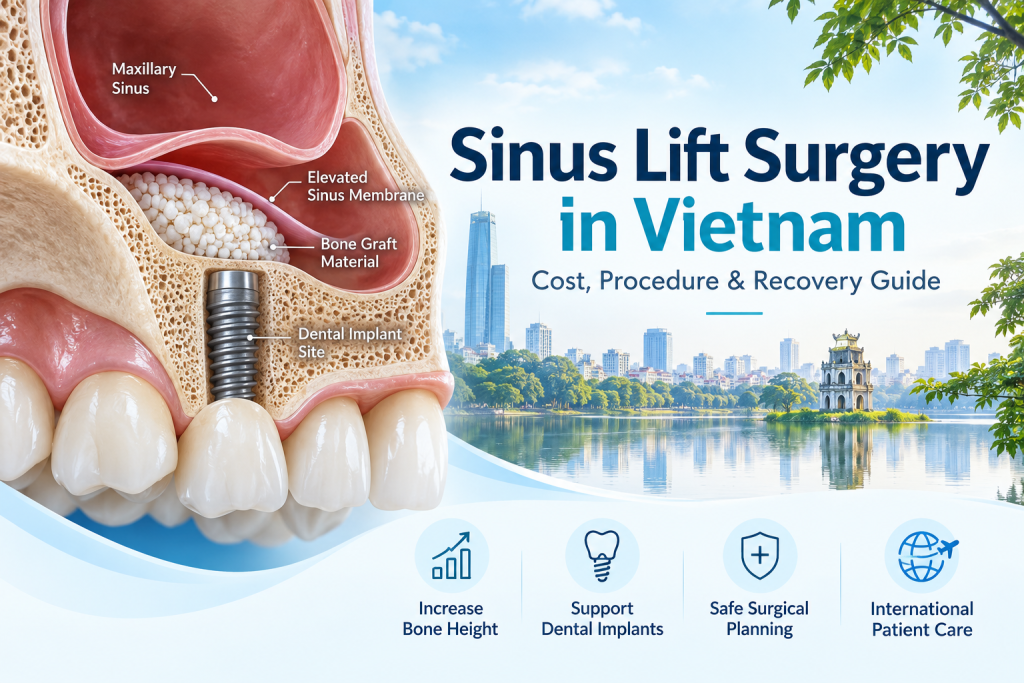
Sinus lift surgery in Vietnam to increase bone height before dental implant placement.
Frequently Asked Questions About Sinus Lift Surgery in Vietnam
How much does sinus lift surgery in Vietnam cost?
Some current Vietnamese implant guides quote approximately USD 400–800 for sinus augmentation associated with a single implant site, but prices vary according to open versus closed technique, graft volume and procedure complexity. More extensive surgery can cost more.
Is sinus lift surgery painful?
The procedure is normally performed under local anaesthesia. Patients may experience swelling, tenderness and discomfort afterward, but pain levels vary according to surgical extent and individual recovery.
How long does a sinus lift take to heal?
External sinus augmentation may require several months of bone healing. Cambridge University Hospitals gives an approximate period of four to nine months for an external graft to integrate before implant placement, although individual cases vary.
Can the implant be placed during sinus lift surgery?
Yes, in selected patients where sufficient residual bone allows the implant to achieve adequate primary stability.
Is a closed sinus lift better than an open sinus lift?
Not necessarily. A closed approach is suitable for limited augmentation, while an open lateral approach can provide greater bone gain when more extensive augmentation is required.
Do all upper-jaw dental implants require sinus lifts?
No. Many patients have enough bone for implants without sinus augmentation.
Is sinus lift surgery the same as bone grafting?
A sinus lift is a specific type of bone augmentation involving the posterior upper jaw and maxillary sinus. Bone grafting is a broader term covering many procedures.
Can a sinus lift fail?
Yes. Infection, membrane problems, graft complications and inadequate bone formation can occur, although treatment is planned to minimise these risks.
Can I fly immediately after a sinus lift?
You should obtain specific advice from your surgeon before flying because the procedure involves the maxillary sinus and pressure changes may be relevant during recovery.
Can I send my CBCT before travelling to Vietnam?
Yes. Existing scans may help with preliminary assessment, but updated imaging can still be required before treatment.
Sinus Lift Surgery in Vietnam: Final Considerations
Sinus lift surgery in Vietnam can make dental implant treatment possible when there is insufficient bone beneath the maxillary sinus.
Treatment may involve a relatively limited internal sinus elevation performed together with implant placement or a more extensive lateral-window procedure followed by several months of graft healing.
For international patients, the key considerations go beyond the advertised price. A suitable treatment plan should clearly explain:
- why sinus augmentation is required;
- how much bone is currently available;
- which surgical approach is recommended;
- what graft material will be used;
- whether the implant can be placed simultaneously;
- expected healing time;
- possible complications;
- number of trips required;
- when flying is appropriate;
- postoperative and long-term follow-up.
Patients considering sinus lift surgery in Vietnam should obtain an individualized assessment based on clinical examination and appropriate imaging before confirming treatment or international travel arrangements.
Medically reviewed by MSc, MD, Doctor Dang Tien Dat
Planning Dental Implant Treatment in Vietnam?
If you need a sinus lift before dental implants, our team can help you understand the procedure, recovery time, and expected cost in Vietnam. We support international patients with treatment guidance and clinic matching.