
A dental bone graft in Vietnam may be recommended when there is not enough healthy jawbone to support a dental implant. Bone loss can develop after long-term tooth loss, periodontal disease, infection, trauma or previous extractions. In these situations, bone grafting can rebuild the implant site and create a more suitable foundation for treatment.
For international patients considering dental implants in Vietnam, the need for grafting can affect not only the treatment cost but also the number of appointments, healing period and number of trips required.
Some patients need only a small amount of graft material placed around an implant. Others may require guided bone regeneration, ridge augmentation or sinus augmentation several months before implant placement.
This guide explains dental bone graft cost in Vietnam, the main grafting procedures and materials, healing time, possible risks and practical considerations for patients travelling to Vietnam for dental treatment.
Quick Navigation
Dental Bone Graft in Vietnam: Quick Overview
| Item | Typical Information |
|---|---|
| Main purpose | Increase or restore jawbone for dental implant placement |
| Common reasons | Long-term tooth loss, periodontal disease, extraction defects, trauma or insufficient natural bone |
| Assessment | Dental examination, X-ray and often CBCT |
| Common procedures | Socket preservation, GBR, ridge augmentation, block graft and sinus augmentation |
| Implant timing | Same appointment in selected cases or after graft healing |
| Healing period | Commonly several months |
| Anaesthesia | Usually local anaesthesia for routine procedures |
| Hospital stay | Usually not required |
| International travel | One or more visits may be necessary depending on treatment complexity |
The exact procedure cannot usually be confirmed from photographs alone. Clinical examination and appropriate imaging are important before a final treatment plan is made.
What Is a Dental Bone Graft?
A dental bone graft is a procedure used to increase bone volume or density in part of the jaw.
Dental implants require adequate surrounding bone for stability and long-term support. When the jawbone is too narrow, too low or has lost significant volume, implant placement may be difficult without additional bone.
During grafting, a dentist or oral surgeon places bone graft material into or around the deficient area. The material acts as a scaffold that supports new bone formation while healing takes place.
According to Cleveland Clinic, dental bone grafting can increase jawbone volume and density and provide a framework for the patient’s own bone to regenerate.
A dental bone graft in Vietnam can therefore range from a small augmentation around one implant site to more extensive reconstruction of a severely resorbed jaw ridge.
Why Is Bone Grafting Needed Before Dental Implants?
Not every implant patient needs bone grafting.
Bone volume can decrease after a tooth has been lost because the jaw no longer receives normal stimulation from the tooth root. Over time, the ridge may become narrower or shorter.
Other causes of inadequate bone include:
- periodontal disease;
- infection around a tooth;
- traumatic tooth loss;
- previous difficult extractions;
- previous implant failure;
- long-term denture use;
- naturally narrow jaw anatomy;
- bone loss beneath the maxillary sinus.
The American Academy of Periodontology explains that dental implants are placed in the jawbone to support prosthetic teeth, which is why the condition of the implant site is an important part of treatment planning.
For a patient replacing only one missing tooth, the amount of grafting required may be relatively limited. You can read more about the overall treatment process in our guide to a single tooth implant in Vietnam.
How Dentists Determine Whether You Need a Bone Graft
Before recommending a dental bone graft in Vietnam, the dentist normally evaluates the gums, jawbone and intended implant position.
Clinical Examination
The dentist may assess:
- gum health;
- ridge width and contour;
- surrounding teeth;
- bite;
- signs of infection;
- periodontal condition;
- soft tissue quality.
A visibly narrow jaw ridge may suggest bone loss, but imaging is usually needed before implant surgery.
Dental X-Rays
Panoramic X-rays provide a broad view of the jaws, teeth and nearby anatomical structures.
They can identify significant bone loss but do not show bone dimensions in the same detail as three-dimensional imaging.
CBCT Scan
Cone Beam Computed Tomography, or CBCT, is commonly used for implant planning because it allows the dentist to assess the jaw in three dimensions.
A CBCT scan can help determine:
- bone height;
- bone width;
- implant position;
- proximity to nerves;
- sinus anatomy;
- the extent of a bone defect;
- whether grafting is required;
- whether a sinus lift may be needed.
For international patients, this information is especially useful because it can influence whether grafting and implant placement can be completed during the same visit.
Types of Dental Bone Graft Materials
Different materials may be used during a dental bone graft in Vietnam. The choice depends on the defect, procedure, clinician’s treatment plan and individual patient factors.
Autograft
An autograft uses the patient’s own bone.
Small amounts may sometimes be harvested from another area of the mouth. Larger grafts may require a more substantial donor site.
Because the material comes from the patient, autogenous bone has useful biological properties, but harvesting it creates an additional surgical site.
Allograft
An allograft uses processed human donor bone.
It avoids the need to obtain bone from another area of the patient’s body and is used in a range of dental augmentation procedures.
Xenograft
A xenograft is derived from an animal source, commonly bovine-derived material that has been processed for medical use.
It is frequently used in guided bone regeneration and sinus augmentation.
Synthetic Bone Graft
Synthetic, or alloplastic, grafts are manufactured biomaterials designed to support bone regeneration.
Cleveland Clinic lists autogenous, allograft, xenograft and synthetic materials among the main categories used in dental bone grafting.
Patients with personal, religious or ethical preferences regarding graft materials should discuss them with the treating dentist before surgery.
Common Dental Bone Grafting Procedures in Vietnam
Bone grafting is a broad term that includes several different techniques.
Cambridge University Hospitals notes that the technique used depends on the amount of grafting required, the anatomy of the area and patient-specific considerations.
Socket Preservation
Socket preservation may be performed when a tooth is removed.
Bone graft material is placed into the extraction socket to help maintain the shape and volume of the ridge while the area heals.
This may make future implant placement easier, although additional augmentation can still be required.
Guided Bone Regeneration
Guided bone regeneration, commonly called GBR, is often used for localized bone defects.
The surgeon places graft material at the deficient site and may cover it with a barrier membrane.
The membrane helps protect the grafted area while new bone develops.
Cambridge University Hospitals explains that guided bone regeneration may sometimes be performed at the same time as implant placement when only limited grafting is needed.
Ridge Augmentation
Ridge augmentation is used when the jaw ridge has lost significant width, height or both.
A moderate defect may be treated with particulate graft material, while more severe resorption may require staged reconstruction.
Block Bone Graft
A block graft uses a solid piece of bone to rebuild a larger defect.
This approach may be considered when there is substantial bone loss and can require a longer healing period before implant placement.
Sinus Augmentation
The posterior upper jaw presents a particular challenge because the maxillary sinus lies above the upper premolars and molars.
When there is not enough bone beneath the sinus to support an implant, sinus augmentation may be required.
Patients considering implants in this area can read our detailed guide to sinus lift for dental implants in Vietnam.
Dental Bone Graft Cost in Vietnam
The dental bone graft cost in Vietnam varies considerably because treatment can range from a small graft around one implant to complex ridge reconstruction.
For routine cases, minor bone grafting may start from approximately USD 150–350 per site at some Vietnamese dental providers. More extensive procedures, membranes, larger quantities of graft material or sinus surgery can cost substantially more.
These figures should be treated as general guidance rather than guaranteed prices.
What Affects Dental Bone Graft Cost?
The total price may depend on:
- size of the bone defect;
- number of graft sites;
- graft material and brand;
- quantity of graft material;
- membrane requirements;
- surgeon’s fee;
- CBCT imaging;
- whether the implant is placed simultaneously;
- whether sinus augmentation is required;
- additional extraction or periodontal treatment.
A quotation that simply states “bone graft” may therefore not provide enough information for a meaningful comparison.
What Should Be Included in a Bone Graft Quote?
Before confirming treatment, check whether the quotation includes:
- consultation;
- dental imaging or CBCT;
- local anaesthesia;
- bone graft material;
- membrane if required;
- surgical fee;
- medication;
- sutures;
- postoperative reviews;
- implant placement;
- sinus lift if needed.
Two clinics may advertise different graft prices because one quote includes graft material and membrane while another lists them separately.
For a broader view of implant fees and related procedures, see our guide to dental implants in Vietnam.
Dental Bone Graft in Vietnam vs Treatment Overseas
Lower treatment costs are one reason international patients consider dental care in Vietnam.
However, price should not be compared in isolation.
When comparing quotations between Vietnam and another country, check:
- graft material;
- amount of material;
- whether a membrane is included;
- CBCT fees;
- surgeon’s fee;
- implant system;
- postoperative reviews;
- number of required visits;
- accommodation and travel costs.
The most useful comparison is therefore the complete treatment plan, not simply the advertised graft price.
Can a Bone Graft and Dental Implant Be Done at the Same Time?
Yes, in some cases.
If enough native bone remains to provide primary stability for the implant, the surgeon may place the implant and add a relatively small graft during the same procedure.
This is often referred to as simultaneous grafting.
It may shorten the overall treatment timeline because the graft and implant can heal during the same period.
Cambridge University Hospitals states that minimal grafting can sometimes be performed at implant placement, whereas more extensive grafting may need to be completed in advance.
When there is more substantial bone loss, the treatment may be staged:
Stage 1: Bone graft
Healing period: Several months
Stage 2: Implant placement
Healing period: Implant integration
Stage 3: Final crown or bridge
For overseas patients, this distinction is important because staged treatment may require additional trips to Vietnam.
Dental Bone Graft Healing Time
Healing after a dental bone graft in Vietnam depends on the size of the graft, its location and the patient’s individual healing response.
Initial gum healing usually occurs much sooner than full bone maturation.
Cleveland Clinic notes that early recovery may occur within about a week, while complete bone healing can take much longer.
Cambridge University Hospitals explains that graft materials act as a scaffold for new bone growth and that this process may take several months.
For many staged implant cases, the graft may be allowed to heal for around three to six months or longer, depending on the procedure.
Factors that may affect healing include:
- graft size;
- graft technique;
- infection;
- smoking;
- oral hygiene;
- periodontal disease;
- diabetes control;
- medication;
- general health;
- compliance with postoperative instructions.
The implant site should be reassessed before proceeding to the next stage rather than relying only on a fixed number of months.
What Is Recovery Like After a Dental Bone Graft?
Recovery varies according to the extent of surgery.
Common short-term effects can include:
- swelling;
- soreness;
- mild bleeding;
- bruising;
- tenderness around the treatment area.
Routine grafting is commonly performed under local anaesthesia.
Patients may be advised to eat softer foods temporarily, maintain careful oral hygiene and avoid disturbing the surgical area.
Cleveland Clinic advises patients to keep the surgical site clean, follow postoperative instructions and avoid smoking or vaping during healing.
Patients should contact the treating clinic if they develop increasing swelling, persistent bleeding, severe pain, fever, discharge or other unexpected symptoms.
How Long Should International Patients Stay in Vietnam?
There is no single recommended stay for every patient having a dental bone graft in Vietnam.
A typical treatment sequence may include:
- consultation;
- X-ray or CBCT;
- treatment planning;
- graft surgery;
- postoperative review.
For a minor graft, a relatively short stay may be sufficient. More extensive surgery may justify a longer period before returning home.
Patients should discuss their intended flight dates with the treating dentist before finalising travel arrangements.
This is particularly important after sinus augmentation or larger graft procedures.
Will You Need to Return to Vietnam?
The number of trips depends largely on whether implant placement can be combined with grafting.
Bone Graft and Implant Together
When simultaneous grafting is possible, the implant may be placed during the first treatment trip.
The patient typically returns later for the final crown or bridge after the implant has integrated.
Bone Graft First
When more extensive reconstruction is required, the graft may need to heal before implant placement.
The patient then returns for implant surgery and may later require another stage for the final restoration.
Treatment Shared Between Vietnam and Your Home Country
Some international patients consider completing one stage in Vietnam and continuing treatment elsewhere.
If this is planned, patients should obtain copies of:
- X-rays;
- CBCT images;
- treatment notes;
- graft material details;
- implant brand;
- implant dimensions;
- surgical records.
Continuity of care is easier when this is discussed before treatment begins.
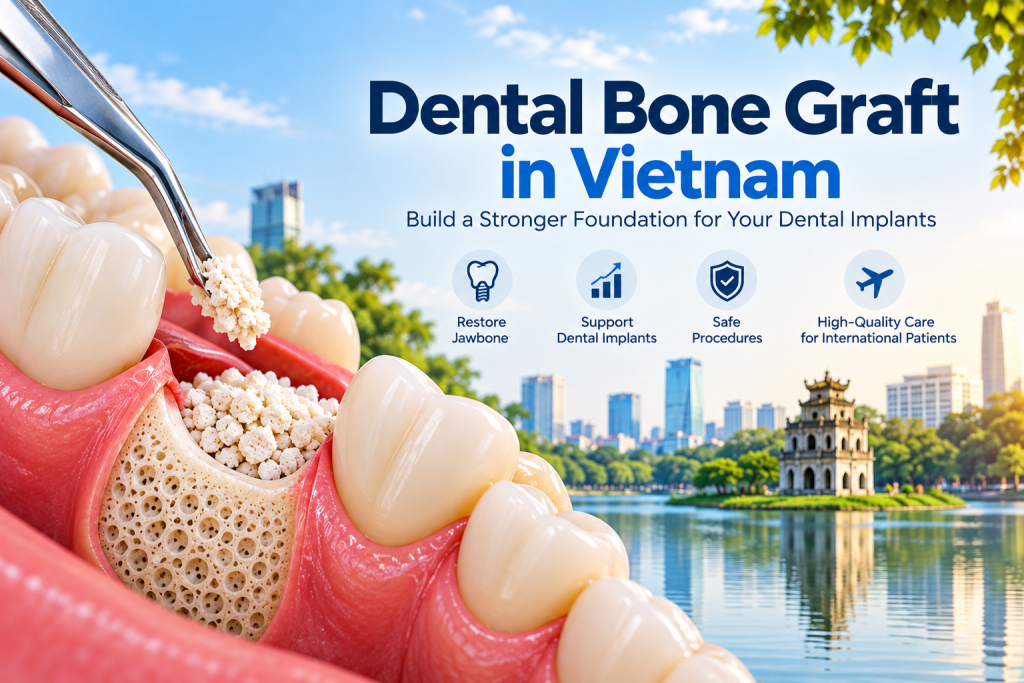
Dental bone graft procedure in Vietnam to rebuild jawbone before dental implant treatment.
Dental Bone Graft vs Sinus Lift
A dental bone graft and sinus lift are related procedures, but they are not the same thing.
A dental bone graft is a general procedure used to increase bone volume in different areas of the jaw.
A sinus lift is a specific form of bone augmentation performed in the posterior upper jaw.
| Dental Bone Graft | Sinus Lift |
|---|---|
| Can be performed in different areas of the jaw | Performed in the upper posterior jaw |
| Can increase bone width or height | Primarily increases available bone beneath the sinus |
| Includes GBR, ridge augmentation and block grafts | Involves elevation of the sinus membrane |
| May or may not involve the sinus | Always associated with maxillary sinus anatomy |
If you have been told you need grafting for an upper molar implant, you may want to review our sinus lift in Vietnam guide.
Can All-on-4 Reduce the Need for Bone Grafting?
In selected cases, full-arch implant techniques may reduce the amount of grafting required.
All-on-4 treatment uses four implants to support a full arch of teeth. Implant angulation can sometimes allow the surgeon to make use of areas with better available bone.
However, this does not mean every patient can avoid grafting.
Bone volume, jaw anatomy, implant stability and prosthetic requirements all need to be considered.
Patients researching full-arch treatment can read more about:
Risks and Possible Complications
A dental bone graft in Vietnam, like any oral surgical procedure, carries potential risks.
These can include:
- pain;
- swelling;
- infection;
- bleeding;
- wound opening;
- graft exposure;
- membrane exposure;
- incomplete graft integration;
- graft loss;
- insufficient new bone formation;
- delayed healing;
- nerve-related symptoms;
- sinus-related complications.
Cleveland Clinic lists infection, nerve damage and bleeding among possible complications of dental bone grafting.
A graft may heal without infection but still fail to create enough bone for the originally planned implant.
Patients should therefore understand that bone grafting can improve the implant site but cannot guarantee a particular outcome.
Smoking and Bone Graft Healing
Smoking and nicotine use are particularly relevant to dental implant and bone graft surgery.
Smoking can interfere with wound healing and may increase the risk of graft or implant complications.
Patients should tell the treating dentist if they:
- smoke cigarettes;
- vape;
- use other nicotine products.
Cleveland Clinic specifically advises avoiding smoking and vaping during recovery after dental bone graft surgery.
The treating surgeon may recommend stopping nicotine before and after the procedure.
Who May Need Additional Assessment?
Some patients require more detailed evaluation before undergoing a dental bone graft in Vietnam.
Factors that may affect treatment include:
- active periodontal disease;
- oral infection;
- poorly controlled diabetes;
- poor oral hygiene;
- heavy smoking;
- certain medications affecting bone metabolism;
- previous radiotherapy involving the jaws;
- significant healing disorders;
- severe bone defects.
These factors do not necessarily prevent treatment, but they may influence treatment timing, graft choice or expected healing.
Questions to Ask Before Having a Dental Bone Graft in Vietnam
Before confirming treatment, consider asking:
- Why do I need a bone graft?
- Can you show me the bone deficiency on my CBCT?
- What type of graft procedure do you recommend?
- What graft material will be used?
- Will a membrane be required?
- Can the implant be placed at the same time?
- If not, how long should the graft heal?
- How many trips to Vietnam may be required?
- What exactly is included in the quotation?
- Will I need a sinus lift?
- What happens if the graft does not produce enough bone?
- What follow-up will I need after returning home?
These questions can make it easier to compare treatment plans from different clinics.
Planning Dental Implant Treatment in Vietnam
Bone grafting is usually only one part of a broader implant treatment plan.
Before travelling, international patients may send:
- recent dental X-rays;
- CBCT scans if available;
- photographs;
- previous treatment records;
- medical history;
- current medications;
- smoking history;
- intended travel dates.
These records may allow a dentist to provide a preliminary assessment.
However, the final treatment plan may change after an in-person examination and updated imaging.
Patients planning several dental procedures during the same trip can also review our broader guide to dental work in Vietnam for information about costs, treatment planning and international travel.
Choosing a Clinic for Dental Bone Grafting in Vietnam
Price should be only one factor when comparing providers.
Consider:
- dentist or oral surgeon qualifications;
- experience with dental implants;
- experience with GBR and bone augmentation;
- CBCT availability;
- graft material documentation;
- sterilisation procedures;
- implant systems;
- written treatment plans;
- postoperative care;
- English-language communication;
- provision of treatment records.
For larger grafts, it may also be useful to ask how frequently the clinician performs the particular procedure being recommended.
Frequently Asked Questions About Dental Bone Graft in Vietnam
How much does a dental bone graft in Vietnam cost?
Minor bone grafting may start from approximately USD 150–350 per site at some providers, while larger grafts, membranes, sinus augmentation or complex reconstruction can cost considerably more. An individual quotation should be based on examination and imaging.
Is a dental bone graft painful?
Routine grafting is usually performed under local anaesthesia. Some soreness, swelling and tenderness may occur during the first few days after surgery.
How long does a dental bone graft take to heal?
Many staged grafts require several months of healing before implant placement. More extensive augmentation may require a longer period.
Can the implant and bone graft be done on the same day?
Yes, when enough existing bone remains to provide implant stability. More substantial defects may require grafting first.
Does every dental implant require bone grafting?
No. Many patients have enough natural bone for implant placement without augmentation.
Do I need a CBCT scan?
CBCT is commonly used when detailed three-dimensional assessment of bone, nerves or sinus anatomy is required for implant planning.
Is a sinus lift the same as a bone graft?
No. A sinus lift is one specific type of bone augmentation performed in the posterior upper jaw.
Can a dental bone graft fail?
Yes. Infection, graft exposure, smoking, poor healing and other factors can affect the outcome. Additional grafting may occasionally be required.
Can international patients send X-rays before travelling to Vietnam?
Yes. Existing X-rays or CBCT scans can help with preliminary planning, but the final treatment plan may still require examination and updated imaging after arrival.
Dental Bone Graft in Vietnam: Final Considerations
A dental bone graft in Vietnam can help create sufficient jawbone for implant treatment when the natural bone is inadequate.
The procedure may range from a small graft performed during implant surgery to more extensive ridge augmentation or sinus grafting that requires several months of healing.
For international patients, the key considerations are not simply the advertised price. A suitable treatment plan should explain:
- why grafting is necessary;
- which technique will be used;
- what graft material is planned;
- whether implant placement can be simultaneous;
- how long healing is expected to take;
- how many trips may be required;
- what postoperative follow-up is available.
Patients considering a dental bone graft in Vietnam should obtain an individualized assessment based on clinical examination and appropriate imaging before confirming treatment or travel arrangements.
Medically reviewed by MSc, MD, Doctor Dang Tien Dat
Planning Dental Treatment in Vietnam?
If you need a bone graft before dental implants, our team can help you understand the procedure, expected recovery, and estimated cost in Vietnam. We support international patients with treatment guidance and clinic matching.