
For people who have lost most or all of their teeth in one jaw, full arch dental implants can provide an alternative to conventional removable dentures. Rather than replacing every missing tooth with an individual implant, a planned number of dental implants can support a larger restoration across the upper or lower arch.
For international patients, Full Arch Dental Implants in Vietnam may include All-on-4, All-on-6 or other implant-supported full-arch restorations. The appropriate approach depends on the condition of the remaining teeth, available bone, gum health, bite, general health and the final prosthetic plan.
Full arch treatment is not one standardized procedure or package. Some patients require extractions, some require additional bone procedures, and some may be suitable for a provisional fixed restoration soon after implant placement. Others require a different treatment sequence.
This guide explains the main full arch implant options in Vietnam, indicative 2026 costs, treatment stages, travel planning, possible additional procedures, risks and long-term maintenance.
For a broader introduction, see our guide to dental implants in Vietnam.
Full arch dental implants in Vietnam – 2026 guide to costs, treatment options and planning for international patients.
Quick Navigation
Full Arch Dental Implants in Vietnam: At a Glance
| Topic | What to Know |
|---|---|
| Purpose | Replace most or all teeth in one upper or lower arch |
| Common approaches | All-on-4, All-on-6 and other implant-supported restorations |
| Number of implants | Determined by individual treatment planning |
| Assessment | Clinical examination and appropriate dental imaging |
| Bone grafting | Required in some cases, but not all |
| Temporary teeth | May be possible in selected cases |
| Final restoration | Usually follows the planned healing/prosthetic stages |
| Number of visits | Depends on treatment and healing |
| Cost | Depends on implants, prosthesis and additional procedures |
| Maintenance | Daily cleaning and professional follow-up remain necessary |
Existing X-rays or CBCT scans can be useful for preliminary review before international travel. However, final treatment planning may require an in-person examination and updated imaging.
What Are Full Arch Dental Implants?
Dental implants are surgically placed into the jaw and can support artificial teeth such as crowns, bridges or dentures. The U.S. Food and Drug Administration describes a dental implant system as including the implant body placed in the jaw and an abutment that can support the artificial teeth.
FDA – Dental Implants: What You Should Know
With a full arch restoration, it is generally not necessary to place one implant for every missing tooth. Instead, multiple implants are positioned to support a larger prosthetic restoration replacing most or all teeth in the arch.
That is why full arch dental implants describe the overall restorative concept rather than one specific technique.
All-on-4 and All-on-6 are two approaches within this broader category.
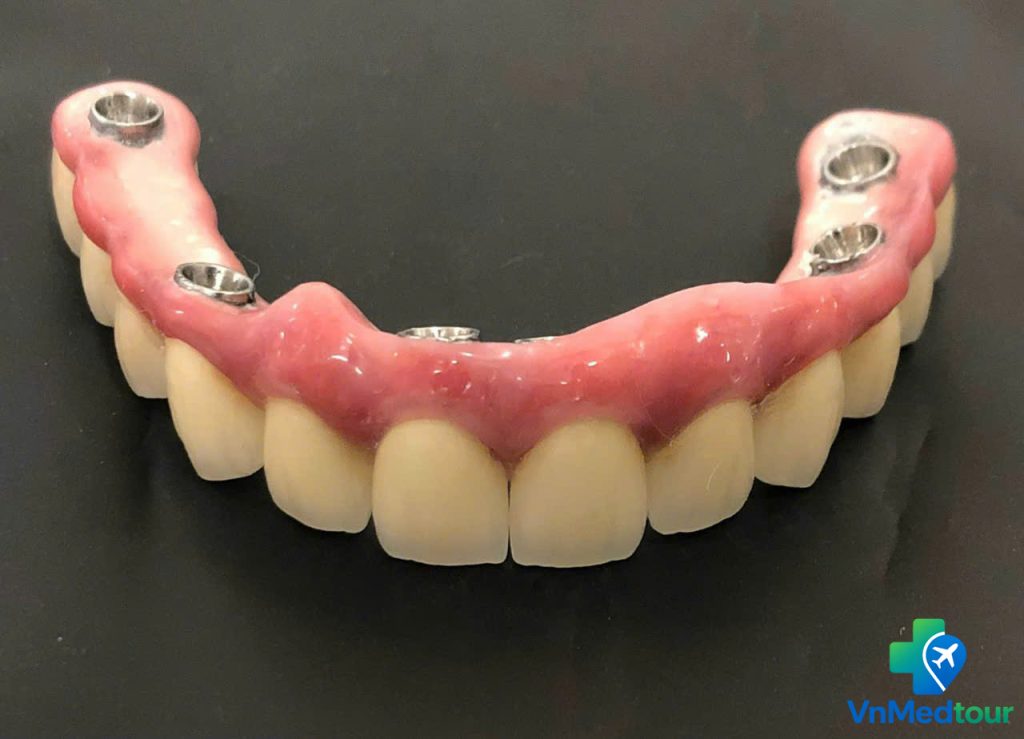
Example of an implant-supported full-arch dental prosthesis. The number and position of implants vary according to the individual treatment plan.
Full Arch vs Full Mouth Dental Implants
Although these terms are sometimes used interchangeably online, there is a useful distinction.
A full arch generally means replacing most or all teeth in one complete dental arch:
- upper jaw; or
- lower jaw.
Full mouth dental rehabilitation may involve both upper and lower arches.
For example, someone who has lost all upper teeth but has maintainable lower teeth may require only an upper full arch restoration.
A patient with severely compromised teeth in both jaws may require a much more extensive full-mouth treatment plan.
This distinction is especially important when comparing prices. A quotation for one arch should not automatically be compared with a quotation for both jaws.
Who May Consider Full Arch Dental Implants?
Full arch implant treatment may be discussed when a patient:
- has lost all teeth in one arch;
- has only a few remaining teeth with a poor prognosis;
- has extensive dental problems affecting most of one arch;
- currently wears complete dentures and wants to explore implant-supported options; or
- may require multiple extractions before reconstruction.
However, the appearance of the teeth alone cannot establish whether implants are appropriate.
The FDA notes that overall health affects implant candidacy and healing, and smoking can affect healing and long-term implant success.
The American Academy of Periodontology also identifies general and oral health, adequate supporting bone and healthy periodontal tissues as important considerations in implant treatment.
American Academy of Periodontology – Dental Implant Procedures
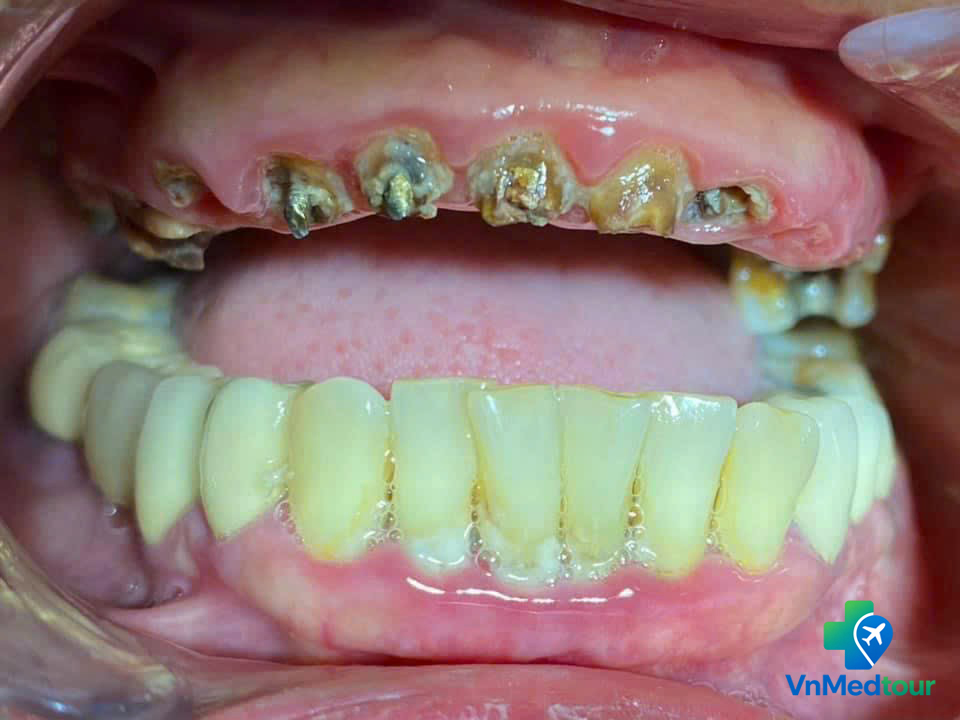
Clinical example of a complex dental condition. Whether remaining teeth should be retained or removed requires individual dental and radiographic assessment.
What Are the Main Full Arch Implant Options?
There is no single implant configuration suitable for every patient considering Full Arch Dental Implants in Vietnam.
All-on-4 Dental Implants
All-on-4 uses four implants to support a full arch restoration.
It is one approach to full arch rehabilitation, but the term should not be used as a generic name for every full arch implant treatment.
Patients specifically researching this technique can read our detailed guide to All-on-4 dental implants in Vietnam.
All-on-6 Dental Implants
All-on-6 generally uses six implants to support a full arch restoration.
The fact that six implants are used does not automatically make it the better option for every patient.
The appropriate implant configuration depends on factors including:
- available bone;
- jaw anatomy;
- implant positions;
- bite forces;
- opposing teeth;
- prosthetic design; and
- the dentist’s treatment plan.
For a detailed explanation of the procedure, costs, treatment stages and candidate considerations, see our guide to All-on-6 dental implants in Vietnam.
Other Implant-Supported Full Arch Restorations
Not every full arch case has to fit the All-on-4 or All-on-6 label.
Other implant numbers, positions and prosthetic designs may be considered according to the individual case.
The important question is therefore not simply:
“Should I choose four implants or six?”
A more useful question is:
“What implant and prosthetic design is appropriate for my anatomy and restorative needs?”
All-on-4 vs All-on-6
A simple comparison can help explain the terminology:
| Feature | All-on-4 | All-on-6 |
|---|---|---|
| Implants supporting the arch | 4 | 6 |
| Full arch restoration | Yes | Yes |
| Suitable for every patient | No | No |
| Clinical assessment required | Yes | Yes |
| Bone condition matters | Yes | Yes |
| Prosthetic planning matters | Yes | Yes |
The dentist should determine the implant configuration after appropriate assessment rather than the patient choosing the number of implants from a package menu.
How Much Do Full Arch Dental Implants in Vietnam Cost?
Based on indicative 2026 pricing supplied to VnMedtour by a dental partner in Vietnam:
| Treatment | Indicative 2026 Price (VND) | Approx. USD |
|---|---|---|
| All-on-4 / All-on-6 treatment | 175–260 million VND | $6,730–$10,000 |
| Full-mouth rehabilitation | 340–520 million VND | $13,080–$20,000 |
These figures are for general reference and are not national average prices or guaranteed quotations. USD equivalents are approximate and calculated using a reference exchange rate of around 1 USD = 26,000 VND. Exchange rates change over time, and final treatment costs depend on the individual treatment plan.
Final cost can vary according to:
- whether one or both arches are treated;
- implant number and brand;
- condition of remaining teeth;
- extractions;
- bone condition;
- grafting or sinus procedures if required;
- provisional restoration;
- final prosthetic material;
- anesthesia or sedation;
- laboratory work; and
- overall treatment complexity.
For broader dental pricing, see our Dental Work in Vietnam guide.
What Should a Full Arch Implant Quote Include?
When comparing quotations, check whether they include the same components.
Ask about:
- consultation;
- dental imaging;
- extractions;
- implant fixtures;
- abutments;
- temporary restoration;
- final restoration;
- anesthesia or sedation;
- bone procedures if necessary;
- laboratory fees;
- medications;
- postoperative reviews; and
- adjustments after the final prosthesis is fitted.
A lower advertised package price is not necessarily a lower final cost if important stages are excluded.
Why Are Dental Imaging and Clinical Assessment Important?
Full arch implant planning requires considerably more information than photographs of a patient’s smile.
The dentist may need to evaluate:
- remaining teeth;
- periodontal condition;
- available bone;
- anatomical structures;
- bite;
- restorative space;
- implant positions; and
- relationship between the upper and lower jaws.
Existing panoramic X-rays or CBCT scans may be useful for preliminary review before traveling to Vietnam.
However, a provider may request updated imaging before confirming the final treatment plan.
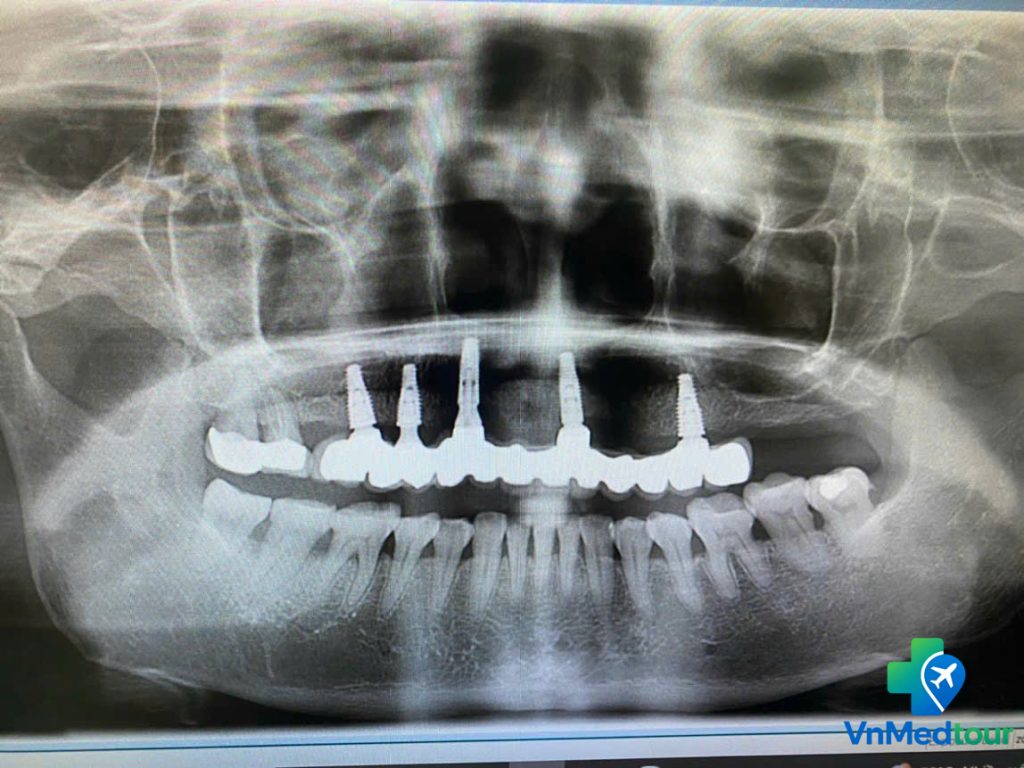
Dental X-ray showing multiple implants supporting an upper-arch restoration. Implant number and positioning depend on individual anatomy and treatment planning.
Will I Need Bone Grafting?
Not every patient needs bone grafting.
Available bone is one factor considered when planning implant placement. Depending on the individual anatomy, procedures such as ridge modification or sinus augmentation may sometimes be considered when available bone is insufficient.
Whether an additional bone procedure is necessary depends on the location and planned implant positions, available bone and the overall treatment strategy.
Possible additional procedures can include:
- bone grafting;
- ridge augmentation; or
- sinus augmentation in selected upper-jaw cases.
These procedures can affect both the treatment timeline and final cost.
Full Arch Dental Implant Treatment Process
The exact sequence differs between patients, but Full Arch Dental Implants in Vietnam may involve the following stages.
Stage 1: Preliminary Review Before Travel
International patients may be asked to provide:
- recent dental photographs;
- panoramic X-ray;
- CBCT scan if available;
- dental history;
- medical history;
- current medications; and
- details of previous implant or restorative treatment.
These records can help a provider prepare preliminary information.
They do not replace an in-person assessment.
Stage 2: Examination and Treatment Planning in Vietnam
The dentist examines the teeth, gums, bite and existing restorations and reviews appropriate imaging.
The preliminary plan may then be confirmed or changed.
Stage 3: Extractions and Implant Placement
Teeth that cannot be maintained may need to be removed.
The planned implants can then be placed according to the individual surgical and restorative plan.
Whether extraction and implant placement can occur during the same treatment stage depends on the case.
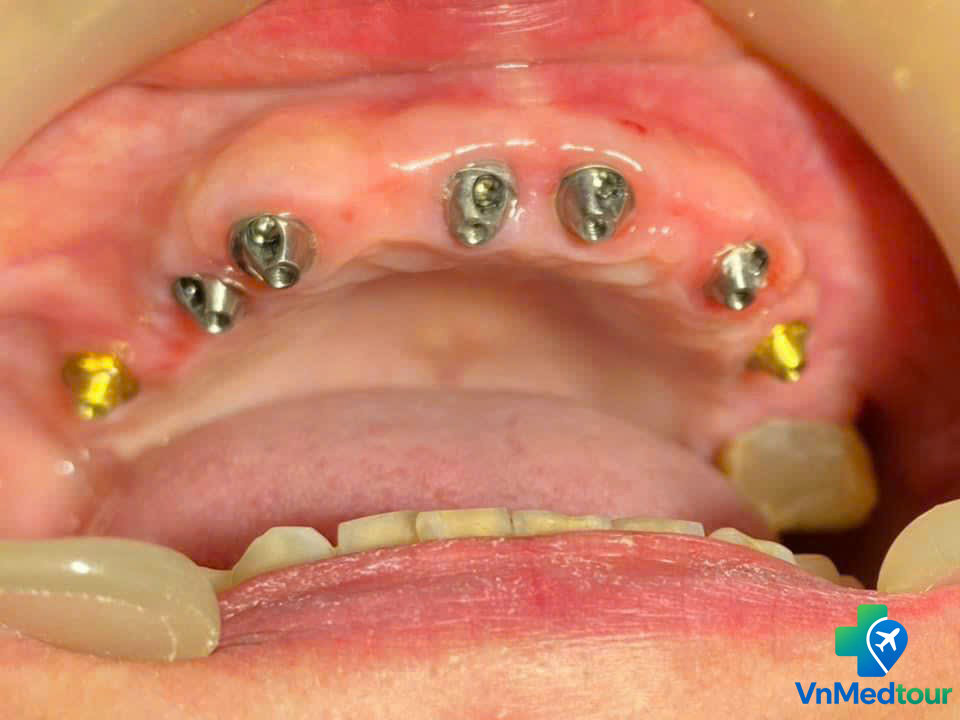
Clinical view of implants and abutments used to support an upper-arch dental restoration.
Stage 4: Provisional Restoration
Some patients may be suitable for a provisional restoration shortly after implant placement.
However, immediate loading should not be assumed or guaranteed before assessment.
The decision can depend on implant stability, bone condition, bite, prosthetic design and other clinical factors.
Stage 5: Healing and Osseointegration
After placement, the bone around an implant heals through a process called osseointegration.
The ADA’s MouthHealthy patient resource explains that this process takes time. Some patients may wait several months before replacement teeth are attached, while selected patients can receive implants and replacement teeth during the same visit.
ADA MouthHealthy – Dental Implants
The FDA similarly notes that healing of the implant body may take several months or longer.
Stage 6: Final Restoration
After the appropriate healing and evaluation, the restorative phase may involve:
- digital scans or impressions;
- bite records;
- prosthetic trials;
- fabrication of the restoration;
- fitting; and
- adjustments.
The final restoration should be planned not only for appearance but also for function and cleaning access.
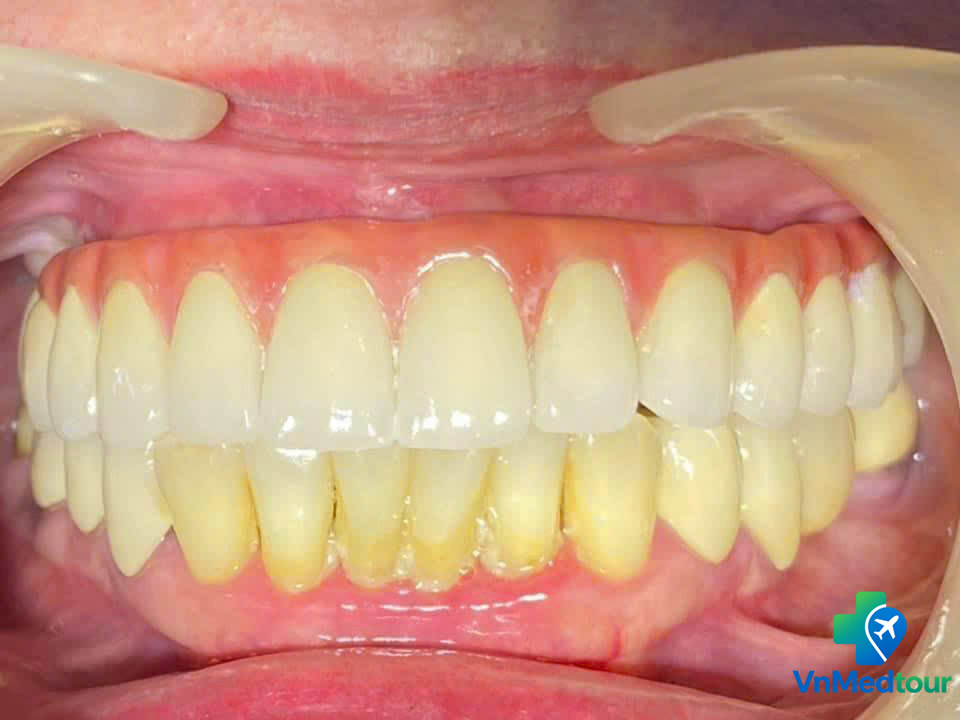
Clinical example of an upper-arch dental restoration following implant treatment.
Temporary Teeth vs Final Teeth
This distinction is especially important for international dental patients.
Advertising phrases such as “teeth in a day” can be misunderstood as meaning the entire definitive treatment is completed in one day.
A restoration fitted soon after implant placement may instead be provisional.
Before treatment, ask:
- Will I receive temporary teeth?
- Will they be fixed or removable?
- What material will be used?
- When is the final prosthesis planned?
- Is a second trip necessary?
- Is the definitive restoration included in the quotation?
Understanding these details before booking travel helps avoid confusion about what will actually be completed during each visit.
Can Full Arch Dental Implants Be Completed in One Trip?
International patients should not assume that every implant case can be completed during one visit to Vietnam.
A treatment plan may involve:
First visit
Assessment → imaging → extractions if required → implant placement → provisional restoration where clinically appropriate.
Healing period
Osseointegration and postoperative monitoring.
Later visit
Implant assessment → prosthetic records → fabrication and fitting of the definitive restoration.
Some treatment plans may differ from this sequence.
The number and duration of trips should therefore be confirmed with the treating dental provider before purchasing flights.
What Materials Are Used for Full Arch Restorations?
Full arch prostheses can be produced using different frameworks, restorative materials and designs.
The appropriate option depends on factors such as:
- prosthetic design;
- available restorative space;
- bite;
- implant system;
- opposing teeth;
- esthetic requirements; and
- clinical considerations.
Instead of choosing solely from marketing terms such as “premium teeth,” ask the provider:
- What is the framework made from?
- What material forms the visible teeth?
- Is the prosthesis fixed or removable by the patient?
- Can it be repaired if damaged?
- How should it be cleaned?
- What maintenance is expected?
- What happens if a component needs replacement after returning home?
The prosthesis photograph shown earlier in this guide also helps demonstrate that the visible full set of teeth is a restorative structure supported by the underlying implant system.
Full Arch Dental Implants vs Dentures
Conventional dentures and implant-supported full arch restorations both replace missing teeth but work differently.
A conventional complete denture does not rely on surgically placed implants for support.
An implant-supported restoration uses dental implants as anchors for the prosthetic teeth.
The appropriate option depends on anatomy, oral health, general health, treatment goals, willingness to undergo surgery and cost.
Patients should not assume that implant treatment is automatically appropriate simply because they prefer fixed teeth.
Risks and Possible Complications
Full arch implant treatment involves surgery as well as restorative dentistry.
Potential implant-related complications can include:
- pain or swelling;
- infection;
- delayed healing;
- implant failure;
- damage to surrounding structures;
- altered sensation or nerve injury;
- sinus-related complications in some upper-jaw cases;
- difficulties with the bite;
- loosening of components; and
- problems maintaining hygiene around the restoration.
The FDA identifies potential complications including injury to surrounding tissues, sinus perforation, implant failure, infection, screw loosening and nerve-related symptoms.
Risk varies according to the patient and procedure. An online guide cannot determine an individual’s suitability for implant surgery.
Are Full Arch Dental Implants Permanent?
The word permanent should be treated carefully.
Implants are designed as long-term tooth replacement devices, but neither an implant nor the prosthetic restoration should be presented as guaranteed for life.
Different components may have different maintenance, repair or replacement requirements.
The FDA advises patients to keep information about the brand and model of their dental implant system and to maintain regular dental follow-up.
International patients should therefore request appropriate implant and treatment records before leaving Vietnam.
Cleaning and Long-Term Maintenance
Full arch implants still require daily oral hygiene and professional monitoring.
The American Academy of Periodontology explains that bacteria can accumulate around implants and contribute to inflammatory conditions including peri-implant mucositis and peri-implantitis.
American Academy of Periodontology – Peri-Implant Diseases
A 2025 AO/AAP consensus also emphasizes continued supportive peri-implant maintenance as part of long-term implant health.
Patients should receive instructions on cleaning:
- around implant-supported restorations;
- underneath the bridge;
- around individual implant sites; and
- any remaining natural teeth.
Professional reviews remain important after returning home.
Planning Full Arch Dental Implants in Vietnam from Overseas
Dental tourism requires planning beyond the procedure itself.
Understand the Treatment Plan
Confirm whether the proposed treatment covers:
- one arch or both;
- All-on-4, All-on-6 or another design;
- extractions;
- additional bone procedures;
- provisional teeth; and
- definitive restoration.
Understand the Timeline
Ask how many treatment stages and visits are anticipated.
Do not assume that the shortest advertised treatment schedule is appropriate for your case.
Stay Close Enough for Follow-Up
Accommodation reasonably close to the dental provider can make early postoperative reviews and adjustments easier.
Plan Follow-Up at Home
Ask what records will be provided and what type of ongoing dental care will be required after returning home.
Keep Your Implant Records
The FDA specifically recommends asking which brand and model of implant system is being used and keeping that information in your records.
This is particularly useful when treatment takes place in another country.
How to Choose a Provider for Full Arch Dental Implants in Vietnam
Price should not be the only selection criterion.
Before treatment, consider asking:
- Who will place the implants?
- Who will design and fit the prosthesis?
- What implant system will be used?
- How many implants are proposed and why?
- What imaging is required?
- Are extractions required?
- Do I need an additional bone procedure?
- Will I receive provisional teeth?
- When will the final restoration be fitted?
- What material will be used?
- What is included in the quotation?
- How are complications managed?
- What happens if an implant does not integrate?
- What records will I receive?
- What follow-up and maintenance are required?
These questions provide more useful information than comparing clinics solely by implant count or advertised package price.
How VnMedtour Supports International Dental Patients
VnMedtour helps international patients communicate with dental providers in Vietnam and coordinate their medical travel journey.
Depending on the case, this may include:
- collecting initial dental information;
- forwarding dental records and imaging;
- requesting preliminary provider feedback where available;
- obtaining indicative treatment costs;
- coordinating appointments;
- assisting with communication; and
- providing information relevant to treatment planning in Vietnam.
VnMedtour does not diagnose dental conditions or determine whether someone is suitable for implants.
Final diagnosis, implant selection and treatment decisions are made by the treating dental professionals after appropriate assessment.
Frequently Asked Questions About Full Arch Dental Implants in Vietnam
What are full arch dental implants?
Full arch dental implants are used to replace most or all teeth in one upper or lower arch with a restoration supported by multiple dental implants.
The exact number and position of implants depend on the individual treatment plan.
Are full arch dental implants the same as All-on-4?
No.
All-on-4 is one approach to full arch implant treatment. Other patients may receive All-on-6 or another implant-supported configuration.
What is the difference between full arch and full mouth dental implants?
A full arch generally refers to one complete upper or lower arch.
Full-mouth rehabilitation may involve both jaws.
How much do Full Arch Dental Implants in Vietnam cost?
Based on current indicative partner pricing available to VnMedtour, All-on-4 or All-on-6 treatment is approximately 175–260 million VND (about USD 6,730–10,000), while more extensive full-mouth rehabilitation may cost approximately 340–520 million VND (about USD 13,080–20,000).
USD equivalents are approximate and calculated using a reference exchange rate of around 1 USD = 26,000 VND. Exchange rates change over time, and final treatment costs depend on the individual treatment plan.
These are reference prices rather than guaranteed quotations or national averages.
Is All-on-4 or All-on-6 better?
Neither option is automatically better.
Available bone, anatomy, implant positions, bite and prosthetic requirements all contribute to the treatment decision.
Do I need bone grafting?
Not necessarily.
Some patients may have sufficient bone for the planned implant positions, while others may require an additional bone procedure.
Imaging and clinical assessment are needed to determine this.
Can I get fixed temporary teeth immediately?
Some patients may be suitable for a provisional restoration soon after implant placement.
This cannot be guaranteed before clinical assessment.
Can my treatment be completed in one trip?
Some treatment plans may allow substantial treatment to be completed during one visit, but implant treatment commonly involves a biological healing period.
Ask the treating provider whether your individual plan requires one or multiple trips.
How long does implant healing take?
Healing varies between patients.
Osseointegration can take several months, although the timing and restorative approach depend on the individual case.
How long should I stay in Vietnam?
The required stay depends on the treatment performed during each visit and the provider’s postoperative schedule.
Confirm the anticipated timeline before purchasing flights.
How do I maintain full arch implants after returning home?
Daily cleaning and ongoing professional dental reviews remain necessary.
Before leaving Vietnam, ask for written maintenance instructions and records identifying the implant and prosthetic systems used.
Considering Full Arch Dental Implants in Vietnam?
Send us your recent dental X-rays or CBCT scans, relevant dental history and treatment goals. VnMedtour can help connect you with dental providers in Vietnam, coordinate a preliminary review where available, and request an indicative treatment plan and cost estimate before you travel.