
Zirconia crowns in Vietnam are an increasingly popular option for international patients seeking durable, natural-looking dental restorations at competitive prices. Made from high-strength ceramic, these crowns can restore damaged teeth, improve chewing function, and provide an attractive alternative to traditional metal-based restorations.
Vietnamese dental clinics offer various zirconia materials, including Ceramill Zolid, Nacera, Lava Plus, and Lava Esthetic. Published prices range from approximately USD 154 to USD 538 per tooth across the selected providers reviewed in this guide, depending on the material and clinic.
However, choosing the right restoration involves more than comparing costs. The condition of your natural teeth, the dentist’s experience, material specifications, treatment schedule, and long-term aftercare all influence the result.
This guide explains real published prices, ceramic materials, clinical procedures, and practical considerations for international patients planning dental treatment in Vietnam.
Quick Navigation
What Are Zirconia Dental Crowns?
A zirconia crown is a custom-made dental restoration manufactured from zirconium dioxide (ZrO₂), a strong, biocompatible ceramic material.
Unlike porcelain-fused-to-metal crowns, zirconia restorations do not require a metal framework. Their tooth-colored appearance makes them suitable for many restorative and aesthetic applications.
A conventional dental crown covers the visible portion of a prepared natural tooth, helping restore its shape, strength, and function.
When Might You Need a Dental Crown?
Dentists may recommend a crown for:
- A tooth weakened by extensive decay.
- A cracked, broken, or severely worn tooth.
- A large filling that no longer provides adequate support.
- Certain root canal-treated teeth.
- Replacement of an old or damaged crown.
- Restoration of a dental implant.
Crowns can also improve the appearance of certain teeth. However, they generally require permanent removal of natural tooth structure.
If your teeth are relatively healthy, more conservative treatments may be appropriate.
For an overview of other restorative options, read our Dental Crowns in Vietnam guide.
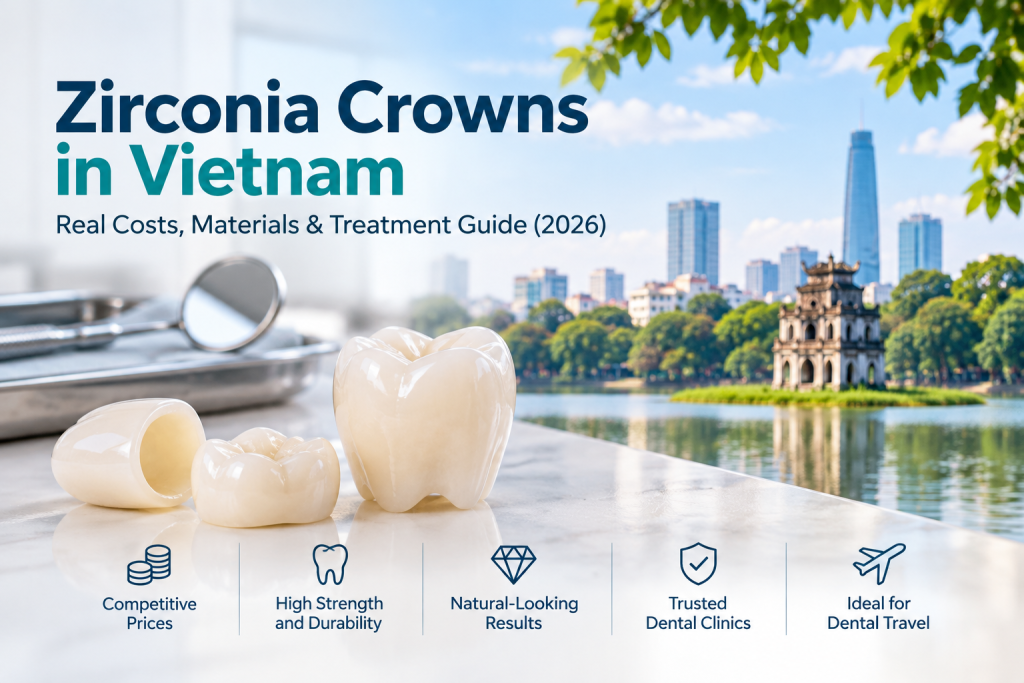
Explore zirconia crown prices, materials, and dental treatment options in Vietnam for international patients.
How Much Do Zirconia Crowns in Vietnam Cost?
The cost varies according to the ceramic brand, restoration design, dental clinic, and additional treatment required.
To provide a clearer picture of actual pricing, we reviewed published price lists from several Vietnamese dental providers.
These are advertised prices, not estimates generated from an assumed national average.
Winsmile Dental Clinic Prices
According to Winsmile’s published price list for March 2026:
| Material | Listed Price (VND) | Approx. USD |
|---|---|---|
| Ceramill Zolid | 8,000,000 | $308 |
| Nacera | 12,000,000 | $462 |
| Lava 3M Plus | 12,000,000 | $462 |
| Lava 3M Esthetic | 14,000,000 | $538 |
Source: Winsmile Dental Clinic, price list valid March 1–31, 2026. Prices shown are the regular listed amounts, not promotional prices for 16 or more crowns.
The clinic also advertised discounts for patients receiving multiple restorations during that promotional period. Those discounts should not be considered currently available without confirmation.
APEC Dental Prices
APEC Dental’s published price list, effective January 1, 2026, includes:
| Material | Price (VND) | Approx. USD |
|---|---|---|
| Standard Zirconia | 4,000,000 | $154 |
| Ceramill Zolid | 7,500,000 | $288 |
| Lava Plus | 11,000,000 | $423 |
Source: APEC Dental – Published Price List 2026.
Phuc Hung Dental Prices
Phuc Hung Dental also publishes prices for several ceramic systems.
| Material | Price (VND) | Approx. USD |
|---|---|---|
| Nacera | 8,000,000 | $308 |
| Lava Plus | 10,000,000 | $385 |
| Lava Esthetic | 12,000,000 | $462 |
Source: Phuc Hung Dental – Crown Prices 2026.
Dental Crown Price Comparison
The table below provides a convenient comparison of selected published prices.
| Crown Material | Winsmile | APEC | Phuc Hung |
|---|---|---|---|
| Standard Zirconia | — | $154 | — |
| Ceramill Zolid | $308 | $288 | — |
| Nacera | $462 | — | $308 |
| Lava Plus | $462 | $423 | $385 |
| Lava Esthetic | $538 | — | $462 |
All amounts are approximate USD prices per tooth, converted at VND 26,000 per USD. A dash means a comparable price was not identified. Published prices were reviewed in October 2026 and may change.
Even when two clinics advertise the same brand, the exact product formulation, laboratory process, warranty, and included services may differ.
What Is Included in the Price?
Before booking treatment, patients should confirm whether the quotation includes:
- Dental consultation and examination.
- X-rays or other necessary imaging.
- Tooth preparation and local anesthesia.
- Digital scanning or impressions.
- Temporary crowns.
- Laboratory fabrication.
- Final fitting and cementation.
- Bite adjustments and follow-up care.
Root canal treatment, gum therapy, replacement of existing restorations, or additional dental procedures may increase the final cost.
Important: The lowest advertised price is not necessarily the lowest total treatment cost. Always request an itemized quotation.
Types of Zirconia Materials Used in Vietnam
Several internationally recognized ceramic systems are available through Vietnamese dental clinics.
Although they share zirconium dioxide as their principal material, their properties and applications can differ.
Ceramill Zolid
Ceramill Zolid is a zirconia material family associated with the dental technology company Amann Girrbach.
Different formulations offer varying combinations of translucency and mechanical strength.
Potential advantages include good durability, metal-free construction, and options suitable for different restorative applications.
Patients should confirm the exact Zolid formulation rather than relying on the general brand name.
Nacera
Nacera is a family of dental zirconia materials used for digitally manufactured ceramic restorations.
Different formulations offer varying optical and mechanical characteristics.
Some are designed to prioritize strength, while others offer improved translucency for aesthetic applications.
A dentist should select the formulation according to the tooth position, available space, and expected biting forces.
Lava Plus
Lava Plus is a zirconia restorative material historically associated with 3M.
It has been used for full-contour crowns and other dental restorations.
The material offers useful mechanical properties and tooth-colored aesthetics.
Its suitability depends on the clinical situation and appropriate restoration design.
Lava Esthetic
Lava Esthetic is designed to provide natural-looking color and translucency.
It may be considered for visible teeth where aesthetic integration with neighboring teeth is especially important.
However, translucency and strength can vary among ceramic formulations, making appropriate material selection essential.
Monolithic vs. Layered Zirconia
Two common fabrication approaches are worth understanding.
Monolithic zirconia is milled from a single ceramic structure. It avoids the specific risk of an external porcelain layer chipping.
Layered zirconia has a zirconia framework covered with veneering porcelain, allowing additional aesthetic customization.
Neither design is ideal for every patient. The dentist should consider appearance, biting forces, and the location of the restoration.
Zirconia vs. E.max Crowns: Which Is Better?
Zirconia and E.max are both metal-free dental ceramic options, but they have different material properties.
E.max is commonly associated with lithium disilicate glass-ceramic, valued for its optical characteristics and bonding capabilities.
| Feature | Zirconia | E.max |
|---|---|---|
| Material | Zirconium dioxide | Lithium disilicate |
| Strength | Generally very high | High |
| Translucency | Varies by formulation | Often excellent |
| Front teeth | Suitable | Suitable |
| Back teeth | Frequently selected | Suitable in selected cases |
| Metal-free | Yes | Yes |
| Main consideration | Strength and versatility | Aesthetics and bonding requirements |
Which Is Better for Front Teeth?
For front teeth, aesthetics are especially important.
E.max may provide excellent natural-looking translucency, particularly when matching adjacent teeth.
Modern high-translucency zirconia can also produce attractive results.
The best choice depends on the underlying tooth color, required crown thickness, and the patient’s expectations.
Which Is Better for Molars?
Molars experience high chewing forces.
High-strength zirconia is frequently used for posterior teeth because of its mechanical properties.
However, lithium disilicate may also be suitable in certain cases when the restoration design and clinical conditions allow.
Material selection should follow a professional dental assessment.
Benefits of Zirconia Dental Crowns
High Mechanical Strength
Zirconia has excellent fracture resistance compared with many other dental ceramics.
This makes it a useful material for restorations exposed to significant chewing pressure.
Nevertheless, no dental crown is completely resistant to damage.
Natural Appearance
Modern zirconia restorations can be manufactured in shades that closely resemble natural teeth.
Multilayered and translucent formulations allow dental laboratories to create more detailed aesthetic effects.
The final appearance depends on material selection, restoration design, and laboratory quality.
Metal-Free Construction
Unlike porcelain-fused-to-metal crowns, zirconia restorations do not have a metal framework.
This can help avoid the appearance of a dark metal margin near the gums.
Good Biocompatibility
Zirconia is generally well tolerated by surrounding oral tissues.
However, gum health also depends on appropriate crown fit, oral hygiene, and regular professional dental care.
Versatility
Depending on the ceramic formulation and clinical situation, zirconia may be used for single crowns, selected dental bridges, and implant-supported restorations.
Risks and Limitations
Although ceramic restorations offer significant benefits, patients should understand their potential disadvantages.
Permanent tooth preparation: Conventional crowns generally require the irreversible removal of natural tooth structure.
Tooth sensitivity: Temporary sensitivity may occur after preparation or fitting.
Crown fracture: Zirconia is strong but can still fracture under certain conditions.
Bite problems: An improperly adjusted restoration may create discomfort while chewing.
Secondary decay: The underlying tooth can develop decay, particularly if plaque accumulates around poorly fitting crown margins.
Future replacement: Crowns may eventually require repair or replacement.
Patients who grind their teeth should inform their dentist, as excessive biting forces can affect restoration longevity.
How Is a Zirconia Crown Procedure Performed?
Treatment typically involves several steps.
Step 1: Examination and Planning
The dentist examines the tooth, surrounding gums, and bite.
Dental X-rays may be required to assess the roots and supporting structures.
Any infection, significant decay, or gum disease may need treatment before placing the crown.
Step 2: Tooth Preparation
The dentist prepares the tooth to create adequate space for the restoration.
Local anesthesia is commonly used when needed.
The extent of preparation depends on the tooth condition and crown design.
Step 3: Digital Scanning or Impressions
The clinic records the prepared tooth and adjacent teeth.
Digital scanning may be used to create a three-dimensional model for restoration design.
Step 4: Crown Fabrication
Many zirconia restorations are produced using computer-aided design and manufacturing technology (CAD/CAM).
The dental laboratory mills the ceramic material and completes the required processing, coloring, and finishing.
Step 5: Fitting and Cementation
The dentist checks the fit, appearance, contact points, and bite alignment.
Adjustments may be made before the crown is permanently cemented.
Step 6: Follow-Up
The dentist provides care instructions and checks for discomfort or bite problems.
International patients should ideally allow sufficient time for any necessary adjustments before leaving Vietnam.
How Long Does Treatment Take?
The number of visits depends on the complexity of the case and the clinic’s laboratory workflow.
| Treatment Type | Suggested Travel Window |
|---|---|
| One uncomplicated crown | 3–5 working days |
| Several crowns | 5–7 days |
| Extensive restorative treatment | 7–14 days or longer |
| Complex treatment with implants or other procedures | Individual schedule required |
These are suggested planning periods, not guaranteed completion times.
A patient requiring one uncomplicated restoration may finish treatment relatively quickly.
However, additional procedures such as root canal therapy or periodontal treatment can extend the schedule.
Can You Get Dental Crowns During a Short Holiday?
Yes, some international visitors can complete straightforward restorative treatment during a short visit.
However, patients should avoid booking flights immediately after the expected final fitting.
Allowing additional time gives the dentist an opportunity to address unexpected adjustments or laboratory delays.
Full-Mouth Zirconia Crowns: Cost and Considerations
Some patients inquire about restoring multiple teeth or replacing several existing crowns.
The total cost depends on the number of teeth requiring treatment and the selected material.
Using APEC’s published Ceramill Zolid price of VND 7.5 million per tooth, the following illustrates the crown-only cost.
| Number of Crowns | Illustrative Cost (VND) | Approx. USD |
|---|---|---|
| 4 | 30,000,000 | $1,154 |
| 6 | 45,000,000 | $1,731 |
| 8 | 60,000,000 | $2,308 |
| 10 | 75,000,000 | $2,885 |
| 16 | 120,000,000 | $4,615 |
These are mathematical examples based on a published unit price, not confirmed full-mouth treatment packages. Additional procedures are excluded.
Patients should not assume that all visible teeth need crowns.
Extensive tooth preparation may be unnecessary or overly invasive when natural teeth are otherwise healthy.
For complex restorative cases, see our guide to Full Mouth Reconstruction in Vietnam.
Dental Crowns vs. Porcelain Veneers
Crowns and veneers are both used to improve tooth appearance, but their clinical purposes differ.
| Dental Crowns | Porcelain Veneers |
|---|---|
| Usually cover the entire prepared tooth | Cover mainly the front surface |
| Often restore weakened teeth | Primarily improve appearance |
| Typically require more tooth reduction | Often require less preparation |
| May restore significant structural damage | Best suited to selected teeth with adequate structure |
| Used for functional and aesthetic purposes | Commonly used for aesthetic improvements |
If your teeth are healthy but you want to improve their shape or color, veneers may be a more conservative option.
Read our Porcelain Veneers in Vietnam guide for more information.
Where Can International Patients Get Dental Treatment in Vietnam?
Vietnam has private dental providers in several major cities.
Ho Chi Minh City
Ho Chi Minh City is a common destination for international visitors arriving through Tan Son Nhat International Airport.
Patients can explore clinics offering restorative dentistry and digital dental laboratory services.
Hanoi
Hanoi also offers dental treatment options, including ceramic crowns, bridges, and implant restorations.
It may be particularly convenient for travelers arriving in northern Vietnam.
Da Nang
Da Nang is an option for visitors who prefer a coastal destination.
However, patients should confirm material availability and treatment timelines with their selected clinic before traveling.
Choosing a dental provider should involve more than geographical convenience.
Dentist qualifications, treatment planning, laboratory quality, and aftercare arrangements are essential considerations.
How to Choose a Reliable Dental Clinic
International patients should ask several questions before making a decision.
Who Will Perform the Treatment?
Confirm the dentist’s professional qualifications and relevant restorative experience.
Which Material Will Be Used?
Ask for the exact brand and product formulation.
A general description such as “German zirconia” may not provide enough information to compare quotations.
What Is Included in the Quotation?
Request an itemized estimate covering the crown, preparation, scans, laboratory work, and potential additional treatments.
How Many Visits Are Required?
Confirm the expected appointment schedule before booking flights and accommodation.
What Warranty Is Offered?
Ask for written warranty terms and information about exclusions.
A lengthy warranty does not mean the restoration is guaranteed to last without complications.
What Happens After Returning Home?
Find out how the clinic handles questions, complications, and follow-up concerns after the patient leaves Vietnam.
Patients should also arrange regular dental care in their home country.
How Long Do Zirconia Crowns Last?
The lifespan of a dental restoration depends on the patient’s oral health, biting forces, material selection, crown fit, and ongoing maintenance.
According to Cleveland Clinic, dental crowns generally last around 5–15 years on average, although some remain functional much longer.
A particular zirconia crown cannot be guaranteed to last for a specific number of years.
How to Care for Your Crowns
Recommended care includes:
- Brushing twice daily with fluoride toothpaste.
- Cleaning between the teeth daily.
- Attending regular dental check-ups.
- Avoiding chewing ice and very hard objects.
- Discussing a protective night guard if you grind your teeth.
- Seeking dental advice if a crown becomes loose or painful.
Good maintenance helps protect both the restoration and the natural tooth beneath it.
How VnMedtour Helps International Dental Patients
Planning dental treatment abroad involves more than choosing a crown material.
International patients often need help understanding treatment options, obtaining preliminary quotations, arranging appointments, and planning an appropriate travel schedule.
VnMedtour assists overseas patients exploring dental treatment in Vietnam.
Our services may include:
- Connecting patients with suitable dental providers.
- Requesting preliminary treatment information and prices.
- Coordinating dental appointments.
- Providing guidance on dental records needed for initial review.
- Assisting with selected travel arrangements where available.
Clinical examinations, diagnoses, material selection, and treatment decisions remain the responsibility of the treating dental professional.
Request a Preliminary Dental Assessment
If you are considering ceramic crowns in Vietnam, you can contact VnMedtour with:
- The number of teeth requiring assessment, if known.
- Recent dental X-rays or reports, if available.
- Clear photographs of the relevant teeth.
- Details of previous dental treatment.
- Your preferred city and expected travel dates.
Our team can help coordinate an inquiry with an appropriate dental provider.
Frequently Asked Questions
Are Zirconia Crowns Expensive in Vietnam?
Published prices from the selected clinics in this guide range from approximately USD 154 to USD 538 per tooth, depending on the material and provider. Actual quotations may differ.
Are Zirconia Crowns Better Than Porcelain?
Zirconia is itself a type of dental ceramic. Compared with some other ceramic materials, it offers greater mechanical strength. The best material depends on the clinical situation.
Which Brand Is Best: Ceramill, Nacera, or Lava?
There is no universally best brand. Each product family contains materials with different characteristics. The dentist should recommend an appropriate formulation based on the patient’s needs.
Are They Suitable for Front Teeth?
Yes. Modern zirconia formulations can provide natural-looking anterior restorations when appropriately selected.
Can They Be Used for Molars?
Yes. High-strength zirconia is commonly used for posterior crowns because of its mechanical properties.
Does the Procedure Hurt?
Local anesthesia is commonly used during tooth preparation. Some temporary sensitivity or discomfort may occur afterward.
Can I Replace an Old Metal Crown?
Possibly. The dentist must examine the existing crown and underlying tooth to determine whether replacement is appropriate.
How Many Days Should I Stay in Vietnam?
A planning window of approximately five to seven days may be useful for several uncomplicated crowns. The clinic should confirm the actual schedule.
Can I Get 20 Crowns at Once?
Extensive restorative treatment may be possible for patients with significant dental problems, but crowning healthy teeth unnecessarily should be avoided. A comprehensive assessment is essential.
Can My Dentist at Home Maintain My Crowns?
Many dentists can assess and maintain existing dental crowns. However, individual practitioners may have different policies regarding restorations performed overseas.
Final Thoughts
Vietnam offers international patients access to a variety of ceramic restorative materials, including internationally recognized zirconia brands.
Published dental clinic prices demonstrate that costs can vary considerably depending on the material and provider.
However, choosing treatment solely on price may overlook important factors such as the condition of the natural tooth, restoration design, laboratory quality, and long-term maintenance.
For patients considering zirconia crowns in Vietnam, the best first step is to obtain a professional dental assessment and a written treatment quotation before making travel arrangements.
Get a Dental Crown Quote with VnMedtour
Looking for dental restoration options in Hanoi, Ho Chi Minh City, or Da Nang?
Contact VnMedtour for assistance with preliminary quotations and appointment coordination.
Our team can help you explore suitable dental treatment options based on your individual needs and travel plans.
Final treatment recommendations, costs, and schedules are subject to clinical examination and provider confirmation.
References
- Winsmile Dental Clinic – Published crown price list, March 1–31, 2026.
- APEC Dental – Published Price List 2026.
- Phuc Hung Dental – Ceramic Crown Prices 2026.
- Cleveland Clinic – Dental Crowns: Types, Procedure & Care.
- American Dental Association – MouthHealthy.
Medical disclaimer: This guide provides general educational information and does not replace professional dental advice. Pricing information reflects published sources reviewed in October 2026 and may change without notice.