
All-on-4 dental implants in Vietnam offer a full-arch tooth replacement option for patients who have lost most or all of their teeth, or whose remaining teeth cannot be predictably restored. Instead of using an implant for every missing tooth, the All-on-4 concept uses four strategically positioned dental implants to support a fixed full-arch restoration.
For international patients considering dental treatment in Vietnam, All-on-4 treatment is available at dental clinics in major cities such as Ho Chi Minh City and Hanoi. Treatment typically involves clinical assessment, dental imaging, implant placement, a temporary restoration when appropriate, a healing period and the placement of the final full-arch prosthesis.
However, All-on-4 is not suitable for every patient. Bone anatomy, gum health, remaining teeth, medical history, smoking, bite forces and the condition of the opposing jaw should be assessed before treatment.
This guide explains All-on-4 dental implants in Vietnam, including costs, treatment stages, candidate selection, potential benefits and limitations, treatment timelines and important considerations for international patients.
All-on-4 Dental Implants in Vietnam at a Glance
| Item | Typical consideration |
|---|---|
| Treatment | Fixed full-arch implant-supported restoration |
| Number of implants | Usually 4 per treated arch |
| Suitable for | Patients with extensive or complete tooth loss |
| Assessment | Dental examination + panoramic X-ray and/or CBCT |
| Temporary teeth | May be possible after implant placement when clinical conditions allow |
| Healing period | Commonly several months |
| Final restoration | Material depends on the individual treatment plan |
| Number of trips | Often 2 visits for international patients |
| Main locations | Ho Chi Minh City and Hanoi |
| Final suitability | Determined after clinical assessment |
Treatment protocols vary between patients and clinics. A personalised treatment plan should be confirmed after clinical examination and appropriate dental imaging.
Quick Navigation
What Are All-on-4 Dental Implants?
All-on-4 is a full-arch dental implant concept in which four implants are used to support a fixed prosthesis replacing an entire row of teeth.
Rather than placing an individual implant for every missing tooth, the implants are distributed across the jaw to provide support for a complete fixed restoration. Depending on the patient’s anatomy and treatment plan, posterior implants may be angled to make appropriate use of the available bone.
An All-on-4 restoration generally includes four dental implants, abutments connecting the implants to the prosthesis, a temporary restoration when immediate or early loading is clinically appropriate, and a definitive full-arch prosthesis after healing.
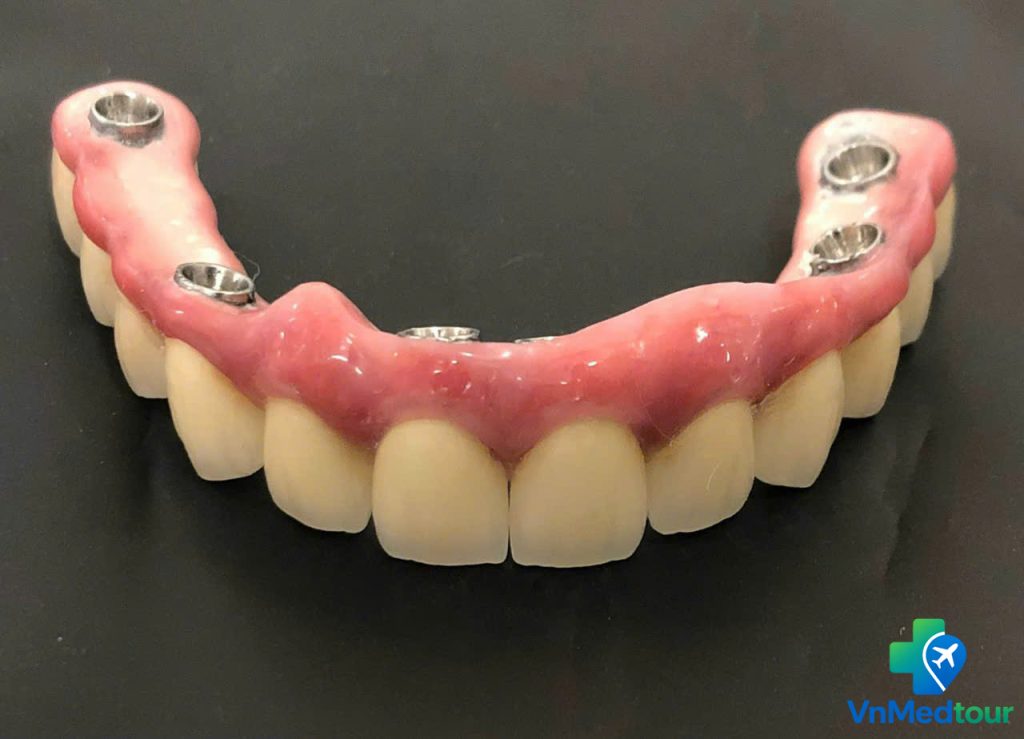
Example of a full-arch dental prosthesis designed to connect to dental implants.
Strategic Angulation: The Engineering Advantage
The defining feature of the All-on-4 concept lies in the precise spatial orientation of the four implant posts:
-
Two Anterior Implants: Placed vertically (straight up and down at 90-degree angles) in the front section of the jaw, where natural bone density is naturally higher.
-
Two Posterior Implants: Placed in the back region of the jaw and tilted posteriorly at angles between 30 and 45 degrees.
This strategic tilting offers critical clinical advantages:
-
Maximized Bone Contact: Tilting the back implants allows the surgeon to anchor them into denser anterior bone, utilizing available bone volume even in patients with moderate jawbone atrophy.
-
Anatomical Structure Avoidance: The angled placement bypasses critical anatomical zones, such as the maxillary sinus cavities in the upper jaw and the inferior alveolar nerve canal in the lower jaw.
-
Reduced Need for Bone Grafting: By exploiting available native bone, All-on-4 frequently eliminates the need for expensive, time-consuming invasive bone grafting or sinus lift procedures.
-
Wider Load Distribution: Angling the posts extends the anteroposterior (AP) spread, creating a wider foundation that stably supports a full 12-to-14-tooth bridge without flexing.
The Three Core Components of an All-on-4 System
-
Four Titanium Implant Posts: Medical-grade, threaded titanium cylinders surgically inserted into the maxilla (upper jaw) or mandible (lower jaw) to act as permanent prosthetic roots.
-
Multi-Unit Abutments (MUAs): Specialized connector components attached to the tops of the implant posts. MUAs correct the angle of tilted implants, ensuring a uniform, parallel seating surface for the prosthetic bridge.
-
Fixed Full-Arch Restorative Bridge: A continuous, non-removable prosthetic arch containing 12 to 14 replacement teeth. Depending on your budget and preference, this bridge is crafted from High-Translucency Full-Contour Zirconia, Porcelain Fused to Metal (PFM), or Titanium-Reinforced High-Impact Acrylic (PMMA).
According to clinical studies published by the National Center for Biotechnology Information (NCBI), full-arch implant-supported fixed prostheses demonstrate long-term clinical survival rates exceeding 95% to 98% over 10-to-15-year monitoring periods, establishing All-on-4 as a highly predictable, life-changing oral procedure.
All-on-4 vs. Alternative Full-Arch Restorations
When evaluating options for full-mouth teeth replacement in Vietnam, patients often compare All-on-4 with other restorative options. Understanding how All-on-4 compares to alternative approaches helps clarify why it is so widely recommended.
All-on-4 vs. Traditional Removable Dentures
Traditional removable dentures simply rest on top of the gum tissue held by surface suction or messy adhesives. Over time, dentures rub against the gums, cause painful sore spots, shift while speaking, and restrict chewing efficiency to less than 20% of natural teeth. Worse, because dentures do not stimulate the underlying jawbone, bone loss continues unchecked.
In contrast, All-on-4 implants are permanently anchored into the bone, stimulating jawbone tissue through natural chewing forces to halt bone loss. They are non-removable, brushed just like natural teeth, and restore up to 90% of original chewing power.
All-on-4 vs. All-on-6 Dental Implants
Both All-on-4 and All-on-6 are full-arch implant treatment approaches, but they differ primarily in the number of implants used to support the restoration.
All-on-4 typically uses four strategically positioned implants to support a fixed full-arch prosthesis. In suitable cases, the posterior implants may be angled to make effective use of the available bone.
All-on-6 uses six implants to support the full arch. The additional implants may provide different options for implant distribution and prosthetic support, but using more implants does not automatically make All-on-6 the better option for every patient.
The appropriate approach depends on factors such as available bone, jaw anatomy, bite forces, implant distribution and the planned restoration. A dentist or implant surgeon should determine the number and position of implants after clinical examination and appropriate imaging.
Patients considering a six-implant approach can read our All-on-6 Dental Implants in Vietnam guide for more information about the procedure, costs and treatment planning.
Why Choose Vietnam for All-on-4 Dental Implants?
Over the past decade, Vietnam has transformed into an international center for complex dental tourism and maxillofacial surgery. Thousands of patients fly into Ho Chi Minh City and Hanoi annually for full-arch reconstructions due to a compelling combination of clinical quality, speed, and affordability.
Massive Financial Savings Without Sacrificing Standards
Operating a dental surgery center in Australia, North America, or Europe involves huge overhead costs, including high malpractice insurance, expensive real estate leases, and administrative fees. In Vietnam, operational expenses are substantially lower. These operational efficiencies allow accredited clinics to offer the exact same international implant brands (such as Straumann and Nobel Biocare) at a fraction of Western costs.
Internationally Trained Surgical Teams
Leading oral surgeons in major Vietnamese cities complete rigorous six-year dental degrees, followed by postgraduate master’s degrees or surgical fellowships in Europe, the United States, Japan, or South Korea. Many hold active memberships in prestigious global implantology bodies, such as the International Congress of Oral Implantologists (ICOI) and the European Association for Osseointegration (EAO).
State-of-the-Art 3D Digital Infrastructure
Top international dental facilities across Vietnam invest heavily in modern clinical technology to maximize surgical precision and patient comfort:
-
3D Cone Beam Computed Tomography (CBCT): Low-radiation 3D imaging that captures micro-precise scans of bone height, density, nerve pathways, and sinus cavities.
-
Intraoral 3D Optical Scanners: Digital scanners (e.g., 3Shape Trios, iTero) that replace uncomfortable impression trays, capturing accurate digital models of your bite in minutes.
-
Computer-Guided Implant Surgery: Custom 3D-printed surgical templates created using computer-assisted design (CAD) software, allowing surgeons to place all four implants with sub-millimeter precision.
-
In-House CAD/CAM Milling Centers: Automated multi-axis milling machines that craft custom temporary and permanent prostheses on-site within hours.
To explore the wider landscape of dental care and travel options, browse our full guide on Dental Work in Vietnam: Costs & Popular Procedures Guide, as well as our primary resource page on Dental Implants in Vietnam.
Comprehensive Cost Comparison: All-on-4 in Vietnam vs. Western Nations
Understanding pricing structures helps you budget effectively for your dental journey. The details below outline average costs for a complete, single-arch All-on-4 treatment—inclusive of 4 implant posts, multi-unit abutments, 3D CBCT diagnostics, tooth extractions, temporary fixed bridge, and a final fixed 12-to-14-tooth bridge—across major destination countries. All prices are listed in USD.
-
United States: $22,000 – $30,000 USD (Save 70% – 75% in Vietnam)
-
Australia: $19,000 – $26,000 USD (Save 68% – 74% in Vietnam)
-
United Kingdom: $16,000 – $22,000 USD (Save 65% – 72% in Vietnam)
-
Canada: $20,000 – $28,000 USD (Save 68% – 74% in Vietnam)
-
Vietnam: $5,000 – $8,500 USD (Base Destination)
Verified International Implant Brands Offered in Vietnam
Top clinics in Vietnam do not use generic or uncertified local implants. They import certified international implant systems that come with traceable manufacturer serial numbers and global warranties:
-
Dentium & Osstem (South Korea): Highly reliable, cost-effective options engineered for strong bone integration. Ideal for budget-conscious patients seeking excellent durability ($5,000 – $6,500 USD per arch).
-
MIS & BioHorizons (USA/Israel): Mid-tier precision-engineered implant systems featuring advanced surface treatments designed to accelerate primary stability ($6,500 – $7,500 USD per arch).
-
Nobel Biocare (Sweden) & Straumann (Switzerland): The gold standard of implantology. Nobel Biocare’s proprietary NobelSpeedy and NobelParallel posts were specifically designed for the original All-on-4 protocol. Featuring advanced surface technology, these systems offer faster healing, high stability in soft bone, and lifetime global manufacturer warranties ($7,500 – $9,000 USD per arch).
Material Options for the Final Fixed Bridge
The cost of your All-on-4 treatment also depends on the restorative material selected for your permanent bridge:
-
Titanium-Acrylic Hybrid (PMMA): A lightweight titanium framework wrapped in high-impact acrylic and resin teeth. Highly shock-absorbent and easy to repair, but requires more frequent long-term maintenance ($5,000 – $6,500 USD).
-
Porcelain Fused to Metal (PFM): A cast metal sub-structure coated with tooth-colored ceramic. Very strong and aesthetic, though heavier than acrylic ($6,500 – $7,500 USD).
-
Full-Contour Monolithic Zirconia: The gold standard in modern prosthodontics. Milled from a single block of biocompatible Zirconia ceramic, this bridge is virtually unbreakable, highly stain-resistant, extremely hygienic, and provides the most natural aesthetic appearance ($7,500 – $8,500 USD).
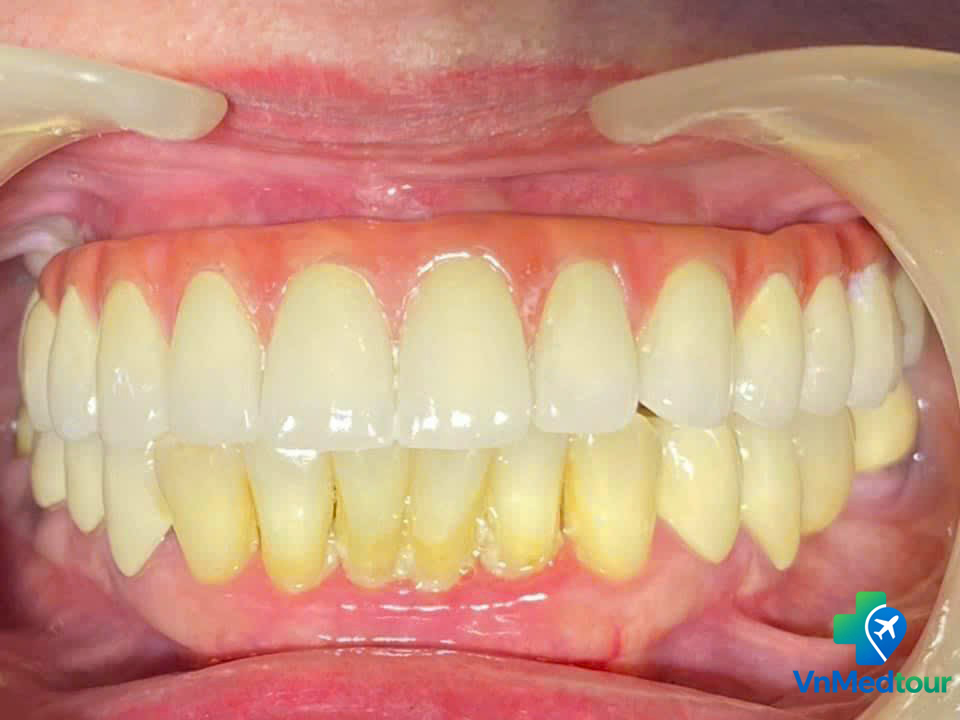
Example of a completed full-arch dental restoration. Treatment results vary according to the patient’s condition and treatment plan.
Step-by-Step All-on-4 Dental Implant Procedure in Vietnam
Full-arch rehabilitation via All-on-4 is a structured clinical process. Depending on your oral condition and chosen materials, treatment is typically completed using a two-trip protocol over 3 to 6 months, or an extended single stay incorporating immediate-loading protocols.
Stage 1: Comprehensive Consultation & 3D Surgical Planning
Your treatment begins with a clinical examination, digital photography, and a 3D CBCT scan. The surgical team uses 3D planning software to analyze bone density, trace nerve pathways, locate sinus cavities, and virtually simulate the position, angle, and depth of all four implant posts.
Stage 2: Extractions & Surgical Implant Placement
Under localized anesthesia or conscious intravenous sedation (painless dentistry), any remaining non-restorable teeth are extracted. The oral surgeon prepares receptor channels in the jawbone, places the two straight front implants and two tilted back implants, and secures multi-unit abutments onto each post. If minor bone smoothing (alveoloplasty) is needed to create a clean, uniform gumline, it is completed during this surgical session.
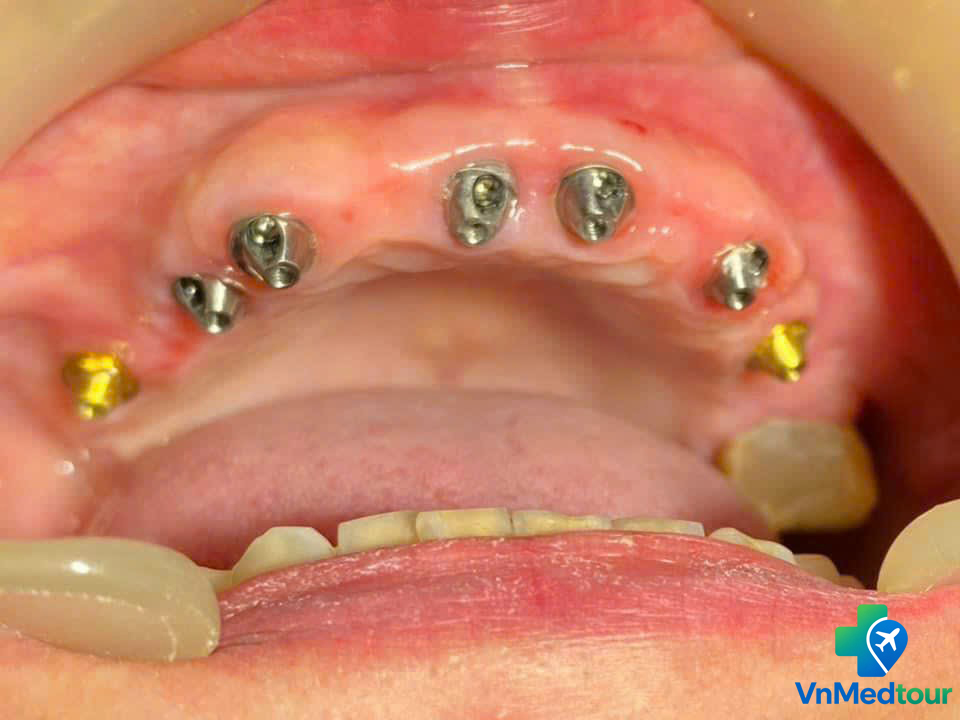
Clinical view of dental implant abutments before placement of a full-arch restoration.
Stage 3: Immediate Provisional Bridge Attachment (Teeth-in-a-Day)
Once all four implants achieve adequate primary insertion torque (typically 35 to 45 Ncm), an intraoral digital scan is taken. Within 24 to 48 hours of surgery, a comfortable, lightweight acrylic temporary bridge is custom-milled and screwed directly onto the multi-unit abutments. You walk out of the clinic with a fixed, functional set of temporary teeth that allows you to smile, speak, and soft-chew comfortably while healing.
Stage 4: Osseointegration Period (3 to 6 Months)
Over the next 3 to 6 months, a natural biochemical process called osseointegration occurs. Living jawbone cells attach directly to the micro-textured titanium surfaces, locking all four posts permanently into the bone tissue.
-
Travel Schedule: Most international patients return home during this phase to continue their regular daily activities while healing takes place.
Stage 5: Precision Impressions & Final Zirconia Bridge Fitting
Once your jawbone has fully integrated with the implants, you return to Vietnam for your second visit (requiring a stay of 7 to 10 days):
-
Osseointegration Verification: A follow-up 3D CBCT scan confirms solid bone integration.
-
Precision Digital Impression: An optical scanner records the position of the four abutments and your bite relationship.
-
CAD/CAM Fabrication: The lab mills your permanent full-arch Zirconia or Titanium-Acrylic bridge.
-
Final Fitting & Bite Tuning: The bridge is securely torqued onto the multi-unit abutments, checked for occlusion and bite balance, polished, and finalized to complete your transformation.
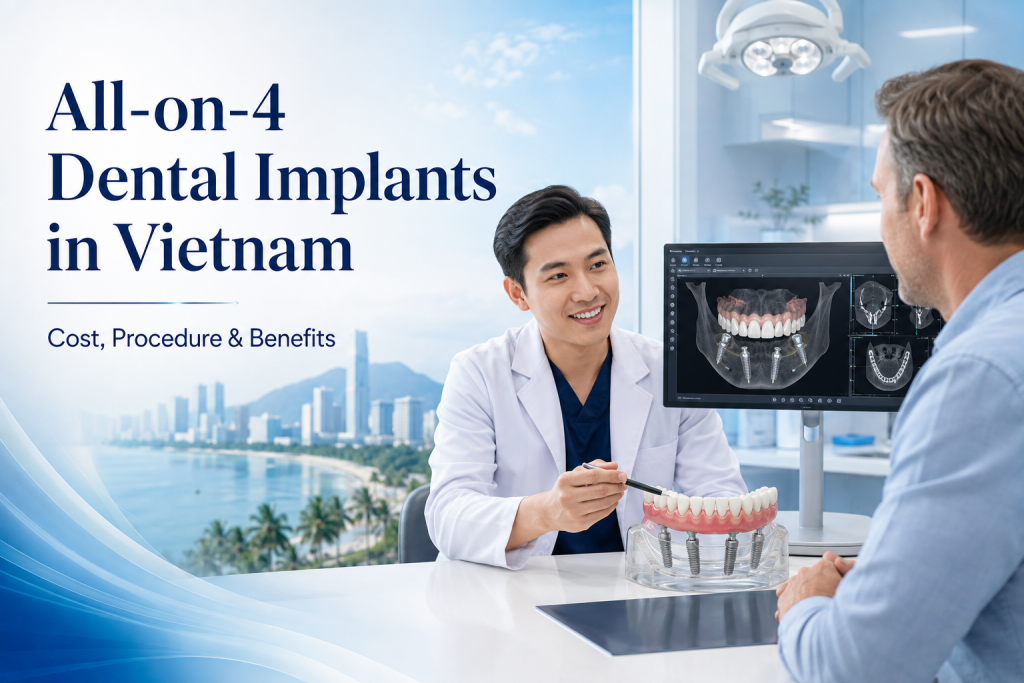
All-on-4 dental implants in Vietnam offer a fixed full-arch restoration using four strategically placed implants, combining modern technology, experienced implant dentists, and competitive treatment costs.
Who May Be a Candidate for All-on-4?
All-on-4 dental implants may be considered for patients who:
- Have lost most or all of the teeth in one arch;
- Have multiple remaining teeth with a poor prognosis;
- Have advanced periodontal disease affecting the long-term stability of their teeth;
- Have failing bridges or extensive previous dental work that can no longer be predictably maintained;
- Currently wear removable dentures and are considering a fixed implant-supported restoration.
However, having multiple damaged teeth does not automatically mean that all remaining teeth should be extracted. Tooth preservation and alternative restorative options should also be considered before proceeding with full-arch implant treatment.
A dentist or implant surgeon should assess the remaining teeth, gum health, available bone, bite, medical history and appropriate dental imaging before determining whether All-on-4 is suitable.
Medical Considerations & Contraindications
Certain health factors require careful management prior to undertaking full-arch implant surgery:
-
Uncontrolled Diabetes: Elevated blood sugar levels can impair micro-vascular wound healing and increase the risk of infection or implant failure.
-
Heavy Tobacco Smoking: Nicotine restricts blood flow to gum tissues and bone, impairing osseointegration. Smokers are strongly advised to stop or reduce smoking weeks before surgery.
-
Intravenous Bisphosphonate Therapy: Patients taking high-dose IV bisphosphonates for cancer care face an elevated risk of osteonecrosis of the jaw and require medical clearance.
-
Severe Bruxism: Uncontrolled nighttime teeth grinding puts massive mechanical stress on implant components. Patients with bruxism must wear a custom night guard to protect their final bridge.
Safety Standards, Sterilization Protocols, and E-E-A-T Quality Assurance
Safety is a top priority when undergoing complex surgical procedures abroad. Leading dental facilities in Vietnam operate under strict regulatory oversight by the Vietnamese Ministry of Health, adhering to cross-infection control standards established by the U.S. Centers for Disease Control and Prevention (CDC) and the World Health Organization (WHO).
Key quality assurance indicators to look for when choosing a provider include:
-
Class-B Autoclave Sterilization: High-grade steam vacuum sterilizers that eliminate bacterial, viral, and spore contaminants on all surgical instruments between uses.
-
Dedicated Sterile Operating Suites: Operating rooms equipped with positive/negative air pressure filtration systems, separate from general dentistry treatment areas.
-
Single-Use Surgical Kits: Sterile drapes, tubing, burrs, and irrigation sets opened in the operating room right before surgery.
-
Official Implant Passport & Warranties: Upon completing your care, certified clinics issue an official Implant Passport / Warranty Card. This document records the brand, exact length, diameter, lot number, and serial number of all four implants, ensuring any qualified dentist globally can identify your components if routine maintenance is ever required.
Planning Your Dental Trip to Vietnam: Travel & Recovery Logistics
Organizing a full-mouth restoration trip requires careful planning. Below is a practical roadmap to organize your travel efficiently.
Step 1: Preliminary Dental Assessment Before Travel
Before arranging travel, international patients may submit recent dental records and imaging to a dental provider in Vietnam for preliminary review.
This may include:
- A recent panoramic dental X-ray (OPG) or CBCT scan, if available;
- Photos of the teeth and gums;
- Relevant dental and medical history;
- Information about current medications and previous implant treatment, if applicable.
Based on the available information, the dental provider may provide a preliminary assessment, discuss possible treatment options and outline estimated costs and the expected treatment schedule.
However, a remote assessment should not be considered a final diagnosis or definitive treatment plan. The proposed All-on-4 treatment may change following an in-person examination and any additional imaging required in Vietnam.
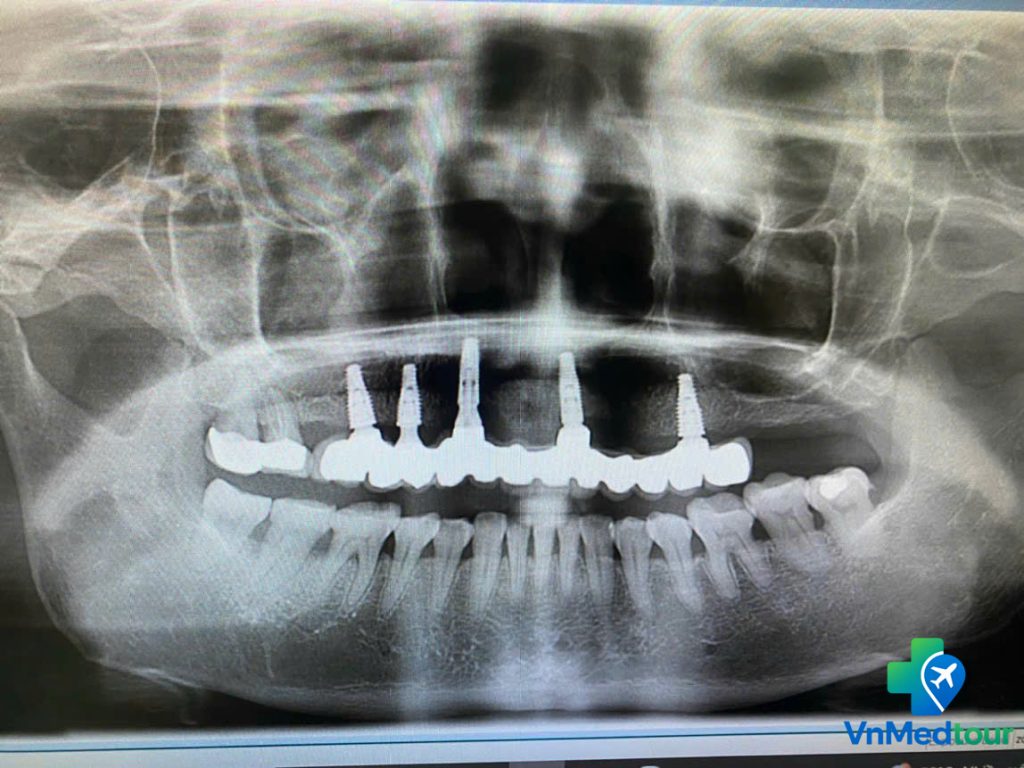
Panoramic dental X-ray showing multiple implants supporting an upper-arch dental restoration.
Step 2: Visa Applications and Travel Setup
-
Vietnamese E-Visa: Citizens of Australia, the US, UK, Canada, New Zealand, and EU countries can easily apply online for an official 90-day multi-entry e-Visa.
-
Flight Destination: Book flights to Tan Son Nhat International Airport (SGN) for treatments in Ho Chi Minh City, or Noi Bai International Airport (HAN) for treatments in Hanoi.
-
Hotels & Transfers: Select a hotel within a 10-to-15-minute radius of your dental center. Many accredited facilities provide complimentary airport pickup and hotel transportation for full-arch patients.
Step 3: Post-Surgical Recovery Care
-
First 48 Hours: Rest comfortably in your hotel room, apply cold ice packs to reduce swelling, and take prescribed antibiotics and anti-inflammatories.
-
Dietary Recommendations: Stick to a smooth, soft diet (protein shakes, lukewarm soups, smoothies, soft scrambled eggs, yogurts). Avoid hot, spicy, or crunchy foods while wearing your temporary bridge.
-
Light Sightseeing: After 3 to 4 days, once initial post-surgical swelling subsides, you can comfortably enjoy light sightseeing, relaxing cultural visits, and shopping.
Essential Aftercare and Long-Term Maintenance for All-on-4
Although high-grade Zirconia crowns cannot develop cavities, healthy surrounding bone and gum tissues are required to maintain long-term stability. Poor oral hygiene can lead to an inflammatory condition known as peri-implantitis, which causes bone loss around implant posts and can result in treatment failure.
To protect your investment, implement these daily aftercare habits:
-
Daily Water Flossing: Use a high-pressure Water Flosser (Waterpik) at least twice daily to flush out trapped food particles, plaque, and bacteria from beneath your bridge and around multi-unit abutments.
-
Specialized Interdental Cleaning: Clean tight spaces between the bridge and gumline using specialized super-floss or rubber-tipped interdental brushes.
-
Custom Night Guard: Request a custom-fitted acrylic night guard to cushion your new bridge against accidental nocturnal clenching or grinding.
-
Bi-Annual Hygiene Check-Ups: Visit a local dental hygienist every six months for routine professional cleanings and annual check-up X-rays to monitor long-term bone levels around your four implant posts.
Frequently Asked Questions (FAQs)
How long do All-on-4 dental implants last?
When placed by experienced oral surgeons and maintained with proper daily oral hygiene, the four titanium implant posts can last a lifetime. The permanent prosthetic bridge (especially full-contour Zirconia) is extremely durable, typically lasting 15 to 25+ years before requiring minor cosmetic refacing or component maintenance.
Is the All-on-4 procedure painful?
No. The surgical placement is performed under effective local anesthesia or conscious IV sedation, ensuring you feel no pain during the operation. Postoperative discomfort, mild bruising, and swelling are easily managed using prescribed anti-inflammatory medications and pain relievers during the first 3 to 5 days.
Can I really get “Teeth-in-a-Day” with All-on-4 in Vietnam?
Yes. Provided your four implants achieve strong primary insertion torque during surgery (35+ Ncm), a lightweight provisional fixed bridge can be attached within 24 to 48 hours. This allows you to walk out of the clinic with functional, fixed teeth while your permanent bridge is crafted during your second visit.
What happens if one of the four implants fails to integrate?
In the rare event that an implant post fails to integrate during the osseointegration period (occurring in less than 2% to 3% of cases), certified clinics in Vietnam replace the implant post under warranty. The failed post is removed, the area is allowed to heal, and a replacement post is placed at no additional surgical cost.
Restore Your Smile and Quality of Life in Vietnam
Choosing to undergo All-on-4 dental implant surgery in Vietnam offers an ideal combination of world-class oral care, state-of-the-art digital technology, certified international materials, and life-changing cost savings. By doing thorough research, choosing accredited surgical specialists, and adhering to recommended aftercare protocols, you can regain complete chewing ability, protect your long-term jaw health, and enjoy a confident, natural smile for decades to come.
Medically reviewed by MSc, MD, Doctor Dang Tien Dat
Book Your All-on-4 Dental Implants in Vietnam
Get a personalized All-on-4 treatment plan, cost estimate, and suggested timeline for your trip to Vietnam.
Send us your dental X-rays or current situation and our team will recommend trusted clinics and options.