
Severe oral health issues—such as worn, broken, or missing teeth, failing dental work, advanced gum recession, and chronic jaw joint pain—can drastically reduce your quality of life. Everyday tasks like chewing food, speaking, or smiling can become difficult and painful. When multiple dental issues affect an entire arch or both jaws, isolated treatments like a single filling or crown are no longer enough. Comprehensive rehabilitation is required to restore function, bite alignment, and aesthetics.
In Western nations such as Australia, the United States, the United Kingdom, and Canada, undergoing a complete oral rehabilitation can cost tens of thousands of dollars. Because health and dental insurance policies rarely cover extensive multi-disciplinary treatments, many patients delay necessary care.
Over the past decade, Vietnam has established itself as an international hub for complex restorative, neuromuscular, and cosmetic dentistry. By combining digital dental technology, globally accredited prosthodontists, and transparent treatment costs, international patients receive high-quality full mouth reconstruction in Vietnam at savings between 60% and 75% compared to Western rates.
This comprehensive guide delivers an exhaustive, medically reviewed breakdown of receiving full mouth reconstruction in Vietnam. From clinical indications and diagnostic protocols to step-by-step treatment pathways, price comparisons, safety standards, and travel logistics, here is everything you need to know before arranging your care.
Quick Navigation
What is Full Mouth Reconstruction? Clinical Indications & Mechanics
Full mouth reconstruction (also referred to as full mouth rehabilitation or full mouth restoration) is a comprehensive, multi-disciplinary treatment plan designed to repair, rebuild, and restore every tooth in both the upper and lower jaws.
Unlike a purely cosmetic smile makeover, a full mouth reconstruction addresses both functional mechanics and aesthetic harmony. It rebuilds a collapsed bite vertical dimension (VDO), fixes temporomandibular joint (TMJ) misalignment, eliminates chronic infection, and restores natural chewing function.
Key Clinical Indications
Specialists in prosthodontics and neuromuscular dentistry recommend full mouth rehabilitation for patients presenting with:
-
Severe Enamel Erosion and Worn Teeth: Extensive tooth wear caused by chronic acid reflux (GERD), bulimia, or severe nocturnal teeth grinding (bruxism) that has collapsed the bite height.
-
Multiple Damaged, Decayed, or Broken Teeth: Widespread tooth loss or structural damage throughout the upper and lower arches that cannot be solved with isolated restorations.
-
Congenital Oral Conditions: Genetic conditions like Ectodermal Dysplasia, Amelogenesis Imperfecta, or Dentinogenesis Imperfecta that require full-mouth coverage.
-
Traumatic Facial Injury: Reconstruction of shattered or severely damaged teeth following physical accidents or facial trauma.
-
TMJ Disorders & Neuromuscular Bite Collapse: Malocclusion and improper bite alignment leading to severe jaw pain, chronic headaches, and facial muscle fatigue.
According to clinical publications by the National Center for Biotechnology Information (NCBI), multi-unit full-mouth ceramic restorations and implant-supported prostheses exhibit long-term clinical survival rates exceeding 93% to 95% over 10-to-15-year monitoring periods.
For a broader perspective on how full mouth procedures fit into medical travel, consult our detailed overview on Dental Work in Vietnam: Costs & Popular Procedures Guide.
Full Mouth Reconstruction vs. Full Mouth Dental Implants
International patients frequently confuse a Full Mouth Reconstruction with full-arch implant systems like All-on-4 or All-on-6. Understanding the clinical distinction between these two approaches is essential when planning your treatment:
-
Full Mouth Reconstruction (Tooth-Preserving Rehabilitation): Designed for patients who still retain salvageable natural teeth. The primary goal is to preserve natural roots whenever possible through a combination of root canals, individual crowns, bridges, and veneers, while utilizing implants only to replace already missing teeth.
-
Full Mouth Implants (Edentulous / Terminal Dentition Cases): Designed for patients who have lost all natural teeth or possess non-restorable terminal teeth affected by severe periodontal disease. In these cases, all remaining compromised teeth are extracted, and fixed full-arch bridges are anchored onto strategically placed titanium posts.
If your oral condition involves complete tooth loss across an arch, explore our specialized clinical manuals on All-on-4 Dental Implants in Vietnam and All-on-6 Dental Implants in Vietnam.
Key Treatments Included in Full Mouth Reconstruction in Vietnam
Because every full mouth reconstruction is customized to the patient’s anatomical needs, your prosthodontist will combine several specialized procedures into a coordinated, phased treatment plan.
1. Advanced Ceramic Crowns and Dental Bridges
Natural teeth that are cracked, heavily decayed, or structurally weakened by root canal therapy are prepared and encased with full-coverage ceramic crowns. Where individual teeth are missing, multi-unit ceramic bridges span the gaps.
-
Read our guide on Dental Crowns in Vietnam to learn about high-strength Zirconia and E.max ceramic options.
-
Learn how fixed bridge spans restore missing tooth gaps in our overview of Dental Bridges in Vietnam.
2. Targeted Dental Implant Restorations
Where natural tooth roots are missing completely, titanium implant posts are surgically placed into the jawbone to serve as artificial roots, avoiding the need to alter adjacent healthy teeth.
-
Review our core guide on Dental Implants in Vietnam.
-
Discover single-unit root replacement options in our manual on Single Tooth Implant in Vietnam.
3. Cosmetic Refinements with Porcelain Veneers
For teeth located in the aesthetic “smile zone” that are structurally sound but severely discolored, chipped, or slightly misaligned, ultra-thin ceramic veneers are bonded to the front enamel to ensure a seamless, natural appearance alongside adjacent crowns.
-
Explore cosmetic options in our guide on Porcelain Veneers in Vietnam.
4. Neuromuscular Bite Realignment & TMJ Therapy
If long-term tooth wear has caused your jaw joint to collapse or shift, your dentist will use T-Scan digital bite analysis and TENS (Transcutaneous Electrical Nerve Stimulation) therapy to determine your correct, pain-free neuromuscular resting position before crafting permanent ceramic restorations.
Cost Comparison: Full Mouth Reconstruction in Vietnam vs. Western Nations
The main factor driving international medical travel for full mouth rehabilitation is cost savings. The details below outline average costs for a comprehensive Full Mouth Reconstruction (involving 20 to 28 units of full ceramic crowns, bridges, and necessary endodontic work) across major destination countries. All prices are listed in USD.
-
United States: $35,000 – $65,000 USD (Save 70% – 75% in Vietnam)
-
Australia: $30,000 – $55,000 USD (Save 68% – 74% in Vietnam)
-
United Kingdom: $25,000 – $48,000 USD (Save 65% – 72% in Vietnam)
-
Canada: $32,000 – $58,000 USD (Save 68% – 75% in Vietnam)
-
Vietnam: $8,500 – $16,000 USD (Base Destination)
Itemized Unit Costs in Vietnam
To estimate the total cost of your full mouth reconstruction, your dentist will calculate an itemized quote based on required individual procedures:
-
Full-Contour Zirconia Crown / Bridge Unit: $250 – $400 USD per tooth
-
E.max Lithium Disilicate Crown / Veneer: $300 – $450 USD per tooth
-
Single Implant Post + Abutment (Premium Straumann / Nobel): $1,200 – $1,600 USD per unit
-
Root Canal Therapy (Microscope-Assisted): $120 – $220 USD per canal
-
Custom Neuromuscular Occlusal Night Guard: $150 – $250 USD
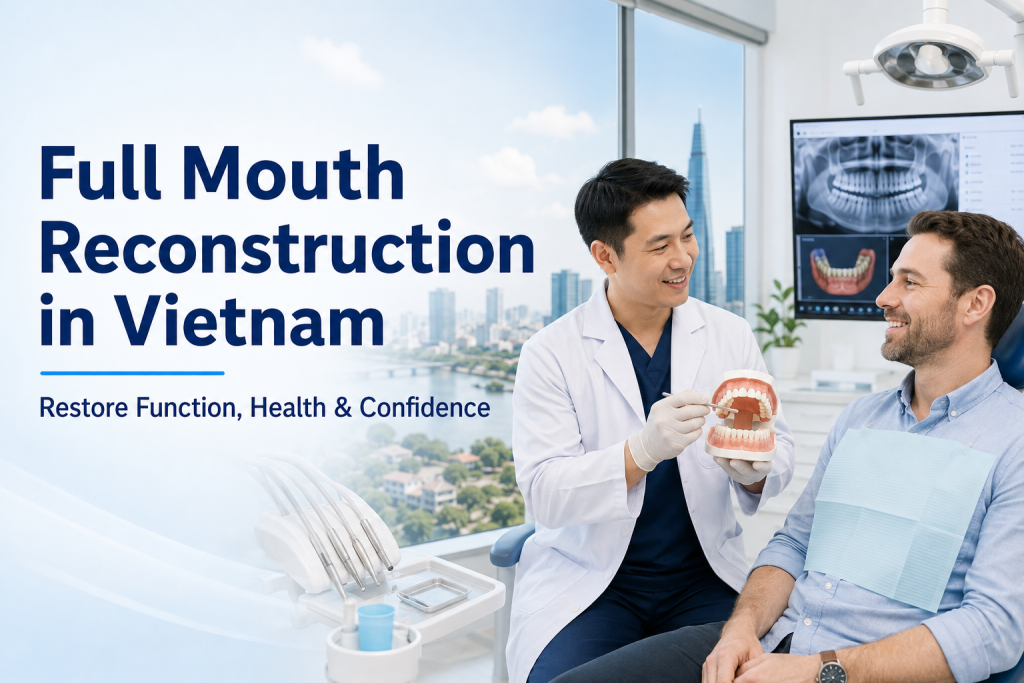
Full mouth reconstruction in Vietnam helps international patients restore chewing function, oral health, and smile aesthetics through personalized treatments such as dental implants, crowns, bridges, and full-arch restorations.
Step-by-Step Clinical Procedure: What to Expect
Because full mouth rehabilitation is a complex multi-disciplinary process, treatment is typically delivered across a two-trip protocol over 3 to 6 months (if dental implants or bone grafting are required) or completed in a single 10-to-14-day visit (if the reconstruction relies exclusively on crowns, bridges, and veneers over natural teeth).
Phase 1: Comprehensive Diagnostics & Digital Smile Design (Day 1 – Visit 1)
-
3D Diagnostics: High-definition 3D Cone Beam Computed Tomography (CBCT) scans, panoramic X-rays, and intraoral 3D optical scans are taken.
-
Joint & Bite Analysis: The prosthodontist uses digital bite alignment tools to measure jaw joint position, muscle stress, and chewing dynamics.
-
Digital Smile Design (DSD): Using 3D modeling software, the surgical team plans the exact height, shape, and position of all 20 to 28 replacement teeth.
Phase 2: Foundation Preparation & Temporary Restorations (Days 2 to 4 – Visit 1)
-
Preliminary Treatments: Any necessary root canals, decay removals, or minor tooth extractions are completed under local anesthesia or conscious IV sedation.
-
Tooth Preparation: Natural teeth across both arches are reshaped to receive crowns or veneers. If surgical implants are needed, posts are inserted during this session.
-
Digital Impression: An intraoral optical scanner captures micro-precise 3D digital impressions of your prepared teeth.
-
Provisional Bite Placement: High-grade acrylic temporary crowns and bridges are cemented over your prepared teeth. These temporaries restore your bite height immediately, allowing you to test-drive your new chewing mechanics comfortably.
Intermission: CAD/CAM Laboratory Fabrication (2 to 4 Weeks)
The digital optical scan is transferred to an in-house CAD/CAM dental laboratory. Using multi-axis automated milling machines, master ceramists mill solid Zirconia or E.max ceramic blocks, hand-staining and glazing each restoration to match natural tooth translucency and shade gradients.
Phase 3: Try-In, Fitting & Permanent Cementation (Visit 2 or Day 10 – 12)
-
Provisional Removal: Temporary crowns are gently removed, and natural abutment teeth are cleaned.
-
Try-In & Aesthetics Evaluation: The permanent Zirconia crowns, bridges, and veneers are placed with temporary try-in paste. You inspect your new smile in a mirror to verify shade, tooth length, and facial aesthetics.
-
Bite Balance Adjustment: The dentist checks bite contacts using digital articulation tools to eliminate high spots and prevent future joint strain.
-
Permanent Bonding: Each ceramic restoration is bonded using high-strength adhesive resin cements and light-cured.
-
Custom Night Guard Fitting: A custom acrylic night guard is provided to cushion your new restorations against nocturnal teeth grinding.
Candidate Selection: Are You a Fit for Full Mouth Reconstruction?
While full mouth rehabilitation offers predictable restorative results, careful clinical screening is required to ensure long-term stability.
Ideal Candidates
-
Patients with extensive tooth wear, severe decay, or multiple broken teeth across both upper and lower arches.
-
Patients suffering from collapsed bite height, deep overbites, or TMJ discomfort caused by worn teeth.
-
Individuals who retain a sufficient number of salvageable natural tooth roots.
-
Patients who want a permanent, non-removable solution rather than removable partial or full dentures.
Medical Considerations & Contraindications
Certain health factors require management before starting extensive dental rehabilitation:
-
Uncontrolled Diabetes: Elevated blood sugar levels impair gum tissue healing and micro-vascular recovery following root canal therapy or oral surgery.
-
Severe Active Periodontal Disease: Advanced gum disease causes bone loss around supporting roots. Periodontal infection must be treated and stabilized before placing permanent ceramic restorations.
-
Heavy Tobacco Smoking: Smoking restricts blood flow to gum tissues, increasing infection risks around newly fitted crown margins and dental implants.
Safety Standards, Sterilization Protocols, and E-E-A-T Quality Assurance
Safety and clinical quality are essential when undergoing complex medical and dental care abroad. Top dental centers in Hanoi and Ho Chi Minh City operate under strict licensing by the Vietnamese Ministry of Health, adhering to infection control guidelines set by the U.S. Centers for Disease Control and Prevention (CDC) and the World Health Organization (WHO).
Key quality standards to verify when selecting your dental center include:
-
Class-B Autoclave Sterilization Systems: High-vacuum steam sterilizers that process all surgical instruments and dental handpieces between patients.
-
Dedicated Operating Theaters: Sterile surgical suites equipped with negative/positive pressure air filtration systems, separate from general dentistry treatment rooms.
-
Certified Global Materials: Authentic ceramic blocks and implant posts imported directly from reputable global manufacturers (such as Ivoclar Vivadent, Kuraray Noritake, Straumann, and Nobel Biocare).
-
Official Warranty Certificates: Professional clinics provide an official warranty card for full-mouth restorations, offering 10 to 15 years of coverage against chipping, fracturing, or material defects under normal usage.
Travel Logistics: Planning Your Trip for Full Mouth Reconstruction in Vietnam
Organizing a full mouth reconstruction trip requires careful planning. Below is a practical roadmap to help structure your itinerary.
Step 1: Remote Virtual Evaluation
Before purchasing flight tickets, contact your chosen clinic online:
-
Send clear studio photos of your smile alongside a recent Panoramic X-ray (OPG) or 3D CBCT scan from a local imaging center in your home country.
-
Participate in a video consultation with the prosthodontist and international patient coordinator.
-
Receive a preliminary treatment plan outlining estimated costs, required visits, and recommended trip durations.
Step 2: Visa & Travel Requirements
-
Vietnamese E-Visa: Citizens of Australia, the US, UK, Canada, New Zealand, and EU countries can easily apply online for an official 90-day multi-entry e-Visa.
-
Flight Destinations: Fly into Tan Son Nhat International Airport (SGN) for treatments in Ho Chi Minh City or Noi Bai International Airport (HAN) for treatments in Hanoi.
-
Recommended Trip Length: Plan a stay of 10 to 14 days if your reconstruction is crown-based (single trip). If your case requires surgical implants, plan two separate trips of 5 to 7 days each, spaced 3 to 6 months apart.
Essential Aftercare and Long-Term Maintenance
Although ceramic crowns, bridges, and veneers cannot develop cavities, the natural tooth roots underneath and the supporting gum tissues remain vulnerable to periodontal disease.
Protect your investment by following these long-term maintenance practices:
-
Brush & Floss Daily: Clean around the base of all crowns and bridges daily using soft-bristled toothbrushes, non-abrasive fluoride toothpaste, and threader floss (Super Floss) or interdental picks.
-
Utilize a High-Pressure Water Flosser: A Water Flosser (Waterpik) is effective for flushing out trapped food debris from beneath bridge pontics and around implant abutments.
-
Wear Your Custom Night Guard: Always wear your custom acrylic night guard while sleeping to cushion ceramic restorations against accidental clenching or grinding forces.
-
Bi-Annual Hygiene Check-Ups: Visit a local dental hygienist every six months for routine professional cleanings and check-up X-rays to monitor the health of your underlying roots and jawbone.
Restore Your Smile and Health in Vietnam
Choosing to undergo full mouth reconstruction in Vietnam offers an ideal blend of state-of-the-art digital dentistry, globally certified materials, experienced prosthodontic care, and life-changing cost savings. By selecting an accredited dental center and following recommended aftercare practices, you can restore complete chewing function, eliminate jaw pain, and enjoy a confident, natural smile for decades to come.
Medically reviewed by MSc, MD, Doctor Dang Tien Dat
Restore Your Smile with Full Mouth Reconstruction in Vietnam
Achieve a healthy, confident smile with world-class dental care at a fraction of the cost.
Trusted by patients from around the world.