
When managing your recovery timeline after breast augmentation, a patient’s focus naturally extends far beyond the initial surgical transformation itself. The journey to achieving an exceptional, natural physical outcome depends heavily on what happens after you leave the operating theater. For international medical tourists, this requires a structured, disciplined healing protocol, particularly when navigating the unique physiological challenges of long-haul aviation back to your home country.
Vietnam has established itself as an elite global destination for high-end aesthetic transformations, drawing thousands of medical tourists to its accredited private hospitals in Hanoi and Ho Chi Minh City. When planning your journey for cosmetic surgery in Vietnam, understanding the post-operative healing window is essential. This comprehensive, medically vetted guide outlines the precise recovery milestones from day one through month six. It delivers actionable clinical insights regarding wound management, localized swelling control, professional compression garment use, and the critical rules for safe air travel after surgery.
Quick Navigation
1. Phase 1: Institutional Care & The First 48 Hours
The immediate post-operative window is dedicated to early clinical stabilization, pain management, and monitoring tissue responses. Whether your surgeon utilized a dual-plane inframammary approach or an endoscopic transaxillary entry pathway, the first 48 hours establish the foundation for your recovery timeline after breast augmentation.
Immediate Post-Anesthesia Awakening
Upon waking from general anesthesia in your private recovery suite, you will feel a distinct sensation of tightness across your chest wall. This tightness is completely normal and stems from the mechanical stretching of the pectoral muscle fibers and dermal layers accommodating the newly placed cohesive silicone gel devices.
Your vital signs, internal fluid balances, and surgical dressing sites are continuously monitored by a dedicated nursing team. Most premium private hospitals in Vietnam include a mandatory 24-hour overnight inpatient stay within their global packages to ensure maximum patient safety before discharge.
Navigating the First 48 Hours at Your Hotel
Following formal clinical discharge to your recovery hotel, managing physical rest is your primary objective.
-
Elevated Sleep Architecture: You must sleep strictly on your back with your torso elevated at a 30-to-45-degree angle. Utilizing a multi-pillowed wedge system reduces hydrostatic pressure across the chest, which directly decreases early localized swelling and eases tension on your fresh incision lines.
-
Controlled Ambulatory Movement: While strenuous activity is completely restricted, you should perform light, gentle walking around your room for 5 to 10 minutes every couple of hours during waking periods. This light movement promotes lower limb venous return and lowers the risk of early vascular complications.
2. Phase 2: Week 1 – Acute Healing & Managing Initial Discomfort
The first week requires careful balance: allowing the acute inflammatory response to stabilize while strictly avoiding activities that could stress your internal tissue planes.
Pain Management and Medication Compliance
Localized discomfort typically peaks between days two and four before starting to steadily improve. Your medical team will provide a comprehensive, prescription-grade medication package, which generally includes:
-
Targeted Antibiotic Prophylaxis: A strict course of oral antibiotics to safeguard the internal implant environment.
-
Analgesic Support: Scheduled anti-inflammatory medications and targeted muscle relaxants to alleviate pectoral spasms.
-
Anti-Nausea Medication: If you have an easily upset digestive tract following anesthesia.
You must take all medications exactly as prescribed by your surgeon; do not alter your medication schedule even if your pain levels feel manageable.
Surgical Cleansing and Wound Integrity
Modern plastic surgery suites in Vietnam favor advanced closure methodologies, often utilizing deep subcuticular absorbable stitching covered by premium liquid skin adhesives like Dermabond. This creates an immediate, waterproof structural seal.
However, you must avoid taking traditional baths, using hot tubs, or entering hotel swimming pools during this stage. When clearing your body, use low-temperature sponge baths or a gentle detachable shower head directed strictly below your shoulder line, ensuring your chest wraps remain completely dry until your formal follow-up appointment.
3. Phase 3: Weeks 2 to 4 – Internal Tissue Accommodation
As you enter the second and third weeks of your recovery timeline after breast augmentation, the initial surgical bruising fades, and your implants begin their natural transition into your body’s structural landscape.
Managing the “Drop and Fluff” Transition
During the initial recovery phase, your breasts will appear set high on your chest wall, and the upper poles may look overly full or firm. This appearance is an expected clinical stage caused by localized fluid retention and muscular tension holding the implants high beneath the pectoralis major muscle.
Over the next two to four weeks, the muscle fibers gradually relax, and gravity guides the devices downward into their natural anatomical positions within the lower breast curvature. This structural progression—commonly referred to as the “drop and fluff” phase—varies for each individual and can progress at different rates between your left and right sides.
The Critical Role of Medical-Grade Compression Garments
During this transitional window, you must transition away from standard fashion brassieres and wear a specialized medical compression garment 24/7, removing it only for brief daily showers.
These specialized garments support your healing tissue planes, minimize fluid collection (seromas), and relieve physical stress on your incision lines to prevent them from stretching. If your surgeon utilizes a dual-plane placement technique, they may also apply a specialized stabilizing elastic band across the upper slope of your breasts to gently guide the implants downward and secure them in place.
4. Phase 4: Weeks 5 to 6 – Achieving Clearance to Fly Safely
For international medical tourists, the fifth and sixth weeks represent a major milestone: completing your definitive clinical follow-up evaluations and preparing for safe air travel back home.
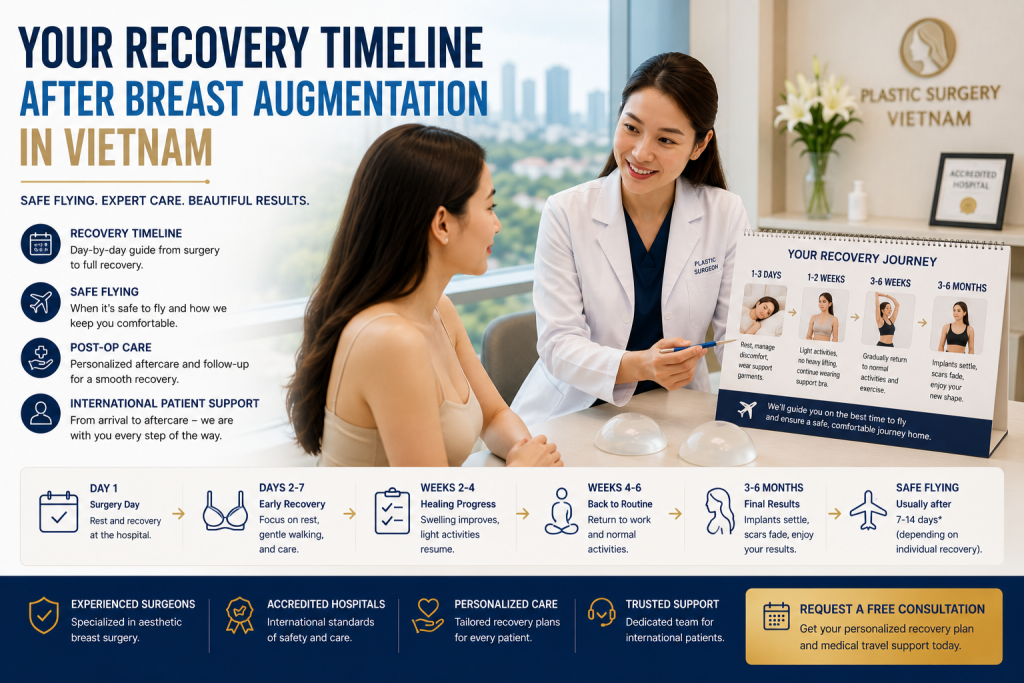
Recovery timeline after breast augmentation in Vietnam includes surgery day, early recovery, healing progress, return to routine, final results, and safe flying guidance for international patients.
Crucial Medical Directives for Safe Aviation
Flying too soon after major surgery introduces distinct physiological stresses due to altered cabin pressures and long periods of physical inactivity. Clinical studies published by the Aerospace Medical Association (AsMA) show that low cabin humidity and immovability significantly increase blood viscosity, raising the risk of deep vein thrombosis (DVT).
Furthermore, sudden atmospheric pressure changes can expand tiny pockets of trapped intra-operative air, putting unnecessary mechanical stress on fresh internal healing planes.
To safely manage these risks, top-tier aesthetic centers across Vietnam require international patients to maintain a 10-to-14-day in-country stay following primary breast enhancement before embarking on a long-haul international flight. You must receive a formal physical checkup and explicit written clearance from your operating specialist before heading to the airport.
Practical Tips for a Safe, Comfortable Flight
When organizing your return journey from Hanoi or Ho Chi Minh City, implement these protective travel habits:
-
Wear Premium Compression Socks: Put on medical-grade graduated compression socks before boarding to improve lower limb circulation and counter the pooling effects of long periods of sitting.
-
Stay Well-Hydrated: Drink plenty of water throughout the flight, and avoid caffeine and alcohol, which can dehydrate your system and compromise optimal microvascular circulation.
-
Move Regularly in the Cabin: Set a gentle timer to stand up and walk along the airplane aisles for 3 to 5 minutes every hour to stimulate blood flow through your deep venous networks.
-
Protect Your Upper Body: Do not lift heavy luggage into overhead compartments or pull heavy wheeled bags through airport terminals. Always use airport porter services or travel with a companion who can handle your bags, ensuring your pectoral muscles remain stress-free.
5. Phase 5: Months 2 to 6 – Scar Maturation & Resuming Activities
The final stage of your recovery timeline after breast augmentation centers on scar refinement, restoring full mobility, and enjoying your final aesthetic results.
Structured Scar Care Regimen
As your incision markings transition from pink to their final pale, faint lines, consistent scar management becomes your priority. Guidance from the National Institutes of Health (NIH) shows that applying topically pure silicone gel creates a balanced, moisture-retaining protective layer that prevents excess collagen production, keeping scars soft and flat.
-
Silicone Therapy: Once your skin surface has fully closed (typically around week three or four), begin applying medical-grade silicone sheets or topical silicone gels daily.
-
Sun Protection: Keep your healing incisions completely shielded from direct sunlight. Fresh scar tissue is highly vulnerable to ultraviolet (UV) rays; exposure can trigger localized hyperpigmentation, causing the lines to turn permanently dark brown or purple. Always apply a broad-spectrum, mineral-based SPF 50+ sunscreen when enjoying outdoor activities.
Gradually Reintroducing Physical Exercise
Returning to your fitness routine should be a gradual, multi-stage process tailored to your body’s healing progress:
| Recovery Milestone | Approved Physical Activities | Restricted Actions |
| Weeks 1 – 2 | Light indoor walking (5-10 mins). | All weight training, stretching, running. |
| Weeks 3 – 4 | Low-impact stationary cycling. | Heavy lifting, torso twisting, bouncing. |
| Weeks 5 – 6 | Light lower-body exercises (bodyweight squats). | Direct chest exercises, heavy pushing. |
| Months 2 – 3 | Power walking, light jogging with support bra. | High-impact jumping, heavy bench presses. |
| Months 4 – 6 | Full reintroduction of regular fitness routines. | Any activity causing sharp pectoral pain. |
To understand the complete preparation phase before entering recovery, including choosing your ideal implant profile and reviewing initial pricing models, explore our detailed resource: Breast Augmentation in Vietnam: A Complete Guide.
6. Real Patient Recovery Roadmap Summary
To help you visualize your progress, this summary milestone matrix outlines your anticipated benchmarks over the six-month healing period:
| Timeline Stage | Expected Structural Progress | Primary Care Requirements | Exercise & Activity Status |
| Days 1 – 3 | Marked tightness across the chest; visible swelling. | Sleep elevated at 45°; take prescribed medications; absolute rest. | Strict resting mode; gentle indoor room walking only. |
| Days 4 – 7 | Swelling begins to stabilize; bruising peaks then fades. | Keep incision wraps dry; attend your first follow-up check. | Light movement; do not lift objects over 2-3 kilograms. |
| Weeks 2 – 4 | Implants begin their gradual downward movement (“drop & fluff”). | Wear your medical compression garment 24/7; start scar gel care. | Gentle lower-body activity; zero upper-body stress. |
| Weeks 5 – 6 | Internal tissues settle; skin incision lines close securely. | Obtain formal medical clearance; follow safe flying protocols. | Light cardio permitted; avoid heavy pushing movements. |
| Months 2 – 3 | Breast shapes soften; tissues feel natural and flexible. | Switch to supportive sports bras; apply daily sun protection. | Gradual return to light gym workouts; no heavy chest presses. |
| Months 4 – 6 | Final breast positions and contours stabilize completely. | Maintain routine self-exams; protect scars from UV light. | Full clearance for all sport and fitness activities. |
7. The Medtour Vietnam Advantage: Comprehensive Support Across Your Recovery Timeline
Attempting to manage a surgical recovery journey in a foreign country can feel overwhelming. When you partner with a dedicated medical travel agency like Medtour Vietnam, you gain a comprehensive support network that manages every detail of your itinerary, ensuring you can focus entirely on your healing.
Our dedicated care management covers every step of your journey:
-
Vetted Healthcare Access: We connect you exclusively with elite, board-certified plastic surgery experts who operate out of fully accredited, modern medical centers equipped with advanced surgical tools.
-
Fixed Global Pricing Packages: Our medical travel options provide absolute financial clarity, bundled into transparent rates that cover your comprehensive surgical fees, pre-operative health screenings, premium implants, inpatient accommodations, and follow-up care.
-
Comprehensive Logistics Coordination: From airport pickup services and private medical transport to local communication setups and recovery-friendly hotel options close to your clinic, we manage your entire stay.
-
In-Country Patient Advocacy: Your personal coordinator accompanies you to clinical consultations, manages language translation, and remains on call to support you throughout your recovery process.
Conclusion: Securing Your Aesthetic Vision Through Patient Care
Your recovery timeline after breast augmentation is a continuous journey that transforms initial surgical adjustments into a beautifully natural, balanced physical outcome. By honoring your body’s native healing phases, wearing your compression garments consistently, and following recommended pre-flight stay protocols, you protect your health and safeguard your aesthetic results. Vietnam’s skilled aesthetic specialists provide the technical expertise to reshape your contours; your commitment to disciplined post-operative care ensures that transformation is realized safely and beautifully.
Are you ready to map out your personalized recovery plan and consult with Vietnam’s premier aesthetic specialists? Connect with a dedicated medical travel coordinator at Medtour Vietnam today to schedule your comprehensive video consultation and start planning your treatment path.
Planning Breast Augmentation in Vietnam?
Get expert guidance on recovery timelines, post-op care, safe flying plans, follow-up appointments, and medical travel support before your surgery.