
A high, prominent forehead or a receding hairline can significantly impact facial harmony, often making individuals look older or less symmetrical than they desire. While genetics, aging, and pattern baldness are the primary culprits behind an elongated forehead, modern aesthetic medicine offers highly effective surgical solutions.
For international patients seeking to balance their facial proportions without incurring prohibitive medical bills at home, Southeast Asia has become the ultimate destination. Specifically, hairline lowering surgery in Vietnam has emerged as a premier choice, combining world-class surgical expertise, advanced medical facilities, and exceptionally competitive pricing.
This comprehensive, search-optimized guide explores the different surgical and restorative modalities available, true financial breakdowns compared to Western nations, top-rated clinical centers, and essential steps for planning a successful medical tourism journey to Vietnam.
Quick Navigation
1. Understanding Hairline Lowering: Surgical Reduction vs. Hairline Transplant
When patients search for ways to achieve a more balanced facial profile, they generally encounter two distinct procedural paths under the umbrella of hairline lowering. Understanding the clinical differences between these two methods is vital for aligning your expectations with the correct anatomical outcome.
Option A: Forehead Reduction Surgery (Surgical Lowering)
Also known as surgical hairline advancement or forehead reduction, this is a one-stage surgical procedure that physically moves the hair-bearing scalp forward.
-
The Procedure: The surgeon makes an intricate, undulating incision along the natural border of the hairline (often using a trichophytic incision technique that allows hair to grow directly through the scar). A calculated strip of excess forehead skin is excised, the scalp is mobilized and advanced forward, and the tissue is secured using deep, dissolvable internal sutures.
-
The Outcome: This method provides an immediate reduction in forehead height, typically lowering the hairline by 1.5 to 3 centimeters in a single session.
-
Ideal Candidates: Women with high hair density at the front but a naturally high forehead due to genetics, and individuals with good scalp laxity (elasticity) who do not suffer from progressive hair loss.
Option B: Hairline Transplant (Restorative Advancement)
Rather than cutting away skin, this method uses advanced micro-grafting techniques to build a completely new, lower hairline graft by graft.
-
The Procedure: Healthy hair follicles are harvested from the permanent donor zone at the back of the scalp using Follicular Unit Extraction (FUE) or Direct Hair Implantation (DHI). These individual grafts are then meticulously implanted into a freshly designed, lower hairline map on the forehead.
-
The Outcome: Results are gradual, with the new hair taking 6 to 12 months to grow into its final density. However, it requires no major skin excision and leaves no linear forehead scar.
-
Ideal Candidates: Men experiencing male pattern baldness (receding hairline or M-shaped hói), individuals with tight scalps lacking the elasticity required for surgical advancement, or those looking to reshape the temple angles.
To discover the deep clinical variations, advanced survival rates, and complete procedure maps of the micro-grafting technique, read our ultimate guide to a hair transplant in Vietnam.
2. Advanced Surgical Methods Practiced by Vietnamese Specialists
Top-tier plastic surgery hospitals in major urban centers like Hanoi and Ho Chi Minh City adhere strictly to international patient safety guidelines outlined by organizations such as the International Society of Aesthetic Plastic Surgery (ISAPS). Vietnamese specialists utilize refined variations of the following methods to ensure virtually invisible scarring and maximum naturalness:
1. The Open Trichophytic Incision
For forehead reduction surgery, the standard straight incision has been completely replaced by the advanced trichophytic incision. The surgeon cuts at a precise bevel angle just behind the first few rows of hairs. This allows the hair roots underneath the incision line to remain perfectly intact. As healing progresses over the months, the natural hair shafts sprout directly through and in front of the mature surgical scar, rendering the microscopic baseline practically invisible even when pulling the hair straight back.
2. Endoscopic Scalp Mobilization
To achieve significant advancement (2cm or more) without placing undue tension on the healing skin, surgeons utilize specialized high-definition endoscopes passed under the scalp tissue. This allows them to safely release the dense galea aponeurotica layer from the skull bones. Relieving this internal tension ensures that the final skin closure remains completely tension-free, preventing complications like widened scars or temporary localized hair thinning near the incision line.
3. Combining Surgical Advancement with Micro-Grafting
In complex cases—such as patients who want an immediate reduction in forehead height but also possess sparse hair density at the temple regions—Vietnamese surgeons frequently employ a hybrid approach. First, the forehead reduction surgery is performed to bring the bulk of the hairline forward.
After the tissue has fully healed, the team uses micro-grafting to soften the borders and round out the temples. During these comprehensive facial rejuvenation plans, patients routinely opt to enhance their entire upper facial symmetry by pairing the advancement with an advanced eyebrow transplant in Vietnam to build full, three-dimensional brow arches that complement their newly balanced forehead.
3. Cost Breakdown of Hairline Lowering Surgery in Vietnam vs. Western Countries
The financial burden of elective plastic surgery in Western nations is the primary catalyst driving the medical tourism boom. Because hairline lowering is categorized as a cosmetic procedure, private healthcare networks in the US, UK, and Australia rarely offer insurance coverage, requiring full out-of-pocket payments.
The Financial Landscape: A Comparative Breakdown
The table below highlights the average cost profiles for a standard, primary forehead reduction surgery across major international markets, revealing the significant savings available to patients traveling to Southeast Asia:
| Country / Region | Average Price Range (USD) | Cost Structure & Inclusions |
| United States | $7,000 – $12,000 | Excludes separate hospital facility fees and private anesthesiologist billing. |
| Australia | $6,500 – $11,000 | High private clinic overhead and regional surgical indemnity costs. |
| United Kingdom | $6,000 – $10,500 | Limited specialized private hospital networks. |
| Thailand | $3,500 – $5,500 | Commercialized medical tourism hubs with moderate operational costs. |
| Vietnam | $2,000 – $3,800 | All-inclusive international packages (Pre-op labs, surgeon fees, general anesthesia, and inpatient care). |
Why is Vietnam So Cost-Effective for Medical Tourists?
The substantial price gap between Vietnam and Western nations does not represent a compromise in medical quality. Instead, the affordability is driven by core macroeconomic factors:
-
Lower Operating Overhead: The structural costs of medical real estate, clinical licensing, staff payrolls, and professional insurance are significantly lower in Vietnam than in metropolitan areas like Sydney, London, or Los Angeles.
-
Strong Currency Exchange: International travelers enjoy immense purchasing power due to favorable exchange rates against the Vietnamese Dong (VND).
-
Transparent Packaging: Private hospitals catering to global patients utilize streamlined, all-inclusive pricing structures that eliminate hidden or unexpected fees, making budgeting simple and reliable.
To evaluate the full cost structures, clinical pathways, and multi-procedure package deals available for all forms of aesthetic enhancements across the country, explore our main directory for cosmetic surgery in Vietnam.
4. Top Clinics and Specialized Plastic Surgery Hospitals in Vietnam
Choosing a highly qualified, state-licensed hospital is the single most important step in guaranteeing a safe surgical outcome. For an invasive procedure like surgical forehead reduction, patients should avoid minor day-clinics and focus exclusively on fully accredited, multi-specialty cosmetic hospitals that feature dedicated general anesthesia cleanrooms and intensive care infrastructure.
1. Kangnam Cosmetic Hospital (Ho Chi Minh City & Hanoi)
-
Accreditation Standards: Kangnam is a major landmark in Vietnam’s private medical sector, operating massive hospital facilities that adhere strictly to international aesthetic standards.
-
Surgical Specialty: The hospital features an elite department of facial contouring, utilizing advanced 3D Vectra imaging systems that allow international patients to visually simulate their post-surgical facial proportions before entering the operating room. Their surgeons are highly adept at the trichophytic incision method, delivering exceptional scar concealment.
2. Gangwhoo Cosmetic Hospital (Ho Chi Minh City)
-
International Profile: Certified by the regional Department of Health, Gangwhoo stands out for its deep integration of South Korean plastic surgery workflows and technologies.
-
Patient Infrastructure: The hospital provides a comprehensive international patient support wing, featuring full English-speaking medical translators, transparent surgical documentation, and state-of-the-art endoscopic equipment to ensure safe, minimally invasive scalp advancement.
3. JW Korea Plastic Surgery Hospital (Ho Chi Minh City)
-
Clinical Reputation: Operating as a direct international affiliate of the renowned JW Medical Group in Seoul, this premier hospital brings elite East Asian facial contouring methodologies straight to Vietnam.
-
Expertise: Led by world-class specialists with global board memberships, JW Korea is highly sought after by patients from Australia, the US, and Singapore for complex hairline reshaping and combined upper-facial rejuvenation procedures.
5. The Comprehensive Patient Journey: What to Expect
Undergoing a surgical hairline advancement abroad requires a well-structured, step-by-step clinical timeline. Knowing what to expect at each phase ensures proper preparation and total peace of mind.
Before booking your flights, you will securely upload high-resolution photographs of your face, profile views, and hair borders. Your assigned surgeon will perform a digital facial analysis, evaluate your scalp mobility, calculate the exact number of centimeters the hairline can be safely advanced, and provide a comprehensive financial quotation.
Upon arriving at the hospital in Vietnam, you will sit down for an in-depth, face-to-face consultation. The surgeon will physically measure your forehead contours and draw the precise surgical marking lines. You will then undergo full pre-operative safety clearances, including comprehensive blood panels, electrocardiograms (ECG), and chest X-rays, to clear you for general anesthesia.
The procedure is performed under deep general anesthesia inside a sterile, positive-pressure operating cleanroom and typically takes 1.5 to 2.5 hours. The surgeon executes the beveled trichophytic incision, advances the mobilized scalp forward using endoscopic visualization, secures the deep tissue layers, and meticulously closes the skin margins with ultra-fine, non-absorbable sutures.
You will spend the first post-operative night resting comfortably in a private hospital room under 24/7 nursing observation. Pain is highly manageable using standard intravenous analgesics. The next morning, the surgical compression dressings are removed, the incision site is gently cleansed, and you are discharged to your hotel with a comprehensive medication package.
Over the next 7 days, you will attend scheduled outpatient follow-ups for wound cleaning and specialized low-level laser therapy (LLLT) to promote rapid tissue healing. On day 7 or 8, the surgical sutures are gently removed. The medical team conducts a final inspection, provides you with complete home-care instructions, and issues an official fit-to-fly certificate for your journey home.
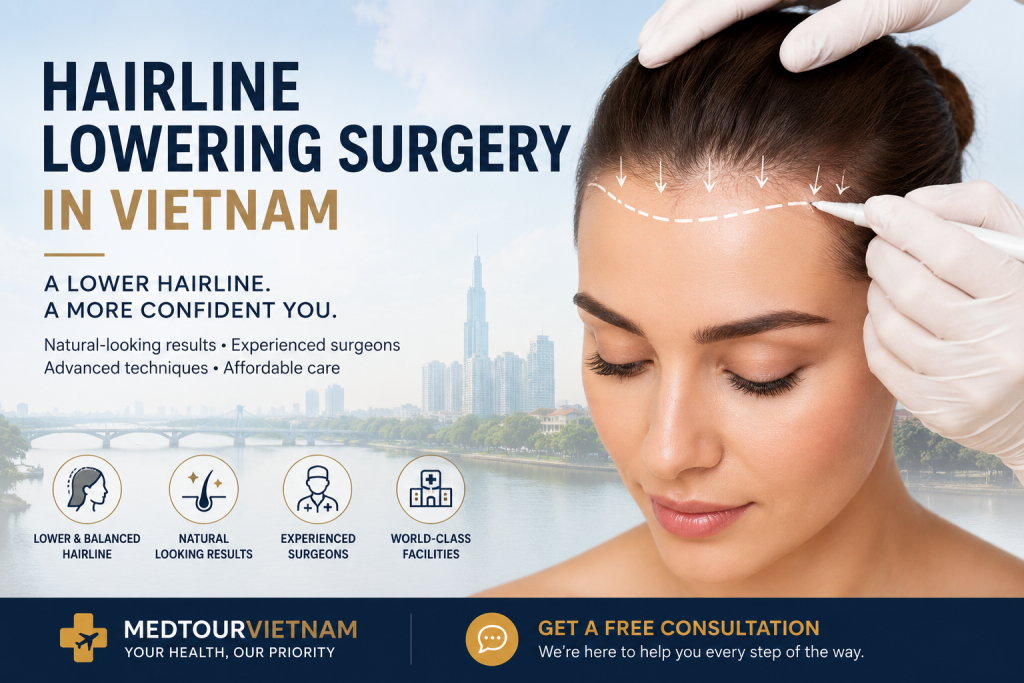
Hairline lowering surgery in Vietnam helps reduce forehead height and create a more balanced hairline with experienced surgeons, advanced techniques, and modern medical facilities.
6. Recovery Timeline and Crucial Post-Operative Instructions
While the initial healing phase of a forehead reduction occurs quickly, the long-term maturation of the surgical scar and the regrowth of surrounding hair follicles follows a specific biological timeline.
Essential Post-Operative Guidelines
To safeguard your healing incision and guarantee a beautiful, faint scar line, you must adhere strictly to the hospital’s recovery protocols:
-
Sleeping Posture: For the first two weeks, you must sleep strictly on your back with your head elevated at a 30-to-45-degree angle using a wedge pillow. This uses gravity to dramatically minimize post-operative swelling around the eyes and brow.
-
Activity Restrictions: Avoid heavy lifting, intense cardio, or any activity that increases blood pressure in the head for a minimum of 4 weeks. Elevated blood pressure can strain the delicate healing margins, leading to widened scarring.
-
Hair Care Protocols: You may gently wash your hair 48 hours after surgery using a mild, doctor-approved antiseptic shampoo, taking care not to scratch or scrub directly along the fresh incision line. Hair dyeing, chemical straighteners, or harsh heat styling must be avoided for at least 8 to 12 weeks.
-
Sun Protection: The healing surgical scar will be highly sensitive to ultraviolet light. For the first 6 months, you must wear a wide-brimmed hat when outdoors and apply a broad-spectrum, medical-grade SPF 50+ sunscreen once the skin has completely closed to prevent permanent hyperpigmentation (darkening) of the scar line.
7. Planning a Seamless Medical Trip to Vietnam
Organizing an invasive surgery overseas involves careful coordination of travel logistics alongside your clinical schedule. By planning ahead, you can ensure a smooth, low-stress experience:
-
Visa Entry Requirements: Most international travelers (including citizens from Australia, the US, and the UK) can quickly secure a 30-day or 90-day electronic visa (e-Visa) via the official Vietnamese government immigration portal prior to departure.
-
Timing Your Flight Home: Ensure your travel itinerary allows for a minimum stay of 9 to 10 days in Vietnam. This gives you ample time for your pre-op testing, the surgical day, the full 7-to-8-day healing window required for suture removal, and a safety margin before boarding long-haul international flights.
-
Utilizing On-the-Ground Coordination: Working with a dedicated medical tourism provider helps eliminate local logistical hurdles. These specialized agencies arrange seamless airport pickups, private hotel-to-hospital transfers, and provide dedicated bilingual medical guides who remain by your side throughout your hospital appointments, allowing you to focus completely on your rest and recovery.
By blending advanced clinical precision with affordable, world-class private hospital networks, opting for hairline lowering surgery in Vietnam provides an exceptional path to permanent facial symmetry, helping you reclaim a youthful, confident look while enjoying a relaxing stay in a beautiful country.
Considering Hairline Lowering Surgery in Vietnam?
Contact MedtourVietnam for clinic recommendations, estimated costs, and appointment support.