
Androgenetic alopecia, commonly known as male and female pattern baldness, remains a pervasive source of significant psychological distress for millions globally, impacting self-esteem and quality of life. While non-surgical pharmacological interventions exist, Follicular Unit Extraction (FUE) has catalyzed a paradigm shift in definitive hair restoration, emerging as the undisputed global gold standard for surgical follicular harvesting.
Over the past five years, Vietnam has rapidly solidified its reputation as an internationally accredited epicenter for medical tourism, particularly in advanced cosmetic and regenerative surgery. Southeast Asia, long a hub for affordable healthcare, now sees Vietnam setting benchmarks through state-of-the-art diagnostic laboratories in Ho Chi Minh City and Hanoi. Operating certified clean-room surgical suites with imported, variable-speed micromotor systems, accredited Vietnamese facilities deliver world-class FUE preparation and implantation at a fraction of Western costs. Whether deployed as an isolated surgical session, or as part of a synergistic regenerative protocol, FUE hair transplant in Vietnam offers clinically validated, scarless outcomes under the highest standards of international patient safety.
Quick Navigation
What Is FUE Hair Transplant? The Clinical Evolution of Scarless Harvesting
Follicular Unit Extraction represents the sophisticated evolution of hair restoration surgery, moving away from the invasive nature of the older Follicular Unit Transplantation (FUT), or “strip harvesting,” method. FUE is a microscopic, minimally invasive technique where individual follicular units—natural clusters typically containing one to four terminal hairs—are harvested directly from the patient’s designated donor area, usually the dense occipital scalp at the back of the head.
Unlike FUT, which requires the surgical excision of a full strip of skin and results in a permanent, linear scar, FUE utilizes specialized manual or motorized punch tools. These punches, ranging from a precise 0.7mm to 1.0mm in diameter, make microscopic, circular incisions around each individual follicular unit. The unit is then gently extracted, leaving behind only tiny punctate scars that are virtually invisible to the naked eye once healed, even with short hairstyles. This microscopic precision preserves the integrity of the fragile follicular graft while dramatically reducing patient downtime and post-operative discomfort.
Primary Indications and Efficacy of FUE in Hair Restoration
The success of a hair restoration plan depends fundamentally on a proper diagnosis and the development of a long-term, medically sound strategy. FUE is highly effective, but patient selection is crucial. Many patients evaluating advanced follicular restoration find that a comprehensive FUE hair transplant in Vietnam provides a permanent solution to years of hair loss.
1. Correcting Androgenetic Alopecia (Pattern Baldness)
The most common indication for FUE is stabilizing and reversing male and female pattern baldness. This condition is largely mediated by dihydrotestosterone (DHT), a testosterone byproduct that binds to androgen receptors on dermal papilla cells, causing progressive follicular miniaturization. FUE harvests terminal hairs from the “permanent zone” at the back and sides of the head—follicles that are naturally resistant to DHT—ensuring that the transplanted hair remains viable and grows for a lifetime. Choosing FUE hair transplant in Vietnam for patterned baldness ensures patients benefit from the latest automated extraction technologies.
2. Strategic Hairline Restoration and Densitization
FUE is unmatched in its ability to recreate a natural frontal hairline (the “Norwood” scale areas 2-3). Vietnamese clinicians performing FUE hair transplant in Vietnam strictly follow international guidelines for anatomical hairline placement. For individuals experiencing only diffuse thinning (rụng tóc), specialized medical restoration, including a combination of PRP therapy in Vietnam, may be prioritized as a first-line non-surgical biological intervention before proceeding to a surgical solution.
The Complete FUE Clinical Pathway: Your Step-by-Step Medical Journey in Vietnam
International medical travelers selecting private, Ministry of Health (MOH) accredited hospitals or specialized dermatological institutes in Ho Chi Minh City and Hanoi benefit from a standardized, clinical, and reproducible FUE pathway. Every FUE hair transplant in Vietnam session must adhere to rigorous sterile protocols.
Step 1: Pre-Operative Digital Analysis and Trichoscopy
Every protocol initiates with a digital microscopic scan of the scalp and donor hair density, known as trichoscopy. Vietnamese specialists perform a prerequisite hematological panel to rule out underlying systemic conditions (such as anemia or discoid lupus) that might contraindicate surgery. A high-quality trichoscopic analysis is a core component of advanced FUE hair transplant in Vietnam consultations. Candidates must discontinue anti-inflammatory medications and high-dose aspirin at least ten days prior to the procedure.
Step 2: Precision Graft Harvesting
The primary constraint in any hair transplant is the finite nature of the donor area. Accredited teams performing FUE hair transplant in Vietnam understand the risk of over-harvesting. The surgeon utilizes magnifying loupes to harvest individual follicular units from the occipital region. State-of-the-art facilities performing FUE hair transplant in Vietnam utilize imported, automated punch systems (such as the WAW system) to minimize transection.
Step 3: Graft Quality Assurance (QA) and Specialized Holding Solutions
As grafts are extracted, they are immediately transferred to a sterile laboratory station where technicians using high-magnification microscopy perform rigorous quality control. Each graft is counted and sorted by hair count (1-hair, 2-hair, 3-hair). To overcome the physiological limitation of ex-vivo ischemia (time spent outside the body), leading facilities performing FUE hair transplant in Vietnam utilize specialized, buffered biological holding solutions to bathe and nourish the grafts while awaiting implantation.
Step 4: Recipient Site Creation and Bio-Implantation
Site creation is where the surgeon’s artistry merges with clinical precision. Utilizing microscopic surgical blades or needles tailored to the diameter of each graft, the physician makes precise incisions in the recipient zone. Following successful site creation, the prepared grafts are delicately “bio-implanted” into these sites. For patients struggling with visible scarring in addition to hair loss, a comprehensive FUE hair transplant in Vietnam often integrates tissue analysis protocols adapted from acne scar treatment in Vietnam.
Synergistic Adjuncts: Optimizing FUE Success in Vietnam
While FUE provides the definitive structural correction, Vietnamese centers frequently utilize advanced biological synergists to maximize recovery intervals. Combining FUE with advanced biological treatments is a significant differentiator of a premium FUE hair transplant in Vietnam.
Biologically Enhanced FUE with PRP
Leading FUE surgeons in Vietnam offer concurrent Platelet-Rich Plasma (PRP) therapy as a surgical adjunct. As detailed in the clinical studies from the Journal of Cosmetic Dermatology (DoFollow external link), autologous PRP utilizes concentrated platelet growth factors to stabilize fragile grafts and boost dermal angiogenesis. For patients prioritizing the fastest recovery and maximal hair density, pre-treating the scalp with PRP therapy in Vietnam offers a clinically proven pathway to accelerated healing.
Adipose Tissue Transfer for Sub-dermal Support
In areas of advanced baldness, the subcutaneous adipose (fat) layer is often significantly depleted, reducing the necessary padding for a healthy follicle. To address this dermal volume deflation, Vietnamese plastic surgeons sometimes combine major FUE procedures with autologous fat transfer in Vietnam. Progenitor cells derived from processed fat tissue can stimulate quiescent follicles and improve overall tissue health, marking a sophisticated level of multi-modal care available when selecting FUE hair transplant in Vietnam.
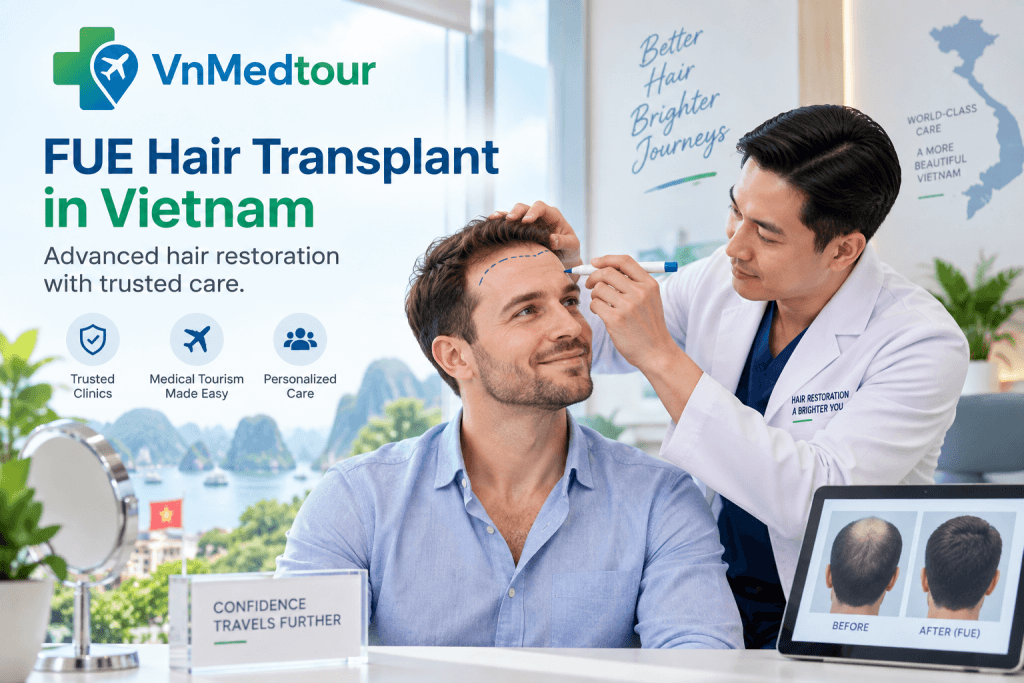
FUE hair transplant in Vietnam provides international patients with modern hair restoration techniques, experienced specialists, personalized treatment planning, and competitive costs.
Establishing Holistic Facial Harmony
A successful hairline restoration must balance with the entire face. To ensure lower-face harmony, many patients undergoing FUE hair transplant in Vietnam choose to synchronize their surgical procedure with the non-surgical facial volumization strategies detailed in our guide to fillers in Vietnam. This holistic approach ensure that the middle and lower face are proportionally contoured to match the newly established, youthful upper face framing.
Cost of FUE Hair Transplant in Vietnam vs. International Benchmarks
The primary driver for international medical travelers choosing Vietnam for advanced healthcare is the impeccable cost transparency and clinical affordability. Clinics pass significant labor and operational savings directly to the patient. For many medical tourists, the total cost for a full, high-graft-count FUE hair transplant in Vietnam is often less than the price of a single localized touch-up session in the United States.
Regional Cost Comparison (USD) for a 3,000-Graft FUE Session
-
United States: $12,000 – $25,000
-
Australia: $10,000 – $22,000
-
Vietnam (Accredited Hospitals): $2,500 – $5,500
Standards of MOH Accreditation
Patients must prioritize Ministry of Health (MOH) accredited hospitals or specialized private clinics for a secure FUE hair transplant in Vietnam. Every licensed FUE hair transplant in Vietnam adheres to rigid MOH guidelines concerning infection control, utilizing state-of-the-art clean-room environments. Comprehensive counseling regarding follicular transection rates and donor hair density limitations is an integral part of an ethical FUE hair transplant in Vietnam.
The Medical Travel Journey and FUE Recovery in Vietnam
One of the distinct advantages of FUE hair transplant is the minimally invasive nature of the procedure, which allows medical tourists to combine specialized clinical care with a comfortable travel itinerary. Organizing a trip for an FUE hair transplant in Vietnam requires only a brief 5-day stay.
Itinerary Management and Post-Op Care
Patients submit trichoscopic images of their loss pattern for a remote virtual consultation to establish a personalized medical strategy for their FUE hair transplant in Vietnam. A standard five-day itinerary provides ample time for the procedure and initial donor area healing. Recovery following a premium FUE hair transplant in Vietnam is exceptionally swift. Patients learn the proper technique for gentle scalp washing and receive comprehensive post-operative kits to manage their scalp health effectively.
Medical Disclaimer: The clinical information presented in this comprehensive guide is intended exclusively for educational and contextual medical travel planning purposes. It does not replace, under any circumstances, a formal, in-person consultation, a diagnostic assessment by a qualified trichologist, or direct physician-guided treatment recommendations. Individuals considering advanced follicular restoration should always consult with a board-certified specialist in plastic surgery or specialized dermatology to ensure personal medical suitability and establish requisite treatment goals.
Considering an FUE Hair Transplant in Vietnam?
Contact VnMedtour for personalized guidance on trusted clinics, treatment options, estimated costs, and support throughout your hair transplant journey in Vietnam.