
If you are considering acne scar treatment in vietnam, achieving smooth, revitalized skin no longer requires spending thousands of dollars in Western clinics. Today, Vietnam has become a premier destination for international patients, expatriates, and medical tourists seeking advanced scar revision. By combining proven clinical modalities—such as Subcision, Fractional CO2 Laser resurfacing, TCA Cross, and Platelet-Rich Plasma (PRP)—with Western-trained dermatologists, the country delivers world-class skin restoration at 60% to 80% lower costs than the US, UK, or Australia.
This complete 2026 guide explores everything you need to know about receiving acne scar treatment in Vietnam: understanding scar types, multi-modality treatment protocols, comprehensive cost breakdowns, top clinics in Ho Chi Minh City and Hanoi, and post-procedure recovery tips.
Quick Navigation
Key Takeaways
-
Massive Cost Savings: A multi-modality acne scar session (combining Subcision, Fractional CO2, and PRP) costs between $150 and $350 USD in Vietnam, compared to $1,200 to $2,500 USD in Western nations.
-
Multi-Modality Approach: Leading Vietnamese dermatologists specialize in tailored combination therapies (Subcision + Fractional CO2 + TCA Cross + PRP) during a single visit for maximum collagen remodeling and minimal downtime.
-
Expert Care: Treatments are performed directly by board-certified dermatologists trained in top medical universities in Vietnam, France, South Korea, and the US.
-
State-of-the-Art Technology: Top clinics utilize genuine, FDA-cleared energy devices including Alma Lasers, Candela, Lutronic, and Cynosure.
-
Rapid Recovery & Travel Integration: Modern scar protocols allow international visitors to undergo treatment and explore Vietnam with minimal disruption.
1. Why Seek Acne Scar Treatment in Vietnam?
Acne scars, particularly deep atrophic scars, are among the most challenging dermatological conditions to repair. They require structural remodeling beneath the skin surface rather than superficial creams. Seeking acne scar treatment in vietnam offers global patients several distinct advantages:
-
Unbeatable Affordability: Save up to 80% on advanced combination scar therapies without sacrificing safety or clinical standards.
-
Specialized Clinical Expertise: Vietnamese dermatologists treat high volumes of complex scar cases daily, giving them vast practical experience across diverse skin phototypes (including Fitzpatrick Types III–V).
-
FDA-Approved Medical Equipment: Clinics in major cities deploy genuine fractional lasers, radiofrequency microneedling systems, and sterile autologous PRP centrifuges.
-
No Prolonged Waitlists: Foreign patients can consult a senior dermatologist and receive same-week or next-day treatment.
To explore the broader landscape of skin care services, medical facilities, and specialist qualifications across the country, refer to our master guide on Dermatology in Vietnam.
2. Understanding Acne Scar Types & Diagnosis
Effective scar restoration begins with precise medical classification. Atrophic (depressed) scars occur when acne inflammation destroys dermal collagen, while hypertrophic scars result from excess collagen deposition.
-
Ice Pick Scars: Narrow (less than 2mm), deep, V-shaped invaginations that extend into the deep dermis or subcutaneous tissue. They account for 60%–70% of atrophic scars.
-
Boxcar Scars: Round to oval depressions with sharply demarcated vertical edges. Shallow boxcar scars (0.1–0.5mm) respond well to laser resurfacing, while deep boxcar scars require subcision or elevation.
-
Rolling Scars: Wide (greater than 4mm), shallow depressions caused by fibrous anchoring bands beneath the skin that pull the epidermis downward, creating a wave-like texture.
-
Hypertrophic & Keloid Scars: Raised, firm pink-to-flesh-colored lesions caused by overproduction of collagen during healing, common on the jawline and chest.
Clinical diagnostic guidelines published by the American Academy of Dermatology (AAD) emphasize that most patients present with a combination of scar types, necessitating a multi-modality approach rather than a single device.
3. Core Treatments: Subcision, Fractional CO2 & Synergistic Therapies
Top clinics in Ho Chi Minh City and Hanoi rarely rely on laser therapy alone. Instead, dermatologists combine complementary techniques to release bound tissue, resurface the epidermis, and stimulate new collagen production.
Subcision (Subcutaneous Incision)
Subcision is the gold-standard treatment for rolling scars and tethered boxcar scars.
-
Mechanism: Using a specialized Nokor needle, cannula, or micro-blade, the dermatologist inserts the instrument subcutaneously under local anesthesia. Moving the blade horizontally severs the rigid fibrous bands binding the scar base to underlying subcutaneous tissues.
-
Benefits: Releases the downward tethering force, allowing the skin to lift immediately. The resulting controlled micro-hematoma beneath the scar stimulates autologous growth factors and collagen synthesis.
To maximize tissue elevation following mechanical subcision, dermatologists frequently inject autologous platelets into the released dermal pockets. This biological step accelerates collagen remodeling and prevents fibrotic re-anchoring; explore the complete preparation protocol and pricing in our guide to PRP therapy in Vietnam.
Fractional CO2 Laser Resurfacing
Fractional CO2 (10,600 nm) lasers represent the benchmark for thermal epidermal and dermal remodeling.
-
Mechanism: The laser creates thousands of microscopic thermal treatment zones (MTZs) deep into the dermis while leaving surrounding tissue intact. This triggers a rapid wound-healing cascade, replacing damaged scar tissue with healthy collagen and elastin.
-
Benefits: Smooths sharp boxcar edges, improves overall skin texture, shrinks enlarged pores, and tightens sagging skin.
TCA Cross (Chemical Reconstruction of Skin Scars)
-
Mechanism: High-concentration Trichloroacetic Acid (70%–100%) is precisely applied directly into the base of deep ice pick and narrow boxcar scars using a micro-applicator.
-
Benefits: Causes local tissue coagulation and intense local dermal remodeling, forcing the deep scar base to “frost,” heal, and gradually elevate over successive sessions.
PRP (Platelet-Rich Plasma) & Microneedling
-
Mechanism: Autologous blood is drawn, spun in a centrifuge to isolate growth-factor-rich plasma, and injected or topically applied following subcision and microneedling.
-
Benefits: Accelerates re-epithelialization, reduces post-laser erythema (redness), reduces downtime, and enhances overall collagen synthesis. Clinical research featured by the National Center for Biotechnology Information (NCBI) confirms that adding PRP to fractional lasers significantly improves scar volume reduction.
Clinical Case Study: Before & After Acne Scar Treatment in Vietnam
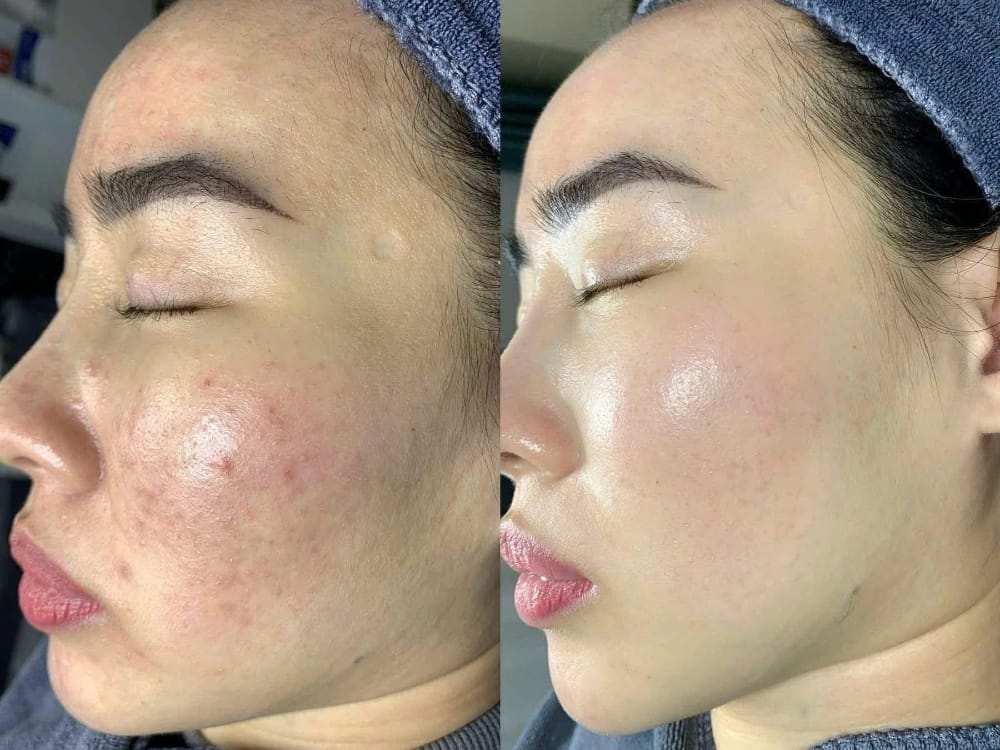
Clinical before-and-after outcome following comprehensive acne clearance and multimodal scar revision (subcision and fractional laser resurfacing).
Note: Severe scar revision requires a customized multi-modality regimen over several months. Results depend on scar depth, tissue response, and individual skin healing capacity. Published with patient consent.
4. Comprehensive Cost Breakdown (2026 Comparison)
Pricing for acne scar treatment in vietnam is exceptionally transparent and accessible. The table below compares average costs for individual and combination scar procedures in Vietnam against Western healthcare markets.
Acne Scar Treatment Cost Comparison (in USD)
| Treatment / Procedure | Vietnam Average | United States | Australia | Singapore | Average Savings in Vietnam |
| Dermatologist Consultation | $25 – $50 | $200 – $400 | $180 – $350 | $120 – $250 | 75% – 85% |
| Subcision (Full Face) | $100 – $220 | $600 – $1,500 | $500 – $1,200 | $400 – $900 | 80% – 85% |
| Fractional CO2 Laser (Single Session) | $120 – $280 | $1,000 – $2,200 | $850 – $1,800 | $700 – $1,500 | 80% – 85% |
| TCA Cross Session | $50 – $120 | $300 – $700 | $250 – $600 | $200 – $500 | 80% – 85% |
| PRP Facial / Microneedling | $100 – $220 | $700 – $1,500 | $600 – $1,200 | $500 – $1,000 | 80% – 85% |
| Combination Package (Subcision + CO2 + PRP) | $200 – $450 | $1,800 – $3,500 | $1,500 – $3,000 | $1,200 – $2,500 | 80% – 88% |
Disclaimer: Costs vary based on severity, number of sessions required, doctor seniority, and facility accreditation. Most patients require 3 to 5 sessions spaced 4 to 6 weeks apart for optimal results.
5. Top Clinics & Hospitals for Acne Scar Treatment in Vietnam
To ensure safe administration and authentic medical laser technology, international patients should seek care at established medical clinics and accredited hospitals.
Ho Chi Minh City (HCMC)
-
Ho Chi Minh City Hospital of Dermatology (Bệnh viện Da liễu TP.HCM)
-
Overview: The leading public tertiary center for skin health in Southern Vietnam. Features specialized high-tech aesthetic departments staffed by academic professors.
-
Strengths: Expert subcision technicians, extensive experience with severe scar cases, highly economical pricing.
-
-
FV Hospital – Dermatology & Laser Center
-
Overview: JCI-accredited international hospital in District 7. Offers a luxurious setting with full English and French support.
-
Strengths: High safety standards, direct international health insurance processing, state-of-the-art laser systems.
-
-
Grace Skincare Clinic
-
Overview: International boutique dermatology clinic led by senior board-certified specialists following strict FDA protocols.
-
Strengths: Customized multi-modality scar management, thorough consultations, dedicated English-speaking team.
-
-
Stamford Skin Centre
-
Overview: Central District 1 clinic with international medical governance and certified laser specialists.
-
Strengths: Premium fractional lasers, subcision, and aesthetic resurfacing.
-
Hanoi
-
National Hospital of Dermatology and Venereology (Bệnh viện Da liễu Trung ương)
-
Overview: Vietnam’s apex national institute for dermatological research and surgical training.
-
Strengths: Unrivaled clinical expertise, advanced scar research units, full diagnostic support.
-
-
Vinmec International Hospital Times City
-
Overview: JCI-accredited private hospital offering multidisciplinary care and cutting-edge aesthetic technologies.
-
Strengths: Premium private rooms, multidisciplinary medical support, exceptional patient privacy.
-
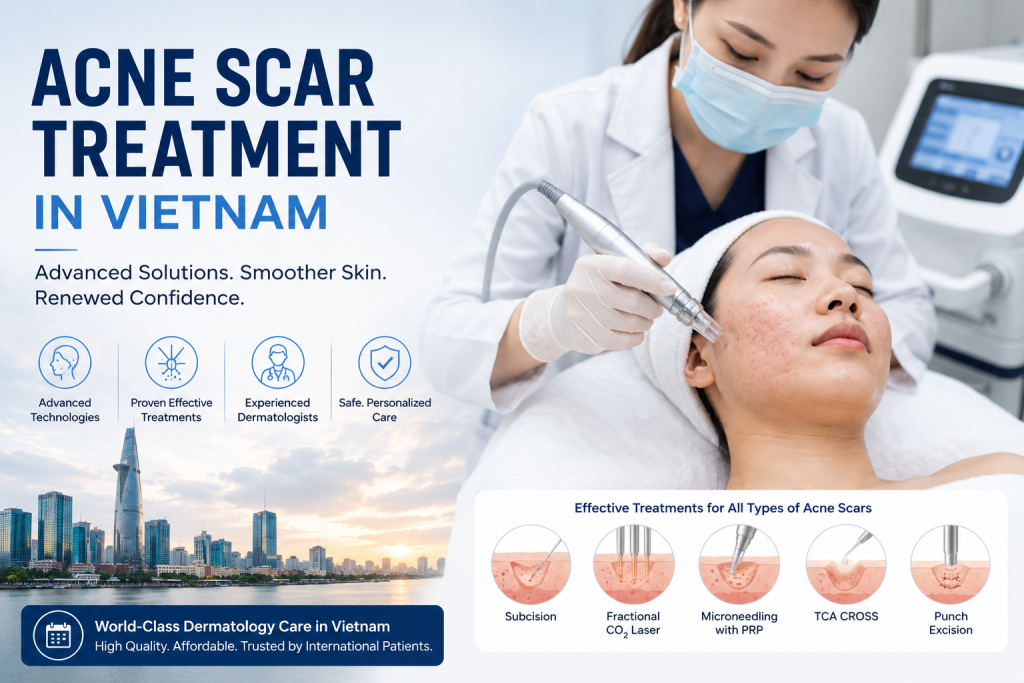
Acne scar treatment in Vietnam with experienced dermatologists and advanced options including fractional CO2 laser, subcision, microneedling, PRP and TCA CROSS.
6. What to Expect: Patient Journey & Recovery Protocol
Understanding the treatment pathway ensures a comfortable experience from pre-arrival planning to post-procedure healing.
Step 1: Digital Consultation & Planning
-
Submit close-up, high-resolution photographs of your scar areas to your chosen clinic or medical travel coordinator.
-
Receive an initial medical review, estimated treatment modalities, required stay duration, and itemized cost breakdown.
Step 2: Clinical Assessment & Procedure Day
-
Preparation: Face is thoroughly cleansed and mapped. Topical anesthetic (numbing cream) is applied for 45 to 60 minutes. Local infiltrative anesthesia is injected for subcision areas.
-
Execution:
-
Subcision is performed first to release fibrous bands.
-
TCA Cross is applied to deep ice pick scars.
-
Fractional CO2 Laser is passed across target zones to smooth skin texture.
-
PRP is applied or injected to accelerate healing.
-
-
Duration: Total procedure time takes approximately 90 to 120 minutes.
Step 3: Post-Procedure Recovery & Care
-
Days 1–3: Mild swelling, localized bruising (from subcision), and pinpoint redness. Apply prescribed antibiotic or healing ointments, avoid direct water contact for 24 hours, and stay indoors.
-
Days 4–7: Tiny grid-like micro-crusts form and slough off naturally. Do not pick or scratch peeling skin.
-
Day 7 Onward: Apply broad-spectrum SPF 50+ broad-spectrum sunscreen daily. Avoid direct tropical sun exposure and strenuous exercise for 10 to 14 days.
7. Travel Logistics & Sun Protection Guidelines
When combining acne scar treatment in vietnam with travel, timing and post-procedure care are essential:
-
Ideal Stay Duration: Plan a stay of 5 to 7 days per treatment session. This allows for in-person follow-up and ensures initial peeling and bruising subside before flying home.
-
Strict UV Protection: Vietnam’s tropical climate carries high UV index levels. Sun exposure following laser therapy or chemical peels increases the risk of Post-Inflammatory Hyperpigmentation (PIH). Wear broad-brimmed hats, stay indoors during peak hours (10 AM – 3 PM), and apply medical-grade zinc oxide sunscreens.
-
Visa Processing: Foreign travelers can easily obtain a 90-day e-Visa via the official Vietnam e-Visa Portal.
8. Frequently Asked Questions (FAQs)
Is acne scar treatment in Vietnam safe for dark skin tones?
Yes. Vietnamese dermatologists are highly experienced in treating Asian and darker skin phototypes (Fitzpatrick III–V). By customizing laser fluence, pulse duration, and incorporating pre-and post-treatment topical agents, the risk of hyperpigmentation is minimized.
How many sessions of Subcision and Fractional CO2 laser will I need?
Most patients achieve a 50% to 80% improvement in scar depth and texture after 3 to 5 sessions, spaced 4 to 6 weeks apart. Significant improvements are often visible after the very first session.
Can I combine acne scar treatment with cosmetic facial procedures?
Yes. Many international patients combine scar therapies with non-surgical aesthetic enhancements such as Botox, fillers, or skin boosters. For individuals considering comprehensive facial contouring or plastic surgery, consult our detailed resource on Cosmetic Surgery in Vietnam.
What is the downtime after a combined Subcision and CO2 session?
Social downtime typically lasts 5 to 7 days. Bruising from subcision fades within a week, while grid-like laser crusting sloughs off naturally within 5 to 6 days.
Conclusion & Next Steps
In conclusion, choosing acne scar treatment in vietnam allows international patients to restore smooth, healthy skin using cutting-edge medical technologies at a fraction of Western costs. By opting for tailored multi-modality care—combining Subcision, Fractional CO2, TCA Cross, and PRP under board-certified dermatologists—you can achieve transformative, lifelong results.
Start Your Skin Transformation with Medtour Vietnam
At Medtour Vietnam, we coordinate every aspect of your medical trip, connecting you with accredited hospital units, top dermatologists, and transparent treatment plans.
-
Ready to smooth your skin? Contact our bilingual medical coordinators today for a free photo assessment and custom quote.
-
Explore complete skin solutions: Read our comprehensive guide on Dermatology in Vietnam to learn more about our full range of medical and aesthetic skin treatments.
Medically Reviewed & Published by Medtour Vietnam Medical Editorial Team (Updated 2026).
Considering Acne Scar Treatment in Vietnam?
Send us photos of your acne scars for an initial assessment and estimated treatment cost.