
E.max crowns in Vietnam offer a metal-free restorative option with natural-looking aesthetics for suitable patients seeking dental treatment abroad.
E.max crowns in Vietnam are an increasingly attractive option for international patients seeking natural-looking, metal-free dental restorations at competitive treatment costs. Made from lithium disilicate glass-ceramic, E.max crowns combine aesthetic versatility with mechanical properties suitable for many anterior and posterior restorations.
For patients traveling from Australia, the United States, the United Kingdom, Canada, and other countries, Vietnam offers an opportunity to explore restorative dental care while potentially reducing treatment expenses. However, choosing the right dental crown requires more than comparing prices.
The condition of the natural tooth, biting forces, available restorative space, ceramic formulation, and dentist’s clinical experience all influence treatment success.
E.max is particularly valued for its ability to reproduce the optical characteristics of natural teeth. Nevertheless, zirconia or another restorative material may be more appropriate in certain situations.
This comprehensive guide explains E.max crown costs in Vietnam in 2026, the differences between IPS e.max CAD and Press, clinical benefits and limitations, treatment procedures, long-term durability, and how to choose between E.max and zirconia.
For a broader introduction to restorative materials, visit our Dental Crowns in Vietnam guide.
Quick Navigation
1. What Are E.max Dental Crowns?
E.max crowns are ceramic dental restorations commonly manufactured using lithium disilicate materials from Ivoclar’s IPS e.max system.
Lithium disilicate is a reinforced glass-ceramic containing crystalline structures within a glass matrix. This composition provides a combination of mechanical strength and optical properties that can help reproduce the appearance of natural enamel.
Unlike traditional porcelain-fused-to-metal crowns, lithium disilicate crowns do not require an underlying metal framework.
They may be used to restore teeth affected by substantial decay, fractures, extensive existing fillings, or other structural problems.
What Makes Lithium Disilicate Different?
Conventional dental porcelain can provide attractive aesthetics but may have limited resistance to fracture under certain conditions.
Lithium disilicate incorporates reinforcing crystals that improve its mechanical properties while maintaining useful translucency.
This allows dentists and dental technicians to create restorations that balance appearance and function.
However, the material is not indestructible. Its performance depends on appropriate preparation, restoration thickness, fabrication, cementation, and bite conditions.
Is E.max the Same as Porcelain?
Patients often use the terms E.max crowns, porcelain crowns, and ceramic crowns interchangeably.
Technically, E.max lithium disilicate is a specific type of dental glass-ceramic.
Not every porcelain crown is made from E.max, and not every product within the IPS e.max family is lithium disilicate.
For example, IPS e.max ZirCAD is a zirconia material.
Patients should therefore confirm whether their proposed restoration uses IPS e.max CAD or IPS e.max Press lithium disilicate, rather than relying on a general description such as “E.max porcelain.”
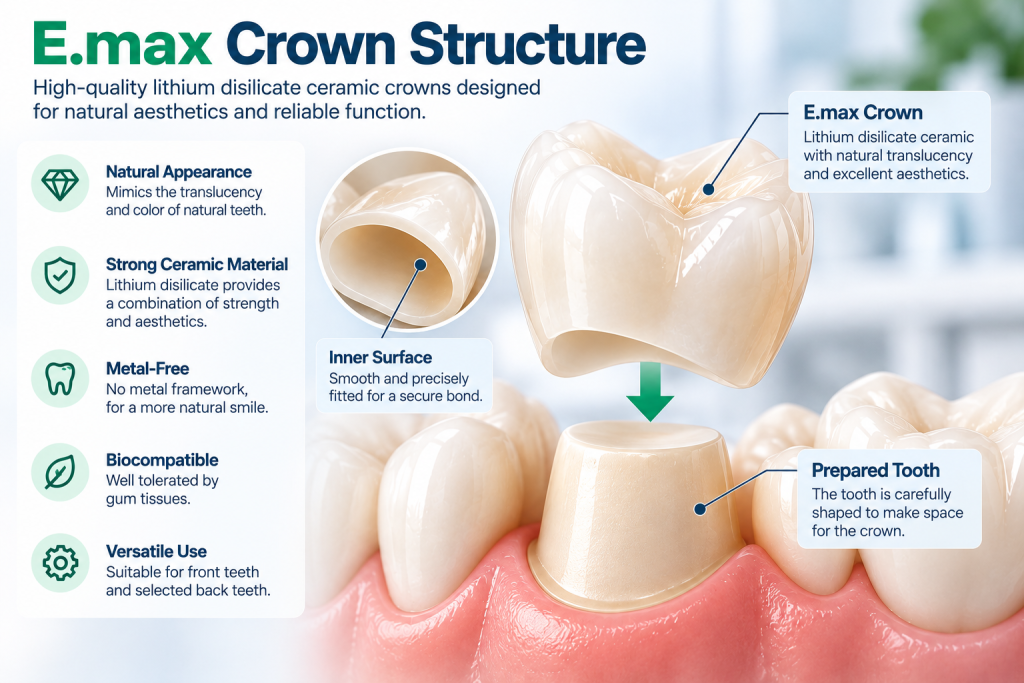
Medical illustration showing the structure of an E.max lithium disilicate crown and how it fits over a prepared natural tooth.
2. IPS e.max CAD vs. IPS e.max Press
Two commonly used lithium disilicate systems are IPS e.max CAD and IPS e.max Press.
Both can produce aesthetically pleasing restorations, but their manufacturing methods differ.
IPS e.max CAD
IPS e.max CAD is designed for computer-aided design and manufacturing.
A typical workflow includes digital scanning, restoration design, milling, crystallization, and finishing.
CAD/CAM technology may allow efficient fabrication and consistent communication between the dentist and laboratory.
However, the availability of digital equipment does not automatically guarantee superior clinical results.
Accurate tooth preparation, laboratory quality control, and careful fitting remain essential.
IPS e.max Press
IPS e.max Press uses a laboratory heat-pressing technique.
A technician creates a restoration pattern and uses specialized equipment to press lithium disilicate ceramic into the required shape.
This approach allows detailed laboratory customization and may be selected for cases requiring particular aesthetic characteristics.
Which Is Better?
| Feature | IPS e.max CAD | IPS e.max Press |
|---|---|---|
| Material | Lithium disilicate | Lithium disilicate |
| Manufacturing | Digital milling | Heat pressing |
| Typical workflow | CAD/CAM-based | Laboratory-based |
| Aesthetic customization | Available | Available |
| Clinical applications | Crowns and other indicated restorations | Crowns and other indicated restorations |
| Best choice | Depends on clinical and laboratory requirements | Depends on clinical and laboratory requirements |
Neither system is automatically superior.
Patients should focus on the dentist’s restorative planning, laboratory standards, and suitability of the proposed design.
For official material information, consult Ivoclar’s IPS e.max CAD product documentation.
3. Benefits of E.max Crowns
Natural-Looking Appearance
One of the principal advantages of E.max crowns is their aesthetic versatility.
Lithium disilicate can transmit and reflect light in ways that help dental restorations resemble natural teeth.
Different translucency and opacity options allow technicians to adapt the restoration to surrounding teeth.
This can be especially important when replacing a single front crown, where even small color differences may be noticeable.
However, appearance also depends on the underlying tooth shade, crown thickness, cement color, and laboratory characterization.
Metal-Free Restorations
E.max lithium disilicate crowns do not contain a metal framework.
This avoids the specific risk of a visible metal margin associated with some older porcelain-fused-to-metal restorations.
Metal-free construction may appeal to patients seeking a natural-looking smile, although material selection should still be based on clinical needs.
Suitable for Selected Front and Back Teeth
E.max crowns are not limited to front teeth.
According to Ivoclar’s material indications, appropriately designed lithium disilicate crowns may be used in anterior and posterior regions.
However, posterior teeth experience considerable chewing forces, making restoration design and material selection particularly important.
Conservative Treatment Possibilities
Lithium disilicate can be used for selected partial-coverage restorations, including onlays and partial crowns.
In appropriate cases, these designs may preserve more natural tooth structure than conventional full crowns.
The dentist must assess whether sufficient healthy tooth tissue remains and follow the manufacturer’s minimum thickness requirements.
Versatile Shade Selection
IPS e.max materials are available in multiple shades and translucency levels.
This helps laboratories address different aesthetic requirements, including bright teeth, naturally translucent teeth, and certain discolored underlying preparations.
The most translucent option is not always the best choice. A darker underlying tooth may require greater opacity.
4. E.max Crown Cost in Vietnam in 2026
The price of E.max crowns in Vietnam varies according to the clinic, material specification, laboratory, number of teeth, and complexity of treatment.
For initial planning, an indicative budget of approximately USD 350–550 per E.max crown may be considered, based on pricing previously published in MedicalTourism.vn’s general dental crown guide.
This is not a confirmed nationwide average or a current quotation from an individual clinic.
Indicative Dental Crown Prices
| Crown Material | Approximate Price per Tooth |
|---|---|
| Porcelain-fused-to-metal | USD 150–250 |
| Full-contour zirconia | USD 300–450 |
| E.max lithium disilicate | USD 350–550 |
| Layered zirconia | USD 400–600 |
Prices are indicative historical website reference ranges. They are not verified quotations for October 2026 and may differ by provider, material grade, and included services.
For additional information about zirconia pricing, read our Zirconia Crowns in Vietnam guide.
What Determines the Final Price?
Several factors can affect the quotation.
Material authenticity: Genuine branded lithium disilicate products may have different laboratory costs from generic ceramics.
Tooth condition: A heavily damaged tooth may require a core build-up, root canal treatment, or other preparatory procedures.
Laboratory complexity: Matching a single front tooth may require additional shade characterization and technician time.
Number of restorations: Multiple crowns can involve more extensive planning and bite analysis.
Temporary restorations: Some patients need temporary crowns while the permanent restorations are manufactured.
Additional examinations: X-rays, periodontal treatment, and other procedures may be charged separately.
What Should Be Included?
Before confirming treatment, request a written quotation specifying the examination, tooth preparation, impressions or scans, temporary crown if needed, laboratory fabrication, final cementation, bite adjustments, and follow-up arrangements.
Ask whether additional treatment will be discussed and approved before it is performed.
Are E.max Crowns Cheaper in Vietnam?
Vietnam may offer lower dental treatment costs than countries such as Australia, the United States, or the United Kingdom.
However, the savings depend on the specific clinic and comparable treatment quotations.
Patients should include airfare, accommodation, travel insurance, and possible follow-up costs when calculating the overall expense.
A lower advertised price does not necessarily represent better value.
5. E.max vs. Zirconia Crowns: Which Is Better?
E.max and zirconia are two widely used metal-free restorative materials.
Although both can provide attractive results, their properties differ.
| Feature | E.max Lithium Disilicate | Zirconia |
|---|---|---|
| Material | Glass-ceramic | Polycrystalline ceramic |
| Translucency | Often highly aesthetic | Depends on formulation |
| Mechanical strength | High for indicated uses | Generally higher in many formulations |
| Front teeth | Commonly selected | Also suitable |
| Molars | Suitable in selected cases | Frequently selected |
| Bonding | Glass-ceramic adhesive protocols | Different surface-treatment protocols |
| Tooth preparation | Depends on restoration design | Depends on zirconia formulation |
| Main consideration | Aesthetics and clinical suitability | Strength and clinical suitability |
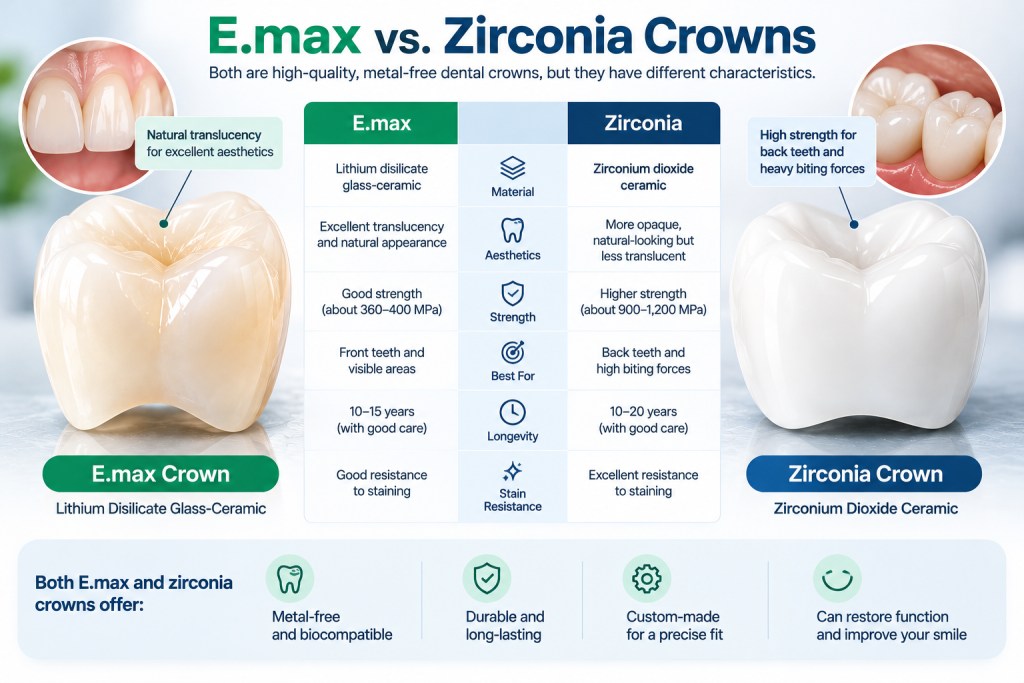
Comparison of E.max lithium disilicate and zirconia dental crowns, highlighting differences in translucency, mechanical strength, and clinical applications.
Which Looks More Natural?
E.max lithium disilicate is frequently selected for visible teeth because of its optical properties.
However, modern translucent zirconia can also provide excellent aesthetic outcomes.
Neither material guarantees a perfect shade match.
The final appearance depends on the individual restoration, underlying tooth color, and dental technician’s work.
Which Is Stronger?
Many zirconia formulations demonstrate higher laboratory flexural strength than lithium disilicate.
However, laboratory strength values do not directly predict the lifespan of an individual crown.
Clinical outcomes also depend on restoration thickness, tooth preparation, cementation, bite forces, and material processing.
Which Is Better for Teeth Grinding?
Patients with significant bruxism require careful assessment.
Depending on the severity of grinding, available space, and tooth condition, a dentist may recommend zirconia or another restorative approach.
Certain minimally invasive E.max designs have specific contraindications that include bruxism.
Patients should not choose a crown material based solely on marketing claims about strength.
Which Should You Choose?
For a visible front tooth, E.max may be attractive when natural translucency is a major priority.
For a heavily loaded posterior tooth, zirconia may be considered when mechanical strength is especially important.
Both materials can be appropriate in other situations.
The best decision requires an individualized clinical assessment.
Read our dedicated Zirconia Crowns in Vietnam article for a more detailed explanation of zirconia restorations.
6. E.max Crowns for Front Teeth vs. Molars
E.max Crowns for Front Teeth
Front teeth play an important role in smile appearance, speech, and biting.
An E.max crown may be considered when a front tooth has extensive damage or requires full-coverage restoration.
Shade matching is especially important.
The dentist may assess photographs, adjacent tooth colors, gum contours, and the underlying tooth shade before choosing a ceramic formulation.
For a healthy tooth requiring only minor cosmetic improvement, a veneer or another conservative treatment may be preferable.
E.max Crowns for Premolars
Premolars are visible in many smiles but also experience chewing forces.
Lithium disilicate may offer a useful balance between appearance and function when the clinical conditions are suitable.
E.max Crowns for Molars
Molars experience substantial occlusal loads.
E.max can be appropriate for selected molar crowns, but the dentist must evaluate available thickness, preparation design, opposing teeth, and any history of grinding.
A posterior crown should never be selected on appearance alone.
7. E.max Crowns vs. Veneers, Onlays and Partial Crowns
A full crown is not always the most conservative option.
Different restorations preserve different amounts of natural tooth structure.
E.max Crowns
A full crown generally covers the prepared tooth.
It may be indicated when extensive damage makes a smaller restoration unsuitable.
E.max Veneers
Veneers primarily cover the visible front surface of a tooth.
They may be appropriate for selected aesthetic concerns when sufficient healthy tooth structure remains.
E.max Onlays
An onlay restores selected chewing surfaces and cusps without necessarily covering the entire tooth.
It may be considered when a tooth requires substantial restoration but does not need full circumferential coverage.
Partial Crowns
Partial crowns provide coverage to selected portions of a tooth.
They may preserve more natural tissue than full crowns in suitable cases.
| Restoration | Main Purpose | Relative Tooth Coverage |
|---|---|---|
| Veneer | Aesthetic correction and selected minor restoration | Mainly front surface |
| Onlay | Restore damaged chewing surfaces and cusps | Partial |
| Partial crown | Restore selected larger portions | Partial |
| Full crown | Restore a tooth requiring extensive coverage | Usually full coverage |
The preferred option depends on the remaining tooth structure, functional requirements, and clinical examination.
Patients should ask whether a less invasive restoration could achieve the required result before choosing a full crown.
8. Who Is a Good Candidate for E.max Crowns?
E.max crowns may be appropriate for patients with:
- Extensively restored or damaged teeth.
- Fractured teeth requiring coverage.
- Selected root canal-treated teeth.
- Existing crowns that need replacement.
- Aesthetic concerns combined with structural restoration needs.
- Adequate remaining tooth structure and suitable bite conditions.
A dentist must assess gum health, tooth vitality, existing restorations, and occlusal forces before recommending treatment.
When Might E.max Be Unsuitable?
Additional caution is needed when patients have severe bruxism, inadequate restorative space, active periodontal disease, extensive tooth destruction, or unfavorable bite relationships.
These conditions may require treatment before crown placement or a different restorative material.
E.max should not be recommended solely because a patient prefers its appearance.
9. E.max Crown Procedure in Vietnam
Step 1: Consultation and Examination
The dentist examines the tooth, surrounding tissues, and bite.
X-rays may be taken when clinically indicated.
The consultation determines whether a full crown is necessary and whether E.max is suitable.
Step 2: Treatment Planning
The dentist discusses the proposed restoration, ceramic material, shade, expected number of visits, and costs.
Additional procedures may be recommended if decay, infection, or gum disease is present.
Step 3: Tooth Preparation
When a crown is indicated, the dentist prepares the tooth to create space for the ceramic restoration.
Local anesthesia may be used.
Preparation requirements vary according to the clinical situation and manufacturer’s instructions.
Step 4: Scanning or Impressions
Digital scans or conventional impressions record the prepared tooth and surrounding structures.
These records guide the design and fabrication of the crown.
Step 5: Crown Manufacturing
The laboratory manufactures the restoration using the selected CAD or Press workflow.
The crown is shaped, characterized, and finished according to the treatment plan.
Step 6: Try-In and Cementation
The dentist checks fit, marginal adaptation, color, contact points, and bite.
Adjustments may be necessary before final cementation.
Step 7: Follow-Up
The dentist provides aftercare instructions and checks for discomfort or bite problems.
International patients should allow sufficient time for adjustments before departing Vietnam.
10. How Long Does E.max Crown Treatment Take?
Treatment duration varies by clinic and case complexity.
| Treatment Situation | Indicative Planning Time |
|---|---|
| One uncomplicated crown | 3–5 working days |
| Several crowns | 5–7 days |
| Extensive restorative treatment | 7–14 days or longer |
| Additional dental procedures | Individual assessment required |
These are suggested travel-planning windows, not guaranteed clinical schedules.
Some digital workflows may allow faster fabrication, while complex cases may require more appointments.
Patients should avoid booking their return flight immediately after the anticipated final fitting.
11. How Long Do E.max Crowns Last?
Lithium disilicate crowns have demonstrated favorable short- and medium-term clinical outcomes.
A systematic review published in the Journal of Dentistry in 2025 examined 28 systematic reviews involving approximately 35,000 crowns. It reported generally high short- and medium-term survival for lithium (di)silicate crowns, while emphasizing limitations in long-term evidence and differences between studies.
A separate systematic review and meta-analysis reported an estimated five-year survival rate of 98.5% for monolithic lithium-disilicate reinforced glass-ceramic single crowns.
These are population-level research findings, not guarantees for individual patients.
What Affects Crown Longevity?
Important factors include:
- Remaining natural tooth structure.
- Restoration design.
- Material thickness.
- Cementation quality.
- Oral hygiene.
- Gum health.
- Teeth grinding.
- Regular dental examinations.
A crown may fail because of ceramic fracture, loss of retention, decay around its margins, or problems affecting the supporting tooth.
Does a High Survival Rate Mean No Complications?
No.
A crown can remain in place while still requiring maintenance or treatment.
Clinical studies distinguish between survival, meaning the restoration remains in function, and success, which generally involves stricter criteria.
Patients should understand this distinction when reviewing dental material advertisements.
12. Risks and Limitations of E.max Crowns
Although E.max crowns are widely used, potential complications include:
Tooth sensitivity: Temporary sensitivity may occur after preparation or cementation.
Ceramic fracture: Excessive biting forces or unfavorable restoration design may contribute to damage.
Crown loosening: Cementation or retention problems can occasionally occur.
Secondary decay: Natural tooth tissue beneath the crown can still develop cavities.
Gum irritation: Poor crown contours or oral hygiene may contribute to gum inflammation.
Aesthetic mismatch: Matching a single crown to neighboring natural teeth can be challenging.
Irreversible preparation: A conventional full crown usually requires permanent removal of natural tooth tissue.
These risks should be discussed during the consultation.
13. How to Care for E.max Crowns
Good maintenance supports both crown performance and the health of the underlying tooth.
Brush twice daily with fluoride toothpaste and clean between teeth regularly.
Attend routine dental examinations and professional cleaning appointments as recommended.
Avoid chewing ice or using teeth to open packaging.
Patients with bruxism should discuss whether a protective night guard is appropriate.
If a crown becomes loose, fractured, painful, or uncomfortable when biting, seek professional dental assessment.
A crown warranty does not replace regular dental care.
14. Choosing a Dental Clinic for E.max Crowns in Vietnam
International patients should evaluate more than price.
Confirm the Exact Material
Ask whether the clinic uses IPS e.max CAD, IPS e.max Press, or another ceramic.
Request documentation where appropriate.
Check the Dentist’s Experience
Restorative dentistry requires accurate preparation, bite assessment, and material selection.
Ask about the treating dentist’s qualifications and experience with ceramic restorations.
Understand Laboratory Standards
The dental laboratory plays an important role in shade matching, fabrication, and quality control.
Both in-house and external laboratories can provide suitable results when appropriate procedures are followed.
Request a Written Quotation
A quotation should identify the proposed treatment, material, included services, and possible additional charges.
Discuss Follow-Up Care
Ask how the clinic handles adjustments or complications after an international patient returns home.
Patients should also understand the terms and limitations of any warranty.
15. Planning E.max Crown Treatment in Vietnam
Vietnam’s major cities provide different travel and dental care options.
Ho Chi Minh City
Ho Chi Minh City may be convenient for international visitors arriving through Tan Son Nhat International Airport.
Patients should confirm clinic availability, laboratory turnaround times, and appointment schedules before booking flights.
Hanoi
Hanoi is a practical option for patients visiting northern Vietnam.
Treatment schedules should allow time for examinations, laboratory fabrication, fitting, and potential adjustments.
Da Nang
Da Nang may appeal to patients combining dental care with a coastal holiday.
However, availability of specific materials and laboratory services should be confirmed in advance.
Can Dental Treatment Be Combined With Tourism?
Some patients combine restorative dentistry with sightseeing.
However, treatment should remain the priority.
Patients should avoid scheduling activities that could interfere with appointments or recommended aftercare.
If extensive treatment is planned, additional recovery or adjustment time may be necessary.
16. Getting E.max Crowns in Vietnam With VnMedtour
VnMedtour assists international patients seeking information and appointment coordination for dental treatment in Vietnam.
We can help patients communicate their treatment needs to suitable providers and request preliminary quotations.
Depending on the case, assistance may include:
- Identifying potential dental providers.
- Coordinating appointments.
- Requesting preliminary treatment information.
- Communicating with dental teams.
- Providing practical guidance for the treatment journey.
VnMedtour does not perform dental procedures or replace the clinical judgment of a qualified dentist.
What Information Should You Prepare?
Patients can begin by providing clear photographs of their teeth, recent dental X-rays if available, a description of existing dental problems, and information about previous crowns or root canal treatment.
It is also helpful to specify the number of teeth involved, preferred treatment city, and approximate travel dates.
A preliminary quotation may be possible, but the final treatment plan and price generally require a clinical examination.
17. Frequently Asked Questions About E.max Crowns in Vietnam
How Much Does an E.max Crown Cost in Vietnam?
An indicative budget is approximately USD 350–550 per tooth based on previously published website reference pricing. Actual quotations vary by provider and treatment requirements.
Are E.max Crowns Better Than Zirconia?
Neither material is universally superior. E.max offers useful optical properties, while many zirconia formulations provide greater mechanical strength. Clinical suitability determines the better option.
Can E.max Crowns Be Used on Molars?
Yes, in selected cases. The dentist must evaluate biting forces, available material thickness, and the restoration design.
Do E.max Crowns Look Like Natural Teeth?
They can provide natural-looking results, especially when shade selection and laboratory customization are carefully performed. Exact matching cannot be guaranteed.
How Many Days Should I Stay in Vietnam?
Approximately three to five working days may be reasonable for one uncomplicated crown. Multiple crowns or additional procedures can require longer.
Are E.max Crowns Painful?
Local anesthesia is commonly available during tooth preparation. Temporary sensitivity may occur afterward.
Can E.max Crowns Break?
Yes. Lithium disilicate is strong but not unbreakable. Fracture risk depends on restoration design, biting forces, and other clinical factors.
Can I Replace an Existing Metal Crown With E.max?
Possibly. The dentist must assess the underlying tooth, remaining structure, and available restorative space before recommending replacement.
Are E.max Crowns Suitable for People Who Grind Their Teeth?
Significant grinding requires careful assessment. Another material or protective measures may be recommended.
Are E.max Crowns Worth the Cost?
They can be a suitable investment when their aesthetic and functional properties match the patient’s clinical needs. A more expensive material is not automatically the best choice.
Conclusion: Are E.max Crowns in Vietnam Right for You?
E.max crowns in Vietnam offer international patients an option for restoring damaged teeth using natural-looking lithium disilicate ceramic.
Their main advantages include aesthetic versatility, metal-free construction, and suitability for a range of carefully selected restorations.
However, E.max is not the ideal material for every tooth. Zirconia, partial crowns, onlays, veneers, or other restorative approaches may be preferable depending on the patient’s circumstances.
The most important considerations are preserving natural tooth structure, selecting an appropriate material, and obtaining treatment from a qualified dental professional.
Patients should request clear quotations, understand the proposed treatment, and allow adequate time for clinical appointments and follow-up.
Request an E.max Crown Consultation in Vietnam
Considering E.max crowns in Hanoi, Ho Chi Minh City, or Da Nang?
Contact VnMedtour for assistance with preliminary dental quotations, appointment coordination, and treatment planning inquiries.
Our team can help you explore suitable providers based on your dental needs and travel schedule.
Final treatment recommendations and costs are subject to the treating dental provider’s assessment.
Medical References
- Ivoclar – IPS e.max CAD. Official information on lithium disilicate materials, indications, and translucency options.
- Ivoclar – IPS e.max CAD and Press: Adhesive 1 mm Crown. Manufacturer guidance on selected minimally invasive crowns.
- Clinical Outcomes and Complications of Lithium (Di)Silicate-Based Single Crowns – Journal of Dentistry, 2025. Overview of systematic reviews evaluating clinical outcomes and complications.
- Systematic Review and Meta-Analysis of Tooth-Supported Single Crowns – PubMed. Comparative five-year survival estimates for different crown materials.
- Clinical Outcomes of Single Full-Coverage Lithium Disilicate Restorations – PMC. Systematic review examining clinical outcomes of lithium disilicate crowns.
Medical Disclaimer: This article provides general educational information and does not replace professional dental advice, diagnosis, or treatment. Crown selection, material suitability, and treatment planning require examination by a qualified dental professional. Prices and treatment timelines are indicative and subject to provider confirmation.
Considering E.max Crowns in Vietnam?
Get personalized guidance on E.max crown options,
estimated treatment costs, and dental appointments
in Vietnam.
VnMedtour connects international patients with dental
providers in Vietnam. Final treatment plans and prices
are confirmed by the treating clinic.