
Ovarian cysts are an incredibly common gynecological concern, affecting millions of women worldwide. While many cysts are benign and resolve on their own, some grow large, cause chronic pelvic pain, or present a risk of rupture or torsion (twisting of the ovary). When conservative management is no longer an option, surgical intervention is required.
For international patients seeking high-quality gynecological care without the burden of long waiting lists or high out-of-pocket costs, undergoing an ovarian cystectomy in Vietnam has become an increasingly popular and highly reliable pathway.
According to global clinical data compiled by the American College of Obstetricians and Gynecologists (ACOG), preserving ovarian tissue and utilizing minimally invasive techniques are paramount to maintaining long-term fertility and hormonal balance. Vietnam’s modern healthcare system is uniquely positioned to deliver exactly this level of sophisticated care. Led by highly trained gynecological surgeons and supported by state-of-the-art hospitals, the country offers world-class minimally invasive surgeries at a fraction of Western costs.
This comprehensive guide covers everything you need to know about planning a safe and successful ovarian cystectomy in Vietnam.
Quick Navigation
1. What is an Ovarian Cystectomy?
An ovarian cystectomy is a surgical procedure performed to carefully remove a cyst from an ovary while leaving the rest of the healthy ovarian tissue intact. This preservation is critical for women of reproductive age, as it protects their egg reserve and natural hormone production.
Ovarian Cystectomy vs. Oophorectomy
It is essential to understand the structural difference between these two procedures:
-
Ovarian Cystectomy: The surgeon isolates and shells out only the cyst wall, preserving the healthy portion of the ovary. This is the primary choice for benign tumors, endometriomas, and dermoid cysts.
-
Oophorectomy: The entire ovary is surgically removed. This is typically reserved for cases where the cyst is extremely large, has completely destroyed the healthy ovarian tissue, or carries a high suspicion of malignancy (cancer).
Types of Cysts Treated
Vietnamese gynecological specialists regularly treat a wide range of benign ovarian masses, including:
-
Endometriomas (“Chocolate Cysts”): Caused by endometriosis, these cysts are filled with dark, old blood and can cause severe pelvic pain and adhesions.
-
Dermoid Cysts (Teratomas): Congenital cysts that can contain tissue such as hair, skin, or teeth. They require careful removal to prevent leakage into the abdominal cavity.
-
Cystadenomas: Benign epithelial tumors that grow on the outer surface of the ovary and can reach massive sizes.
-
Functional Cysts: Large follicular or corpus luteum cysts that fail to shrink on their own and cause persistent pain or threat of torsion.
If you are dealing with other uterine-related issues alongside ovarian cysts, such as painful fibroids, you may also want to read about the advanced options for Myomectomy in Vietnam to see how multiple gynecological concerns can be addressed in a single, coordinated trip.
2. Why Choose Vietnam for Ovarian Cystectomy?
Over the past decade, Vietnam has transformed into a leading destination for medical travel in Southeast Asia. International patients choosing Vietnam benefit from a combination of clinical excellence, modern facilities, and compassionate care.
Highly Qualified Gynecological Surgeons
The top-tier gynecologists operating in major Vietnamese metropolitan centers like Hanoi and Ho Chi Minh City have completed advanced fellowships and clinical training in world-renowned medical hubs across France, South Korea, Japan, and Singapore.
Most senior surgeons are active members of international medical societies, such as the International Federation of Gynecology and Obstetrics (FIGO), ensuring they practice according to the latest global guidelines. They specialize in fertility-sparing techniques, using micro-dissection to peel away cyst walls while minimizing damage to the surrounding ovarian cortex where eggs are stored.
Advanced Minimally Invasive Technology
Modern Vietnamese hospitals have shifted almost entirely toward keyhole (laparoscopic) surgeries for benign gynecological conditions. Operating rooms are equipped with ultra-high-definition 4K camera systems, specialized laparoscopic instruments, and advanced energy devices (such as harmonic scalpels and bipolar coagulators) that minimize bleeding and surrounding tissue damage.
Additionally, leading-edge institutions in Vietnam have introduced robotic-assisted surgery, which provides surgeons with 3D visualization and greater dexterity when performing complex surgeries near delicate pelvic structures.
3. Surgical Approaches: Laparoscopy vs. Open Surgery
Depending on your medical history, the size of the cyst, and diagnostic imaging results, your surgeon will recommend one of two primary surgical approaches.
Laparoscopic Ovarian Cystectomy (Minimally Invasive)
This is the gold standard approach for the vast majority of benign ovarian cysts.
-
The Procedure: The surgeon makes three to four tiny incisions (ranging from 0.5 to 1 cm) in the abdomen. Carbon dioxide gas is gently introduced to inflate the abdomen, providing a clear working space. A laparoscope (a thin tube with a camera and light) is inserted through the belly button, allowing the surgeon to view the pelvic organs on a high-definition monitor. Specialized instruments are then used to separate the cyst from the ovary, place it in a sterile retrieval bag, and remove it through one of the small incisions.
-
Clinical Advantages: Significantly less post-operative pain, minimal blood loss, minimal risk of abdominal adhesions, tiny cosmetic scars, and a swift return to normal activities.
Open Ovarian Cystectomy (Laparotomy)
An open surgery is reserved for specific, highly complex clinical cases.
-
The Procedure: A single, larger incision (typically 8 to 12 cm) is made horizontally along the bikini line or vertically down the midline of the abdomen. This allows direct visual and physical access to the pelvic organs.
-
When It is Necessary:
-
The cyst is exceptionally large (e.g., over 10-15 cm in diameter) and cannot be safely removed laparoscopically without risking rupture.
-
There is a significant concern that the cyst may be malignant.
-
The patient has dense abdominal scar tissue (adhesions) from multiple previous surgeries.
-
4. The Cost of Ovarian Cystectomy in Vietnam
One of the most compelling advantages of traveling to Vietnam for gynecological care is the exceptional financial value. Patients can expect to save up to 60% to 80% compared to the costs of the same procedure in the United States, Australia, or Western Europe, without making any compromises on safety, hygiene, or surgical expertise.
Typical cost packages for laparoscopic ovarian cystectomy across key destinations highlight this massive difference:
-
United States: $12,000 – $22,000 for laparoscopic procedures, and up to $25,000 for open laparotomy.
-
Australia: $9,000 – $15,000 for laparoscopic surgery, and up to $18,000 for open laparotomy.
-
Singapore: $8,500 – $14,000 for keyhole surgery, and up to $16,000 for open laparotomy.
-
Vietnam: $2,200 – $4,500 for advanced laparoscopic procedures, and $3,000 – $5,500 for open laparotomy.
Why are the costs so much lower?
The significant cost difference is driven by lower operational overhead, localized medical labor costs, and competitive pharmaceutical pricing within Vietnam—not by a reduction in clinical quality. In fact, the medical supplies, sutures, and surgical implants used in top Vietnamese hospitals are imported from the same leading global manufacturers (such as Johnson & Johnson and Medtronic) used in Western hospitals.
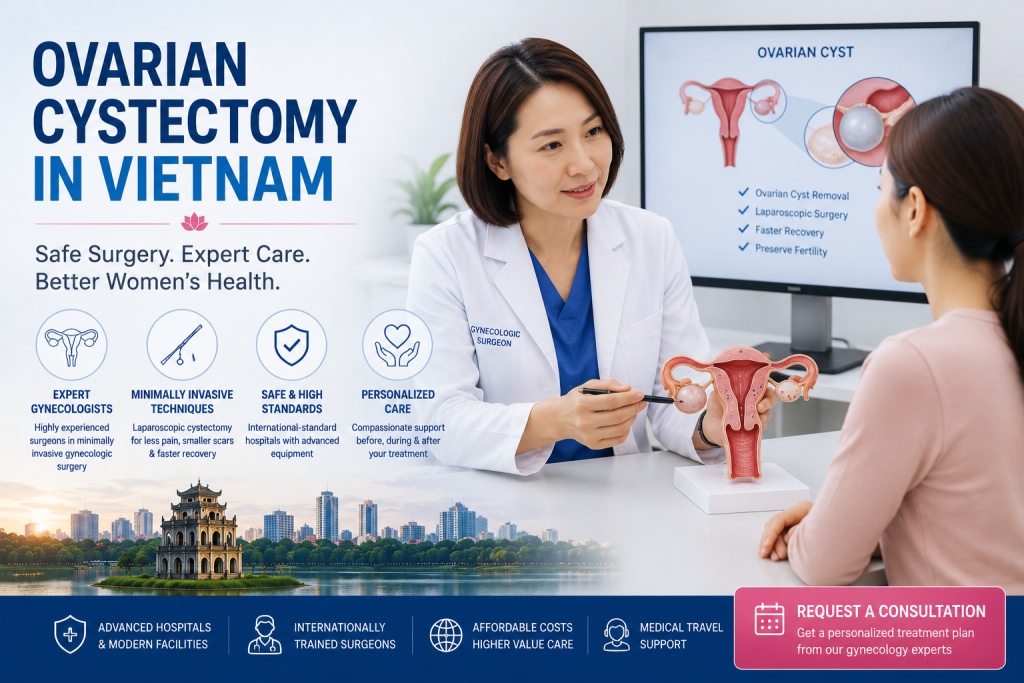
Ovarian cystectomy in Vietnam offers international patients access to experienced gynecologic surgeons, minimally invasive laparoscopic techniques, safe hospital care, and personalized medical travel support.
5. Top Accredited Hospitals for Gynecological Care
Vietnam is home to several highly modern, internationally accredited hospitals that regularly care for expatriates and medical tourists:
-
Vinmec International Hospital (Hanoi & Ho Chi Minh City): This prestigious, JCI-accredited hospital group features world-class operating theaters and a highly specialized Department of Obstetrics and Gynecology. They have extensive experience managing complex reproductive surgeries and offer comprehensive English-speaking medical coordination.
-
FV Hospital (Ho Chi Minh City): Strategically located in District 7, FV Hospital is JCI-accredited and operates strictly under French medical standards. The hospital features fully bilingual medical teams, a dedicated international patient support desk, and transparent, pre-negotiated surgical package options.
-
Tam Anh General Hospital (Hanoi & Ho Chi Minh City): Widely recognized for its state-of-the-art reproductive medicine and minimally invasive surgery centers. Tam Anh is equipped with advanced robotic surgical platforms and offers highly personalized post-operative care packages.
-
Tu Du Hospital & Hung Vuong Hospital (Ho Chi Minh City): As the largest specialized obstetrics and gynecology tertiary centers in Southern Vietnam, these institutions perform thousands of complex gynecological procedures annually. Their elite, senior surgeons frequently consult on highly complex cases.
6. What to Expect: Your Medical Travel Journey
Planning a medical trip abroad is straightforward when you know the key milestones. A typical timeline for an international patient undergoing a laparoscopic ovarian cystectomy in Vietnam spans 7 to 10 days:
-
Step 1: Pre-Travel Planning & Consultation (Before Booking Travel) You will upload your diagnostic reports (such as pelvic ultrasounds, MRI scans, and recent blood test results like CA-125) to our secure medical portal. A senior gynecologist will review your files, confirm your eligibility for laparoscopic surgery, and outline a clear, all-inclusive pricing plan.
-
Step 2: In-Person Evaluation (Day 1 in Vietnam) Upon arrival, you will visit the hospital for a comprehensive consultation. Your medical team will perform a fresh ultrasound scan, conduct standard pre-op blood work, and coordinate an anesthesia consultation to confirm you are fully cleared for surgery.
-
Step 3: The Surgery (Day 2 in Vietnam) A laparoscopic cystectomy typically takes 1 to 2 hours under general anesthesia. Following the procedure, you will spend a few hours in the recovery room before being moved to your private, modern hospital room. Most laparoscopic patients stay in the hospital for 1 to 2 nights for professional monitoring.
-
Step 4: Rest & Initial Healing (Days 3–6 in Vietnam) After discharge, you will rest comfortably in your hotel. You will be able to walk gently, which is highly encouraged as it helps your body naturally absorb and eliminate any remaining carbon dioxide gas used during surgery.
-
Step 5: Follow-Up & Flight Clearance (Day 7 in Vietnam) You will return to the hospital for your post-operative checkup. Your surgeon will inspect the tiny incision sites, change the dressings, review your pathology report (which confirms the benign nature of the cyst), and issue a medical clearance certificate so you can safely fly home.
7. Recovery Tips and Post-Operative Care
Adhering to proper recovery protocols ensures that your incisions heal perfectly and your body recovers its strength quickly:
-
Manage Carbon Dioxide Gas Pain: It is common to experience mild shoulder or upper back discomfort during the first 48 hours. This is caused by the carbon dioxide gas used during laparoscopy irritating the diaphragmatic nerve. Walking gently and drinking warm water are highly effective ways to relieve this temporary discomfort.
-
Incision Site Care: Keep your tiny incision dressings clean and dry. Avoid soaking in bathtubs or swimming pools until the incisions are completely closed and healed.
-
Dietary Guidance: Focus on fiber-rich, easily digestible foods (such as soups, steamed vegetables, and fruits) during the first few days to prevent constipation, which can cause pelvic pressure and discomfort.
-
Activity Restrictions: Avoid any heavy lifting (nothing over 5 kg) or strenuous exercise for at least 4 weeks. Walking is excellent, but high-impact workouts or abdominal exercises must be avoided to allow internal tissues to heal properly.
-
Sexual Activity: Refrain from vaginal intercourse or using tampons for 4 to 6 weeks post-surgery, or until your gynecologist gives you explicit clearance during your follow-up checkup.
FAQs: Frequently Asked Questions
Will an ovarian cystectomy affect my ability to get pregnant?
On the contrary, a carefully performed ovarian cystectomy is designed to protect your fertility. By removing a large or painful cyst, the surgeon relieves pressure on your healthy ovarian tissue and reduces pelvic inflammation. Choosing a skilled specialist ensures that the maximum amount of healthy, egg-producing tissue is preserved.
How long should I wait before flying back home?
For a standard laparoscopic cystectomy, we recommend waiting 7 days after your surgery before taking a commercial flight. This allows the surgical gas to fully dissipate, minimizes the risk of deep vein thrombosis (DVT), and ensures you can have an in-person follow-up checkup with your surgeon before departure.
What happens if the cyst turns out to be complex or cancerous?
Prior to scheduling your surgery, your medical team will perform highly detailed ultrasounds, MRI scans, and tumor marker blood tests (such as CA-125) to assess the risk of malignancy. In the extremely rare event that a cyst shows signs of complexity during surgery, a rapid frozen section biopsy is performed in the lab while you are asleep, allowing the surgeon to immediately adapt the procedure to ensure your safety.
Take the Next Step with Medtour Vietnam
Dealing with chronic pelvic pain or the worry of an ovarian cyst can be incredibly stressful. You do not have to navigate this journey alone.
At Medtour Vietnam, we specialize in organizing seamless, high-quality medical travel. From coordinating your initial medical file reviews with elite gynecologists to organizing comfortable accommodations, professional interpretation, and airport transfers, we handle all the logistics. Our mission is to allow you to focus entirely on your health, comfort, and recovery.
Considering Ovarian Cystectomy in Vietnam?
Get expert guidance on ovarian cyst removal, gynecologic surgeons, laparoscopic options, estimated costs, hospital selection, and treatment planning in Vietnam.