
IPL Treatment in Vietnam is increasingly considered by international patients looking for non-surgical options to improve certain pigmentation concerns, facial redness, visible blood vessels, and signs of sun damage. Intense Pulsed Light (IPL) uses controlled pulses of broad-spectrum light to target selected structures within the skin, potentially improving its appearance without surgical incisions.
For visitors traveling to Hanoi, Ho Chi Minh City, or Da Nang, light-based dermatology treatments may offer an opportunity to address specific skin concerns during a stay in Vietnam. However, not every skin condition responds to IPL, and treatment suitability depends on individual factors such as skin tone, medical history, recent sun exposure, and the underlying diagnosis.
Understanding how the technology works is particularly important for patients who have previously experienced pigmentation problems, sensitive skin, or unsuccessful cosmetic treatments.
This comprehensive guide explores the benefits, limitations, treatment process, potential risks, recovery requirements, and costs of IPL. It also explains how international patients can select an appropriate dermatology provider and coordinate consultations through VnMedtour.
For a broader overview of skin consultations and available procedures, visit our guide to Dermatology in Vietnam.
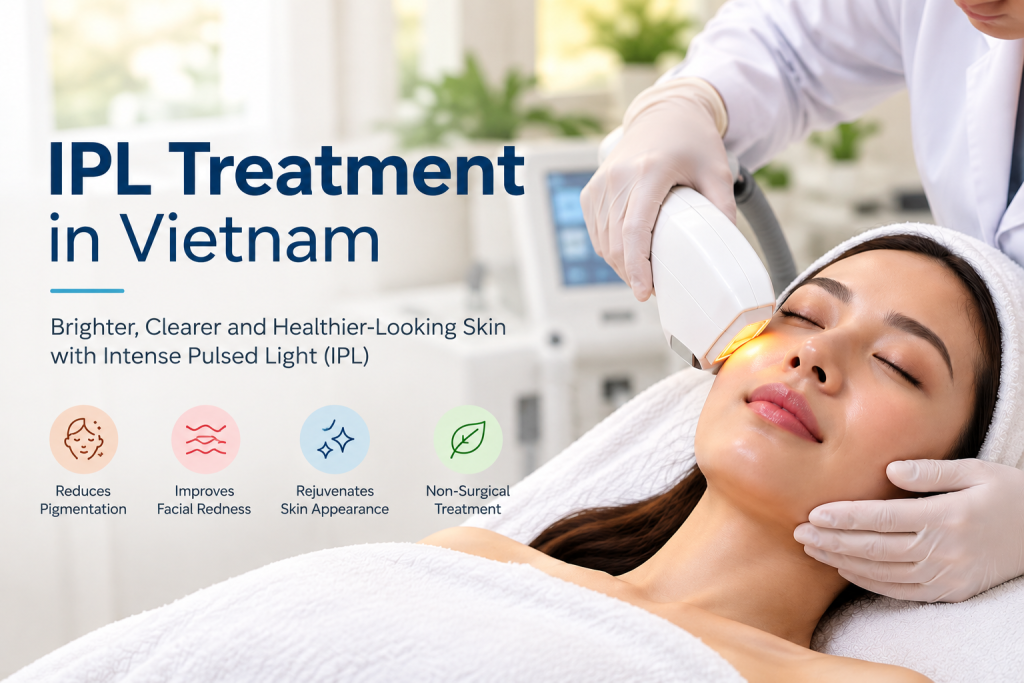
Intense Pulsed Light (IPL) therapy may help improve selected pigmentation concerns, facial redness, and signs of sun damage.
Quick Navigation
What Is Intense Pulsed Light (IPL)?
Intense Pulsed Light is a light-based technology used in dermatology and aesthetic medicine. It delivers short bursts of high-intensity, broad-spectrum light to the skin.
Although IPL is sometimes described as laser treatment, the technologies are different.
A conventional laser generally produces light within a relatively narrow wavelength range. An IPL device emits multiple wavelengths that can be filtered and adjusted for particular treatment applications.
This flexibility allows some devices to address selected pigmentation concerns, superficial vascular changes, and unwanted hair.
When used for facial photorejuvenation, IPL is often marketed as an IPL photofacial.
The procedure does not require surgical incisions, but it still produces a biological effect through light energy and heat.
For patients researching IPL treatment in Vietnam, it is important to understand that different clinics may use different devices, treatment protocols, and clinical assessment procedures.
The availability of an IPL machine does not necessarily mean that every skin concern can be treated effectively or safely.
A qualified practitioner should establish the diagnosis before recommending a particular technology.
How Does IPL Work?
IPL works through the interaction between light energy and substances within the skin that absorb particular wavelengths.
Two important targets are melanin and hemoglobin.
Melanin contributes to skin pigmentation and is present in many brown spots. Hemoglobin is found in blood and can absorb light energy within certain wavelength ranges.
When the intended target absorbs light, some of that energy is converted into heat.
Under controlled conditions, this process may alter selected pigmented lesions or reduce the appearance of superficial blood vessels.
The principle is related to selective photothermolysis, which describes how light can be used to affect specific structures while attempting to limit injury to surrounding tissue.
Treatment settings may include wavelength filters, energy levels, pulse durations, and cooling methods.
These settings matter because the same amount of energy can produce different effects in different patients.
For example, recently tanned skin may contain more epidermal melanin, increasing the risk of unwanted heat absorption.
This is one reason why professional skin assessment is essential before treatment.
What Skin Conditions Can IPL Treat?
1. Sunspots and Age Spots
Sunspots, medically known as solar lentigines, are pigmented lesions associated with cumulative sun exposure.
They commonly appear on the face, neck, chest, shoulders, and hands.
Certain superficial sunspots may respond to IPL because melanin within the lesion absorbs light energy.
After treatment, some spots may temporarily darken before gradually fading.
However, not every brown lesion is a harmless sunspot.
Changing, irregular, bleeding, or otherwise suspicious pigmented lesions require medical assessment before any cosmetic procedure.
IPL should never be used as a substitute for evaluating a potentially serious skin lesion.
2. Facial Redness and Rosacea
Persistent facial redness is another reason patients may consider IPL.
Rosacea is a chronic inflammatory skin condition that can cause flushing, visible vessels, sensitivity, and acne-like bumps.
IPL may reduce certain vascular features of rosacea, including persistent redness and some visible superficial blood vessels.
However, it does not cure rosacea.
Patients may still need medication, gentle skincare, sun protection, and management of individual triggers.
The American Academy of Dermatology discusses laser and light-based treatments as options for selected rosacea symptoms.
A dermatologist should determine whether IPL is appropriate for the patient’s particular presentation.
3. Visible Blood Vessels
Small facial blood vessels can become more noticeable due to sun exposure, aging, or inflammatory skin conditions.
These vessels are often visible around the nose and cheeks.
IPL may help reduce the appearance of selected superficial vessels.
However, certain vascular lasers may be preferable for particular vessel sizes, depths, or patterns.
The treatment decision should be based on a clinical examination rather than the assumption that one device is suitable for all vascular concerns.
4. Uneven Skin Tone
Sun exposure can produce a combination of brown discoloration and diffuse facial redness.
For suitable patients, IPL photorejuvenation may improve selected pigmentation and vascular changes, contributing to a more even-looking complexion.
Results vary depending on the cause and depth of discoloration.
Patients should distinguish sun-related pigmentation from melasma, post-inflammatory hyperpigmentation, and other conditions that may require different management.
5. Acne-Related Redness
Some patients experience persistent red marks after acne lesions have healed.
IPL may be considered for selected redness-related concerns.
However, active acne, post-inflammatory redness, brown pigmentation, and depressed acne scars are different problems.
Treatments that improve redness may not correct structural scarring.
Patients with significant acne scars should undergo a separate assessment to identify the most appropriate treatment.
6. Hair Reduction
IPL can also be used for hair reduction by targeting pigment within hair follicles.
This application involves different treatment goals and protocols from facial photorejuvenation.
Patients primarily interested in unwanted hair reduction can explore our guide to Laser Hair Removal in Vietnam.
Benefits of IPL Treatment in Vietnam
For appropriately selected patients, IPL offers several potential advantages.
Non-Surgical Treatment
IPL does not require incisions, stitches, or general anesthesia.
Sessions are generally performed in an outpatient clinical setting.
Multiple Possible Applications
Depending on the device and treatment plan, IPL may address selected pigmented and vascular concerns.
This can be useful for patients experiencing a combination of sunspots and facial redness.
Relatively Short Appointments
The light application itself may be relatively brief, particularly when treating a small area.
However, patients should allow additional time for consultation, skin preparation, consent, and post-treatment assessment.
Limited Downtime for Some Patients
Mild redness or swelling may resolve relatively quickly.
Nevertheless, some patients experience more noticeable reactions, and recovery cannot be guaranteed to follow a fixed schedule.
Gradual Improvement
Some patients prefer treatments that produce improvement over several sessions rather than a more intensive procedure.
The degree of improvement depends on the underlying condition and individual response.
One reason international patients explore IPL treatment in Vietnam is the opportunity to discuss non-surgical skin treatments while visiting the country.
However, convenience should never take priority over accurate diagnosis or appropriate clinical care.
IPL vs. Laser Treatment: What Is the Difference?
IPL and laser treatments both use light energy, but their technical characteristics differ.
| Feature | IPL | Laser |
|---|---|---|
| Light source | Broad-spectrum light | More narrowly defined wavelength |
| Treatment targets | Selected pigmentation, vessels, and hair | Depends on the laser technology |
| Target specificity | Can address different structures | Often more selective |
| Treatment schedule | Frequently requires several sessions | Varies by indication |
| Recovery | Depends on settings and skin response | Depends on laser type and intensity |
| Suitability | Requires individual assessment | Requires individual assessment |
Neither technology is universally better.
For example, a vascular laser may be more appropriate for certain visible blood vessels, while a pigment-specific laser may offer advantages for selected pigmented lesions.
Fractional resurfacing lasers are commonly considered for different concerns, including certain scars and textural changes.
Our guide to Laser Skin Treatment in Vietnam explains these technologies and their potential applications.
Patients should ask why a particular device is being recommended and what results are realistic for their diagnosis.
IPL Treatment in Vietnam: Cost and Pricing Factors
The cost of IPL varies between providers and depends on the proposed treatment.
There is no single standardized national price for every IPL procedure.
A quotation for a small area of pigmentation may differ from one covering the entire face, neck, or chest.
Factors Affecting the Price
Treatment area: Larger areas may require more time and resources.
Clinical indication: Different conditions may require different treatment protocols.
Number of sessions: A course involving several appointments affects the overall budget.
Equipment: Device capabilities and maintenance requirements can influence provider pricing.
Practitioner qualifications: Specialist consultation or medical supervision may be charged separately.
Additional services: Follow-up appointments, skincare products, or other treatments may increase the total cost.
What Should Be Included in a Quotation?
Before booking, international patients should confirm whether the quoted fee includes:
- Initial dermatology consultation.
- Skin assessment and treatment planning.
- The IPL procedure.
- The specified treatment area.
- Taxes and applicable service charges.
- Follow-up assessment, if recommended.
- Additional sessions or maintenance treatment.
- Recommended skincare products.
A low advertised price may not reflect the full cost of the treatment plan.
Patients considering IPL treatment in Vietnam should request an itemized quotation and confirm whether the price covers one session or multiple appointments.
VnMedtour can assist with requesting current pricing information from an appropriate healthcare provider.
Pricing note: Treatment fees vary and may change. Final quotations should be confirmed by the treating facility before booking.
Who Is a Good Candidate for IPL?
A potentially suitable candidate has a clearly diagnosed skin concern that may respond to broad-spectrum light treatment.
Examples include selected superficial pigmentation, certain visible blood vessels, and some forms of persistent facial redness.
However, suitability depends on several factors.
Skin Tone
Skin tone influences how light energy is absorbed.
Patients with darker or recently tanned skin may have a higher risk of certain pigment-related complications.
Medical History
A clinician should review relevant medical conditions, previous skin reactions, and any history of scarring or abnormal pigmentation.
Medication Use
Some medications and topical products may increase sensitivity or irritation.
Patients should provide a complete list of prescription medications, supplements, and skincare products.
Recent Sun Exposure
Tanning or substantial sun exposure before treatment may affect safety.
Patients should disclose recent beach holidays, outdoor activities, and tanning-bed use.
Treatment Expectations
IPL may improve certain visible skin changes, but it does not necessarily eliminate them permanently.
Patients should understand the expected number of sessions and the possibility of maintenance treatment.
When IPL May Not Be Recommended
Recent Tanning
Recently tanned skin may absorb more light energy, increasing the risk of burns and pigment changes.
A clinician may recommend postponing treatment.
Melasma
Melasma is a chronic pigmentation condition that often appears as symmetrical brown or gray-brown facial patches.
It can be influenced by sun exposure, hormonal factors, and individual susceptibility.
Heat and light-based procedures may worsen pigmentation in some patients.
IPL should therefore not be presented as a routine or guaranteed treatment for melasma.
Patients interested in alternative technologies can learn about Pico Laser in Vietnam, although suitability for melasma also requires careful assessment.
Photosensitivity
Certain medications and medical conditions can increase sensitivity to light.
Patients should disclose relevant information before treatment.
Do not discontinue prescribed medication without professional advice.
Suspicious Skin Lesions
Changing moles, irregular pigmentation, bleeding lesions, or unexplained skin changes should be examined before cosmetic treatment.
Active Infection or Severe Irritation
Skin infections, open wounds, or significant inflammation may require treatment to be postponed.
The final decision should follow an appropriate clinical assessment.
What Happens During an IPL Session?
Step 1: Initial Consultation
The practitioner reviews the patient’s concerns, medical history, medications, previous procedures, and recent sun exposure.
The skin is examined to determine whether IPL is suitable.
Photographs may be taken to document the initial condition.
Step 2: Treatment Planning
The clinician identifies the target area and explains the proposed device, expected benefits, limitations, and risks.
A test spot may be considered in selected cases.
Although a test spot can provide useful information, it does not eliminate all potential complications.
Step 3: Skin Preparation
The treatment area is cleaned.
Cooling gel or other preparation may be used depending on the device.
Appropriate protective eyewear is essential.
Step 4: Light Application
The practitioner delivers a series of light pulses using the device handpiece.
Patients may experience brief warmth, snapping, or stinging sensations.
Discomfort varies according to the treatment area, settings, and individual sensitivity.
Step 5: Post-Treatment Assessment
The practitioner checks the skin response and provides aftercare instructions.
Patients should understand which reactions are expected and which symptoms require medical attention.
How Long Does an IPL Session Take?
The duration depends on the size of the treatment area and the complexity of the appointment.
A small facial area generally requires less treatment time than the entire face, neck, or chest.
However, the appointment also includes consultation, preparation, consent, and post-treatment assessment.
International patients should allow sufficient time rather than scheduling the procedure immediately before another important commitment.
Even when the light application is brief, an unexpected skin reaction may require additional observation or medical advice.
How Many IPL Sessions Are Needed?
IPL is frequently performed as a series rather than a single session.
The number of appointments depends on the condition being treated, device settings, skin characteristics, and response to previous treatment.
For some cosmetic indications, a clinician may propose approximately three to five sessions separated by several weeks.
This is only a general planning example, not a universal treatment protocol.
Some patients may need fewer sessions, while others require additional treatment or maintenance.
When planning IPL treatment in Vietnam, international visitors should discuss the recommended number of sessions and whether the schedule fits their travel dates.
A short holiday may not provide enough time to complete an entire treatment course.
Patients may need to arrange subsequent sessions during another visit or with an appropriate provider in their home country.
Is IPL Treatment Safe?
IPL has established applications in dermatology, but it is not free from risk.
Safety depends on the diagnosis, patient selection, device characteristics, treatment settings, operator experience, and appropriate protective measures.
Common Temporary Reactions
Patients may experience:
- Redness.
- Warmth.
- Mild swelling.
- Temporary tenderness.
- Darkening of certain treated pigmented spots.
These effects may settle relatively quickly, although recovery varies.
Possible Complications
Less common but more serious complications include:
- Burns or blistering.
- Crusting or prolonged irritation.
- Post-inflammatory hyperpigmentation.
- Hypopigmentation.
- Scarring.
- Persistent discoloration.
- Eye injury when protection is inadequate.
Patients with darker skin tones or recent tanning may face increased risks of certain pigment changes.
The American Academy of Dermatology provides information about laser and light-based treatments for rosacea, including considerations related to practitioner expertise and post-treatment care.
If severe pain, extensive blistering, increasing swelling, or unusual discoloration occurs, prompt medical evaluation is important.
Eye pain or visual symptoms require urgent medical attention.
IPL Recovery and Aftercare
Recovery depends on the treatment intensity, skin condition, and individual response.
Immediately After Treatment
The skin may appear mildly red and feel warm.
Some patients experience temporary swelling or sensitivity.
The practitioner may recommend cooling measures or suitable skincare products.
During the First Few Days
Certain pigmented areas may become darker before gradually fading.
Mild dryness or surface changes can occur.
Patients should avoid scratching or peeling treated areas.
Over the Following Weeks
Visible improvement may develop gradually.
Patients undergoing several sessions should not expect the final result immediately after the first appointment.
Some conditions may recur or require ongoing management.
Essential Aftercare Recommendations
Protect the skin from sunlight. Avoid unnecessary direct exposure and use appropriate broad-spectrum sunscreen, shade, and protective clothing.
Use gentle skincare. Mild cleansing and moisturizing may help reduce irritation.
Avoid aggressive exfoliation. Scrubs, exfoliating acids, and irritating products should only be resumed when appropriate.
Review retinoid use. Inform the clinician if you use tretinoin, adapalene, or other active skincare products.
Avoid picking at treated spots. Allow the skin to recover naturally.
Follow individualized instructions. Recommendations concerning exercise, swimming, makeup, and heat exposure may vary.
Patients considering IPL treatment in Vietnam during a holiday should discuss their sightseeing and outdoor activity plans with the treating clinician.
IPL for Darker Skin Tones
Skin tone is an important consideration in light-based treatment.
Melanin absorbs light energy. In darker or recently tanned skin, additional epidermal absorption can increase the risk of unwanted heating.
This may contribute to burns, hyperpigmentation, or hypopigmentation.
Patients with Fitzpatrick skin types IV–VI may require particular caution, although individual risk cannot be determined from skin type alone.
A qualified practitioner should consider the patient’s natural skin tone, tanning history, target condition, and previous treatment responses.
In some cases, modified settings, a test spot, or an alternative technology may be recommended.
Patients should ask whether the provider has experience treating people with similar skin characteristics.
The objective is to select a treatment with a reasonable balance of potential benefit and risk.
Can IPL Treat Melasma?
Melasma deserves particular attention because it is often confused with ordinary sun-related pigmentation.
It commonly appears as brown or gray-brown patches on the cheeks, forehead, nose, or upper lip.
Hormonal influences, sunlight, visible light, and individual susceptibility may contribute to the condition.
Because melasma can be sensitive to heat and inflammation, some light-based treatments may worsen pigmentation.
Although certain procedural approaches have been studied, improvement can be unpredictable and recurrence is common.
A dermatologist may prioritize photoprotection and topical medication before considering additional procedures.
Patients should be cautious about advertising that promises permanent melasma removal.
IPL vs. Other Skin Rejuvenation Treatments
Different dermatological procedures address different concerns.
Chemical Peels
Chemical peels use selected solutions to produce controlled exfoliation.
They may be considered for certain superficial pigmentation, acne-related concerns, or uneven texture.
Treatment depth and recovery depend on the formulation and clinical plan.
Learn more in our guide to Chemical Peels in Vietnam.
Microneedling
Microneedling creates controlled micro-injuries in the skin to stimulate a repair response.
It is commonly considered for certain textural concerns and acne scars.
Its mechanism differs from IPL, which relies on light absorption.
Fractional Laser Resurfacing
Fractional lasers create microscopic treatment zones and may be used for selected scars, wrinkles, and textural changes.
Recovery requirements depend on the device and treatment intensity.
Acne Scar Procedures
Depressed acne scars often require treatments that address scar structure rather than superficial redness.
Options may include subcision, fractional resurfacing, or other procedures selected according to scar type.
Our guide to Acne Scar Treatment in Vietnam explains these approaches in greater detail.
The best treatment depends on the patient’s diagnosis, not simply the popularity of a particular technology.
Can IPL Be Combined With Other Treatments?
Some patients have multiple concerns, such as redness, pigmentation, and uneven texture.
A dermatologist may recommend different treatments for different problems.
However, combining procedures is not automatically more effective.
Performing several energy-based or exfoliating treatments too close together may increase irritation.
Patients should disclose recent laser procedures, chemical peels, injections, prescription skincare, and other aesthetic treatments.
The clinician should determine whether combination treatment is appropriate and how much recovery time is needed between procedures.
International visitors should avoid scheduling multiple treatments solely to fit them into a short holiday.
Choosing a Clinic for IPL Treatment in Vietnam
Selecting an appropriate provider involves more than comparing advertised prices.
Qualified Clinical Assessment
A suitable provider should examine the skin and establish a diagnosis before recommending treatment.
The consultation should include expected benefits, limitations, alternatives, and potential complications.
Appropriate Technology
Ask which IPL device is available and whether it is intended for the specific condition being treated.
Different systems may have different capabilities.
A recognizable brand name does not guarantee a better result.
Experience With Your Skin Type
Patients prone to pigmentation changes should ask about the practitioner’s experience treating similar skin characteristics.
Safety Protocols
Appropriate eye protection and treatment precautions are essential.
Patients should understand the expected skin response and when to seek medical advice.
Follow-Up Arrangements
International visitors should know whom to contact if complications develop after returning home.
Ask whether treatment records and post-procedure instructions can be provided.
Planning IPL During Your Vietnam Holiday
For international visitors, treatment timing is an important practical consideration.
Vietnam’s climate and popular outdoor destinations can make sun protection particularly relevant.
Before Arrival
Contact the provider with a description of your concerns and relevant medical history.
Mention recent sun exposure, tanning, medications, and previous procedures.
Preliminary photographs may support communication but cannot replace an in-person diagnosis.
During Your Stay
Allow time for consultation and clinical assessment.
Do not assume that treatment can be performed immediately after arrival.
If you plan beach activities or extensive outdoor sightseeing, discuss the timing with the clinician.
Before Departure
Request written aftercare instructions and the clinic’s contact details.
Confirm whether follow-up is recommended.
If additional sessions are needed, discuss whether they can be arranged during a future visit or with a qualified provider in your home country.
IPL Treatment in Vietnam: Hanoi, Ho Chi Minh City and Da Nang
International patients may explore dermatology consultations in several major Vietnamese cities.
Ho Chi Minh City
Ho Chi Minh City offers a range of private medical and aesthetic dermatology services.
Patients should confirm the availability of the specific treatment and an appropriately qualified practitioner before booking.
Hanoi
Hanoi may be convenient for visitors traveling in northern Vietnam or staying in the capital for an extended period.
The suitability of a clinic should be assessed according to the patient’s condition and the provider’s capabilities.
Da Nang
Da Nang may be convenient for visitors to central Vietnam.
However, the availability of specific devices and treatment protocols should be verified individually.
A clinic advertising IPL hair reduction does not necessarily offer medical IPL treatment for facial redness or pigmentation.
The most appropriate destination depends on clinical needs, provider availability, and follow-up arrangements.
IPL for Dry Eye: A Different Medical Application
Intense Pulsed Light is also used in certain ophthalmic treatment protocols for evaporative dry eye associated with meibomian gland dysfunction.
Although the underlying technology involves intense pulsed light, ophthalmic IPL is different from cosmetic facial photorejuvenation.
It involves different treatment goals, patient selection, equipment considerations, and eye-protection requirements.
Patients with dry eye symptoms should consult an ophthalmologist rather than booking a standard cosmetic IPL appointment.
Likewise, a dermatology clinic offering IPL for pigmentation should not automatically be assumed to provide ophthalmic treatment.
Frequently Asked Questions About IPL
Is IPL treatment painful?
Patients may experience brief warmth, snapping, or stinging sensations during the procedure.
Discomfort varies according to the treatment area, device settings, and individual sensitivity.
How quickly will I see results?
Some changes may become noticeable over the following days or weeks.
Other concerns require several sessions before improvement can be evaluated.
Is IPL better than laser treatment?
Not necessarily.
The most suitable technology depends on the diagnosis, target structure, skin characteristics, and treatment goals.
Can IPL permanently remove pigmentation?
Certain lesions may improve significantly, but new pigmentation can develop and some conditions may recur.
Ongoing sun protection is often important.
Can IPL worsen melasma?
Yes.
Heat and inflammation may worsen melasma in susceptible patients.
A dermatologist should confirm the diagnosis before recommending treatment.
Is IPL suitable for sensitive skin?
Suitability depends on the cause of sensitivity and the patient’s skin condition.
An individualized assessment is necessary.
How many sessions will I need?
The number varies.
Some patients require a series of treatments, while others may need fewer sessions or a different procedure.
Can I go to the beach after IPL?
Sun exposure and heat may irritate recently treated skin.
Discuss your travel plans with the clinician and follow recommended restrictions.
Can I use makeup after treatment?
The timing depends on the skin response and procedure performed.
Ask your provider when makeup can safely be resumed.
Does IPL help with acne scars?
IPL may address certain redness-related concerns, but depressed acne scars generally require different treatments.
Is IPL suitable for darker skin?
Some patients may be suitable, but the risk of pigment changes can be higher.
Device selection and practitioner experience are especially important.
Can I combine IPL with chemical peels?
Combination treatment may be possible in selected cases, but the order and timing should be determined by a qualified clinician.
Is IPL covered by health insurance?
Cosmetic treatment is often excluded from insurance coverage.
Coverage for medically indicated procedures depends on the insurer and policy terms.
Can I arrange a consultation before arriving in Vietnam?
Preliminary coordination may be possible.
However, the final recommendation should follow an appropriate clinical assessment.
Why Choose VnMedtour for IPL Treatment Coordination?
VnMedtour helps international patients explore medical and aesthetic treatment options in Vietnam.
For patients researching IPL treatment in Vietnam, our team can assist with communication, consultation scheduling, and requests for information from suitable healthcare providers.
Depending on provider availability and the patient’s needs, our services may include:
- Identifying appropriate dermatology consultation options.
- Communicating skin concerns to the medical provider.
- Requesting information about available IPL technologies.
- Obtaining itemized treatment quotations.
- Coordinating appointment dates.
- Clarifying practical arrangements before arrival.
- Supporting communication during the booking process.
VnMedtour is a medical tourism coordinator, not a medical provider.
The treating clinician remains responsible for diagnosis, treatment recommendations, informed consent, and clinical care.
VnMedtour does not guarantee treatment suitability, clinical results, or the availability of a particular device.
Request an IPL Consultation in Vietnam
If you are considering IPL treatment in Vietnam for facial redness, selected pigmentation concerns, or sun-damaged skin, an appropriate dermatological assessment is the best starting point.
Share your main concern, preferred destination, and expected travel dates with VnMedtour.
Our team can help you explore available consultation options and request relevant information from a healthcare provider.
Medical disclaimer: This article provides general educational information and does not replace professional medical advice, diagnosis, or treatment. IPL suitability, risks, and expected outcomes must be assessed by a qualified healthcare professional.
Considering IPL Treatment in Vietnam?
Looking to improve pigmentation, facial redness, or sun-damaged skin?
VnMedtour can help you explore dermatology consultation options,
check available Intense Pulsed Light (IPL) technologies, and request
a personalized treatment quotation from a healthcare provider in Vietnam.