
Skin conditions like deep-set acne scars, pronounced fine lines, hyperpigmentation, and sun damage often require treatments that go beyond surface-level skincare. Among modern aesthetic procedures, fractional CO2 laser resurfacing stands out as the gold standard for clinical skin rejuvenation and scar remodeling.
In recent years, Vietnam has rapidly emerged as a premier global hub for international patients seeking high-precision dermatological care. By combining board-certified specialists, state-of-the-art European and US FDA-cleared laser technologies, and savings of up to 70% compared to Western rates, CO2 laser resurfacing in Vietnam offers an ideal balance of medical excellence and value.
This guide covers everything international patients need to know—from clinical mechanisms, candidate selection, and detailed cost comparisons to top-accredited clinics and post-treatment travel logistics.
Quick Navigation
What is Fractional CO2 Laser Resurfacing?
Fractional Carbon Dioxide (CO2) laser resurfacing is an ablative skin-rejuvenation procedure that utilizes a specialized 10,600-nanometer wavelength. Unlike traditional continuous-beam lasers that remove the entire top layer of skin, fractional technology delivers micro-beams of light energy arranged in a precise grid pattern.
These micro-thermal zones (MTZs) penetrate deep into the dermal layer, vaporizing damaged columns of tissue while leaving the surrounding microscopic zones untouched. This fractional approach triggers a cascade of natural biological healing:
-
Immediate Tissue Contraction: Thermal energy instantly tightens existing collagen fibers in the dermis.
-
Neocollagenesis: The body stimulates fibroblasts to generate new, healthy collagen and elastin fibers over the subsequent 3 to 6 months.
-
Rapid Re-epithelialization: Because intact skin surrounds each micro-column, recovery is significantly faster than with older, fully ablative laser systems.
Clinical studies published by the National Center for Biotechnology Information (NCBI) demonstrate that fractional CO2 lasers provide superior structural remodeling for severe acne scarring and photoaging compared to non-ablative modalities.
Primary Indications: What Conditions Does CO2 Laser Treat?
International patients traveling to Vietnam seek CO2 laser therapy for various structural and cosmetic skin concerns.
1. Severe Atrophic Acne Scars
For individuals suffering from ice-pick, boxcar, or rolling acne scars, fractional CO2 laser energy breaks down fibrous scar tissue beneath the skin, forcing new collagen to lift depression marks from within. For comprehensive treatment strategies, explore our full guide on acne scar treatment in Vietnam.
2. Advanced Photoaging & Deep Wrinkles
Sun exposure destroys the extracellular matrix, causing solar elastosis, deep rhytids (wrinkles), and sagging skin. CO2 resurfacing strips away photo-damaged epidermal cells while tightening the deep dermal structure.
3. Hyperpigmentation & Uneven Tone
Age spots, melasma, and post-inflammatory hyperpigmentation (PIH) resolve as the laser vaporizes excess melanin deposits, revealing a brighter, more even complexion.
4. Enlarged Pores & Rough Skin Texture
By rebuilding the collagen support structure surrounding pore walls, fractional CO2 tightens lax skin texture and noticeably minimizes enlarged pores.
Why Choose Vietnam for CO2 Laser Resurfacing?
While medical facilities worldwide offer fractional resurfacing, Vietnam has established a distinctive competitive advantage in international medical tourism.
| Advantage Category | Medical Landscape in Vietnam | Western Countries (US / UK / Australia) |
| Average Cost per Session | $250 – $600 USD | $1,500 – $3,500 USD |
| Laser Device Standards | FDA & CE-marked (e.g., Lumenis Ultrapulse, Candela) | FDA-cleared |
| Practitioner Expertise | Dermatologists with specialized laser fellowships | Dermatologists, PA-Cs, or Registered Nurses |
| Wait Times | Same-week or direct booking | 1 to 3 months waitlist |
| Concierge & Care Integration | Integrated VIP transport, translation, recovery care | Separate out-of-pocket costs |
World-Class Clinical Expertise
Top dermatological centers in Vietnam employ board-certified physicians trained in France, South Korea, the United States, and Japan. Treatment plans are customized to match individual skin phototypes, minimizing risks such as post-laser hyperpigmentation in darker Fitzpatrick skin tones. To discover the broader clinical ecosystem, review our overview of dermatology in Vietnam.
Advanced FDA-Cleared Laser Platforms
Leading Vietnamese clinics utilize premier global laser devices, including:
-
Lumenis UltraPulse® / AcuPulse™ (Industry-standard for deep scar remodeling)
-
Candela CO2RE® (Versatile fractional platform with multi-depth capability)
-
DEKA SmartXide Touch (Italian engineering featuring RF-assisted CO2 energy)
Cost Analysis: Vietnam vs. Global Standards
Price transparency is a crucial factor for international patients planning medical travel. The cost of CO2 laser resurfacing in Vietnam is substantially lower than in Western nations, without compromising treatment quality or safety protocols.
| Procedure Scope | Vietnam | Australia | United States | United Kingdom |
| Full Face CO2 Laser (Single Session) | $300 – $600 | $1,800 – $2,500 | $2,000 – $3,500 | £1,500 – £2,800 |
| Partial Face / Target Zone (e.g., Cheeks) | $180 – $350 | $1,000 – $1,500 | $1,200 – $2,000 | £900 – £1,500 |
| 3-Session Package (Full Face) | $750 – $1,400 | $4,500 – $6,500 | $5,000 – $8,500 | £3,800 – £6,500 |
| Subcision + CO2 Laser Combination | $450 – $800 | $2,500 – $3,800 | $3,000 – $4,500 | £2,200 – £3,500 |
What Is Included in the Vietnamese Clinic Fee?
Unlike Western clinics that often invoice separately for consultations, topical anesthetics, and post-care products, reputable clinics in Vietnam provide transparent bundled pricing that generally includes:
-
Initial consultation with a certified Specialist Dermatologist.
-
Medical-grade topical numbing cream application (45–60 minutes).
-
The CO2 laser resurfacing procedure.
-
Post-procedure soothing treatments (e.g., Cryo-cooling, LED red-light therapy, or PRP application).
-
Basic post-care cream kits (gentle cleanser, antibiotic/healing ointment, medical sunblock).
To learn more about additional energy-based treatments available in the country, read our dedicated guide on laser skin treatment in Vietnam.
Step-by-Step Procedure: What to Expect
Understanding the clinical workflow helps ensure a stress-free experience during medical travel.
1. Dermatological Consultation & Visia™ Skin Analysis
Your dermatologist evaluates your skin history, assesses your Fitzpatrick phototype, and analyzes scar depth using 3D skin analysis systems (like Canfield Visia). The physician sets exact laser parameters, adjusting pulse energy, density, and depth of penetration.
2. Preparation & Anesthesia
After cleansing the target area, a high-potency topical anesthetic cream (typically 5% Lidocaine mixture) is applied for 45 to 60 minutes to ensure patient comfort. For extensive deep-resurfacing procedures, local nerve blocks may be administered.
3. The Laser Execution
The practitioner glides the laser handpiece across the treatment zones. You will feel a mild warming or snapping sensation as the laser fires. A session for a full face typically takes 30 to 45 minutes.
4. Post-Treatment Cooling & Recovery Application
Immediately following the laser pass, the skin will feel warm, similar to a moderate sunburn. Clinics apply cold compress packs, medical-grade sheet masks, or growth-factor serums (such as Platelet-Rich Plasma – PRP) to accelerate tissue repair and calm inflammation.
Downtime & Recovery Timeline
Managing downtime is crucial when scheduling international travel around your procedure.
Recovery Breakdown Day-by-Day
-
Days 1–2 (Inflammatory Phase): The skin appears dark red and feels warm. Mild swelling is normal, particularly around the eyes. Apply prescribed healing ointments (like Cicalfate or Aquaphor) continuously and keep skin thoroughly hydrated while strictly avoiding the sun.
-
Days 3–5 (Crusting Phase): The micro-thermal treatment dots darken into a fine grid pattern (bronzing). The skin feels tight and rough to the touch. Continue gentle cleansing only.
-
Days 6–7 (Desquamation Phase): The dead epidermal layer sheds naturally. Never pick or scratch peeling skin, as forced shedding can cause scarring or hyperpigmentation.
-
Week 2 Onward (Maturation Phase): Fresh, pink, rejuvenated skin is revealed. Redness gradually fades over 2 to 4 weeks. Apply broad-spectrum SPF 50+ daily as collagen production continues beneath the surface for up to 6 months.
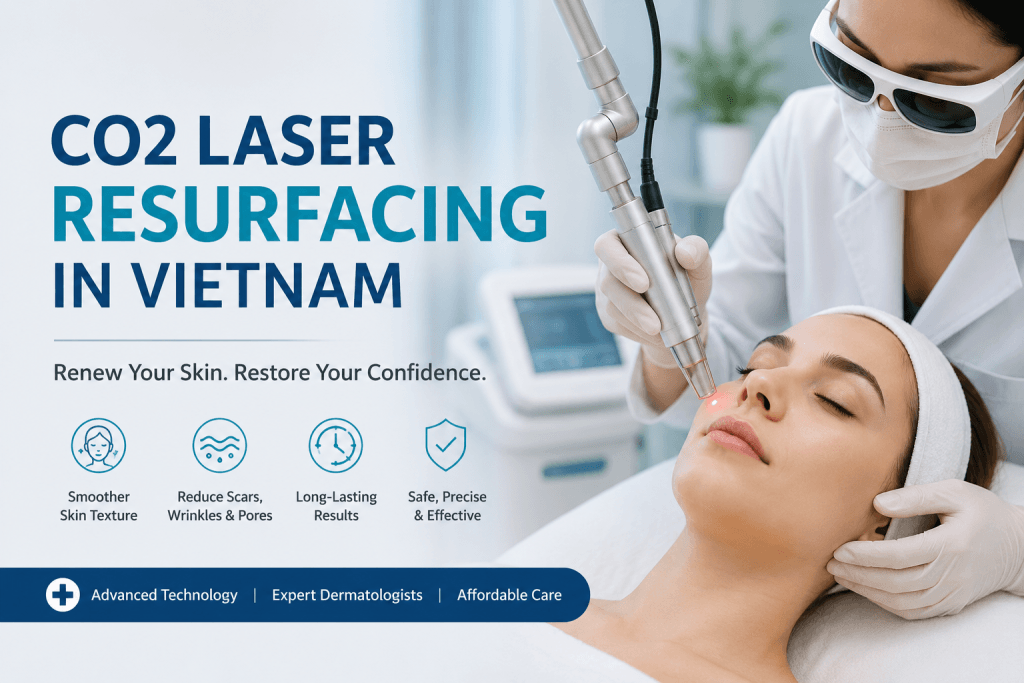
CO2 laser resurfacing in Vietnam offers international patients advanced skin rejuvenation for acne scars, wrinkles, enlarged pores, and uneven texture at modern dermatology and aesthetic clinics.
Pre-Treatment and Post-Care Guidelines for Medical Travelers
To maximize clinical outcomes and avoid complications, international patients must strictly adhere to dermatological protocols before and after treatment. According to the American Academy of Dermatology (AAD), proper sun protection and gentle skin care during the healing phase are essential to prevent post-laser hyperpigmentation.
Pre-Procedure Checklist (Before Arriving in Vietnam)
-
Discontinue Retinoids & Acids: Stop using Tretinoin, Retinol, Glycolic Acid, and Salicylic Acid at least 7 to 10 days prior to treatment.
-
Avoid Tanning & Sun Exposure: Do not tan or spend extended periods in direct sunlight for 4 weeks before your session.
-
Medication Review: Inform your dermatologist if you take blood thinners or have a history of oral herpes (cold sores), as prophylactic antiviral medication (e.g., Acyclovir) may be prescribed.
Post-Procedure Guidelines (During Your Stay in Vietnam)
-
Strict Sun Avoidance: Keep out of direct sunlight completely for the first 7 days. Wear a wide-brimmed hat and UV-protective sunglasses when traveling between your hotel and the clinic.
-
Use Broad-Spectrum Sunscreen: Once peeling is complete (around Day 7), apply a mineral-based physical sunscreen (Zinc Oxide / Titanium Dioxide) with SPF 50+ PA++++ every 2 to 3 hours.
-
Avoid Swimming & Hot Tubs: Steer clear of swimming pools, ocean water, saunas, and intense workouts for 14 days to prevent bacterial infection.
Safety, Risks, and Fitzpatrick Skin Type Considerations
While CO2 laser resurfacing is highly effective, it is an ablative procedure that requires expert administration.
Fitzpatrick Phototypes & Risk Management
Asian, Mediterranean, and darker skin types (Fitzpatrick Types III–V) have higher baseline melanin activity. If incorrect laser energy or density is applied, the risk of Post-Inflammatory Hyperpigmentation (PIH) increases significantly.
To safely treat darker skin phototypes, expert Vietnamese dermatologists employ specific clinical strategies:
-
Lowering energy density while maintaining deeper micro-column penetration.
-
Prescribing pre-treatment skin-lightening creams (e.g., Hydroquinone or Kojic Acid) 2 to 4 weeks prior to the session.
-
Utilizing post-laser cool-down protocols and topical anti-inflammatory agents.
For authoritative safety guidelines on aesthetic medical procedures, review resources provided by the Mayo Clinic.
How to Plan Your Medical Trip for CO2 Laser in Vietnam
Proper planning ensures a seamless blend of high-quality treatment and an enjoyable vacation.
-
Day 1: Arrival & Check-In: Arrive in Ho Chi Minh City (SGN) or Hanoi (HAN) and transfer to your hotel.
-
Day 2: Consultation & Skin Analysis: Attend your in-person evaluation, 3D skin analysis, and patch testing at the clinic.
-
Day 3: Procedure Day: Undergo the CO2 laser resurfacing session. Rest in your hotel room during the evening.
-
Days 4–6: Initial Indoor Recovery: Relax in air-conditioned indoor venues (cafes, museums, art galleries). Avoid outdoor tours during peak daylight hours.
-
Day 7: Follow-Up & LED Therapy: Visit the clinic for professional skin cleansing and LED light recovery therapy.
-
Day 8: Final Evaluation & Departure: Receive post-care products, complete your final evaluation, and fly home safely.
Frequently Asked Questions (FAQs)
1. How many CO2 laser sessions will I need?
For mild skin rejuvenation and fine lines, a single session often produces dramatic improvements. For deep, severe acne scars or pronounced photoaging, a series of 2 to 4 sessions spaced 6 to 8 weeks apart is typically recommended for optimal results.
2. Is fractional CO2 laser painful?
With the application of high-potency medical topical numbing cream for 60 minutes, discomfort during the treatment is minimal—most patients describe it as a light tingling or warm snapping sensation.
3. Can I combine CO2 laser resurfacing with other treatments?
Yes. Vietnamese dermatologists frequently combine CO2 laser resurfacing with Subcision (for tethered rolling scars), TCA Cross (for deep ice-pick scars), or PRP (Platelet-Rich Plasma) to enhance collagen synthesis and shorten recovery times.
4. Is it safe to travel after getting a CO2 laser in Vietnam?
Yes, provided you take strict precautions against direct UV exposure. Flying home 5 to 7 days post-treatment is ideal, as the initial peeling phase will be complete and your new skin barrier will be established.
Conclusion
Fractional CO2 laser resurfacing in Vietnam offers an exceptional combination of world-class dermatological expertise, advanced FDA-cleared technology, and accessible pricing. Whether you are seeking to erase long-standing acne scars or achieve comprehensive structural skin rejuvenation, Vietnam provides a safe, professional, and cost-effective pathway to radiant skin.
Ready to plan your transformation? Contact medicaltourism.vn today to connect with accredited dermatologists, receive a personalized pre-consultation, and get a transparent cost estimate for your treatment journey.
Considering CO2 Laser Resurfacing in Vietnam?
Get personalized treatment advice, clinic recommendations, and a cost estimate from trusted dermatology and aesthetic centers in Vietnam.