
Invisalign in Vietnam is an option for people seeking straighter teeth without conventional metal braces. This orthodontic system uses custom-made, removable clear aligners to move teeth gradually according to a dentist’s or orthodontist’s treatment plan.
Vietnam has dental providers offering Invisalign treatment, including options for mild alignment problems and more complex orthodontic cases. For international patients, however, choosing a provider involves more than comparing prices. Invisalign treatment typically continues for months and requires ongoing professional supervision.
Based on a 2026 price list supplied by a VnMedtour dental partner, Invisalign treatment in Vietnam costs approximately VND 65–120 million (USD $2,500–$4,615), depending on the package.
This guide explains Invisalign prices, available packages, treatment stages, benefits, limitations, and what overseas patients should consider before starting treatment.
Quick Navigation
Invisalign in Vietnam: At a Glance
| Treatment Information | Details |
|---|---|
| Treatment | Invisalign clear aligners |
| Indicative cost | VND 65–120 million |
| Approximate USD | $2,500–$4,615 |
| Packages | Lite, Moderate, Comprehensive |
| Recommended daily wear | Usually 20–22 hours |
| Treatment duration | Several months to longer than one year, depending on the case |
| Main treatment locations | Hanoi, Ho Chi Minh City and selected other cities |
| Follow-up | Professional monitoring throughout treatment |
| Suitable for tourists? | Depends on length of stay and continuity-of-care arrangements |
Prices reflect an indicative partner price list, not a nationwide average. Final costs require clinical assessment.
What Is Invisalign?
Invisalign is a branded clear aligner system developed by Align Technology. Instead of fixed brackets and wires, treatment uses a series of transparent plastic aligners designed to move teeth progressively.
Each aligner is custom-made according to a digital treatment plan. Patients wear the aligners for most of the day and change them according to their clinician’s instructions.
Unlike traditional braces, Invisalign aligners can be removed for eating, brushing and flossing.
The system may also involve:
- Tooth-colored attachments that help control movement.
- Orthodontic elastics for selected bite corrections.
- Interproximal reduction (IPR) to create limited space between teeth.
- Additional aligners, known as refinements.
- Retainers after treatment.
Invisalign is not the same as every clear aligner product. It is a specific brand with its own treatment-planning system and product range.
For a broader comparison of transparent orthodontic systems, read our Clear Aligners in Vietnam guide.
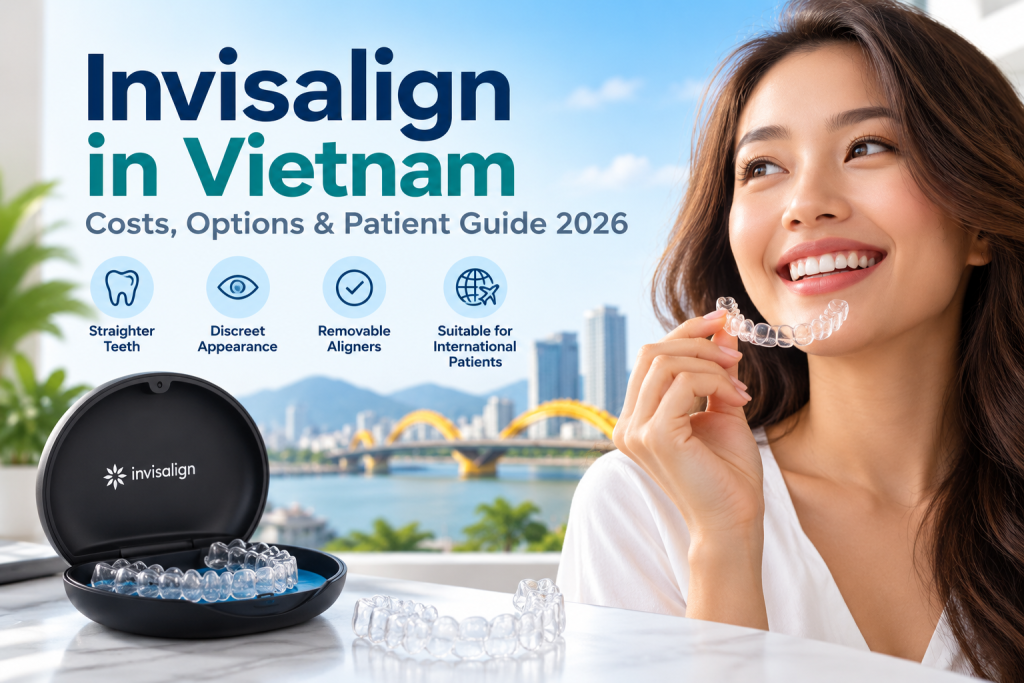
Invisalign in Vietnam: Explore clear aligner treatment options, costs, and orthodontic care for international patients.
Invisalign Cost in Vietnam (2026)
The cost of Invisalign in Vietnam depends on orthodontic complexity, the treatment package and any additional procedures required.
The following prices come from a 2026 price list supplied by one of VnMedtour’s dental partners.
Invisalign Price List
| Invisalign Package | Price (VND) | Approx. USD |
|---|---|---|
| Invisalign Lite | 65,000,000 | $2,500 |
| Invisalign Moderate | 90,000,000 | $3,462 |
| Invisalign Comprehensive – Level 3 | 110,000,000 | $4,231 |
| Invisalign Comprehensive – Level 4 | 120,000,000 | $4,615 |
Important pricing information: These figures are indicative prices from an individual partner clinic, not average Invisalign prices throughout Vietnam. USD equivalents use a reference exchange rate of approximately USD 1 = VND 26,000. Exchange rates and provider prices may change.
What Is Included in the Price?
Before accepting a quotation, patients should ask whether the package includes:
- Initial orthodontic consultation.
- Digital intraoral scans.
- Dental X-rays where required.
- Digital treatment planning.
- Invisalign aligners.
- Attachments and necessary adjustments.
- Scheduled follow-up appointments.
- Refinement aligners.
- Retainers after treatment.
Package inclusions vary. A quoted price should not be assumed to cover every item above.
Additional Orthodontic Costs
Some patients need procedures beyond their standard Invisalign package.
The same partner price list includes the following indicative charges:
| Additional Procedure | Price |
|---|---|
| Palatal expansion appliance | VND 5 million per arch |
| Bone-anchored expansion appliance | VND 10 million per arch |
| Orthodontic mini-screw | VND 2 million per screw |
| Selected premolar extractions | VND 500,000 per tooth |
| Selected other tooth extractions | VND 1 million per tooth |
| Impacted tooth extraction with orthodontic traction | VND 5 million |
These procedures are not necessary for every patient. The orthodontist determines whether they are clinically appropriate.
Retainers, replacement aligners and treatment transfers may also involve additional fees, depending on the provider’s terms.
Invisalign Lite vs Moderate vs Comprehensive
Different Invisalign packages accommodate different levels of orthodontic treatment.
The following descriptions are based on the supplied partner price list. Exact eligibility and refinement conditions must be confirmed before treatment.
Invisalign Lite – VND 65 Million
Invisalign Lite is generally intended for relatively minor tooth movements.
The partner’s listed package provides up to 14 pairs of aligners, with a stated opportunity for one refinement during the first year.
It may be considered for selected cases involving:
- Minor crowding.
- Small spaces between teeth.
- Limited alignment corrections.
- Certain cosmetic adjustments.
Not every mild-looking case qualifies for Lite. The bite and underlying dental condition must also be assessed.
Invisalign Moderate – VND 90 Million
Invisalign Moderate is designed for cases requiring more extensive movement than Lite.
The partner’s listed package provides up to 26 pairs of aligners, with refinements described within the first two years.
Potential candidates include patients with mild-to-moderate crowding, spacing or selected bite discrepancies.
Invisalign Comprehensive – VND 110–120 Million
Invisalign Comprehensive accommodates a broader range of orthodontic treatment needs.
The partner offers two listed pricing levels:
- Level 3: VND 110 million, with a stated three-year refinement period.
- Level 4: VND 120 million, with a stated five-year refinement period.
Both are described as having no fixed aligner-count limit within the listed package conditions.
However, this does not mean every procedure or treatment extension is free. Refinement eligibility, treatment changes and additional fees should be clarified in writing.
Comprehensive treatment may be appropriate for selected complex cases, but severe skeletal problems or difficult tooth movements may require other orthodontic approaches.
Who Is Suitable for Invisalign?
Invisalign can treat a range of orthodontic conditions, but not every patient is an appropriate candidate.
| Orthodontic Concern | Can Invisalign Help? |
|---|---|
| Crowded teeth | Often suitable for selected cases |
| Gaps between teeth | May help close spaces |
| Overbite | Some cases can be treated |
| Underbite | Depends on dental and skeletal factors |
| Crossbite | Suitable for certain cases |
| Open bite | Requires individual assessment |
| Relapse after braces | May be suitable for limited corrections |
Treatment suitability depends on tooth positions, gum health, bite relationships and the movements required.
Patients with untreated tooth decay, active periodontal disease or other dental problems may need treatment before beginning orthodontics.
Some severe jaw discrepancies require fixed appliances, surgery or a combination of approaches.
For an overview of alternative methods, see our Orthodontics in Vietnam guide.
How Does Invisalign Treatment Work?
Although individual protocols vary, Invisalign treatment generally follows six stages.
Step 1: Orthodontic Consultation
The dentist or orthodontist examines the teeth, gums and bite.
Diagnostic records may include photographs, digital scans and dental X-rays where clinically indicated.
The clinician evaluates whether Invisalign is suitable and discusses other treatment options when necessary.
International patients can sometimes submit existing dental records for a preliminary review before traveling.
However, photographs alone cannot establish a definitive orthodontic diagnosis.
Step 2: Digital Treatment Planning
If Invisalign is recommended, the clinician develops a digital treatment plan using the Invisalign system.
ClinCheck software allows the provider to plan the proposed sequence of tooth movements.
Patients may be shown a digital simulation of the intended result.
This simulation is a planning tool, not a guarantee that every tooth will move exactly as predicted.
Step 3: Aligner Manufacturing
Once the plan is approved, custom aligners are manufactured.
Production and delivery times vary.
Patients visiting Vietnam briefly should confirm whether the aligners can be delivered and fitted during their stay.
Step 4: Aligner Fitting
The clinician checks the aligners and provides instructions for wearing and changing them.
Some patients require tooth-colored attachments, elastics or other orthodontic procedures.
Most patients are instructed to wear their aligners for approximately 20–22 hours per day.
According to Invisalign’s official patient guidance, consistent daily wear is important for treatment progress.
Step 5: Progress Monitoring and Refinements
The clinician reviews tooth movement, aligner fit, oral health and bite changes.
Appointment intervals depend on the individual treatment plan.
If teeth do not move as expected, additional scans, refinements or adjustments may be necessary.
Remote communication may support selected follow-up activities, but it does not replace every in-person examination.
Step 6: Retainers and Long-Term Care
After active treatment, retainers are normally prescribed to help maintain the corrected tooth positions.
Without appropriate retention, teeth can shift over time.
Patients should clarify the retainer type, wearing schedule, replacement costs and follow-up arrangements before completing treatment.
How Long Does Invisalign Treatment Take?
Treatment duration depends on the complexity of the orthodontic problem and how the teeth respond.
As a broad planning guide:
| Case Complexity | Possible Treatment Duration |
|---|---|
| Minor alignment correction | Several months |
| Moderate orthodontic treatment | Approximately 6–18 months |
| More complex treatment | 12–24 months or longer |
These are illustrative ranges rather than guaranteed timelines.
Factors affecting treatment duration include:
- Severity of crowding or spacing.
- Bite correction requirements.
- Number and complexity of planned movements.
- Daily aligner wear.
- Whether refinements are needed.
- Individual biological response.
Wearing aligners consistently is important, but it cannot guarantee a particular completion date.
Invisalign vs Traditional Braces
Both Invisalign and conventional braces can correct selected orthodontic problems.
The appropriate choice depends on clinical requirements, lifestyle and patient preferences.
| Feature | Invisalign | Traditional Braces |
|---|---|---|
| Appearance | Transparent aligners | Visible brackets and wires |
| Removable | Yes | Usually no |
| Eating | Remove aligners | Braces remain attached |
| Cleaning | Remove aligners to brush and floss | Clean around brackets and wires |
| Daily compliance | Requires consistent wear | Less dependent on remembering to wear appliances |
| Complex tooth movements | Suitability varies | May be preferable for certain cases |
| Professional monitoring | Required | Required |
| Retainers afterward | Usually required | Usually required |
Why Choose Invisalign?
Some patients prefer Invisalign because the aligners are discreet and removable.
This can make meals and oral hygiene more convenient.
However, Invisalign requires discipline. Patients must wear their aligners consistently and follow their clinician’s instructions.
When Might Braces Be Better?
Traditional braces may be recommended when certain movements are difficult to achieve predictably with aligners or when patients are unlikely to meet the daily wear requirements.
Neither option is universally more effective.
Invisalign vs Other Clear Aligners
The terms Invisalign and clear aligners are sometimes used interchangeably, but they are not identical.
Invisalign is a specific commercial brand. Clear aligners describe the wider category of transparent, removable orthodontic appliances.
Different systems may vary in:
- Materials.
- Treatment-planning software.
- Available treatment packages.
- Manufacturing processes.
- Provider requirements.
- Refinement policies.
- Costs.
Patients comparing brands should ask who will supervise their treatment and what happens if the teeth do not move as planned.
The cheapest aligner system is not necessarily the most appropriate.
For further comparison, visit our Clear Aligners in Vietnam article.
Benefits of Invisalign Treatment
Invisalign offers several potential advantages for suitable patients.
Discreet appearance: Transparent aligners are generally less noticeable than metal braces, although attachments may still be visible.
Removable design: Patients can remove aligners for meals and oral hygiene.
Digital planning: The treatment plan provides a visual explanation of proposed tooth movements.
Fewer restrictions during meals: Because aligners are removed before eating, patients do not have the same appliance-related food restrictions as those wearing fixed braces.
Flexible daily routine: For patients who can comply with the prescribed wear schedule, removable aligners may fit comfortably into work and social activities.
These benefits do not eliminate the need for professional monitoring or guarantee a particular outcome.
Risks and Limitations of Invisalign
Invisalign is an orthodontic treatment and carries potential risks.
Patients may experience temporary pressure, tenderness or irritation, especially after changing aligners.
Other considerations include:
- Teeth not moving according to the original plan.
- The need for additional aligners or treatment adjustments.
- Tooth decay or gum inflammation associated with inadequate oral hygiene.
- Root resorption or changes in supporting tissues.
- Unwanted bite changes.
- Tooth movement after treatment if retainers are not worn appropriately.
Some patients may need a different orthodontic approach if Invisalign cannot achieve the required movements predictably.
The American Association of Orthodontists provides patient information about orthodontic treatment and the importance of professional care.
Patients should discuss their individual risks with the treating clinician before consenting to treatment.
Can International Patients Get Invisalign in Vietnam?
Yes, but the practicality of treatment depends on the patient’s circumstances.
Invisalign is different from dental procedures such as whitening or a single crown because orthodontic treatment continues over an extended period.
Foreign Residents in Vietnam
Expatriates and long-term residents may find Invisalign easier to coordinate because they can attend scheduled reviews locally.
Frequent Visitors
Patients who regularly travel to Vietnam may be able to arrange some appointments around their visits.
However, the orthodontist must determine whether the proposed intervals are appropriate.
Short-Term Tourists
For someone visiting Vietnam for only one or two weeks, starting Invisalign requires careful planning.
A short trip may allow an initial consultation, digital scanning and treatment discussion.
It does not necessarily allow enough time for aligner production and fitting.
More importantly, the patient needs a safe plan for continuing treatment after leaving Vietnam.
Can You Start Invisalign in Vietnam and Continue Treatment Overseas?
Potentially, but a treatment transfer is not automatic.
Patients from Australia, the United States, the United Kingdom or other countries may want to begin treatment in Vietnam and continue with a local provider at home.
This may be possible if a qualified dentist or orthodontist agrees to accept the case.
However, another Invisalign provider is not automatically required to take responsibility for an existing treatment plan.
Before beginning treatment, ask:
- Can a provider in your home country review or accept the case?
- What clinical records will be available?
- Who will manage future refinements?
- Will additional consultation or transfer fees apply?
- What happens if an aligner does not fit correctly?
- Will you need to return to Vietnam for certain procedures?
A new provider may require another examination, revised planning or additional fees.
For international patients, continuity of care is just as important as the initial Invisalign price.
If you cannot arrange reliable follow-up, beginning treatment closer to your permanent residence may be the more practical option.
Invisalign Treatment in Hanoi, Ho Chi Minh City and Da Nang
Invisalign services are available through selected dental providers in Vietnam.
Invisalign in Hanoi
Hanoi offers orthodontic and dental providers serving local residents and international patients.
Patients considering treatment in Hanoi should ask about the clinician’s orthodontic experience, treatment planning, package conditions and follow-up arrangements.
Invisalign in Ho Chi Minh City
Ho Chi Minh City is another option for patients seeking orthodontic consultations and clear aligner treatment.
International visitors should confirm appointment availability, expected treatment stages and whether the clinic can provide the necessary long-term supervision.
Invisalign in Da Nang
Patients living in or spending extended periods in central Vietnam may also explore Invisalign services in Da Nang.
Provider availability and the exact aligner system should be verified before making travel arrangements.
The best treatment location is not necessarily the city with the lowest quotation. It is the location where the patient can access appropriate clinical care throughout treatment.
How to Choose an Invisalign Provider in Vietnam
Before selecting a clinic, international patients should consider several practical questions.
1. Who Will Supervise Your Treatment?
Ask about the treating dentist’s or orthodontist’s qualifications and experience with similar cases.
2. Is the System Genuine Invisalign?
Confirm that the quotation is for the Invisalign brand rather than another clear aligner product.
Patients can explore provider information through the official Invisalign website.
3. What Does the Quotation Include?
Request written information about aligners, appointments, refinements, retainers and additional procedures.
4. What Happens If Treatment Takes Longer?
Ask about the provider’s policy if additional aligners or extended monitoring become necessary.
5. How Will Follow-Up Be Managed?
This question is especially important for patients who do not live in Vietnam.
A responsible provider should explain when clinical reviews are needed and how unexpected problems will be handled.
How to Care for Invisalign Aligners
Good daily habits help maintain oral hygiene and protect the aligners.
Patients should generally:
- Wear aligners according to the prescribed schedule.
- Remove them before meals.
- Brush and floss regularly.
- Clean aligners as directed by the clinician.
- Avoid exposing aligners to hot water.
- Keep unused aligners in their protective case.
- Contact the clinic if an aligner is lost, damaged or does not fit.
Drinking sugary beverages while wearing aligners may increase the risk of dental problems.
Patients should follow their provider’s instructions regarding aligner changes and cleaning products.
For additional guidance, see Invisalign’s information about living with aligners.
How VnMedtour Can Help
VnMedtour helps international patients communicate with dental providers in Vietnam and coordinate treatment-related arrangements.
For Invisalign inquiries, our assistance may include:
- Collecting preliminary dental information.
- Connecting patients with dental providers.
- Requesting indicative treatment plans and quotations.
- Coordinating consultations.
- Clarifying estimated treatment stages.
- Helping patients understand practical follow-up requirements.
Patients can begin by providing their age, main orthodontic concerns, relevant dental records and intended travel dates.
VnMedtour is a medical tourism coordination service, not a dental clinic. Diagnosis, treatment selection, clinical decisions and orthodontic supervision remain the responsibility of licensed dental professionals.
Patients should also explore our broader Dental Work in Vietnam guide when comparing different dental procedures.
Frequently Asked Questions About Invisalign in Vietnam
How much does Invisalign cost in Vietnam?
Based on a 2026 price list from a VnMedtour dental partner, Invisalign treatment costs approximately VND 65–120 million (USD $2,500–$4,615). The final quotation depends on clinical assessment and treatment requirements.
Is Invisalign cheaper in Vietnam?
Some patients may receive attractive quotations in Vietnam, but savings depend on the provider, treatment scope, currency exchange rates and follow-up expenses. Patients should compare complete treatment costs rather than advertised starting prices.
How long does Invisalign treatment take?
Treatment may last several months or longer than a year. Complex cases can require additional time. The orthodontist provides an individualized estimate after examination.
Can I complete Invisalign during a holiday in Vietnam?
Usually not. Orthodontic treatment requires ongoing monitoring over months. A short holiday may be sufficient for an initial consultation, but not for completing most treatment plans.
Can I continue Invisalign in Australia or the United States?
Possibly, if a qualified provider agrees to accept your case. Transfer arrangements should be discussed before treatment starts. Additional examinations or fees may be necessary.
Is Invisalign painful?
Temporary pressure or soreness may occur, especially when changing aligners. Persistent or severe pain should be assessed by the treating clinician.
Is Invisalign better than braces?
Neither is universally better. Invisalign offers removable, discreet aligners, while traditional braces may be more suitable for certain orthodontic problems or patients who cannot wear aligners consistently.
Are Invisalign refinements included in the price?
Some packages include refinements under specified conditions. Patients should request written clarification about eligibility, time limits and additional charges.
Do I need retainers after Invisalign?
Yes, retainers are generally needed to help maintain the corrected tooth positions. The clinician determines the appropriate type and wear schedule.
Can Invisalign treat severe crowding?
Some complex cases can be treated with Invisalign, sometimes alongside additional orthodontic procedures. Others may require fixed braces or a different approach. An examination is necessary to determine suitability.
Planning Invisalign Treatment in Vietnam
Invisalign in Vietnam offers an option for patients interested in clear, removable orthodontic treatment. The availability of different packages allows providers to develop plans for a range of orthodontic needs.
However, the initial quotation is only one part of the decision.
Patients should also consider the treating clinician’s experience, the expected treatment duration, possible additional procedures and the arrangements required for ongoing care.
For overseas patients, a well-organized follow-up plan is particularly important.
Before committing to treatment, request an individual clinical assessment and a written explanation of the expected costs, treatment stages and monitoring requirements.
Medical disclaimer: This article provides general information and does not replace professional dental advice. Invisalign suitability, risks, treatment duration and final costs must be assessed by a qualified dental professional. Prices are indicative and subject to confirmation.
Medically reviewed by MSc, MD, Doctor Dang Tien Dat
Thinking About Invisalign in Vietnam?
Send us your photos or dental X-rays and we’ll help you find a trusted Invisalign provider in Vietnam.