
For many individuals, a rhinoplasty represents a highly anticipated turning point in self-confidence and facial harmony. However, when the primary nose surgery yields unsatisfactory aesthetic outcomes or, worse, leads to physiological complications such as nasal airway obstruction, the emotional and physical distress can be overwhelming. This is where revision rhinoplasty (corrective nose surgery) enters the picture.
Widely regarded as one of the most challenging and mathematically demanding subspecialties in all of plastic surgery, revision rhinoplasty requires an expert hand to navigate complex anatomical landscapes altered by scar tissue, depleted native cartilage, and structurally compromised nasal frameworks.
In recent years, Vietnam has rapidly transformed into a globally recognized epicenter for this highly specialized procedure. International patients from the United States, Australia, Singapore, and Europe are increasingly bypassing traditional cosmetic hot spots to seek out the elite talent pool, state-of-the-art hospitals, and cost-efficient medical infrastructure offered within the country.
In this definitive guide, we delve deep into the intricacies of undergoing revision rhinoplasty in Vietnam, exploring why it has become the premier choice for corrective facial surgery, the advanced techniques employed by elite Vietnamese specialists, and how you can safely plan your corrective surgical journey.
According to data compiled by the International Society of Aesthetic Plastic Surgery (ISAPS), nose reshaping remains among the top five most frequently performed aesthetic procedures worldwide, but it also carries one of the highest revision rates due to its extreme geometric complexity and the delicate nature of nasal healing.
Quick Navigation
Understanding Revision Rhinoplasty: Why Is It So Complex?
To appreciate why choosing the right destination and surgeon is paramount, one must first understand what makes corrective nose surgery significantly more difficult than a primary procedure. In a primary rhinoplasty in Vietnam, the surgeon is working with virgin tissue, intact cartilaginous support structures, and predictable vascular pathways. In contrast, revision rhinoplasty presents several distinct surgical hurdles:
-
Scar Tissue Management: Previous incisions and tissue dissection generate dense, fibrous scar tissue. This tissue limits skin elasticity, making it incredibly difficult to redrape the skin envelope smoothly over the newly reconstructed framework.
-
Depleted Cartilage Reserves: To restructure a nose, surgeons rely heavily on structural grafts. During a primary surgery, the nasal septum is typically harvested for this purpose. If the septum has already been depleted, the revision surgeon must source autologous (self-derived) cartilage from other parts of the patient’s body, such as the ear or rib.
-
Altered Blood Supply: Each subsequent surgical intervention compromises the local microcirculation. An experienced surgeon must exercise extreme care to preserve the remaining blood supply to avoid skin necrosis or prolonged healing issues.
-
Psychological & Functional Restoration: Corrective surgery is rarely just about looks; it is frequently about restoring basic breathing functions. Surgeons must balance delicate internal nasal valves while simultaneously creating a visually stunning, symmetrical exterior.
Because of these compounding complexities, revision surgery is not merely an aesthetic touch-up—it is an intricate, reconstructive puzzle that demands a surgeon possessing both an artistic eye and a deep understanding of reconstructive otolaryngology (ENT).
Why Vietnam Has Become a Global Hub for Corrective Nose Surgery
Vietnam’s emergence as a premier destination for complex cosmetic surgery in Vietnam is the result of a deliberate, multi-decade evolution. The nation has successfully synthesized top-tier clinical expertise with massive private-sector investment, creating a world-class environment for medical travelers.
1. Elite Surgical Expertise and Super-Specialization
Vietnamese plastic surgeons are globally renowned for their meticulous attention to detail and unmatched clinical volume. Due to the high demand for nasal aesthetic adjustments within Southeast Asia, top-tier surgeons in Ho Chi Minh City and Hanoi perform hundreds of nasal procedures annually—far exceeding the average case volume of many Western counterparts. Many of these specialists have completed rigorous, multi-year fellowships in global plastic surgery capitals such as South Korea, Taiwan, and France. They bring back cutting-edge, micro-surgical techniques and apply them with exceptional precision to complex reconstructive cases.
2. The Pioneering Use of Structural Autologous Grafts
While some Western practices still rely on synthetic, off-the-shelf implants for revisions, Vietnam’s leading surgeons are pioneers in structural autologous rhinoplasty. By using the patient’s own rib cartilage (costal cartilage) or temporalis fascia, they reconstruct the nasal tip and bridge from the ground up. This natural approach virtually eliminates the risk of implant rejection, extrusion, or thin-skin contractures, which are common issues associated with historical silicone implant failures.
3. World-Class JCI-Accredited Medical Facilities
International medical tourists are often pleasantly surprised by the sheer scale and technological advancement of private hospitals in Vietnam. Elite clinics and hospitals utilize 3D CT scanning systems to map out residual bone and cartilage structures prior to making a single incision. Many facilities feature ultra-modern, laminar-flow operating rooms that dramatically minimize the risk of post-operative infections—a critical safety factor in revision procedures where compromised blood flow makes tissues more vulnerable to pathogens.
4. Exceptional Cost-Efficiency
Without compromising on surgical talent, medical materials, or clinical safety, the cost of revision rhinoplasty in Vietnam is highly competitive. Patients typically save between 50% and 70% compared to prices in Australia, the United States, or Singapore. These savings are driven by lower operational overhead, local real estate advantages, and favorable currency exchange rates, allowing patients to invest their savings instead into superior grafting materials, extended recovery care, and luxury recuperation stays.
Comparing Primary vs. Revision Rhinoplasty
To help patients set realistic expectations, the following table highlights the structural and operational differences between primary and corrective nasal surgeries:
| Parameter | Primary Rhinoplasty | Revision Rhinoplasty |
| Surgical Complexity | Standard to Moderate | Very High to Reconstructive |
| Anatomical Status | Virgin tissue, predictable anatomy | Scar tissue, distorted/missing cartilage |
| Common Graft Sources | Nasal septum | Autologous rib (costal) or ear cartilage |
| Anesthesia Type | Local with sedation or General | General anesthesia (highly recommended) |
| Average Operating Time | 1.5 to 3 hours | 3 to 5+ hours |
| Recovery Timeline | 7–10 days for initial swelling | 10–14 days for initial; up to 18 months for final |
Advanced Techniques Employed in Vietnamese Revision Microsurgery
A successful revision does not rely on a “one-size-fits-all” approach. Elite Vietnamese surgeons assess each nose individually to choose the correct material and structural technique. The leading methodologies include:
A. Autologous Rib Cartilage Grafting (Costal Cartilage)
When the internal septal framework is completely collapsed or harvested during the previous surgery, the rib cartilage serves as the gold standard. A minor, highly precise 1.5 cm incision is made just under the breast crease to harvest a small segment of the 6th or 7th rib. The surgeon then meticulously carves this cartilage into ultra-thin struts, splints, and cap grafts to rebuild the nasal bridge, elongate a short nose, or project a collapsed nasal tip. This technique provides unparalleled, lifelong structural support.
B. Ear Cartilage and Temporalis Fascia Wraps
For patients who require moderate volume restoration or softening of the nasal tip, ear cartilage (conchal cartilage) is incredibly useful due to its natural, soft curvature. To prevent any sharp edges from showing through thin, damaged nasal skin, surgeons often wrap the cartilage in temporalis fascia—a thin, strong layer of connective tissue harvested discreetly from the hairline. This creates a remarkably natural, soft, and youthful aesthetic contour.
C. Advanced Hybrid Techniques (Mesh and Biocompatible Synthetics)
In cases where autologous harvesting is not preferred by the patient, highly advanced biocompatible materials such as PCL (Polycaprolactone) mesh or porous high-density polyethylene (such as Medpor) may be used alongside ear cartilage to construct a stable nose tip. These materials act as a scaffold, allowing the patient’s own tissue to grow into them over time, minimizing movement and maintaining pristine definition.
The choice of material is crucial. According to guidelines set by the American Society of Plastic Surgeons (ASPS), autologous tissue remains the safest medium for complex secondary nasal reconstructions, as it carries the lowest long-term complication and infection rate.
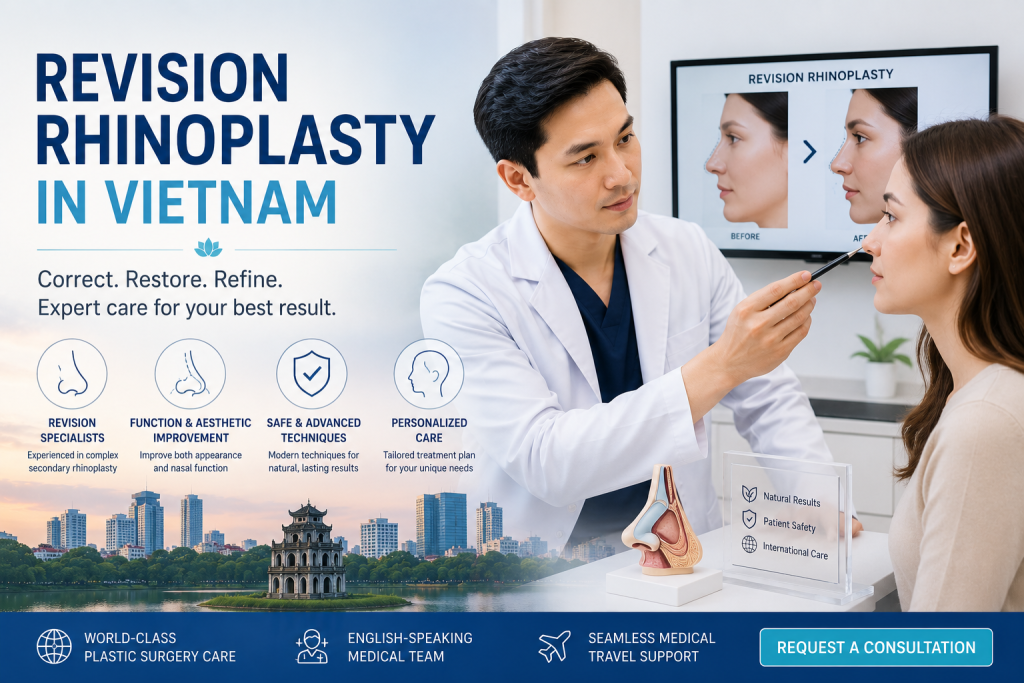
Revision rhinoplasty in Vietnam helps international patients correct previous nose surgery concerns with experienced plastic surgeons, advanced techniques, personalized planning, and medical travel support.
Your Patient Journey: How to Organize Revision Rhinoplasty in Vietnam
Embarking on a cross-border medical journey for a procedure as critical as revision rhinoplasty requires meticulous planning. Working with a dedicated medical tourism facilitator like Medtour Vietnam ensures that every variable is expertly managed.
Phase 1: Comprehensive Virtual Consultation & Surgical Assessment
Because you are traveling from abroad, the journey begins digitally. You will be asked to provide high-resolution, multi-angle photographs of your current nose, along with a detailed medical history of your previous nasal surgeries (including operative reports, if available). In cases of functional breathing issues, a localized CT scan may be requested. This data allows the surgeon to perform a preliminary assessment, outline expected graft needs, and establish realistic aesthetic goals.
Phase 2: Customizing the Surgical Plan & Travel Logistics
Once the clinical path is agreed upon, a tailored medical itinerary is crafted. This includes scheduling the precise surgery date, coordinating pre-operative lab work, arranging comfortable airport transfers, and booking recovery-friendly accommodations close to the hospital. Due to the swelling and healing dynamics of revision cases, patients should plan to stay in Vietnam for at least 10 to 14 days post-surgery to allow for close monitoring and stitch removal.
Phase 3: The Surgical Day & Immediate Post-Op Recovery
On the day of surgery, you will undergo a comprehensive physical check-up at the hospital, including an in-person, detailed consultation with your surgeon using 3D simulation software. The surgery is performed under general anesthesia. Following the procedure, you will spend the first night under the watchful eye of a professional nursing team. A custom external nasal splint and internal soft silicone splints will be placed to stabilize the delicate reconstructed framework.
Phase 4: Post-Operative Care, Stitch Removal, and Healing
Over the next 7 to 10 days, you will attend regular follow-up clinics for gentle wound cleansing, laser swelling-reduction therapy, and eventual removal of all sutures and splints. Once the primary swelling begins to subside and the surgeon confirms that the structural healing is on track, you will be cleared to fly home with a comprehensive, long-term recovery protocol.
Cost Breakdown: How Much Does Revision Rhinoplasty Cost in Vietnam?
While pricing varies based on the exact complexity of the case, the number of previous surgeries, and the specific cartilage harvesting required, Vietnam offers exceptional financial feasibility compared to Western countries and other medical tourism destinations:
| Country | Primary Rhinoplasty (USD) | Revision Rhinoplasty (USD) | Estimated Savings for Revision |
| United States | $8,000 – $12,000 | $15,000 – $25,000+ | Baseline |
| Australia | $9,000 – $14,000 | $16,000 – $24,000+ | Up to 70% |
| Singapore | $7,000 – $11,000 | $12,000 – $18,000+ | Up to 60% |
| South Korea | $5,000 – $8,000 | $8,000 – $14,000+ | Up to 45% |
| Vietnam | $2,500 – $4,500 | $4,500 – $8,500 | 50% – 70% Savings |
Note: The prices listed above for Vietnam generally include the surgeon’s fee, general anesthesia, operating room fees, pre-op tests, implant/graft materials, and routine post-operative care, making the total package remarkably transparent and manageable.
Crucial Safety Checklist for International Patients
To ensure a completely seamless and highly successful experience, keep the following safety checklist in mind when choosing your clinical provider in Vietnam:
-
Verify Board Certifications: Ensure your operating surgeon is fully licensed by the Ministry of Health (MOH) and holds specialized board certifications in Plastic and Reconstructive Surgery.
-
Request Before & After Portfolios: Ask to see long-term (6 months to 1 year) Before and After photos specifically of revision cases. A great primary rhinoplasty surgeon is not automatically a great revision surgeon.
-
Check Hospital Affiliation: Confirm that your surgery will take place in a fully licensed, accredited general hospital equipped with intensive care units (ICU) and emergency response capabilities, rather than a small, standalone day clinic.
-
Establish Clear Communication: Ensure the medical staff and surgical team provide fluent English-speaking coordinators, preventing any nuances or aesthetic preferences from being lost in translation.
Choosing Medtour Vietnam for Your Revision Journey
A corrective nose surgery is more than just a medical procedure; it is a profound journey of physical restoration and peace of mind. At Medtour Vietnam, under the corporate oversight of LVS Vietnam Co., Ltd., we specialize in bridging the gap between discerning international patients and the absolute finest surgical minds in Hanoi and Ho Chi Minh City.
From organizing your virtual 3D consultations and guiding you toward the optimal surgical specialists, to securing premium, sanitized aftercare villas and providing dedicated in-person English translators, we ensure your safety and comfort are prioritized at every single milestone. Let us help you restore your breathing, your natural facial harmony, and your self-assurance with the world-class clinical care that Vietnam is celebrated for.
Medically reviewed by MSc, MD, Doctor Nguyen Dang Dai
Considering Revision Rhinoplasty in Vietnam?
Get expert guidance on revision nose surgery, implant removal or replacement, surgeon selection, estimated costs, and safe treatment planning in Vietnam.