
Face lift in Vietnam is an option for international patients considering surgical facial rejuvenation at cosmetic surgery hospitals in Hanoi or Ho Chi Minh City. Available techniques include SMAS facelifts, deep plane facelifts, mini facelifts and procedures combining facial lifting with neck rejuvenation.
A facelift, medically known as rhytidectomy, is designed to improve visible signs of facial aging by repositioning sagging tissues and removing excess skin. Depending on the surgical technique, it may improve jowls, deep facial folds and loss of jawline definition.
Vietnam offers different surgical approaches and treatment prices. However, choosing cosmetic surgery overseas involves more than comparing quotations. Patients should consider the surgeon’s qualifications, hospital facilities, anesthesia arrangements, recovery time and postoperative care.
Based on a 2026 price list provided by one of VnMedtour’s partner hospitals, selected SMAS facelift procedures start at VND 49.5 million (approximately USD $1,904), while selected deep plane procedures start at VND 66 million (approximately USD $2,538).
These are prices for specific treatment areas, not complete face-and-neck packages. Final quotations require an individual assessment and confirmation by the hospital.
This guide explains facelift costs, surgical techniques, recovery, potential risks and practical considerations for patients traveling to Vietnam.
Quick Navigation
Face Lift in Vietnam: At a Glance
| Information | Details |
|---|---|
| Procedure | Surgical facelift (rhytidectomy) |
| Main techniques | SMAS, deep plane, mini facelift |
| Treatment areas | Cheeks, jowls, jawline and neck |
| Indicative partner prices | VND 49.5–99 million for selected areas |
| Anesthesia | Depends on the procedure and medical assessment |
| Initial recovery | Commonly around 2–3 weeks |
| Suggested overseas stay | Often 2–3 weeks, subject to surgeon approval |
| Main destinations | Ho Chi Minh City and Hanoi |
| Results | Long-lasting but not permanent |
| Follow-up | Required after surgery |
The prices above refer to selected procedures rather than a complete facelift package.
What Is a Face Lift?
For patients considering a Face Lift in Vietnam, understanding the procedure is essential before comparing surgical techniques or treatment costs.
A facelift is a surgical procedure that addresses sagging facial tissues associated with aging.
Over time, changes in skin elasticity, fat distribution and underlying facial structures can contribute to loose cheeks, jowls and less defined facial contours.
Modern facelift surgery generally involves more than tightening the skin. Depending on the technique, the surgeon may reposition deeper tissues, adjust the superficial musculoaponeurotic system (SMAS) and remove excess skin.
The procedure may help improve:
- Sagging cheeks and lower facial tissues.
- Jowls along the jawline.
- Deep folds around the nose and mouth.
- Loose skin in the lower face.
- Reduced jawline definition.
A facelift does not stop the natural aging process or correct every sign of facial aging.
Patients with concerns involving the forehead or eyebrows may require a separate brow-lifting procedure.

Before-and-after photographs illustrating changes in facial appearance. Individual results may vary.
How Much Does a Face Lift Cost in Vietnam?
Facelift prices depend on the surgical technique, treatment area, complexity, surgeon and services included in the quotation.
VnMedtour has received procedure-specific pricing from one of its partner hospitals in Ho Chi Minh City, providing a useful reference for international patients.
Facelift Price List from a VnMedtour Partner Hospital – 2026
| Surgical Area | SMAS Facelift | Deep Plane Facelift |
|---|---|---|
| Forehead | VND 49,500,000 | VND 66,000,000 |
| Mid/Lower Face – Areas 4–6 | VND 83,000,000 | VND 99,000,000 |
| Neck – Areas 7–8 | VND 55,000,000 | VND 66,000,000 |
Approximate Prices in USD
| Surgical Area | SMAS (USD) | Deep Plane (USD) |
|---|---|---|
| Forehead | $1,904 | $2,538 |
| Mid/Lower Face | $3,192 | $3,808 |
| Neck | $2,115 | $2,538 |
Currency conversion: USD 1 ≈ VND 26,000.
Important: These are indicative prices from a 2026 partner quotation, not nationwide averages or guaranteed current rates. Final costs depend on individual assessment and confirmation by the hospital.
A separate patient-specific quotation during 2026 listed an SMAS lower-face procedure at VND 75 million (approximately $2,885), illustrating how prices may differ according to the treatment plan and applicable offers.
What Is Included in the Surgical Package?
The partner’s supplied package information listed:
- Preoperative health assessment.
- Surgical procedure.
- Prescribed postoperative medication.
- One-night hospital stay.
- Postoperative nursing care.
- Airport or hotel pickup.
- Interpretation assistance.
The listed exclusions included compression garments, nutritional supplements, international flights and hotel accommodation.
Patients should obtain written confirmation of current inclusions, particularly anesthesia, additional testing, follow-up appointments and management of complications.
Does a Facelift Price Include Neck Surgery?
Not necessarily.
The partner hospital’s price list separates mid/lower-face surgery from neck surgery.
Patients who want improvement in both areas should request an individualized combined quotation rather than assume that a lower-face facelift includes neck lifting.
The final surgical plan depends on whether the patient’s concerns involve facial descent, neck skin laxity, muscle changes or excess fat.
Types of Facelift Surgery Available in Vietnam
Patients researching Face Lift in Vietnam options can choose from several surgical techniques, depending on their facial anatomy, degree of skin laxity and treatment goals.
Different facelift techniques address different anatomical concerns. They also vary in surgical approach, incision placement and tissue manipulation.
1. SMAS Facelift
The SMAS is a layer of connective and muscular tissue beneath the skin.
During an SMAS facelift, the surgeon tightens, folds or repositions this supporting layer, depending on the specific technique.
The procedure may improve sagging around the cheeks, jowls and lower face.
SMAS surgery can be considered for patients with moderate or more pronounced facial laxity. However, suitability depends on individual anatomy and treatment goals.
Read more about SMAS Facelift in Vietnam.
2. Deep Plane Facelift
A deep plane facelift involves dissection beneath selected facial supporting tissues, allowing the surgeon to mobilize and reposition them.
This approach may address tissue descent involving the midface and lower face.
Deep plane surgery requires detailed knowledge of facial anatomy, particularly the location of facial nerve branches.
Although it is often promoted as an advanced technique, it is not automatically the best option for every patient.
Outcomes depend on the surgeon’s experience, anatomical characteristics and the specific operation performed.
Learn more in our Deep Plane Facelift in Vietnam guide.
3. Mini Facelift
A mini facelift generally involves a more limited surgical approach, often targeting early sagging around the lower cheeks and jawline.
The term is not standardized. Different surgeons may use different incision patterns and tissue-repositioning techniques.
It may be appropriate for selected patients with relatively mild laxity.
However, a mini facelift may not adequately correct extensive facial sagging or significant neck laxity.
For further information, see Mini Facelift in Vietnam.
4. Endoscopic Facelift
Endoscopic techniques use a small camera to assist surgical visualization through selected incisions.
They may be used for particular areas of the upper or midface.
An endoscopic facelift is not necessarily a substitute for traditional lower-face lifting, because the procedures may target different anatomical problems.
Read our Endoscopic Facelift in Vietnam article.
5. Face and Neck Lift
Patients with both facial sagging and loose neck skin may benefit from a combined surgical approach.
A neck lift can involve repositioning tissues, addressing the platysma muscle and removing excess skin.
The surgeon determines whether the neck requires separate treatment or whether the planned facelift can adequately address the patient’s concerns.
SMAS vs Deep Plane Facelift: Which Is Better?
Both techniques aim to improve facial contours, but they use different surgical approaches.
| Feature | SMAS Facelift | Deep Plane Facelift |
|---|---|---|
| Surgical approach | Manipulates the SMAS layer | Uses deeper tissue dissection |
| Common treatment areas | Cheeks, jowls, lower face | Midface, jowls, lower face |
| Neck surgery | May be combined | May be combined |
| Recovery | Depends on surgical extent | Depends on surgical extent |
| Main consideration | Technique and patient suitability | Technique and surgeon experience |
| Partner mid/lower-face price | VND 83 million | VND 99 million |
Neither technique is universally superior.
The appropriate choice depends on the degree of facial sagging, skin quality, tissue distribution, previous procedures and the surgeon’s assessment.
Patients should avoid selecting a technique based only on marketing claims or the assumption that a more expensive operation necessarily produces a better result.
Who Is a Suitable Candidate for Facelift Surgery?
Facelift candidates are generally adults who have visible facial tissue laxity and want to improve their facial contours.
Potential candidates may have:
- Sagging cheeks or jowls.
- Reduced jawline definition.
- Loose skin in the lower face.
- Selected deep facial folds.
- Realistic expectations.
- Medical conditions that have been appropriately assessed.
There is no single ideal age for a facelift.
Some patients seek surgery in their forties, while others consider treatment later in life.
Health status, anatomy and treatment goals are more important than age alone.
When Surgery May Not Be Appropriate
Elective surgery may need to be postponed or avoided when patients have uncontrolled medical conditions, active infections or significant risk factors.
Smoking and nicotine use can impair wound healing and increase the risk of complications.
Patients should disclose all medications, supplements, previous surgeries and cosmetic treatments, including facial fillers and thread lifts.
Previous procedures may affect tissue characteristics and surgical planning.
How Is a Facelift Performed?
The exact procedure varies according to the chosen technique.
Step 1: Consultation and Assessment
The surgeon examines the face and neck, evaluates skin laxity and discusses the patient’s goals.
Photographs may support preliminary communication, but an in-person assessment is necessary before confirming the operation.
Step 2: Preoperative Testing
Patients undergo appropriate medical investigations based on their health history, age and planned anesthesia.
Additional testing may be required when underlying medical conditions are present.
Step 3: Anesthesia
The anesthesia plan depends on the procedure, patient condition and surgical facility.
Patients should confirm who will administer and monitor anesthesia.
Step 4: Surgical Repositioning
The surgeon creates incisions according to the planned technique, often around the ears and sometimes extending into the hairline.
Deeper tissues are repositioned, and excess skin may be removed.
If neck surgery is included, additional steps may address the neck muscles and skin.
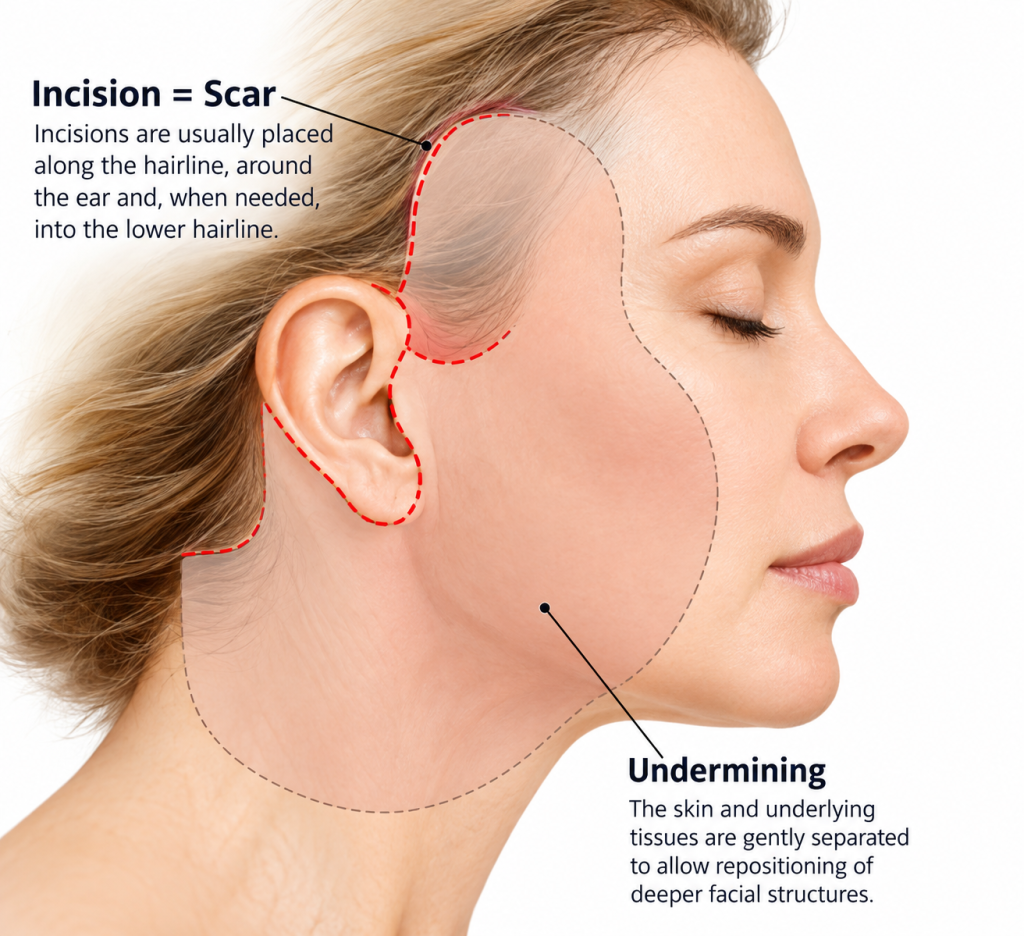
Illustration of typical facelift incision locations and tissue undermining during facial rejuvenation surgery.
Step 5: Postoperative Monitoring
After surgery, the patient is monitored for bleeding, swelling, pain and other immediate concerns.
Dressings or drains may be used when appropriate.
The need for overnight observation depends on the operation and medical circumstances.
Face Lift Recovery: What to Expect
Recovery is an important consideration for patients traveling internationally.
Recovery after a Face Lift in Vietnam depends on the surgical technique, the extent of tissue repositioning and individual healing. International patients should allow sufficient time for postoperative monitoring before returning home.
Swelling, bruising, tightness and temporary changes in sensation are common during the initial healing period.
Typical Recovery Timeline
| Recovery Period | What to Expect |
|---|---|
| Days 1–3 | Swelling, bruising and close postoperative monitoring |
| Days 4–7 | Continued healing and wound assessment |
| Days 8–14 | Gradual improvement; suture care when indicated |
| Weeks 3–4 | Many patients resume routine activities if cleared |
| Months 2–3 | Facial contours may become clearer |
| Later months | Residual swelling and scars continue to mature |
Recovery varies according to the surgical technique, extent of treatment and individual healing.
Patients should follow their surgeon’s instructions regarding wound care, medications, sleeping position and physical activity.
How Long Should International Patients Stay in Vietnam?
For travel planning, approximately two to three weeks may be a reasonable initial estimate.
However, the actual required stay must be determined by the surgeon.
Patients undergoing extensive or combined procedures may need longer observation.
Returning home too early may interfere with postoperative reviews and access to medical care if complications develop.
When Can You Fly After a Facelift?
Flight timing depends on recovery, medical risk factors and the surgeon’s assessment.
Long-distance travel can involve prolonged immobility, which may increase blood clot risk in susceptible patients.
Patients should obtain medical clearance before flying and should not assume that feeling comfortable means they are ready for international travel.
Sightseeing, strenuous activities and spa treatments should not be prioritized during early postoperative recovery.
Risks and Possible Complications
Facelift surgery carries risks, even when performed by appropriately qualified professionals.
Potential complications include:
- Bleeding or hematoma.
- Infection.
- Poor wound healing.
- Skin loss.
- Facial nerve injury or weakness.
- Temporary or persistent numbness.
- Unfavorable scarring.
- Hair loss near incision sites.
- Asymmetry.
- Anesthesia-related complications.
- Blood clots.
- Dissatisfaction with the cosmetic result.
Some complications may require additional treatment or surgery.
The American Society of Plastic Surgeons provides information about facelift procedures, safety and recovery.
Patients should discuss individual risks, alternatives and postoperative emergency arrangements before consenting to surgery.
Will a Facelift Leave Scars?
All surgical facelifts involve incisions and therefore leave scars.
Surgeons commonly place incisions around natural contours near the ears and hairline to make them less noticeable where possible.
However, scars cannot be guaranteed to become invisible.
Their final appearance depends on incision placement, skin characteristics, wound healing and individual scar formation.
Patients with a history of abnormal scarring should inform their surgeon.
Authentic before-and-after photographs may help illustrate typical results, but they cannot predict an individual’s outcome.
How Long Do Facelift Results Last?
A facelift can produce long-lasting improvements in facial contours, but it does not stop aging.
The appearance and durability of results depend on:
- Surgical technique.
- Facial anatomy.
- Skin quality.
- Genetics.
- Weight changes.
- Sun exposure.
- Smoking.
- Natural aging.
It is not appropriate to guarantee that every SMAS or deep plane facelift will last a fixed number of years.
Patients should discuss realistic expectations and possible future changes with their surgeon.
Face Lift vs Non-Surgical Facial Rejuvenation
Not every patient with facial aging requires surgery.
Different treatments address different concerns.
| Treatment | Main Purpose | Limitation |
|---|---|---|
| Surgical facelift | Repositions sagging tissues | Requires surgery and recovery |
| Neck lift | Improves selected neck contours | Does not correct every facial concern |
| Thread lift | Provides limited tissue lifting | Usually less substantial than surgery |
| Dermal fillers | Restore or modify facial volume | Do not remove excess skin |
| Botulinum toxin | Reduces selected expression lines | Does not correct major sagging |
| Energy-based treatments | Improve selected skin concerns | Limited effect on significant laxity |
For patients with relatively mild concerns, our Thread Lift in Vietnam guide explains another option.
A proper consultation should distinguish between skin laxity, volume loss and structural changes.
Face Lift Surgery in Ho Chi Minh City and Hanoi
International patients commonly consider Vietnam’s major cities because of access to cosmetic surgery providers and supporting services.
Ho Chi Minh City
Ho Chi Minh City has cosmetic surgery hospitals offering various facial rejuvenation techniques.
One of VnMedtour’s partner hospitals in Ho Chi Minh City provides SMAS and deep plane facelift procedures.
VnMedtour can help international patients request an initial assessment, obtain an individualized quotation and coordinate consultation arrangements.
Hanoi
Hanoi also has hospitals and cosmetic surgery providers offering facial aesthetic procedures.
Patients should compare surgical experience, available techniques, anesthesia arrangements and postoperative support.
A provider’s location or promotional pricing should not be the sole reason for choosing surgery.
How to Choose a Plastic Surgeon in Vietnam
Choosing a qualified surgeon is one of the most important steps when planning a Face Lift in Vietnam. Patients should evaluate surgical experience, hospital facilities, safety standards and postoperative care rather than focusing only on price.
Before proceeding, consider the following questions.
Is the Surgeon Qualified?
Ask about medical qualifications, professional licensing and experience with the proposed facelift technique.
Is the Facility Licensed?
Confirm that the hospital or clinic is authorized to perform the planned surgery and provide appropriate anesthesia and postoperative care.
Does the Surgeon Explain the Procedure?
A consultation should include the recommended technique, incision locations, expected changes and limitations.
Are the Risks Discussed?
Patients should receive clear information about complications, alternatives and recovery requirements.
Are Before-and-After Photographs Available?
Authentic photographs of comparable cases can help patients understand possible outcomes.
They should not be treated as guarantees.
What Happens If Complications Occur?
Ask about emergency arrangements, revision policies and follow-up after returning home.
The International Society of Aesthetic Plastic Surgery (ISAPS) provides general resources about aesthetic plastic surgery and patient safety.
Planning Facelift Surgery in Vietnam
Planning a Face Lift in Vietnam requires careful coordination of medical consultations, surgery, recovery and international travel. Patients should arrange their trip around the surgeon’s recommended treatment schedule.
International patients should organize their trip around medical requirements rather than tourism activities.
Before Traveling
Prepare:
- Age and medical history.
- Current medications and supplements.
- Smoking or nicotine history.
- Previous facial procedures.
- Photographs showing areas of concern.
- Preferred travel dates.
A preliminary online review may help identify possible treatment options, but it cannot confirm surgical eligibility.
During Your Stay
Allow time for medical assessment, surgery, recovery and follow-up appointments.
Choose accommodation close enough to the treating facility for convenient postoperative visits.
Patients traveling alone should discuss whether assistance is needed during the early recovery period.
Before Returning Home
Confirm that the surgeon has assessed healing and approved travel.
Obtain relevant medical documents, postoperative instructions and contact information.
Patients should know how to access medical care if complications occur after returning home.
Why Consider Vietnam for Facelift Surgery?
Vietnam offers several surgical facial rejuvenation techniques and opportunities to request preliminary consultations before traveling.
For international patients, potential advantages may include access to different providers and itemized treatment quotations.
However, a lower initial price does not necessarily mean a lower total treatment cost.
Flights, accommodation, time away from work, postoperative care and potential complications should all be considered.
Patients should prioritize clinical suitability, surgeon qualifications and continuity of care over promotional pricing.
For more information about other procedures, read our Cosmetic Surgery in Vietnam guide.
How VnMedtour Can Help
VnMedtour helps international patients communicate with cosmetic surgery providers in Vietnam and coordinate treatment-related arrangements.
Our assistance may include:
- Collecting preliminary medical information and photographs.
- Contacting suitable cosmetic surgery providers.
- Requesting indicative surgical recommendations.
- Obtaining procedure-specific quotations.
- Coordinating consultations.
- Clarifying expected hospital stays and postoperative schedules.
- Assisting with communication and practical arrangements.
VnMedtour is a medical tourism coordination service, not a hospital or surgical provider.
All medical assessments, operations and postoperative clinical decisions are made by the treating medical professionals.
Frequently Asked Questions
How much does a face lift cost in Vietnam?
Prices depend on the technique and treatment area. A 2026 partner quotation listed SMAS mid/lower-face surgery at VND 83 million (approximately $3,192) and deep plane mid/lower-face surgery at VND 99 million (approximately $3,808). These are indicative procedure-specific prices, not complete face-and-neck packages.
Is SMAS or deep plane facelift better?
Neither technique is automatically best for everyone. The surgeon should recommend an approach based on facial anatomy, degree of sagging, medical history and treatment goals.
Can a face lift and neck lift be performed together?
Yes, selected patients may undergo combined surgery. The surgeon must assess suitability and provide an individualized quotation.
How many days should I stay in Vietnam?
Approximately two to three weeks may be useful for initial planning, but the surgeon must confirm the required stay.
Is facelift surgery painful?
Discomfort, tightness and tenderness may occur during recovery. Severe or worsening pain should be reported to the treating team.
Will the scars be visible?
Facelift incisions leave scars, usually positioned around the ears and sometimes the hairline. Their final appearance varies.
Can I combine a facelift with eyelid surgery?
Some patients may be candidates for combined procedures, but additional surgery increases complexity. The surgeon must assess the risks and recovery requirements.
How long will facelift results last?
Results can be long-lasting, but aging continues. The duration varies and cannot be guaranteed.
Can I fly home one week after surgery?
One week may be insufficient for postoperative monitoring. Patients should follow the surgeon’s advice regarding travel timing.
How do I obtain an accurate quotation?
Provide your medical history, photographs and preferred travel dates. A preliminary estimate may be possible, but final pricing requires clinical assessment.
Final Thoughts
Face lift in Vietnam may be worth considering for international patients exploring SMAS, deep plane or other facial rejuvenation procedures.
The most important factors are the surgeon’s qualifications, the recommended technique, hospital facilities, recovery arrangements and management of possible complications.
The 2026 price list provided by one of VnMedtour’s partner hospitals offers a useful reference for selected facelift procedures. However, patients should obtain an updated, individualized quotation before making treatment or travel commitments.
A carefully planned consultation is the first step toward understanding whether facelift surgery is appropriate and what results can realistically be expected.
Medical disclaimer: This article provides general educational information and does not replace consultation with a qualified plastic surgeon. Prices are indicative quotations supplied during 2026 and may change. Surgical suitability, risks, recovery and final costs require individual medical assessment.
Considering a Face Lift in Vietnam?
Share your facial concerns, medical history, photographs and travel plans. VnMedtour can help coordinate a preliminary review with a cosmetic surgery provider in Vietnam and request an individualized quotation for SMAS, deep plane or other facelift procedures.