
For men navigating the physical restrictions and psychological exhaustion of an enlarged prostate, selecting a medical intervention has long felt like a series of compromises. The primary goal is simple: restore normal, unrestricted urinary function. Yet, for decades, achieving this meant accepting a high probability of permanent sexual side effects, delayed recovery windows, or incomplete surgical tissue ablation. Traditional surgeries cut or burn tissue, risking crucial surrounding nerve pathways. Daily medical regimens offer mild symptomatic relief but tether patients to permanent chemical side effects.
Today, the landscape of global urology has changed. The introduction of Aquablation therapy represents the world’s first autonomous, robotic, heat-free surgical treatment for Benign Prostatic Hyperplasia (BPH). By replacing thermal energy and manual surgical scraping with an ultra-high-pressure waterjet controlled by artificial intelligence, this cutting-edge procedure addresses the root cause of bladder obstruction while aggressively preserving sexual health and urinary continence.
As international patients search globally for affordable, premier access to this robotic revolution, Aquablation in Vietnam has rapidly emerged as a dominant solution. Vietnam’s top-tier private healthcare sector has experienced an unprecedented phase of capital modernization. By placing certified robotic systems in Joint Commission International (JCI) accredited hospitals and empowering Western-trained urological surgeons, Vietnam delivers the identical clinical outcomes of major Western medical centers at a fraction of the out-of-pocket cost. This comprehensive, expert guide provides an in-depth analysis of Aquablation clinical science, direct cost comparisons, top hospital choices, and the structured travel blueprint for international patients seeking treatment in Vietnam.
Quick Navigation
1. The Clinical Burden of BPH and Traditional Surgical Risks
Benign Prostatic Hyperplasia (BPH) is an almost inevitable consequence of male biological aging. As cellular proliferation causes the prostate gland to expand, it applies constant structural pressure to the prostatic urethra—the narrow channel through which urine must travel to exit the body. This mechanical blockage triggers Lower Urinary Tract Symptoms (LUTS), including chronic nocturia, weak urinary stream, hesitancy, and acute urinary retention. Left untreated, chronic bladder outlet obstruction can lead to irreversible bladder wall hypertrophy, recurrent urinary tract infections, bladder stones, and progressive renal insufficiency.
When daily medications fail or present intolerable side effects like chronic dizziness and retrograde ejaculation, surgical removal of the obstructive tissue becomes clinically necessary. To fully evaluate diagnostic techniques and multi-specialty male healthcare facilities, check out our foundational manual on Urology in Vietnam: Treatments, Costs & Best Hospitals.
The Limitations of Traditional Thermal and Scraping Interventions
For decades, the global standard for BPH surgery relied on thermal or mechanical removal of prostate tissue. However, these methods carry inherent clinical risks:
-
Transurethral Resection of the Prostate (TURP): TURP requires a surgeon to manually pass an electrosurgical loop through the urethra, cutting away obstructive prostate lobes slice by slice using high electrical heat. Because the human hand faces natural anatomical restrictions, and high-heat currents spread unpredictably to adjacent tissues, TURP carries a staggering 65% to 75% risk of permanent retrograde ejaculation, alongside risks of erectile dysfunction and urethral strictures.
-
Laser Enucleation and Ablation (HoLEP / ThuLEP): High-powered lasers use extreme localized heat to vaporize or enucleate the prostate. While highly effective at reducing tissue mass, the thermal energy still radiates into adjacent structures. This can inflame the delicate cavernous nerves regulating erectile function and the internal urinary sphincter, resulting in transient incontinence and significant post-operative dysuria.
To view how these traditional options compare across regional clinics and understand the evolution toward tissue-preserving solutions, you can review our full guide on BPH Treatment in Vietnam.
2. What is Aquablation Therapy? The Robotic Waterjet Science
Aquablation therapy, delivered exclusively via the AquaBeam Robotic System cleared by the U.S. Food and Drug Administration (FDA), completely eliminates thermal injury and manual human surgical error from BPH surgery. It is the only surgical procedure that combines real-time, multi-dimensional imaging with automated, robotic execution to treat an enlarged prostate.
The Dual-Imaging Diagnostic Matrix
Traditional surgeries require the urologist to view the prostate solely through a standard cystoscope, limiting their vision strictly to what is visible inside the urethral tunnel. Aquablation fundamentally alters this dynamic by combining simultaneous transrectal ultrasound (TRUS) imaging and cystoscopic visualization.
This dual-imaging layout gives the surgeon a full cross-sectional view of the entire prostate gland in real time. The surgeon can precisely map the exact boundaries of the obstructive adenoma while clearly identifying the critical anatomical landmarks that must remain untouched: the verumontanum, the external urinary sphincter, and the surrounding ejaculatory duct networks.
AI-Guided, Heat-Free Autonomous Ablation
Once the surgeon finishes mapping the target ablation zone on the digital console, the robotic system takes over. The system deploys a high-velocity, fine-gauge waterjet that travels at near-supersonic speeds. Utilizing the physical principle of fluid dynamics rather than electricity or fire, this high-pressure water stream rapidly liquefies and removes the targeted prostate tissue without generating a single degree of heat.
Because the ablation is completely automated and controlled by pre-programmed algorithms, the system maintains sub-millimeter precision. It eliminates the variations caused by a surgeon’s fatigue or hand tremors, completing the actual tissue removal phase in a remarkable 3 to 5 minutes, regardless of whether the prostate gland is 40 grams or over 150 grams.
3. Unparalleled Clinical Benefits of Aquablation
Large-scale, multi-center global clinical trials, including the landmark WATER Study published by the American Urological Association (AUA), have established Aquablation as a highly advanced option for long-term BPH management. Its clinical benefits stem directly from its robotic, non-thermal mechanism of action:
-
Maximum Preservation of Sexual Function: Because the waterjet does not generate heat, it causes zero thermal damage to the cavernous nerves running along the outside of the prostate. Clinical data demonstrates that Aquablation preserves normal erectile function and maintains normal ejaculatory function in nearly 90% of patients—an outcome unmatched by any traditional resective surgery.
-
Efficacy for Any Prostate Size or Shape: Traditional minimally invasive tools are restricted to smaller glands, and TURP becomes risky for prostates over 80 grams due to prolonged operative times and bleeding risks. Aquablation can treat any prostate architecture, from small 40g glands to massive, highly complex 150g+ prostates, including those with an obstructive median lobe protruding into the bladder neck.
-
Zero Thermal Irritation and Rapid Healing: Traditional laser or plasma surgeries leave behind charred, thermal-damaged tissue borders that require weeks to slough off, causing significant post-operative burning, frequency, and pain. Aquablation leaves behind smooth, perfectly contoured, non-cauterized tissue edges, leading to a much cleaner and faster healing response.
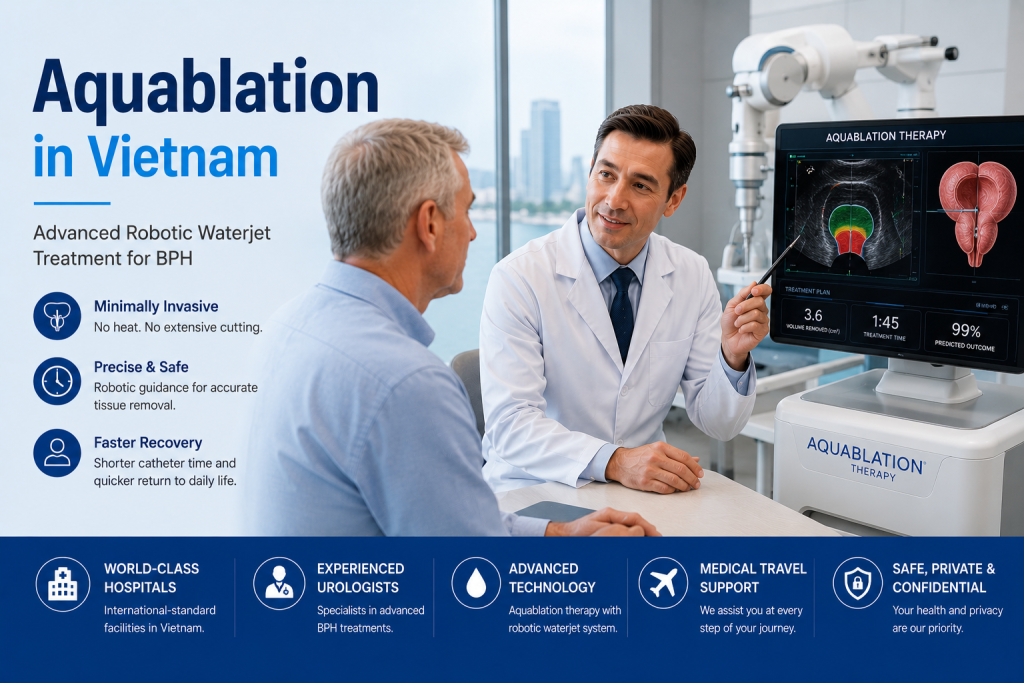
Aquablation in Vietnam offers international patients access to experienced urologists, advanced robotic waterjet therapy for BPH, faster recovery, and personalized medical travel support.
4. Why Vietnam Has Become a Global Center for Robotic Urology
The rapid rise of Vietnam as a destination for international medical travel is the result of strategic public-private healthcare investments, world-class medical talent, and an unyielding commitment to clinical excellence.
World-Class Robotic Surgical Expertise
Senior urological surgeons practicing in Vietnam’s elite private hospitals represent a highly trained class of medical specialists. The majority have completed extensive medical residencies, clinical fellowships, and advanced robotic certifications in prestigious institutions across Western Europe, South Korea, Japan, and the United States. These specialists are fully fluent in medical English, participate regularly in global urological symposiums, and possess deep experience in managing complex, high-volume robotic prostate cases.
State-of-the-Art Private Infrastructure
The premier private hospitals in Hanoi and Ho Chi Minh City feature medical infrastructure that mirrors or exceeds that of major Western facilities. These elite institutions operate ultra-clean, positive-pressure operating theaters equipped with integrated robotic platforms, high-definition digital visualization loops, and dedicated critical care support units. International patient divisions provide comprehensive concierge care, providing seamless bilingual medical translation, immediate airport pick-ups, health insurance processing, and private VIP inpatient suites to ensure complete peace of mind.
5. Transparent Cost Analysis: Vietnam vs. The West
Financial transparency is vital for international patients seeking medical treatment abroad. Pursuing Aquablation care within Vietnam’s premium private healthcare sector allows overseas patients to save between 55% and 75% compared to out-of-pocket costs in nations like the United States, Australia, or the United Kingdom, without making any compromises on surgical safety or technology.
Global Cost Comparison Table (USD)
| Medical Procedure / Service Component | United States | Australia | United Kingdom | Vietnam (Premium Wing) |
| Pre-Op Specialist Consultation & Advanced TRUS Diagnostics | $600 – $1,100 | $700 – $1,200 AUD | £500 – £900 | $150 – $300 |
| AquaBeam Robotic System Treatment Wand & Consumables | $4,000 – $5,500 | $4,500 – $6,000 AUD | £3,200 – £4,500 | $2,200 – $2,800 |
| Robotic OR Time, Anesthesia, & Inpatient Ward (2 Nights) | $12,000 – $19,000 | $13,000 – $21,000 AUD | £9500 – £15,000 | $3,500 – $4,900 |
| Post-Operative Follow-Up & Flight Safety Clearance | $500 – $900 | $600 – $1,000 AUD | £400 – £800 | $100 – $200 |
| Total Estimated Out-of-Pocket Cost | $17,100 – $26,500 | $18,800 – $29,200 AUD | £13,600 – £21,200 | $5,950 – $8,200 |
Note: Individual clinical costs are dynamic and depend on the absolute volume of the prostate gland, specific anatomical variations, the patient’s baseline cardiovascular or metabolic health, and any customized post-operative inpatient care requirements.
6. Top Accredited Hospitals for Aquablation in Vietnam
To secure access to genuine robotic systems, sterile safety protocols, and premium post-operative care, international patients should look to Vietnam’s top accredited multi-specialty private medical systems.
FV Hospital (Ho Chi Minh City)
Ancholored in the master-planned District 7 of Ho Chi Minh City, FV Hospital is highly celebrated as one of the premier private institutions in Southeast Asia to maintain prestigious Joint Commission International (JCI) accreditation. This ensures strict compliance with international medical safety, rigorous infection controls, and top-tier clinical quality. Their elite Urology and Andrology Department features ultra-modern surgical suites and a highly structured International Patient Service Center tailored for seamless overseas care.
Vinmec International Hospital Network (Hanoi & Ho Chi Minh City)
Operated by Vingroup, the JCI-accredited Vinmec network—anchored by Vinmec Times City in Hanoi and Vinmec Central Park in Ho Chi Minh City—represents a major force in robotic medicine. Their urological divisions utilize high-precision imaging systems and automated surgical devices. Vinmec offers international medical travelers dedicated concierge medical management, luxurious private inpatient rooms, and streamlined processing for global health insurance policies.
Tam Anh General Hospital (Hanoi & Ho Chi Minh City)
Tam Anh General Hospital houses one of Vietnam’s most comprehensive and advanced Centers for Urology, Andrology, and Nephrology. Renowned for its rapid adoption of advanced surgical technologies, Tam Anh allows international medical travelers to be treated directly by senior professors, industry innovators, and department heads who routinely manage highly complex prostate, oncological, and reconstructive cases.
7. The Step-by-Step International Patient Journey
Undergoing an advanced robotic procedure abroad requires a clear, meticulously planned timeline to maximize patient safety, physical comfort, and clinical success from the first digital touchpoint to the return flight home.
Phase 1: Pre-Arrival Remote Consultation
Your healthcare journey begins entirely from your home country. Through secure, digital channels, you will transmit your comprehensive medical records, including your International Prostate Symptom Score (IPSS), recent prostate-specific antigen (PSA) blood panels, and transrectal ultrasound scans. Vietnam’s international patient teams will facilitate a comprehensive review by a senior urological surgeon. Through a virtual video consultation, the surgeon will confirm if you are an ideal candidate for Aquablation, map out your personalized clinical approach, and provide a binding, transparent cost estimate.
Phase 2: In-Person Diagnostics and Surgery
-
Day 1 (In-Person Mapping): You arrive at the hospital’s international wing to undergo comprehensive baseline testing, including pre-operative lab work, an updated ultrasound prostate volume mapping, and an in-person anesthesia review.
-
Day 2 (Procedure Day): You are brought into the robotic operating suite under general or spinal anesthesia. The AquaBeam system is positioned, your surgeon maps out the automated treatment path, and the robotic waterjet executes the tissue ablation smoothly within a matter of minutes. You are then moved to a private inpatient recovery suite.
-
Days 3 – 4 (Inpatient Monitoring): Unlike simpler mechanical treatments like UroLift, Aquablation requires a brief 2-night hospital stay. Because a substantial volume of prostate tissue is rapidly removed, a temporary urinary catheter is kept in place to flush the bladder and ensure pristine healing. On Day 4, the catheter is comfortably removed, your spontaneous urinary function is verified, and you are discharged to your hotel.
Phase 3: Hotel Recovery and Flight Clearance
You will spend Days 5 through 8 recovering comfortably at your hotel. Mild post-operative symptoms, including minor pelvic pressure, an urgent need to urinate as the bladder adapts, and trace hematuria (blood in the urine), are standard and easily managed with oral anti-inflammatories. On Day 9, you return to the hospital for a comprehensive final evaluation. Your surgeon will analyze your urinary flow kinetics, perform a post-void residual ultrasound, and issue a formal “Fit to Fly” safety clearance for your return trip.
8. Practical Medical Travel Guide for Vietnam
International entry into Vietnam is highly streamlined. The official government electronic visa portal easily grants a 30-day or 90-day tourist or medical visa to citizens of most Western nations within a few business days. For city transit, avoid unverified street taxis. Instead, download the air-conditioned ride-hailing app Grab. This app provides transparent, upfront pricing directly on your smartphone, entirely eliminating language barriers or currency confusion.
When choosing your accommodations, reserve a premium 4-star or 5-star hotel located within a convenient 10-to-15-minute drive of your primary hospital. Vietnam’s luxury hospitality market is exceptionally affordable, allowing you to rest in a clean environment with 24/7 room service at a fraction of Western costs. Pack loose, dark, and highly breathable clothing to maximize physical comfort and minimize localized pelvic pressure during your post-operative recovery walks.
Conclusion: A New Chapter in Prostate Health
Aquablation therapy in Vietnam represents a major milestone for men’s health, combining the power of robotic automation with the safety of heat-free fluid dynamics. Overseas patients no longer have to choose between effective urinary flow and the preservation of their sexual health. By choosing Vietnam’s premier, accredited private hospital systems, you gain immediate access to elite surgical talent and cutting-edge robotic systems while saving tens of thousands of dollars compared to Western clinical fees.
With a structured medical travel plan, expert surgical oversight, and dedicated international patient support, your journey to Vietnam will provide a safe, permanent solution—allowing you to return home with renewed health, long-term vitality, and personal confidence.
Frequently Asked Questions (FAQs)
1. How long does the clinical symptom relief from Aquablation therapy last?
Extensive 5-year and long-term multi-center clinical data shows that Aquablation provides exceptionally durable symptom relief. Because the robotic system removes the core obstructive adenoma tissue entirely, the rate of requiring a secondary treatment down the line is remarkably low (less than 1% per year), matching or exceeding the durability of traditional TURP but with vastly superior safety profiles.
2. Is Aquablation therapy safe for patients with a history of prostate cancer or high PSA?
Aquablation is strictly indicated for Benign Prostatic Hyperplasia (BPH), which is non-cancerous tissue growth. If a patient has an elevated Prostate-Specific Antigen (PSA) score, a comprehensive pre-operative screening—including a multi-parametric MRI or a prostate biopsy—must be conducted to definitively rule out active prostate malignancy before an Aquablation procedure can be scheduled.
3. Why does Aquablation require a hospital stay compared to a UroLift procedure?
UroLift is a mechanical, tissue-preserving treatment that uses tiny implants to physically pin prostate tissue back without removing it, making it an outpatient procedure that requires no catheter. Aquablation actually removes the obstructive tissue mass to wide open the urinary channel. Because tissue is ablated, the bladder requires a temporary urinary catheter and professional monitoring for 48 hours to ensure a safe, sterile recovery.
Considering Aquablation in Vietnam?
Get personalized guidance on Aquablation for BPH, urology specialists, estimated costs, hospital selection, and treatment planning in Vietnam.