
When exploring options for Peyronie’s disease treatment in Vietnam, international patients and expatriates will discover a rapidly modernizing medical hub that combines world-class urological expertise with exceptional patient privacy. Intimacy and reproductive health are essential pillars of a man’s long-term confidence, vitality, and relationship satisfaction. According to clinical resources from the Weill Cornell Medicine Department of Urology, Peyronie’s disease is a localized connective tissue disorder characterized by the development of fibrous scar tissue plaques within the penile shaft, leading to painful erections, severe structural curvature, and secondary functional challenges.
While advanced therapeutic options are widely performed globally, accessing specialized treatments for penile curvature in Western countries like the United States, Australia, or the United Kingdom presents major obstacles. Patients often face extensive waiting lists under public health systems, while private medical fees out-of-pocket can reach tens of thousands of dollars, as health insurance providers frequently classify newer, non-surgical corrective solutions or complex reconstructive operations as “quality of life” procedures rather than essential medical needs.
This combination of steep domestic costs, long structural delays, and a growing desire for absolute confidentiality has driven an exponential rise in medical tourism to Southeast Asia. Vietnam has established itself as a premier global destination for advanced men’s health, andrology, and state-of-the-art reconstructive surgery. By pairing highly skilled, board-certified urologists with internationally accredited multi-specialty hospitals and incredibly competitive pricing structures, Vietnam offers international travelers a world-class surgical and medical path to reclaiming their anatomy at a fraction of Western costs.
Whether you are seeking a solution for yourself or researching options for a loved one, this definitive manual covers everything you need to know about undergoing Peyronie’s disease treatment in Vietnam.
Quick Navigation
1. Understanding Peyronie’s Disease: Medical Phases and Symptoms
To make a well-informed healthcare decision, it is essential to understand exactly what Peyronie’s disease is, its distinct clinical phases, and how it impacts the broader male pelvic ecosystem.
What is Peyronie’s Disease?
Peyronie’s disease involves the formation of abnormal fibrous scar tissue or plaques inside the tunica albuginea—the thick, elastic membrane surrounding the erection chambers (corpora cavernosa) of the penis. As outlined by the Urology Care Foundation, these plaques are not cancerous, but they lack elasticity. When the erection chambers fill with blood during arousal, the scarred, inelastic area cannot expand normally. As a result, the penis is pulled toward the side containing the plaque, causing a visible, structural bend or indentation.
The Two Distinct Clinical Phases
Peyronie’s disease progresses through two highly specific clinical stages, each requiring a fundamentally different medical approach:
-
The Acute (Active) Phase: This phase typically lasts between 6 to 18 months. During this period, the plaque is actively forming and changing. Patients often experience significant pain during erections, and the penile curvature may gradually worsen over time. Clinical Rule: Surgical corrections are strictly avoided during this active phase to prevent recurrence, focusing instead on stabilizing tissue inflammation.
-
The Chronic (Stable) Phase: This stage occurs when the plaque stops growing and the degree of curvature stabilizes completely. The pain during erections usually subsides or disappears entirely, but the structural deformity remains. Once a patient has been in the chronic phase with stable curvature for at least 3 to 6 months, they become an ideal candidate for corrective interventions.
Common Symptoms and Structural Deformities
The clinical indicators of Peyronie’s disease extend beyond simple cosmetic bending, directly affecting structural mechanics. Typical presentations include:
-
Severe Penile Curvature: The penis may bend upward, downward, or sideways, sometimes reaching angles greater than 45 degrees, making sexual intercourse physically difficult or impossible.
-
Hourglass Indentations: The plaque can form a tight ring around the penile shaft, causing a noticeable narrowing or “hourglass” constriction that destabilizes structural rigidity.
-
Penile Shortening: The dense internal scar tissue can cause a significant reduction in total penile length during an erection.
-
Palpable Hard Nodules: Patients can clearly feel firm, flat lumps or hardened plaques beneath the skin of the penis.
The Close Connection to Erectile Dysfunction
Because dense fibrous plaques physically disrupt the natural blood-trapping mechanisms of the erection chambers, Peyronie’s disease and erectile failure frequently occur together. The localized tissue damage can cause a venous leak (the inability of the vessels to retain blood within the shaft), compounding physical curvature with a loss of necessary firmness. Furthermore, the psychological stress and performance anxiety associated with a structural deformity can create a severe cycle of psychogenic intimacy challenges.
If you are experiencing structural firmness concerns alongside penile curvature, read our comprehensive guide on Erectile Dysfunction Treatment in Vietnam. For a broader overview of advanced diagnostic technologies, specialized surgical care, and general urological treatments available across Southeast Asia, explore our full review of Urology in Vietnam: Treatments, Costs & Best Hospitals.
2. Why Choose Vietnam for Peyronie’s Disease Treatment?
Vietnam’s private healthcare infrastructure has undergone exceptional modernization, positioning the country as an elite, high-value alternative to traditional regional medical hubs.
Elite, Globally Trained Reconstructive Surgeons
The senior urologists and andrologists operating in Vietnam’s premier international wings represent a highly respected tier of surgical excellence. Most have completed extensive clinical residencies, advanced fellowships, and hands-on microsurgical training loops in world-renowned medical capitals across France, the United States, Germany, and South Korea. They are exceptionally proficient in complex penile anatomy and follow strict, evidence-based international guidelines.
State-of-the-Art Diagnostic Modalities
Premium private medical centers in major Vietnamese hubs like Ho Chi Minh City and Hanoi refuse to compromise on equipment. Accurate treatment planning for Peyronie’s disease requires precise visualization. Top-tier Vietnamese clinics utilize high-resolution color Doppler ultrasound imaging combined with medically induced erections to meticulously map out the exact location, length, depth, and calcification level of the plaque, as well as the surrounding arterial blood flow.
Total Discretion and Anonymity
Undergoing a sensitive andrological procedure carries a natural desire for absolute privacy. For many international patients, traveling to Vietnam offers the ideal blend of top-tier medical care and complete personal anonymity. Far away from your local social or professional circles, you can complete your consultation, undergo surgery, and navigate your initial recovery phase in total comfort and confidentiality.
3. Advanced Peyronie’s Treatment Modalities Available in Vietnam
Top-tier urology departments in Vietnam provide a comprehensive matrix of treatments customized entirely to the patient’s specific clinical phase, degree of curvature, plaque characteristics, and baseline erectile function.
1. Advanced Non-Surgical Therapies (Acute Phase Focus)
During the active, inflammatory phase, the primary medical objective is to alleviate pain, halt plaque progression, and stabilize or reduce early-stage curvature without invasive procedures:
-
Intralesional Injection Therapy: Using ultra-fine needles under local numbing, specialized andrologists inject therapeutic agents directly into the fibrous plaque. This can include calcium channel blockers (Verapamil) or specialized steroid solutions designed to break down the dense collagen fibers, reduce local inflammation, and gradually soften the hardened scar tissue.
-
Extracorporeal Shockwave Therapy (ESWT): A non-invasive technology that delivers low-intensity acoustic shockwaves directly to the hardened plaque. ESWT stimulates local blood circulation, activates natural tissue remodeling, and breaks down micro-calcifications, serving as an exceptional tool for reducing erection-associated pain during the acute phase.
-
Penile Traction Therapy (PTT): Clinicians guide patients on using advanced mechanical traction devices. Applied daily for specific intervals, PTT applies continuous, controlled stretching forces to the penis, effectively counteracting the contracting pull of the plaque to preserve penile length and reduce curvature angles over time.
2. High-Precision Surgical Reconstructions (Chronic Phase Focus)
When the disease has stabilized in the chronic phase and the remaining curvature prevents comfortable intercourse, advanced surgical interventions are executed inside pristine, sterile operating pavilions:
-
The Nesbit / Plication Procedure: Ideal for patients with adequate penile length and mild to moderate curvature (less than 45 degrees). The surgeon places permanent, high-strength sutures or removes a tiny wedge of tissue from the unaffected side of the penis (opposite the plaque). When tightened, these plication stitches straighten the penis perfectly. This method is highly favored for its structural simplicity, minimal risk, and preservation of natural erectile tissues.
-
Plaque Incision/Excision and Grafting: Reserved for severe curvature (greater than 60 degrees), hourglass deformities, or cases where significant shortening has occurred. The reconstructive surgeon meticulously cuts open or removes the dense plaque to release the contracting force on the shaft. The resulting defect in the erection chamber wall is then covered using a high-grade biocompatible graft material (such as pericardial or collagen matrices), fully restoring natural symmetry and length.
-
Simultaneous Penile Implant Placement: For patients suffering from severe Peyronie’s disease combined with advanced, treatment-resistant erectile dysfunction, elite Vietnamese centers offer the ultimate dual-corrective solution. The surgeon places a state-of-the-art inflatable penile prosthesis entirely inside the erection chambers while simultaneously performing plication or plaque release. The internal cylinders provide absolute structural straightness and instant, on-demand rigidity, permanently resolving both structural curvature and ED in a single surgical session.
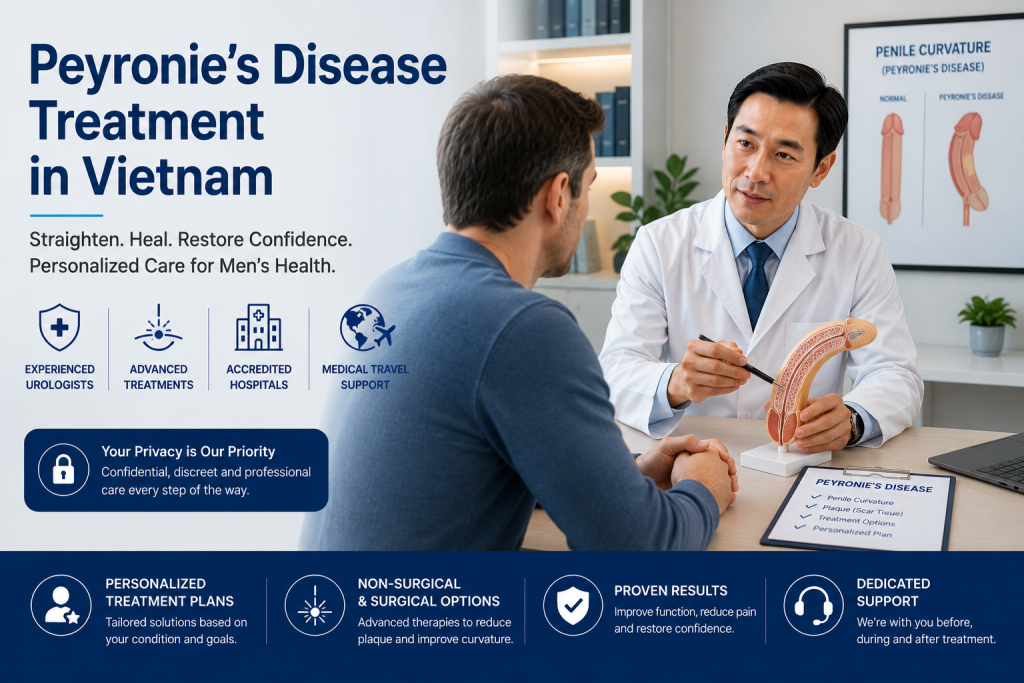
Peyronie’s disease treatment in Vietnam offers international patients confidential urology consultation, advanced non-surgical and surgical options, and personalized medical travel support.
4. How Much Does Peyronie’s Disease Treatment Cost in Vietnam? (2026 Price Guide)
Financial clarity is essential when coordinating an international medical trip. Overseas patients choosing Vietnam routinely save between 60% to 75% on complex urological care compared to Western surgical fees, without making a single compromise on material quality, clinical safety, or surgical outcomes.
Global Cost Comparison Table (USD)
| Medical Service / Procedure | United States | Australia | United Kingdom | Vietnam (Premium Wing) |
| Consultation + Inducted Penile Doppler Ultrasound | $650 – $1,200 | $700 – $1,300 AUD | £500 – £850 | $150 – $280 |
| Intralesional Injection Cycle (Per Injection) | $1,500 – $3,000 | $1,700 – $3,200 AUD | £1,200 – £2,400 | $450 – $750 |
| Low-Intensity Shockwave Therapy (Full 6-Session Course) | $2,400 – $4,000 | $2,600 – $4,500 AUD | £1,800 – £3,200 | $650 – $1,100 |
| Penile Plication (Nesbit) Corrective Surgery | $9,500 – $14,000 | $11,000 – $16,000 AUD | £7,500 – £11,500 | $2,800 – $4,200 |
| Advanced Plaque Grafting Reconstructive Surgery | $16,000 – $25,000+ | $18,500 – $28,000+ AUD | £13,000 – £20,000 | $5,500 – $8,500 |
5. Top Accredited Hospitals for Peyronie’s Care in Vietnam
To ensure the highest safety profiles, meticulous tissue alignments, and superior functional outcomes, patients should select fully accredited, licensed multi-specialty hospitals led by credentialed andrological departments.
FV Hospital – Urology & Andrology Department (Ho Chi Minh City)
Located in Ho Chi Minh City’s District 7, FV Hospital is highly celebrated as one of the premier private healthcare centers in Vietnam to maintain prestigious Joint Commission International (JCI) accreditation. This represents the absolute gold standard for global healthcare safety, strict infection control, and premium quality management. Their dedicated Urology & Andrology Department features an elite clinical team specialized in complex penile reconstructions, advanced grafting techniques, and non-invasive plaque therapies. Featuring a highly efficient international patient department, they provide seamless care, detailed medical translation, and expert coordination with international health insurance providers.
Vinmec International Hospital Network (Hanoi & Ho Chi Minh City)
As the flagship premium healthcare brand of Vingroup—Vietnam’s largest private enterprise—the JCI-accredited Vinmec International Hospitals in Hanoi (Vinmec Times City) and Ho Chi Minh City (Vinmec Central Park) feature world-class clinical infrastructure. Their urology centers are equipped with advanced micro-surgical suites, high-resolution diagnostic imaging, and luxury private inpatient recovery wings. Vinmec operates under strict, evidence-based international clinical protocols, providing foreign patients with highly personalized case management, dedicated English-speaking medical teams, and premium post-procedure care.
Binh Dan Hospital – Specialized Andrology Wing (Ho Chi Minh City)
For specialized academic authority, Binh Dan Hospital is historically recognized as the foundational pioneer and leading institution for specialized andrology and male reproductive medicine in Vietnam. Their specialized high-end international division provides foreign patients with direct access to senior professors, academic researchers, and urological department heads who have performed some of the highest volumes of plication surgeries, advanced plaque releases, and complex penile reconstructions in Southeast Asia. This exceptional experience makes it a highly reliable option for complex surgical cases or secondary corrective procedures.
6. The Patient Journey and Clinical Recovery Timeline
Undergoing a major penile reconstructive surgery abroad requires a structured, well-planned timeline to accommodate your clinical treatments, healing milestones, and travel safety.
Phase 1: Pre-Arrival Digital Case Coordination
Your care pathway begins entirely online. Through secure, encrypted communication channels, you will share your medical history, photographs of the penile curvature from multiple angles (taken discreetly during a natural erection), any prior ultrasound reports, and a list of current medications with your international case coordinator. Your assigned surgeon will review this data during a virtual video consultation to confirm that you are in the stable chronic phase, discuss the optimal surgical strategy (such as plication vs. grafting), and establish a transparent, fixed financial quote.
Phase 2: The Day of Surgery
Upon arriving at the hospital and completing your final in-person diagnostic workup, you will be escorted into the advanced operating pavilion.
The procedure is performed under general anesthesia or spinal block, typically lasting between 60 to 120 minutes depending on the structural complexity. The surgeon makes a small, highly concealed incision—often utilizing a standard circumcision-style cut around the base of the glans—to access the deep tunica albuginea. The plaque is addressed with extreme micro-precision, the shaft is fully straightened, and the incision is closed with fine, dissolvable sutures that leave absolutely no disruptive external scars.
Phase 3: Post-Operative Healing and Activity Timeline
-
Days 1 – 2 (Hospital Recovery): You will spend 1 or 2 nights recovering comfortably in your private luxury hospital room. The nursing team will administer intravenous antibiotics to protect the surgical site and manage local discomfort with tailored pain relievers. A light compression dressing is applied around the shaft to minimize local swelling.
-
Days 3 – 7 (Local Hotel Rest): Following hospital discharge, focus on quiet rest at your hotel. Expect mild to moderate localized swelling, bruising, and a dull pressure across the groin, which is easily managed with oral medications. Around day 7 or 10, you will return to the clinic for a routine wound check and to receive your formal “Fit to Fly” flight safety clearance from your surgeon.
-
Weeks 2 – 4 (Gradual Return to Routine): Local swelling and bruising will fade completely. Most patients can comfortably return to light daily activities, professional desk work, and domestic travel. However, heavy lifting, strenuous physical exercise, and swimming must be strictly avoided to protect the internal healing zones.
-
Weeks 6 – 8 (Full Tissue Maturation): Internal tissues and grafts are completely healed and physically stable. Your urologist completes a final digital checkup to verify optimal structural integrity. Once your surgeon confirms complete architectural healing, you are cleared to safely resume full physical and sexual intimacy with complete confidence.
7. Practical Travel and Lifestyle Guide for International Patients
To guarantee your medical travel experience in Vietnam is smooth, comfortable, and stress-free, keep these practical travel tips in mind.
Streamlined Visa and Local Transport Protocols
Securing entry into Vietnam is highly efficient via the government’s official E-visa portal online, which easily grants a stay of 30 or 90 days with single or multiple entries for international travelers. For local transportation, avoid unverified street taxis and utilize modern, air-conditioned ride-hailing applications like Grab. This application provides transparent, upfront pricing directly on your smartphone, entirely eliminating any language barriers, currency confusion, or local route disputes.
Choosing Your Recovery Accommodation
When booking your hotel, look for premium 4-star or 5-star properties located within a convenient 10-to-15-minute drive of your primary medical center. Vietnam’s luxury hospitality sector is highly affordable, allowing you to recover in exceptional comfort, access room service, and enjoy a peaceful environment at a fraction of Western rates.
Because regions like Southern Vietnam experience year-round tropical warmth and humidity, pack lightweight, loose-fitting cotton clothing to maximize your physical comfort, prevent pelvic friction, and keep your surgical incision sites perfectly cool, clean, and dry during your initial post-operative recovery walks.
Conclusion: Reclaiming Your Confidence and Well-Being
Undergoing Peyronie’s disease treatment in Vietnam offers an exceptionally safe, medically advanced, and confidential path to permanently resolving severe penile curvature and restoring your physical vitality. By partnering with Vietnam’s premier, JCI-accredited international hospitals, you gain direct access to elite, internationally trained reconstructive urologists and advanced biocompatible graft materials—all while saving thousands of dollars compared to Western clinical costs.
When planning your care, always prioritize established clinical quality: select fully licensed medical wings with recognized international credentials, work with verified board-certified specialists, and verify that your tailored treatment package is completely transparent and all-inclusive. With the right clinical preparation, your medical trip to Vietnam will provide a safe, permanent solution that allows you to return home with a renewed sense of health, structural confidence, and personal happiness.
Frequently Asked Questions (FAQs)
1. Will corrective surgery for Peyronie’s disease reduce my total penile length?
Penile plication procedures (the Nesbit technique) straighten the shaft by shortening the long, unaffected side to match the side restricted by the plaque, which can result in a minor loss of perceived length (typically less than 0.5 to 1 centimeter). However, if maximizing length is your primary clinical objective, advanced plaque incision/excision and grafting surgeries or simultaneous inflatable penile implant placements performed by elite specialists in Vietnam can safely straighten the penis while preserving or restoring maximum anatomical length.
2. How long do I need to remain in Vietnam for a Peyronie’s surgical procedure?
For a safe and clinically sound recovery journey, international patients undergoing plication or grafting surgeries should plan to stay in Vietnam for a minimum of 10 to 14 days. This timeframe safely covers your comprehensive pre-operative physical evaluations, the surgical procedure itself, 1 to 2 nights of inpatient hospital monitoring, a full week of local hotel rest, and your vital day-7 or day-10 follow-up wound evaluation and formal “Fit to Fly” flight safety clearance from your surgeon.
3. Can the fibrous plaque of Peyronie’s disease return after a successful surgery?
The risk of recurrence is exceptionally low if the operation is performed correctly during the chronic stable phase of the disease. Because elite Vietnamese urologists strictly adhere to international clinical guidelines and confirm that your penile curvature has been completely stable for at least 3 to 6 months before operating, the active scarring process has fully stopped, ensuring that your newly straightened anatomy remains structurally stable over the long term.
Looking for Peyronie’s Disease Treatment in Vietnam?
Get confidential guidance on penile curvature treatment, urology specialists, diagnostic options, estimated costs, and appointment planning in Vietnam.