
Quick Navigation
The Ultimate Guide to Stem Cell Fat Grafting in Vietnam: Cost, Procedure, and Medical Tourism Benefits
The global evolution of aesthetic medicine has shifted drastically toward natural, long-lasting, and biologically active solutions. Traditional dermal fillers and standard lipofilling methods are increasingly being enhanced by advanced biotechnology. At the forefront of this revolution is Stem Cell Fat Grafting—scientifically known as Cell-Assisted Lipotransfer (CAL).
As international medical travel reaches new heights, Vietnam has transformed into a leading global hub for advanced regenerative aesthetics. Combining state-of-the-art international laboratory standards with highly competitive pricing, the country attracts thousands of global patients annually. This article provides an extensive, SEO-optimized exploration of what stem cell fat grafting entails, how it works, and why choosing Vietnam for this procedure is a highly strategic decision for your aesthetic and financial goals.
What is Stem Cell Fat Grafting (Cell-Assisted Lipotransfer)?
Stem cell fat grafting is a highly advanced autologous (using your own tissue) transplantation technique. While conventional fat grafting simply transfers fat from a surplus area (such as the abdomen or thighs) to a deficient area (like the face, breasts, or buttocks), CAL enhances this process through cellular biology.
Standard lipofilling suffers from an unpredictable survival rate. According to systemic clinical reviews on National Institutes of Health (NIH) databases, anywhere from 50% to 70% of transferred fat can be reabsorbed by the body within the first few months. This occurs because the newly transplanted fat cells lack an immediate blood supply, leaving them starved of oxygen and essential nutrients.
Cell-Assisted Lipotransfer solves this fundamental limitation. By extracting and isolating Adipose-Derived Stem Cells (ADSCs) from a portion of the harvested fat and mixing them back into the remaining fat tissue, scientists create a highly enriched, robust graft. These stem cells fundamentally alter the local microenvironment, driving the retention rate of the injected fat up to an impressive 70% to 80%.
How Adipose-Derived Stem Cells (ADSCs) Work
The primary agents behind the success of this procedure are Adipose-Derived Stem Cells, which reside abundantly within the structural network of our fat tissue. These multipotent cells offer major regenerative benefits:
-
Angiogenesis (Neovascularization): ADSCs release potent paracrine factors, including Vascular Endothelial Growth Factor (VEGF). This action stimulates the rapid development of new capillary networks directly inside the newly transferred fat, ensuring the cells receive vital blood flow immediately.
-
Adipogenesis: Once injected into the target area, a significant percentage of these stem cells naturally differentiate into new, mature fat cells, adding long-term volume.
-
Tissue Rejuvenation and Collagen Production: Beyond simple volume expansion, ADSCs trigger localized fibroblasts to produce new collagen and elastin, noticeably improving skin elasticity, texture, and radiance.
The Clinical Framework of Stem Cell Fat Grafting in Vietnam
Undergoing a cell-assisted lipotransfer procedure in a premier Vietnamese clinical facility involves a meticulously structured, multi-phase medical protocol designed to maximize cellular viability.
Phase 1: Harvesting the Tissue (Liposuction)
Using gentle syringe liposuction or specialized low-pressure systems, the plastic surgeon extracts high-quality fat from donor sites. Common areas include the lower abdomen, flanks, or inner thighs. Low pressure is absolutely critical to preserve the integrity of both the fat cells (adipocytes) and the delicate surrounding stem cell niche.
Phase 2: Isolation of the Stromal Vascular Fraction (SVF)
The harvested lipoaspirate is divided into two distinct portions:
-
Portion A: Undergoes gentle centrifugation and washing to isolate pure micro-fat particles.
-
Portion B: Sent directly to an on-site, certified Good Manufacturing Practice (GMP) laboratory. Here, the tissue undergoes enzymatic digestion or mechanical processing to isolate the Stromal Vascular Fraction (SVF)—a highly concentrated cellular pellet containing millions of viable ADSCs, endothelial progenitor cells, and supportive extracellular matrix elements.
Phase 3: Creating the Enriched Graft
The highly concentrated SVF pellet is meticulously recombined with the purified fat from Portion A. This creates a bio-advanced, “super-charged” fat graft where the ratio of stem cells to adipocytes is exponentially higher than what occurs naturally in the human body.
Phase 4: Precision Infiltration
The surgeon utilizes specialized micro-cannulas to inject the enriched fat into the recipient sites. The grafting is performed utilizing a multi-planar, micro-droplet distribution technique. By placing tiny droplets of fat across multiple tissue layers, every single cell maximizes its contact with the surrounding host tissue, accelerating nutrient absorption.
Key Clinical Applications of the Procedure
Stem cell fat grafting is extremely versatile, serving both pure aesthetic enhancements and complex reconstructive surgeries.
Facial Rejuvenation and Volumization
As the body ages, it naturally loses deep fat pads in the face, leading to hollow temples, sunken cheeks, deep nasolabial folds, and sagging skin. CAL acts as a natural, permanent volumetric filler. Furthermore, because of the high concentration of stem cells, patients experience a profound “stem cell glow” as skin texture, pigmentation, and fine lines improve over the subsequent 6 months.
Natural Breast and Buttock Augmentation
For individuals seeking a moderate increase in breast or buttock volume without the risks of silicone implants (such as capsular contracture or breast implant illness), stem cell fat grafting is an ideal alternative. The enrichment process ensures that the breasts remain soft, natural to the touch, and free from the structural lumps or oil cysts often caused by conventional fat grafting failures.
Reconstructive Surgery and Scar Revision
Beyond aesthetics, the powerful tissue-remodeling properties of ADSCs are widely used to treat severe scar contractures, radiation-induced tissue damage, and congenital asymmetry. The anti-inflammatory nature of these cells softens rigid scar tissue and restores normal cellular function.
Why Choose Stem Cell Fat Grafting in Vietnam?
Vietnam has rapidly climbed the ranks of international medical tourism destinations, especially for regenerative aesthetics and advanced cellular therapies.
Advanced Regulatory Standards and GMP Laboratories
The Ministry of Health in Vietnam has fostered a highly progressive yet strictly monitored environment for regenerative medicine. Leading hospitals in Hanoi and Ho Chi Minh City boast international-standard cleanrooms and automated cellular isolation systems that mirror those found in Japan, South Korea, and Western Europe.
World-Class Surgical Expertise
Vietnamese plastic surgeons are globally recognized for their meticulous skill and precision. Many leading specialists hold advanced degrees and fellowships from elite institutions in the United States, South Korea, and Australia. They combine Western medical training with a deep understanding of refined, natural Asian facial and body aesthetics.
Remarkable Costs and Efficiencies of Stem Cell Fat Grafting in Vietnam
The most compelling factor for international patients is the exceptional cost savings, achieved without compromising medical quality.
| Procedure Location | Average Cost Range (USD) | Retention Rate Estimation | Medical Standards |
| United States | $9,000 – $25,000 | 50% – 80% (Varies widely) | FDA / JCI |
| South Korea | $6,500 – $14,000 | 65% – 80% | KAHF / JCI |
| Vietnam | $3,000 – $6,000 | 70% – 85% | MOH / ISO / JCI |
The significantly lower cost in Vietnam is driven by lower operational overhead, localized medical staff structures, and favorable exchange rates—allowing patients to receive premium care at a fraction of Western prices.
Stem Cell Fat Grafting vs. Traditional Dermal Fillers
For patients debating between continuous dermal filler injections and a singular surgical intervention, evaluating long-term value is critical.
| Feature | Stem Cell Fat Grafting (CAL) | Temporary Dermal Fillers (HA) |
| Composition | 100% Autologous Tissue & Stem Cells | Synthetic/Cross-linked Hyaluronic Acid |
| Longevity | Permanent (Once cells integrate) | Temporary (6 to 18 months) |
| Biocompatibility | Perfect; Zero risk of foreign body rejection | Risk of delayed granulomas or hypersensitivity |
| Skin Quality | Active cellular rejuvenation & collagen synthesis | Basic mechanical hydration and volume filling |
| Long-Term Cost | One-time investment with permanent results | Compounding expenses due to perpetual maintenance |
While synthetic fillers are convenient for immediate, short-term touch-ups, they cannot match the holistic tissue-regenerating properties of your own stem cell-enriched fat.
Important Safety Considerations and Risk Management
While CAL exhibits an exceptional safety profile due to its autologous nature, it remains a highly specialized surgical procedure. It should only be performed by board-certified plastic surgeons operating within licensed hospital facilities.
Potential minor side effects include localized swelling, bruising, and temporary numbness at both the harvest and injection sites. These issues typically resolve within 7 to 14 days. Choosing a clinic with an uncompromised sterile chain and an advanced cell-processing laboratory completely eliminates major risks such as bacterial contamination, fat embolism, or extensive fat necrosis.
Strategic Integration of Stem Cell Therapies in Vietnam
Stem cell fat grafting represents just one facet of Vietnam’s thriving biomedical landscape. The country’s top-tier institutions routinely integrate cell-assisted lipotransfer with broader systemic and targeted regenerative applications.
For instance, patients traveling to Vietnam frequently combine facial fat grafting with localized cutaneous treatments, such as stem cell acne scar treatment in Vietnam, which focuses on using cellular signaling to rebuild deep dermal defects left by severe dermatological conditions.
Furthermore, international medical travelers are increasingly utilizing comprehensive clinical consultations to explore systemic benefits. To fully understand how these procedures align with regional healthcare protocols, cell tracking, and therapeutic processing, you can read our comprehensive analysis on stem cell therapy in Vietnam and regenerative treatments explained.
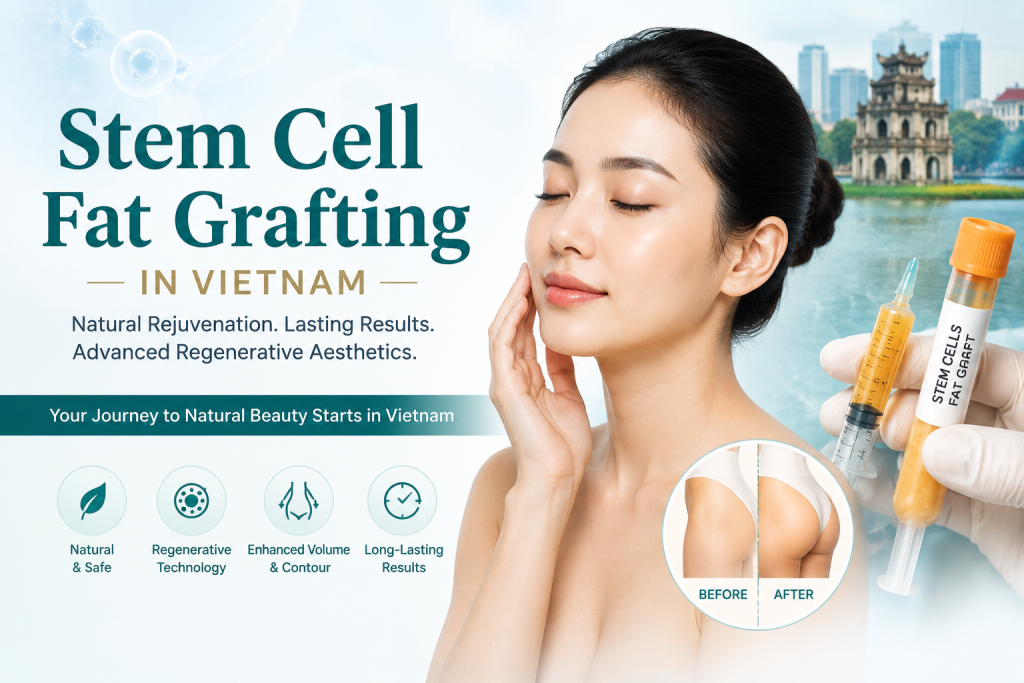
Stem Cell Fat Grafting in Vietnam combines regenerative medicine and cosmetic enhancement to restore facial volume, improve skin quality, and achieve natural-looking rejuvenation at internationally recognized clinics.
Preparing for Your Medical Tourism Journey to Vietnam
If you are planning to travel to Vietnam for Cell-Assisted Lipotransfer, following a structured preparation timeline ensures a seamless and successful experience:
-
Step 1: Virtual Consultation: Secure an initial telehealth consultation with your chosen Vietnamese medical coordinator. Prepare to share your complete medical history, clear high-resolution photographs of your target areas, and your specific aesthetic expectations.
-
Step 2: Medication Screening: In alignment with global surgical guidelines published by organizations like the International Society of Aesthetic Plastic Surgery (ISAPS), you must stop taking blood-thinning medications, aspirin, and specific herbal supplements at least two weeks before your scheduled surgery to minimize bruising.
-
Step 3: Plan Your Stay: For a standard facial or moderate body stem cell fat grafting procedure, expect an optimal stay of 7 to 10 days in Vietnam. This window allows for precise preoperative mapping, the procedure itself, and vital follow-up assessments before you fly home.
Summary
Stem Cell Fat Grafting represents a major leap forward in modern anti-aging and reconstructive medicine. By utilizing the regenerative power of Adipose-Derived Stem Cells, this procedure delivers natural, safe, and permanent structural volume.
With its world-class medical infrastructure, highly skilled surgeons, and cost-effective treatment packages, Vietnam stands out as an exceptional choice for international patients seeking premium regenerative care. Investing in a cell-enriched treatment in Vietnam means choosing long-term, natural vitality for your body and skin.
Considering Stem Cell Fat Grafting in Vietnam?
VnMedtour can help you connect with trusted hospitals and aesthetic specialists in Vietnam for stem cell fat grafting consultation, treatment planning, and medical travel support.
Get guidance on treatment options, estimated costs, clinic selection, and recovery planning in Vietnam.