
Quick Navigation
The Ultimate Guide to Stem Cell Therapy for Knee Osteoarthritis in Vietnam: Costs, Regimen, and Cartilage Regeneration
Chronic joint pain can severely diminish your quality of life, turning simple daily movements like walking, climbing stairs, or enjoying recreational activities into agonizing tasks. For decades, patients suffering from degenerative joint diseases faced a rigid, progressive treatment ladder: shifting from short-term anti-inflammatory medications to lubricating intra-articular hyaluronic acid injections, and ultimately undergoing invasive major surgery like total knee replacement.
However, advanced biotechnology is fundamentally rewriting this medical paradigm. At the forefront of this shift is Stem Cell Therapy for Knee Osteoarthritis—a breakthrough in regenerative medicine designed to repair structural joint damage, eliminate chronic inflammation, and actively stimulate long-term tissue healing.
As global healthcare expenses continue to climb, international medical travelers are looking beyond traditional Western borders for advanced cellular treatments. Today, Vietnam has emerged as a premier global hub for cutting-edge regenerative orthopedics. By combining state-of-the-art Good Manufacturing Practice (GMP) laboratory infrastructure with world-class surgical expertise and highly competitive pricing, the country attracts thousands of international patients annually.
This comprehensive, SEO-optimized guide provides an extensive look into why choosing Stem Cell Therapy for Knee Osteoarthritis in Vietnam is a highly strategic and life-changing decision for your health, mobility, and financial well-being.
Understanding the Anatomy of Joint Degeneration
To fully appreciate how cellular therapy works, it is important to understand why conventional treatments frequently fail to deliver permanent relief.
The Functional Role of Knee Cartilage
A healthy knee joint relies on a smooth, glistening layer of connective tissue known as articular cartilage. This specialized structure serves as a natural shock absorber, preventing friction by ensuring that the two primary bones—the femur (thigh bone) and the tibia (shin bone)—glide seamlessly against each other during motion.
Unlike skin, muscle, or bone, articular cartilage is completely avascular and aneural. This means it lacks an internal blood supply to deliver regenerative nutrients and has no nerves to trigger early warning signs of minor wear. Because sụn khớp possesses no innate capacity for self-repair, any micro-tear, physical trauma, or age-related degeneration initiates a continuous, irreversible decline.
The Pathology of Osteoarthritis
Osteoarthritis (OA) is a progressive degenerative condition characterized by the mechanical breakdown of this protective cellular matrix. As the disease advances, several destructive structural changes occur simultaneously within the joint:
-
Cartilage Matrix Loss: The smooth surface of the cartilage cracks, shreds, and gradually wears away, exposing the raw underlying bone.
-
Joint Space Narrowing: As the cellular cushion disappears, the physical gap between the bones shrinks, leading to painful bone-on-bone friction.
-
Subchondral Bone Alterations & Osteophytes: In a flawed attempt to stabilize the unstable joint, the body produces localized bony projections known as bone spurs (osteophytes), which further restrict movement and inflame surrounding tissues.
-
Chronic Synovitis: Debris from the eroding cartilage flakes off into the joint capsule, triggering a perpetual, low-grade inflammatory response within the synovial membrane, causing chronic swelling, stiffness, and severe pain.
How Stem Cell for Knee Pain and Cartilage Regeneration Operates
When exploring advanced treatments, many patients begin their research using broad terms like stem cell for knee pain. However, the underlying science goes far beyond simple symptomatic relief.
The primary biological agents utilized in modern regenerative orthopedics are Mesenchymal Stem Cells (MSCs). These multipotent cells can be harvested from various autologous (self-derived) donor tissues—such as bone marrow (Bone Marrow Aspirate Concentrate – BMAC) or adipose tissue (Stromal Vascular Fraction – SVF)—or obtained from premium allogeneic (donor-derived) sources like umbilical cord tissue (Wharton’s Jelly).
When clinical specialists introduce a highly concentrated dose of MSCs directly into a damaged joint, the cells execute a sophisticated, three-pronged regenerative strategy:
1. The Homing Effect and Immunomodulation
The targeted joint acts as a biological beacon, releasing specific chemical distress signals (chemokines and inflammatory cytokines). Once introduced, the stem cells utilize their innate homing mechanism to migrate directly to the areas of highest mechanical friction and tissue damage.
Instead of differentiating immediately, their first critical task is to act as a powerful anti-inflammatory commander. The MSCs systematically reprogram the local immune environment, shifting destructive pro-inflammatory macrophages into healing anti-inflammatory states. This swift reduction in chronic joint inflammation is the primary reason patients report a dramatic drop in daily pain within the first few weeks following treatment.
2. Paracrine Signaling and the Cellular Microenvironment
Stem cells operate predominantly as highly advanced “biochemical factories.” They release a vast array of biologically active molecules, including exosomes, microRNAs, and vital growth factors (such as Transforming Growth Factor-beta (TGF-$\beta$) and Fibroblast Growth Factor (FGF)).
This chemical cocktail signals the patient’s remaining, dormant native cartilage cells (chondrocytes) to wake up, proliferate, and resume their vital work of synthesizing new extracellular matrix components like Type II collagen and glycosaminoglycans.
3. Active Stem Cell for Knee Cartilage Structural Repair
In specialized clinical environments, MSCs are increasingly applied to target structural deficits. In cases of distinct structural voids, the stem cells adhere directly to the damaged areas.
Over subsequent months, influenced by localized mechanical cues and chemical signaling within the joint fluid, these cells can differentiate directly into chondrocyte-like lineages. This progressive cellular growth builds a stable, durable fibrocartilaginous matrix that fills structural gaps, widening the narrowed joint space and restoring smooth motion.
Navigating the Broad Spectrum of Stem Cell for Knee Arthritis
Medical terminology can occasionally confuse patients seeking definitive answers. For instance, many individuals wonder if a distinction exists when researching options for stem cell for knee arthritis.
“Arthritis” serves as an broad clinical term covering over 100 distinct conditions that cause joint inflammation. While conditions like Rheumatoid Arthritis (an autoimmune disorder) or Gout (a metabolic disease) fall under this wider heading, Osteoarthritis remains the most widespread form of knee arthritis worldwide.
When evaluating cellular treatments for general knee arthritis, a precise medical diagnosis is vital. While rheumatoid conditions require systemic intravenous protocols to modulate the entire immune system, mechanical wear-and-tear arthritis responds exceptionally well to direct, targeted intra-articular injections.
By delivering millions of active, anti-inflammatory stem cells directly into the synovial space, this therapy neutralizes the destructive enzymes (such as matrix metalloproteinases) that drive arthritic decay, offering a highly effective alternative for patients who have found no relief from traditional physical therapy or cortisone treatments.
The Clinical Regimen: What to Expect During Treatment in Vietnam
Choosing to undergo Stem Cell Therapy for Knee Osteoarthritis in Vietnam grants you access to an organized, internationally accredited medical protocol designed to prioritize patient safety and maximize cellular viability.
Phase 1: Comprehensive Diagnostics and Pre-Mapping
Your therapeutic journey begins with an extensive orthopedic evaluation. Physicians utilize high-resolution, weight-bearing X-rays and 1.5T or 3.0T Magnetic Resonance Imaging (MRI) to assess your joint damage based on the internationally recognized Kellgren-Lawrence (KL) Grading System:
-
Grade 1 (Doubtful): Minimal osteophyte formation; normal joint space.
-
Grade 2 (Mild): Definite osteophytes; possible joint space narrowing.
-
Grade 3 (Moderate): Moderate osteophyte development; clear joint space narrowing; structural sclerosis.
-
Grade 4 (Severe): Large osteophytes; severe joint space narrowing; advanced bone-on-bone friction.
Note: While Grades 1 through 3 are the ideal targets for structural cartilage regeneration, Grade 4 patients frequently utilize this therapy as an excellent palliative option to eliminate chronic pain and delay major surgery.
Phase 2: Harvesting and Laboratory Processing
Depending on your personalized clinical plan, stem cells are obtained via one of two major pathways:
-
The Autologous Adipose Pathway (SVF): Performed under local anesthesia, a specialist conducts a mini-liposuction procedure to harvest a small volume of fat from your abdomen or thigh. This tissue is processed in an on-site, internationally certified laboratory using specialized enzymes and filtration systems to isolate the Stromal Vascular Fraction (SVF), which is exceptionally rich in native ADSCs.
-
The Allogeneic Umbilical Cord Pathway (UC-MSCs): For patients who prefer to avoid a harvesting procedure, clinics utilize pre-screened, ultra-pure Umbilical Cord-Derived Mesenchymal Stem Cells. These cells are cultivated under strict sterile conditions inside premium, certified Good Manufacturing Practice (GMP) laboratories, ensuring immense vitality and zero risk of cross-contamination.
Phase 3: Precision Ultra-Sound Guided Injection
On the day of your procedure, you are positioned comfortably in a sterile outpatient suite. The physician utilizes real-time musculoskeletal ultrasound guidance to visualize the inside of your knee joint. This step is absolutely vital; blind injections have an error rate of up to 20%, whereas ultrasound guidance ensures the cellular graft is placed with pinpoint accuracy directly into the areas of greatest cartilage erosion or the synovial recess. The entire injection takes less than 30 minutes and requires no general anesthesia.
Phase 4: Post-Treatment Recovery and Rehabilitation
Because the procedure is minimally invasive, there is no extensive downtime. You can walk out of the clinic on the same day.
During the first 48 hours, mild localized swelling or a feeling of fullness within the joint is completely normal, representing the initial activation of the localized cellular response. Patients are provided with a customized, low-impact physical therapy regimen designed to stimulate fluid circulation within the joint without overloading the newly introduced cells, accelerating your return to pain-free mobility.
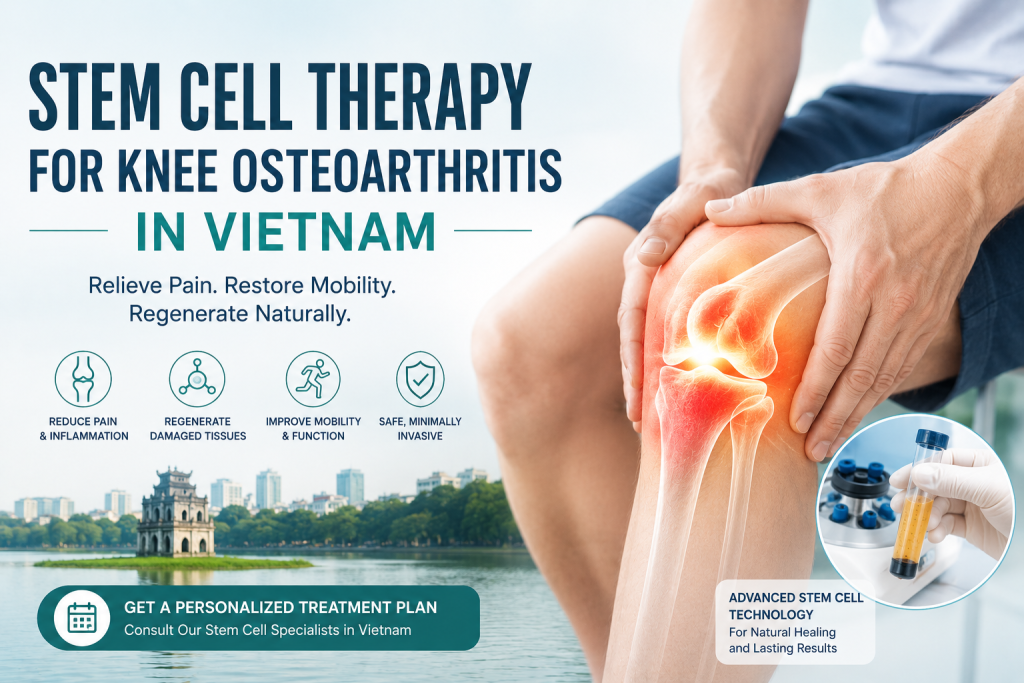
Stem Cell Therapy for Knee Osteoarthritis in Vietnam offers a minimally invasive regenerative treatment designed to reduce joint pain, improve mobility, and support cartilage healing at leading Vietnamese medical centers.
Why Choose Vietnam for Regenerative Orthopedics?
Vietnam has steadily climbed the ranks of elite international medical tourism destinations, rapidly becoming a preferred choice for advanced cellular medicine and orthopedic care.
1. International Laboratory Standards and Advanced Infrastructure
The Ministry of Health in Vietnam maintains a progressive yet strictly monitored regulatory framework for cellular therapies. Leading medical centers across major cities like Hanoi and Ho Chi Minh City feature state-of-the-art cleanrooms, automated cell-counting technologies, and cryopreservation systems that align with international ISO and GMP standards. These facilities closely match the laboratory protocols utilized in medical hotspots like Japan, South Korea, and Western Europe.
2. World-Class Clinical Expertise
Vietnamese orthopedic surgeons and regenerative medicine specialists are highly respected globally for their clinical precision and skill. Many leading experts hold advanced doctoral degrees and have completed extensive clinical fellowships at top-tier medical institutions across the United States, Australia, and South Korea. They regularly participate in international clinical trials, ensuring that your treatment follows the most up-to-date global medical guidelines.
3. Clear Financial Value
The most compelling advantage for international patients is the remarkable cost-efficiency achieved without making any compromises in clinical quality, safety, or sterility.
| Medical Tourism Destination | Average Cost per Joint (USD) | Regulatory Certification | Lab Standard |
| United States | $6,000 – $15,000 | FDA Guidelines | ISO Class 5 |
| Western Europe | $5,500 – $12,000 | EMA Framework | GMP Compliant |
| Vietnam | $2,500 – $5,500 | MOH Regulated | Certified GMP / ISO |
This significant price difference is driven entirely by lower domestic operational overhead, localized medical staff structures, and favorable currency exchange rates. This allows international travelers to receive premium, cutting-edge biological care at a fraction of Western prices.
Analyzing Long-Term Clinical Outcomes and Safety
For patients evaluating their healthcare options, understanding long-term success metrics and safety profiles is essential.
Clinical Success Rates
Peer-reviewed longitudinal data published in prominent journals like the Journal of Orthopaedic Translation show that over 80% of patients with mild-to-moderate knee osteoarthritis who undergo stem cell therapy report a significant, measurable reduction in pain scales (such as the Visual Analog Scale – VAS) and a marked improvement in joint function indexes (such as the WOMAC score) within 3 to 6 months post-injection. These positive structural and palliative benefits are frequently shown to persist for 2 to 5 years, depending on the patient’s age, baseline joint condition, and post-procedure lifestyle choices.
Comprehensive Risk Management
Because Mesenchymal Stem Cells are immunoprivileged—meaning they do not express major histocompatibility complex (MHC) Class II molecules—they do not trigger an aggressive immune rejection response from the host body. This makes both autologous and allogeneic MSC transfers remarkably safe.
Minor side effects are rare and typically limited to temporary soreness, localized bruising from the injection site, or minor joint stiffness, all of which generally resolve naturally within 3 to 7 days. Choosing a premier, certified medical facility completely removes major procedural risks such as deep joint infections or structural tissue misplacement.
Strategic Integration of Advanced Stem Cell Frameworks
Stem cell therapy for knee osteoarthritis represents just one facet of Vietnam’s rapidly growing biomedical landscape. The country’s top-tier institutions routinely integrate targeted orthopedic procedures with a wide range of specialized cellular and aesthetic treatments.
For example, many international medical travelers take advantage of their time in the country to combine joint procedures with advanced systemic therapies. To fully explore how these different cellular tracking protocols, regulatory standards, and therapeutic cleanrooms operate across the country, you can read our detailed analysis on stem cell therapy in Vietnam and regenerative treatments explained.
Additionally, the specialized laboratory infrastructure required to isolate highly viable Adipose-Derived Stem Cells (ADSCs) for joint health is closely linked to advanced aesthetic procedures. Patients looking to combine structural joint health with facial or body rejuvenation frequently explore cross-disciplinary options, such as stem cell fat grafting in Vietnam, which leverages the exact same tissue-rich cellular pathways to deliver long-lasting, natural volumization and deep dermal cell renewal.
Streamlining Your Medical Journey to Vietnam
Planning an international trip for advanced medical care requires careful attention to detail. Following a structured preparation framework ensures a smooth, stress-free, and successful experience:
-
Step 1: Digital Consultation & Medical Review: Connect with an international patient coordinator online. You will need to provide your latest medical records, orthopedic history, and recent knee MRI or X-ray scans for a comprehensive pre-screen by a specialist.
-
Step 2: Pre-Arrival Medication Adjustments: In strict compliance with global surgical safety standards established by organizations like the International Society of Arthroscopy, Knee Surgery and Orthopaedic Sports Medicine (ISAKOS), patients must discontinue all blood-thinning medications, high-dose aspirin, and specific anti-inflammatory supplements at least 14 days prior to injection to prevent internal joint bleeding.
-
Step 3: Itinerary Mapping: For a standard bilateral or unilateral ultrasound-guided knee injection, an overall stay of 5 to 7 days in Vietnam is highly recommended. This window comfortably covers your face-to-face preoperative evaluation, the day of the procedure, vital post-injection monitoring, and your initial guided physical therapy sessions before you board your flight home.
Summary
Stem Cell Therapy for Knee Osteoarthritis in Vietnam represents a major advancement in modern orthopedic medicine. By leveraging the natural healing and anti-inflammatory properties of Mesenchymal Stem Cells, this advanced therapy offers a safe, clinically proven, and highly effective alternative to continuous medication use and major joint replacement surgeries.
With its world-class medical facilities, highly experienced orthopedic specialists, and exceptional cost-saving packages, Vietnam stands out as a premier destination for international patients seeking to reclaim their active, pain-free mobility. Choosing a cell-enriched joint treatment in Vietnam is a powerful investment in your long-term health, structural vitality, and overall quality of life.
Considering Stem Cell Therapy for Knee Osteoarthritis in Vietnam?
VnMedtour can help you connect with trusted hospitals and regenerative medicine specialists in Vietnam for knee osteoarthritis consultation, treatment planning, and medical travel support.
Request a Free Knee Consultation
Get support with doctor selection, estimated costs, medical record review, appointment booking, and recovery planning in Vietnam.