
For individuals experiencing the discomfort, pain, or visible bulging of an inguinal hernia, prompt surgical intervention is often the only definitive cure. Left untreated, this common abdominal wall defect carries a continuous risk of severe complications, such as intestinal incarceration or strangulation.
However, in many Western countries like the United States, Australia, the United Kingdom, and Canada, the cost of elective general surgery has surged out of financial reach for uninsured or underinsured individuals. Simultaneously, public healthcare systems in these regions are frequently plagued by exhausting multi-month waiting lists.
This dual barrier of high costs and prolonged delays has accelerated the growth of global medical travel. Vietnam has rapidly transitioned into a premier medical tourism hub in Southeast Asia. By blending elite, internationally credentialed surgical teams and internationally accredited hospitals with highly competitive healthcare pricing, the country offers global patients world-class surgical treatment at a fraction of Western costs.
This ultimate guide provides an exhaustive, multi-dimensional analysis of everything you need to know about planning a safe, affordable, and highly successful journey for inguinal hernia repair in Vietnam.
Quick Navigation
1. Understanding Inguinal Hernias and the Need for Repair
An inguinal hernia occurs when intra-abdominal tissue—such as a portion of the small intestine, omentum, or fatty tissue—protrudes through a weak spot or tear in the lower abdominal muscles, specifically within the inguinal canal located in the groin. While anyone can develop this condition, it is statistically far more prevalent in men due to the natural anatomical pathway left by the descent of the testes during fetal development.
Symptoms and Clinical Presentation
Patients suffering from an inguinal hernia typically present with one or more of the following clinical signs:
-
A distinct, palpable bulge in the groin area or scrotum that becomes more prominent when standing, coughing, straining, or lifting heavy objects.
-
A dull, aching pain, burning sensation, or feeling of heaviness in the groin.
-
Localized pressure or weakness in the lower abdomen.
-
Occasional sharp pain or tugging sensations around the scrotum in male patients.
Why Watchful Waiting Carries Risks
While some small, asymptomatic hernias can be monitored temporarily under strict medical supervision, the American College of Surgeons (ACS) notes that the vast majority of inguinal hernias will gradually enlarge and become more symptomatic over time. The primary risk of delaying surgery is strangulation, a critical medical emergency where the blood supply to the herniated tissue becomes completely cut off. If not operated on within hours, tissue necrosis (gangrene) can set in, leading to life-threatening systemic infections like peritonitis.
2. Surgical Techniques: Open vs. Laparoscopic Repair
When undergoing surgery in Vietnam, your treatment plan will be highly customized based on your body mass index (BMI), natural anatomy, prior abdominal surgeries, and whether the hernia is unilateral (on one side) or bilateral (on both sides). Modern hospitals across Vietnam utilize two primary surgical modalities.
A. Open Inguinal Hernia Repair (Lichtenstein Tension-Free Technique)
In a traditional open repair, the surgeon makes a single incision (typically 6 to 8 centimeters in length) directly over the groin bulge. The protruding tissue is gently pushed back into its proper anatomical position within the abdominal cavity. The weakened muscular wall is then reinforced using a sterile, flexible synthetic mesh.
This approach is widely referred to as the “tension-free” repair because the mesh supports the muscle defect without pulling the edges of the muscle tightly together, drastically reducing post-operative pain and lowering the long-term recurrence rate. Open surgery is highly reliable and is often preferred for exceptionally large hernias, complex recurrent hernias, or patients who cannot safely undergo general anesthesia.
B. Laparoscopic Inguinal Hernia Repair (Minimally Invasive)
Laparoscopic surgery represents the modern gold standard for patient recovery. Instead of a single large incision, the surgeon creates three microscopic incisions (ranging from 0.5 to 1 centimeter) in the abdomen. A laparoscope—a thin tube equipped with a high-definition fiber-optic camera and light source—is inserted, illuminating the internal structures on a monitor.
The surgeon uses specialized micro-instruments to repair the hernia defect from the inside out, placing the reinforcing mesh behind the abdominal wall. There are two primary techniques utilized in laparoscopic repairs:
-
TAPP (Transabdominal Preperitoneal): The surgeon enters the peritoneal cavity and approaches the hernia space by making a small incision in the peritoneal lining.
-
TEP (Totally Extraperitoneal): The surgeon works entirely within the preperitoneal space without entering the actual abdominal cavity, minimizing the risk of accidental organ injury.
Comparing Surgical Approaches
| Feature | Open Hernia Repair | Laparoscopic Hernia Repair |
| Incision Size | Single 6–8 cm incision in the groin | Three 0.5–1 cm micro-incisions |
| Anesthesia Type | Local, spinal, or general anesthesia | Strictly general anesthesia |
| Post-Op Pain | Moderate; requires localized management | Minimal; rapid resolution |
| Recovery Timeline | 4 to 6 weeks for full physical strain | 1 to 2 weeks for full physical strain |
| Best Suited For | Massive, complex, or single unilateral hernias | Bilateral hernias, recurrent hernias, active individuals |
Vietnam has emerged as a top destination for medical tourists seeking high-quality specialized operations, particularly in the field of General Surgery in Vietnam. Among these, inguinal hernia repair is one of the most frequently performed procedures. Top-tier hospitals in Hanoi and Ho Chi Minh City leverage advanced equipment to perform general surgery using advanced techniques, ensuring minimal scarring and faster recovery times for hernia patients.
3. Cost Breakdown for Inguinal Hernia Repair in Vietnam
The most immediate catalyst driving global patients to travel to Vietnam for general surgery is the profound financial savings. Healthcare inflation in Western nations has made routine elective surgeries economically prohibitive. In contrast, Vietnam offers exceptional medical care at a sustainable, transparent price point.
Comparative Financial Breakdown
A standard, uncomplicated unilateral laparoscopic inguinal hernia repair using premium, FDA-approved synthetic mesh exhibits the following cost variations globally:
-
United States: $9,500 – $17,500 USD (Outpatient hospital fees, surgeon fees, and anesthesia fees are frequently billed separately, leading to unpredictable final expenses).
-
Australia: $7,000 – $11,000 AUD (Within private hospital networks for self-paying patients).
-
United Kingdom: £5,500 – £8,500 GBP (Within private healthcare setups).
-
Vietnam: $2,500 – $4,800 USD (Comprehensive, all-inclusive package pricing).
What is Included in a Vietnamese Medical Package?
One of the distinct advantages of traveling for care via specialized agencies in Vietnam is the use of transparent “bundled” packages. Unlike Western hospitals where patients receive multiple confusing bills months after the procedure, a standard surgical package in Vietnam generally encompasses:
-
All pre-operative diagnostic screenings (Complete blood counts, electrocardiograms, chest X-rays, and specialized abdominal ultrasounds).
-
The full surgeon, assistant surgeon, and anesthesiologist fees.
-
All operating room expenses, including advanced single-use laparoscopic instruments and premium biocompatible surgical mesh.
-
A 1-to-2-night stay in a private, luxury inpatient hospital room with 24/7 nursing care and all meals included.
-
All post-operative medications, antibiotics, pain management infusions, and follow-up consultations before hospital discharge.
Even when you factor in the cost of round-trip international flights, a week of relaxation at a luxury hotel during convalescence, and dedicated local transportation, patients regularly save up to 70% of their total out-of-pocket expenses compared to staying home, all while completely bypassing long waiting queues.
4. Top Internationally Accredited Hospitals in Vietnam
To ensure absolute clinical safety and maximize your long-term success, medical tourists traveling to Vietnam should restrict their treatment to fully accredited, multi-specialty international hospitals. These premier institutions operate under rigorous clinical quality mandates established by the Joint Commission International (JCI), which serves as the gold standard for global patient safety.
The leading medical facilities offering advanced general surgery for international travelers include:
Vinmec International Hospital Group
Vinmec is the most expansive premium private healthcare network in Vietnam, with its flagship campuses in Hanoi (Vinmec Times City) and Ho Chi Minh City (Vinmec Central Park) maintaining continuous JCI accreditation.
-
Surgical Infrastructure: The hospitals feature state-of-the-art positive-pressure operating theaters designed to completely eliminate airborne contaminants, cutting-edge Karl Storz high-definition laparoscopic towers, and dedicated intensive care units (ICUs) to handle any unexpected medical complexities.
-
International Patient Support: Vinmec operates highly professional international departments staffed with full-time coordinators fluent in English, French, Japanese, and Korean to facilitate seamless medical translations, medical record transfers, and direct billing with global health insurance providers.
FV Hospital (Ho Chi Minh City)
Located in the District 7 medical hub of Ho Chi Minh City, FV Hospital was founded by a group of French physicians and achieved full JCI accreditation. It stands out for its European-standard clinical governance.
-
Clinical Expertise: The Department of General Surgery at FV Hospital is deeply specialized in minimally invasive abdominal wall reconstruction. Their senior surgeons hold advanced degrees from European medical boards and routinely utilize ultra-lightweight, partially absorbable modern meshes that conform naturally to human tissue, drastically reducing chronic post-operative stiffness or groin discomfort.
-
Comprehensive Logistics: FV Hospital provides dedicated medical tourism services, assisting patients directly with airport transfers, visa extensions, and nearby hotel accommodations optimized for post-surgical recovery.
Hanoi French Hospital (HFH)
As the pioneering international hospital in Northern Vietnam, Hanoi French Hospital blends European medical culture with local hospitality.
-
Surgical Environment: Offering an intimate, patient-centric environment, HFH boasts an elite team of resident French and internationally trained Vietnamese general surgeons. Their operating blocks are systematically audited under European infection control protocols, assuring international travelers of an exceptionally low surgical site infection (SSI) rate.
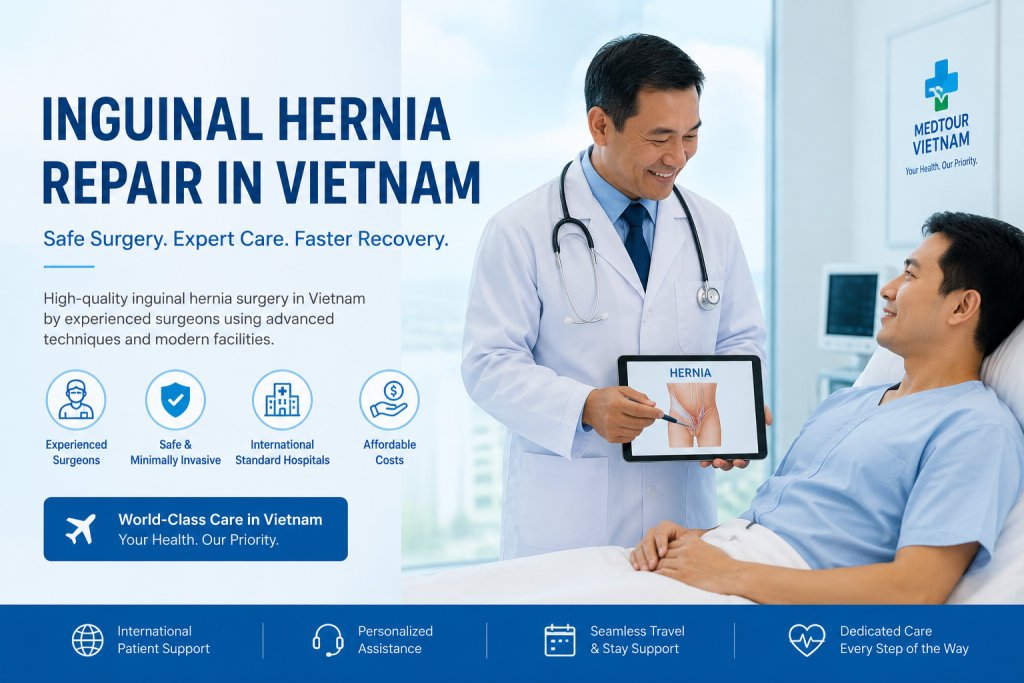
Inguinal hernia repair in Vietnam offers minimally invasive surgery, experienced specialists, modern hospitals, and affordable treatment costs.
5. Your Journey: Step-by-Step Guide to Inguinal Hernia Repair in Vietnam
Embarking on a cross-border medical trip requires thorough, meticulous preparation. By breaking down your journey into distinct operational phases, you can guarantee a safe, structured, and completely stress-free experience.
6. Recovery Timeline and Post-Operative Care Guidelines
Your long-term surgical outcome is heavily dependent on how strictly you respect your body’s healing timelines during the initial post-operative window. The synthetic mesh requires several weeks to become completely integrated into your surrounding abdominal tissue via a natural process called fibroblastic ingrowth.
The Immediate 48-Hour Window
During the first two days following surgery, localized swelling, mild bruising, and a feeling of tightness in the groin or scrotum are entirely normal physiological responses.
-
Activity: You should actively avoid prolonged bed rest. Gentle, slow walks around your private room or hotel suite are highly encouraged, as early mobilization drastically reduces the risk of post-operative pneumonia, stimulates sluggish bowel motility, and prevents blood clots in the lower extremities.
-
Pain Management: Take all prescribed pain medications on a strict, rotating schedule rather than waiting for the discomfort to become severe. Applying a cloth-wrapped ice pack to the groin for 15-minute increments can significantly minimize local swelling.
Weeks 1 to 2: Resuming Light Daily Activities
By the end of the first week, patients who underwent laparoscopic repairs generally experience a sharp decline in discomfort.
-
Diet: Focus on a clean diet rich in dietary fiber (leafy greens, fresh fruits, whole grains) and maintain high fluid intake to completely eliminate the risk of constipation. Straining during bowel movements exerts sudden intra-abdominal pressure that can stress the newly placed mesh.
-
Physical Restrictions: You may safely resume driving, light administrative office work, and casual walking. However, you must adhere to a strict lifting restriction: do not lift anything weighing more than 5 kilograms (11 pounds). Avoid strenuous abdominal exercises, running, or sudden twisting motions.
Weeks 4 to 6: Tissue Integration and Clearance
By the one-month milestone, the surgical incisions are typically completely closed and fading, and the mesh is structurally sound.
-
Clinical Clearance: Following a remote digital check-in or an evaluation by a local general practitioner in your home country, you can gradually reintroduce moderate physical activities, including swimming, jogging, and gym workouts.
-
Long-Term Precautions: According to guidelines from the European Hernia Society (EHS), it takes up to six full weeks for the abdominal wall to regain the majority of its native tensile strength. Refrain from extreme heavy lifting or high-impact competitive sports until you have crossed this six-week threshold.
7. How to Plan Your Medical Trip with Absolute Peace of Mind
Navigating a medical procedure in a foreign country can feel daunting without structured support. To make your journey seamless, it is highly recommended to collaborate with a professional, specialized agency such as Medtour Vietnam. Acting as your dedicated on-the-ground partner, a medical tourism agency streamlines the process by providing:
-
Direct, expedited communication lines with chief general surgeons at JCI-accredited hospitals.
-
Comprehensive, pre-negotiated all-inclusive medical packages with no hidden fees or unexpected surcharges.
-
Personalized local logistics, including dedicated airport meet-and-greet services, bilingual medical translators, and private point-to-point vehicle transfers.
-
Continuous remote post-operative tracking once you return home to ensure your recovery remains on a perfect trajectory.
To see how much you can save on various surgical procedures and to check the full list of accredited facilities, explore our comprehensive overview of General Surgery in Vietnam. By choosing a dedicated healthcare partner and leveraging Vietnam’s top-tier medical infrastructure, you can confidently resolve your inguinal hernia safely, affordably, and return home to a pain-free, active life.
Looking for Inguinal Hernia Repair in Vietnam?
Contact VnMedtour for hospital recommendations, estimated costs, and appointment support.