
For decades, breast reconstruction and aesthetic enhancement focused primarily on the end result: volume and shape. However, traditional surgical approaches often came at a high physical cost—marked by extensive tissue disruption, muscle trauma, significant post-operative pain, and prolonged recovery periods.
Today, a major paradigm shift is underway in aesthetic plastic surgery. Tissue Preservation Breast Augmentation in Vietnam has emerged as the modern gold standard. This advanced technique prioritizes the integrity of your body’s natural anatomy while delivering highly aesthetic, natural-looking, and long-lasting outcomes.
For international patients looking to combine this revolutionary, rapid-recovery procedure with world-class medical care and an exotic holiday, Vietnam has become the premier global destination. This ultimate guide will walk you through the science, benefits, costs, and journey of undergoing tissue preservation breast surgery in Vietnam.
Quick Navigation
What is Tissue Preservation Breast Augmentation?
At its core, Tissue Preservation Breast Augmentation in Vietnam is a surgical philosophy and methodology designed to minimize surgical trauma. Traditional breast augmentation often requires aggressive manual dissection, cutting of muscle fibers, and the tearing of connective tissues to create a pocket for the implant.
In contrast, the tissue preservation approach utilizes specialized instruments, high-definition optical magnification, and gentle hydrodynamic or balloon dissection to naturally separate anatomical planes. By protecting the blood vessels, nerves, lymphatic pathways, and supporting ligaments, this technique “preserves” the breast’s biological framework.
The Scientific Shift: Why Less Trauma Means Better Results
When tissue is cut or torn, the body initiates a profound inflammatory response. This leads to:
-
Increased edema (swelling) and hematoma (blood pooling).
-
Higher risk of capsular contracture (the body forming a hard, painful fibrous shell around the implant due to chronic inflammation).
-
Prolonged nerve numbness or permanent loss of nipple sensation.
By conserving these delicate tissues, patients experience significantly less physiological stress, resulting in a dramatic reduction in recovery times and post-operative discomfort.
The 4 Pillars of the Tissue Preservation Technique
The success of a tissue preservation procedure relies on a highly refined, four-step surgical protocol. Unlike conventional blind dissection, every step of this technique is executed with microscopic precision.
-
Atraumatic Tunneling and Visualization: Instead of wide, aggressive incisions, the surgeon creates a highly localized micro-incision, typically between 2.5 to 3.5 cm. Using high-definition endoscopic cameras and specialized blunt-tipped dissectors, the surgeon navigates through the natural anatomical layers. This ensures that every major blood vessel and sensory nerve pathway is identified and safely bypassed rather than severed.
-
Hydrodissection and Balloon Expansion: One of the most revolutionary aspects of this procedure is how the implant pocket is formed. While traditional surgeons used electrocautery (heat-cutting devices) or surgical scissors to cut away tissues and detach muscles, the tissue preservation way is entirely different. The surgeon introduces a specialized, temporary inflatable balloon device into the target plane. Once in place, the balloon is gently filled with a sterile saline solution. The outward, multidirectional hydraulic pressure gently coaxes the tissues to yield and stretch, naturally creating a perfect pocket without a single cut.
-
Subfascial Placement (The “No-Cut” Muscle Approach): To achieve natural coverage without sacrificing muscle function, implants are frequently placed in the subfascial pocket, which is directly beneath the fascia (a tough membrane enveloping the pectoralis major muscle). By sliding the implant under this strong fascial sheath rather than splitting or detaching the pectoralis major muscle itself, the muscular system remains entirely intact. Patients retain full upper-body strength, and the risk of “animation deformity”—where the breast unnaturally shifts or distorts when you flex your chest muscles—is completely eliminated.
-
The “No-Touch” Sleeve Insertion: To slide the implant through the micro-incision without damaging the surrounding skin edges or introducing bacteria, surgeons utilize a sterile, lubricated funnel known as the Keller Funnel or Motiva Insertion Sleeve. This “no-touch” method minimizes friction against the preserved tissue margins and reduces the risk of subclinical bacterial contamination, which is a leading cause of late-stage capsular contracture.
Why Choose Vietnam for Tissue Preservation Breast Augmentation?
Medical tourism in Southeast Asia has experienced exponential growth, with Vietnam leading the way as a top-tier hub for advanced aesthetic procedures. For international patients seeking premium plastic surgery, Vietnam offers a unique combination of medical excellence and high-end hospitality.
1. Board-Certified Expertise and Cutting-Edge Facilities
Aesthetic hospitals in Hanoi and Ho Chi Minh City feature state-of-the-art operating suites equipped with the latest endoscopic cameras, hydrodynamic dissection systems, and premium implant brands.
Plastic surgeons in Vietnam are highly trained globally, often holding active memberships in prestigious international bodies like the International Society of Aesthetic Plastic Surgery (ISAPS) and collaborating regularly with European, American, and Korean plastic surgery boards.
2. Incredible Cost Efficiency
Because of lower operational, administrative, and labor costs, patients can save up to 60% to 70% compared to the costs of the same procedure in the United States, Australia, or Western Europe—without compromising on safety, surgical talent, or implant quality.
3. The Ultimate Healing Environment
Recovery is a vital part of any surgical journey. Vietnam offers private, luxurious recovery suites, serene beach resorts in places like Da Nang or Nha Trang, and world-class hospitality, allowing you to heal in a stress-free, beautiful environment. Because tissue preservation techniques allow for rapid mobilization, you can comfortably enjoy light sightseeing, gourmet dining, and relaxing walks just days after your procedure.
Tissue Preservation vs. Traditional Breast Augmentation
To fully appreciate the benefits of this modern approach, it helps to compare it directly with classic breast surgery techniques:
| Feature | Traditional Breast Augmentation | Tissue Preservation Breast Augmentation in Vietnam |
| Surgical Dissection | Sharp cutting, tearing of tissues, cauterization | Blunt separation, balloon expansion, hydrodissection |
| Muscle Status | Often cut, split, or detached (Submuscular/Dual Plane) | Completely preserved (Subfascial or untouched Submuscular) |
| Nerve & Sensation Preservation | Higher risk of temporary or permanent numbness | Maximally preserved; sensory pathways are mapped and bypassed |
| Bleeding & Bruising | Moderate to high; relies heavily on thermal cautery | Minimal; blood vessels are spared, resulting in virtually no bruising |
| Post-Operative Pain | Significant; requires narcotics/opioids for days | Mild to moderate; easily managed with non-opioid analgesics |
| Recovery Time | 1 to 2 weeks of restricted basic mobility | 24 to 48 hours to resume light, daily activities |
| Capsular Contracture Risk | Standard risk rates | Significantly lower due to decreased inflammation and “no-touch” insertion |
Clinical Benefits of the Tissue Preservation Approach
1. Rapid Recovery (The 24-Hour Return to Normalcy)
Because the chest muscles are not sliced and the vascular network remains undisturbed, the body does not need to expend immense energy repairing structural damage. Many patients undergoing tissue preservation breast surgery are able to wash their hair, raise their arms, and walk comfortably within 24 hours of their procedure.
For a deeper look at what to expect during your surgical stay, explore our breast augmentation in Vietnam: a complete guide.
2. Preservation of Nipple and Breast Sensation
The breast and nipple-areola complex are innervated primarily by the lateral and anterior cutaneous branches of the fourth intercostal nerves. In traditional aggressive surgeries, these nerves are easily stretched or severed. By utilizing visual endoscopic guidance and gentle balloon expansion, these crucial pathways are left undisturbed, maintaining normal, natural sensitivity.
3. Reduced Long-Term Complications
According to clinical data published by the Aesthetic Surgery Journal, minimizing tissue trauma directly correlates with lower revision rates. The lack of raw, bleeding tissue surfaces within the breast pocket prevents the formation of seromas (fluid accumulation) and hematomas, which are primary triggers for long-term capsular contracture.
4. Highly Natural Aesthetic Results
Because the natural supporting ligaments (such as Cooper’s ligaments) are preserved rather than cut, the breast tissue retains its natural suspension and structural bounce. When paired with highly cohesive, ergonomically responsive implants—like those discussed by the U.S. Food and Drug Administration (FDA) in breast implant safety updates—the implant integrates seamlessly with your movement, shifting naturally whether you are lying down, running, or standing.
Who is an Ideal Candidate?
While tissue preservation breast augmentation is an outstanding choice for most patients, it is especially beneficial for individuals who:
-
Demand Minimal Downtime: Professionals, mothers, and active individuals who cannot afford weeks of strict bed rest.
-
Are Medical Tourists: International patients traveling abroad need a safe, rapid-healing option. If you are planning to travel for your transformation, reviewing our insights on cosmetic surgery in Vietnam can help you plan a seamless medical holiday.
-
Value Natural Sensation: Patients who prioritize the preservation of intimate sensitivity and natural breast warmth.
-
Have Adequate Tissue Coverage: Candidates with a moderate amount of natural breast tissue to cover a subfascial implant, though advanced dual-plane variations of tissue preservation can accommodate slender patients as well.
Note on Combined Procedures: If you have significant skin laxity or sagging due to pregnancy, nursing, or weight loss, you may achieve your ideal aesthetic goals by pairing your tissue preservation implant placement with a lifting procedure. Learn more about your options in our comprehensive guide to a breast lift in Vietnam.
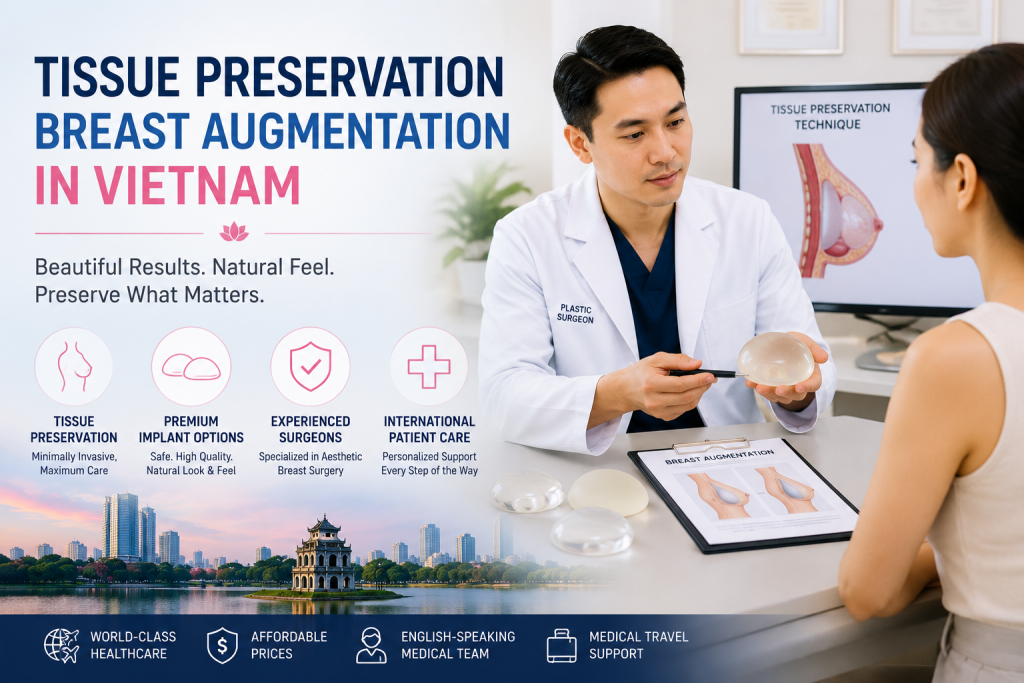
Tissue preservation breast augmentation in Vietnam focuses on gentle surgical techniques, premium implant options, natural-looking results, experienced plastic surgeons, and personalized medical travel support.
The Step-by-Step Medical Tourism Journey in Vietnam
Planning a surgical procedure abroad can feel overwhelming, but when managed by a professional medical tourism agency, the process is seamless and highly structured.
Phase 1: Pre-Arrival Virtual Consultation
Before you even book your flight to Vietnam, your journey begins with a private online consultation. You will share your medical history, aesthetic goals, and photographs with our partner plastic surgeons. Using advanced 3D simulation software, the surgeon can show you projected outcomes and recommend the ideal implant sizes and profiles.
Phase 2: In-Person Assessment & Lab Work
Upon arriving in Vietnam, you will visit our accredited partner hospital for a comprehensive, in-person consultation and pre-operative health check. This includes blood tests, an electrocardiogram (ECG), and a breast ultrasound or mammogram to ensure you are 100% cleared for surgery.
Phase 3: The Surgical Procedure
While you rest comfortably under light intravenous sedation (twilight anesthesia) combined with local tumescent numbing blocks, the surgeon:
-
Makes a precise, hidden micro-incision (usually in the inframammary fold).
-
Carefully channels down to the subfascial space using high-definition endoscopic visualization.
-
Deploys the saline-filled balloon expander to gently pave the way.
-
Glides the pre-washed, sterile implant into position using the “no-touch” sleeve.
-
Closes the incision using multi-layered, absorbable intradermal sutures and medical skin adhesive, eliminating the need for painful drain tubes.
Phase 4: Post-Operative Care & Recovery
-
Day 1: You will stay overnight in a private, modern hospital room with 24/7 nursing care. Because the muscle was not cut, your pain level is minimal, often described as mild muscle soreness after an intense workout.
-
Day 2: You are discharged to your hotel or luxury service apartment. You can comfortably wash your hair, walk around, and enjoy Hanoi or Ho Chi Minh City’s incredible culinary scene.
-
Day 3–6: Enjoy relaxing in Vietnam. You will attend minor follow-up checks where nurses will clean your incisions and monitor your early healing.
-
Day 7–10: Your final checkup and suture removal (if non-absorbable sutures were used). Your surgeon will provide you with a “Fit to Fly” medical certificate, and you can safely board your flight back home.
Understanding the Role of Advanced Implant Technology
A tissue preservation surgical approach is only as good as the device placed inside the body. Modern medical advancements have led to the creation of sixth-generation cohesive gel implants designed specifically to complement tissue-sparing techniques.
SmoothSilk® and Nanotextured Surfaces
Unlike historical rough-textured implants (which have been heavily studied due to friction-induced tissue irritation), modern tissue preservation procedures utilize nano-textured or smooth-silk surfaces. These advanced shells exhibit high biocompatibility with the surrounding fascial tissue. The body accepts the implant readily, minimizing chronic low-grade inflammation and encouraging the surrounding tissue to heal in a relaxed, natural state.
Ergonomic Cohesive Gels
Traditional round implants can look stiff and artificial, particularly when placed above or below a preserved muscle. Modern ergonomic gels are designed to mimic natural breast tissue. They hold a round shape when you lie down but shift to a natural teardrop (glandular) shape when you stand up, moving in perfect harmony with your body.
Frequently Asked Questions (FAQs)
Does tissue preservation breast augmentation affect breastfeeding?
No. Because this technique avoids cutting through the glandular breast tissue and protects the milk ducts and mammary nerves, your physiological ability to produce milk and breastfeed remains entirely unaffected and safe for your future children.
How long do I need to stay in Vietnam after the procedure?
Thanks to the rapid recovery nature of the tissue preservation technique, international patients are typically cleared to safely fly home 7 to 10 days post-surgery. This gives your surgeon ample time to perform follow-up evaluations and ensure your incisions are healing beautifully.
Is this technique more expensive than traditional breast augmentation?
The specialized instruments (such as endoscopic cameras, hydrodissection tools, and no-touch sleeves) and advanced implants used in this technique can carry a slightly higher material cost. However, because it dramatically reduces the risk of complications, revisions, and extended hospital stays, it is highly cost-effective in the long run.
Will there be visible scarring?
Surgical scars are kept to an absolute minimum. By utilizing micro-incisions hidden neatly in the natural crease beneath the breast (inframammary fold) and sealing them with advanced skin glues, the resulting scar heals into a very fine, faint line that is virtually invisible when standing or wearing swimwear.
Conclusion: Embrace the Future of Aesthetic Surgery in Vietnam
Your breasts are a dynamic, living, and sensitive part of your body. Enhancing them shouldn’t require compromising your anatomical health, enduring debilitating pain, or facing weeks of stressful downtime.
Tissue Preservation Breast Augmentation in Vietnam represents the perfect marriage of advanced medical science, cutting-edge engineering, and artistic surgical execution—all delivered at a fraction of Western costs. By respecting and preserving your natural tissues, this modern approach delivers the beautiful, soft, and life-like results you desire with an incredibly gentle, rapid recovery journey.
If you are ready to take the next step towards your dream silhouette with a team of elite international surgeons, we invite you to explore our specialized services and discover why thousands of patients choose us for their life-changing aesthetic transformations.
Considering Tissue Preservation Breast Augmentation in Vietnam?
Get expert guidance on tissue preservation techniques, implant options, surgeon selection, recovery planning, and transparent treatment costs in Vietnam.