
Considering a Tummy Tuck in Vietnam? Abdominoplasty is a surgical procedure that removes excess abdominal skin and, when necessary, repairs weakened or separated abdominal muscles. It is commonly considered by people experiencing loose skin after pregnancy, significant weight loss, or changes in body shape.
Vietnam offers tummy tuck procedures through private hospitals and specialized cosmetic surgery facilities. For international patients, treatment costs may be attractive, but choosing an experienced surgeon and planning a safe recovery are equally important.
This guide covers 2026 reference prices, different tummy tuck techniques, surgical procedures, recovery timelines, risks, and practical advice for patients traveling to Vietnam.
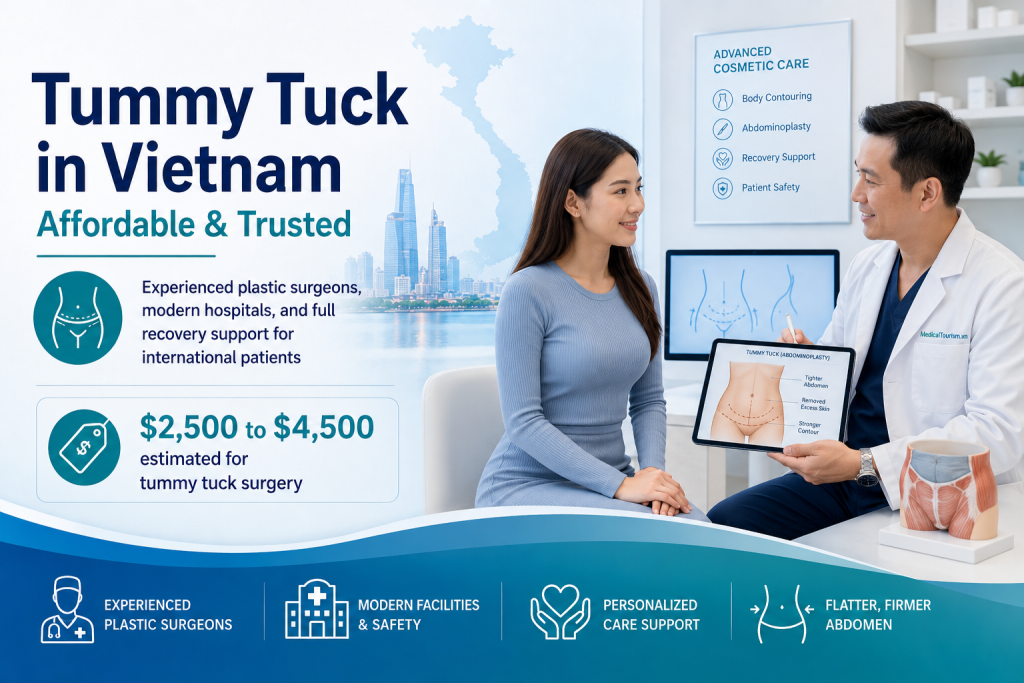
Tummy tuck in Vietnam offers international patients affordable abdominoplasty, experienced plastic surgeons, modern facilities and personalized recovery support, with estimated costs from $2,500 to $4,500.
Quick Navigation
Tummy Tuck in Vietnam at a Glance
| Information | Details |
|---|---|
| Medical name | Abdominoplasty |
| Main purpose | Remove excess abdominal skin and improve abdominal contour |
| Common techniques | Mini, full, and extended tummy tuck |
| 2026 reference prices | 66–99 million VND (approximately USD 2,538–3,808) |
| Anesthesia | Usually general anesthesia for full abdominoplasty |
| Surgery duration | Commonly 2–4 hours, depending on complexity |
| Hospital stay | Determined by the surgical team |
| Suggested travel planning | Approximately 2–3 weeks or longer, subject to medical clearance |
| Main concerns | Scarring, wound healing, swelling, blood clots, and postoperative care |
Prices are based on a 2026 reference price list from one of VnMedtour’s partner hospitals, not nationwide averages. USD conversions use an indicative exchange rate of 26,000 VND per USD.
What Is a Tummy Tuck?
A tummy tuck, or abdominoplasty, is designed to improve the appearance and contour of the abdomen by removing excess skin and, in selected cases, tightening the abdominal wall.
The procedure may be appropriate for people who have loose or hanging skin that does not respond adequately to exercise or weight management.
Common reasons for considering surgery include:
- Loose abdominal skin after pregnancy.
- Excess skin following significant weight loss.
- Persistent lower-abdominal folds.
- Abdominal muscle separation, known as diastasis recti.
- Changes in abdominal shape after previous weight fluctuations.
- Skin irritation or discomfort associated with abdominal folds.
During a full tummy tuck, the surgeon typically makes an incision across the lower abdomen, removes redundant skin, and may repair separated abdominal muscles. The belly button may also be repositioned.
A tummy tuck is not a weight-loss procedure. Patients generally achieve more predictable results when their weight is stable and they have realistic expectations.
Can Exercise Tighten Loose Abdominal Skin?
Exercise improves muscle strength and body composition but cannot reliably eliminate substantial excess skin.
Likewise, abdominal muscle separation does not always require surgery. Some patients may benefit from physiotherapy or other non-surgical management.
A qualified surgeon should determine whether abdominoplasty is appropriate after examining the abdominal skin, muscles, and overall body contour.
Types of Tummy Tuck Surgery in Vietnam
Patients exploring Tummy Tuck in Vietnam options can choose from several techniques, depending on the amount of excess skin, abdominal muscle condition, and desired correction.
Mini Tummy Tuck
A mini tummy tuck focuses primarily on loose skin below the belly button.
It may be suitable for patients with relatively limited lower-abdominal skin laxity and minimal changes above the navel.
The incision is generally shorter than that used in full abdominoplasty, and the belly button often remains in its original position.
However, a mini tummy tuck cannot adequately address every type of abdominal laxity. Patients with extensive loose skin or significant muscle separation may require a different approach.
Full Tummy Tuck
A full tummy tuck treats a larger portion of the abdomen, including excess skin above and below the belly button.
It may involve removing redundant skin, repairing separated abdominal muscles, and repositioning the navel.
This procedure is often considered after pregnancy or substantial weight changes when abdominal skin laxity is more extensive.
Because full abdominoplasty involves a larger treatment area, recovery is generally more demanding than after a limited skin-removal procedure.
Extended Tummy Tuck
An extended tummy tuck addresses excess skin across the abdomen and toward the sides of the waist.
It may be recommended for selected patients following major weight loss.
The incision extends farther around the flanks than in a standard tummy tuck, and postoperative wound care may be more extensive.
Patients should confirm that their surgeon has experience with the specific body-contouring procedure being recommended.
Tummy Tuck With Liposuction
Some patients may benefit from combining a tummy tuck with liposuction.
Liposuction removes localized fat deposits, while abdominoplasty removes excess skin and may repair abdominal muscle separation.
A combined procedure can improve contouring in selected patients, but it may also increase surgical complexity and recovery requirements.
The surgeon must evaluate whether combining these procedures is medically appropriate.
Learn more in our Liposuction in Vietnam guide.
How Much Does a Tummy Tuck Cost in Vietnam in 2026?
The cost of a Tummy Tuck in Vietnam depends on the surgical technique, amount of excess skin, muscle repair requirements, hospital facilities, anesthesia, and postoperative services.
Patients should compare written quotations rather than relying solely on advertised prices.
2026 Reference Prices From a Partner Hospital
The following prices come from a 2026 price list provided by one of VnMedtour’s partner hospitals.
| Procedure | Price (VND) | Approximate USD |
|---|---|---|
| Tummy Tuck – Excess Skin | 66,000,000 | $2,538 |
| Full Tummy Tuck | 99,000,000 | $3,808 |
| 4K Endoscopic System, if applicable | Additional 33,000,000 | Additional $1,269 |
Exchange rate: approximately 26,000 VND = 1 USD.
These are provider-specific reference prices, not average prices across Vietnam. The final quotation must be confirmed after a medical assessment.
The excess-skin procedure should not automatically be considered equivalent to every mini tummy tuck technique. Similarly, the full tummy tuck price should not be assumed to include all forms of muscle repair or combined liposuction.
The additional endoscopic-system fee applies only when that technology is included in the proposed treatment plan.
What Affects the Final Price?
Several factors can change the total cost:
Surgical complexity: Extensive skin removal or abdominal wall repair may require more operating time.
Additional procedures: Combining abdominoplasty with liposuction or another operation can increase costs.
Hospital services: Anesthesia, operating-room facilities, hospitalization, and nursing arrangements differ between providers.
Medical requirements: Previous operations, existing scars, or medical conditions may require additional investigations.
Postoperative care: Compression garments, dressings, medications, and follow-up services may or may not be included.
Patients should request a detailed quotation specifying all inclusions and exclusions.
What Is Usually Included?
Depending on the hospital, a surgical quotation may cover the surgeon’s fee, anesthesia, operating-room charges, hospital accommodation, prescribed medication, and postoperative consultations.
However, inclusions vary. Patients should specifically ask about laboratory tests, compression garments, wound dressings, surgical drains, and follow-up appointments.
International flights, hotels, meals, personal expenses, and additional treatment are often separate costs.
The hospital should also explain how unexpected complications or a change in surgical technique could affect the final bill.
Tummy Tuck vs. Liposuction: Understanding the Difference
Although both procedures can improve abdominal contour, they address different concerns.
| Feature | Tummy Tuck | Liposuction |
|---|---|---|
| Removes excess skin | Yes | No |
| Removes localized fat | Sometimes | Yes |
| Repairs separated abdominal muscles | When indicated | No |
| Main purpose | Improve loose skin and abdominal contour | Reduce localized fat |
| Incisions | Usually a longer lower-abdominal incision | Smaller access incisions |
| Recovery | Generally more extensive | Depends on treatment extent |
Liposuction may be appropriate for patients with localized fat and relatively good skin elasticity.
A tummy tuck may be more suitable when excess skin is the main concern, particularly following pregnancy or substantial weight loss.
Some patients benefit from a combined approach. Others may not require surgery at all.
The most appropriate treatment depends on an individualized examination.
Who Is a Suitable Candidate for Tummy Tuck Surgery?
Suitable candidates generally have excess abdominal skin or contour changes that can reasonably be addressed through surgery.
They should also be in sufficiently good health, have relatively stable body weight, and understand the recovery requirements.
A surgeon will consider:
- General health and existing medical conditions.
- Body weight and recent weight changes.
- Previous abdominal operations.
- Smoking and nicotine use.
- Current medications.
- Abdominal muscle condition.
- Future pregnancy plans.
- Expectations regarding scars and results.
Patients with uncontrolled medical conditions, active infections, significant nutritional deficiencies, or other risk factors may need to postpone surgery.
Smoking and nicotine exposure can impair wound healing. Patients should disclose smoking, vaping, and nicotine replacement products before surgery.
Tummy Tuck After Pregnancy
Pregnancy can stretch the abdominal skin and contribute to separation of the rectus muscles.
For some patients, these changes remain after postpartum recovery.
However, there is no single waiting period that is appropriate for everyone.
The surgeon should assess recovery after childbirth, weight stability, breastfeeding status where relevant, and plans for future pregnancy.
Patients considering another pregnancy may prefer to postpone abdominoplasty because subsequent pregnancy can change the surgical result.
Tummy Tuck After Significant Weight Loss
Major weight loss can leave substantial abdominal skin folds that do not contract naturally.
For these patients, a full or extended tummy tuck may be considered.
The surgeon will assess weight stability, nutritional status, previous bariatric surgery, and the amount of excess skin.
Patients with extensive loose skin around the entire lower torso may require a different body-contouring procedure rather than a standard tummy tuck.
How Is Tummy Tuck Surgery Performed?
The surgical approach varies according to the patient’s anatomy and the recommended technique.
A typical full tummy tuck involves four main stages.
Step 1: Consultation and Surgical Planning
The surgeon examines the abdomen, reviews the patient’s medical history, and discusses the intended correction.
Preoperative tests may be required to assess fitness for anesthesia and surgery.
The surgeon marks the treatment area and explains the expected incision position.
Step 2: Anesthesia and Incision
Full abdominoplasty is commonly performed under general anesthesia.
An incision is typically made across the lower abdomen. Its length depends on the amount of skin requiring removal.
The anesthesiologist monitors the patient throughout surgery.
Step 3: Skin Removal and Muscle Repair
The surgeon lifts the abdominal skin as needed, removes excess tissue, and repairs separated abdominal muscles when indicated.
In a full tummy tuck, the belly button may be repositioned through the adjusted abdominal skin.
The remaining skin is then brought into its new position.
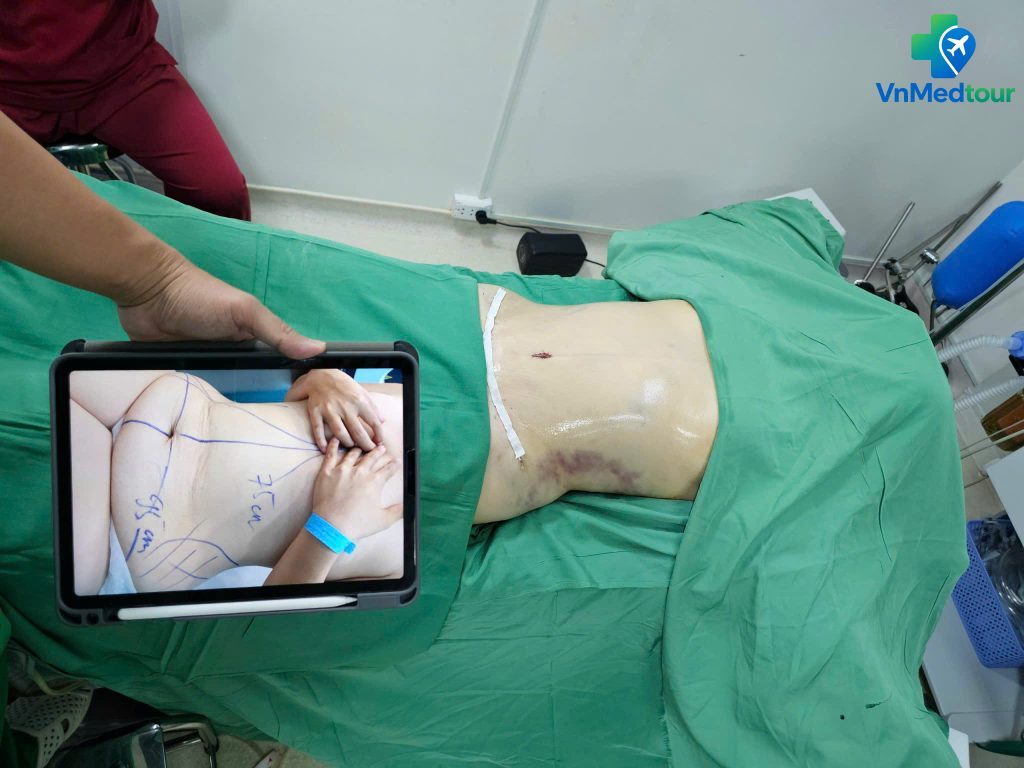
Clinical photograph showing the abdominal surgical area alongside preoperative markings used for body contouring.
Step 4: Closure and Postoperative Monitoring
The incisions are closed, and dressings are applied.
Some patients require temporary surgical drains, while others may undergo techniques that do not use drains.
After surgery, the medical team monitors pain, circulation, bleeding, wound condition, and recovery from anesthesia.
Patients receive individualized instructions about movement, medications, and follow-up care.
Recovery After a Tummy Tuck in Vietnam
Recovery after a Tummy Tuck in Vietnam requires careful planning, particularly for international patients who need to travel home after surgery.
The recovery period depends on the procedure, medical history, and individual healing.
First 48 Hours
Patients commonly experience abdominal tightness, swelling, bruising, discomfort, and reduced mobility.
Pain medication and wound-care instructions are provided by the medical team.
Gentle assisted walking may be encouraged when medically appropriate to support circulation.
Patients should follow the surgeon’s instructions regarding movement and posture.
First Two Weeks
Swelling and tightness may continue during the first one to two weeks.
Patients may need assistance with dressing, transportation, meals, and other daily activities.
Follow-up appointments allow the surgeon to assess wound healing, change dressings, and remove drains if necessary.
Heavy lifting and strenuous activities should be avoided until medically cleared.
Weeks Three to Six
Many patients gradually become more comfortable with routine activities.
Some may return to desk-based work during this period, although the timing varies.
Exercise, abdominal workouts, and physically demanding work may require longer restrictions.
The surgeon should determine when normal activities can safely resume.
Longer-Term Recovery
Swelling can persist for several months, and the abdominal contour may continue changing as tissues settle.
Scars also mature gradually and may remain noticeable for a year or longer.
The appearance during the first postoperative weeks should not be considered the final result.
Typical Recovery Timeline
| Recovery Period | General Expectations |
|---|---|
| First 1–2 days | Medical monitoring, pain management, assisted movement |
| Days 3–7 | Swelling, wound care, gradual mobility |
| Weeks 1–2 | Follow-up examinations and continued activity restrictions |
| Weeks 3–6 | Gradual return to selected daily activities |
| Months 2–3 | Further improvement in swelling and mobility |
| Months 6–12+ | Continued scar maturation and contour changes |
Recovery varies. The treating surgeon’s instructions take priority over any general timeline.
How Long Should International Patients Stay in Vietnam?
International patients considering Tummy Tuck in Vietnam surgery should allow enough time for preoperative assessment, hospitalization, initial recovery, and postoperative reviews.
Approximately two to three weeks or longer may be a reasonable planning allowance for some patients, but it is not a universal requirement or guarantee of fitness to fly.
The surgeon must assess recovery before international travel.
Flying After Tummy Tuck Surgery
Major surgery and prolonged immobility can increase the risk of blood clots, including deep vein thrombosis and pulmonary embolism.
Long-haul flights may add further periods of restricted movement.
Patients should discuss their individual risks and travel plans with the surgeon, including whether any preventive measures are appropriate.
Do not independently start blood-thinning medication or use medical compression products without appropriate advice.
Traveling with a companion may also be helpful, particularly during early recovery when lifting luggage and walking long distances can be difficult.
Risks and Possible Complications of Tummy Tuck Surgery
Abdominoplasty is a major operation and carries risks even when performed by qualified professionals.
Common postoperative effects include swelling, bruising, tightness, temporary discomfort, and changes in skin sensation.
Potential complications include:
- Bleeding or hematoma.
- Infection.
- Fluid accumulation, known as seroma.
- Delayed wound healing or wound separation.
- Skin or fat tissue damage.
- Persistent numbness or altered sensation.
- Unfavorable scarring.
- Asymmetry or dissatisfaction with the result.
- Anesthesia-related complications.
- Deep vein thrombosis or pulmonary embolism.
- The need for additional treatment or revision surgery.
The likelihood of complications depends on individual risk factors and the extent of surgery.
Patients should seek urgent medical attention for chest pain, sudden shortness of breath, fainting, or significant new leg swelling.
Fever, worsening wound pain, increasing redness, unusual drainage, or sudden abdominal swelling also require prompt medical assessment.
For further information, see the American Society of Plastic Surgeons’ guidance on tummy tuck safety.
Tummy Tuck Scars and Long-Term Results
A tummy tuck leaves a permanent surgical scar.
In a typical full abdominoplasty, the main scar runs across the lower abdomen. There may also be a scar around the belly button.
The exact length and position depend on the procedure and the amount of excess skin removed.
Surgeons generally aim to place the lower incision where clothing may conceal it, but this cannot be guaranteed.
Scars usually change in color and appearance over time. Their maturation may take a year or longer.
Factors influencing scar healing include genetics, skin characteristics, surgical technique, smoking, wound tension, and postoperative complications.
The surgeon may recommend appropriate scar-care measures after the incision has healed.
Are Tummy Tuck Results Permanent?
The improvements can be long-lasting, but aging, pregnancy, and significant weight changes may alter abdominal contour.
Maintaining a stable weight can help preserve the surgical result.
Patients should understand that surgery cannot stop natural aging or guarantee a permanently unchanged appearance.
Choosing a Hospital and Plastic Surgeon in Vietnam
Choosing a qualified surgeon is an essential part of planning a Tummy Tuck in Vietnam.
Patients should assess medical qualifications, surgical experience, hospital facilities, and postoperative care rather than comparing prices alone.
Surgeon Qualifications
Ask about the surgeon’s medical license, specialist training, and experience performing abdominoplasty.
Experience with abdominal muscle repair, previous surgical scars, and complex body contouring may be particularly relevant.
Patients should also understand who will perform the operation and who will manage postoperative care.
Hospital Facilities and Safety
Confirm that the facility is appropriately licensed for the proposed procedure.
Important considerations include anesthesia services, operating-room equipment, postoperative monitoring, and emergency arrangements.
International accreditation may provide additional information about a facility, but it does not replace verification of the actual surgeon and services.
Questions to Ask Before Booking
Before confirming surgery, ask:
- Which tummy tuck technique is recommended?
- Will abdominal muscle repair be included?
- Is liposuction necessary or optional?
- What is included in the quotation?
- How long should I remain near the hospital?
- What happens if a complication occurs?
- Who will provide follow-up care after I return home?
Clear answers can help patients make informed decisions.
Where Can International Patients Have a Tummy Tuck in Vietnam?
Tummy tuck procedures may be available through selected private hospitals and specialized cosmetic surgery facilities in major Vietnamese cities.
Ho Chi Minh City
Ho Chi Minh City has private medical providers offering cosmetic surgery and body-contouring services.
Its international airport makes it accessible to travelers from Australia, Southeast Asia, and other markets.
Patients should verify the availability of the specific abdominoplasty technique they require.
Hanoi
Hanoi is another option for international patients considering cosmetic surgery.
Provider selection should focus on the surgeon’s qualifications, hospital facilities, and postoperative arrangements rather than location alone.
Da Nang
Da Nang may be convenient for some travelers, but patients should confirm whether appropriate surgical and postoperative services are available before planning treatment.
The most suitable destination is the one offering an appropriate medical team and practical recovery arrangements.
Planning Your Tummy Tuck in Vietnam From Overseas
Planning a Tummy Tuck in Vietnam requires coordination between medical consultations, surgery, recovery, and international travel.
Step 1: Share Your Medical Information
Patients may be asked to provide their age, height, weight, medical history, previous operations, medications, allergies, smoking status, and treatment goals.
Photographs of the abdominal area may also help with a preliminary review when shared through an appropriate secure channel.
Step 2: Obtain a Preliminary Assessment and Quotation
A hospital or surgeon may review the information and suggest potential treatment options.
An initial assessment does not confirm surgical eligibility. The final treatment plan normally requires an in-person examination.
Patients should request a written quotation showing the proposed procedure and included services.
Step 3: Arrange Travel and Complete Surgery
Travel plans should allow sufficient time for consultation, preoperative tests, surgery, hospitalization, and recovery.
Choose accommodation with convenient access to the hospital.
If the examination identifies additional medical risks, the surgeon may recommend modifying or postponing the operation.
Step 4: Attend Follow-Up Appointments Before Returning Home
Postoperative reviews allow the medical team to assess wound healing and recovery.
Before departure, patients should obtain relevant medical records, medication instructions, and information about follow-up care in their home country.
International travel should take place only after appropriate medical assessment.
Why Consider Cosmetic Surgery in Vietnam?
Vietnam may appeal to international patients because of its range of cosmetic surgery providers, access through international airports, and treatment prices that can be lower than those quoted in some higher-cost healthcare markets.
However, a surgical quotation is only one part of the overall budget.
Patients should consider flights, accommodation, transport, time away from work, recovery assistance, and potential additional medical expenses.
They should also consider the challenges of receiving postoperative care after returning to another country.
For a broader overview of available procedures, visit our Cosmetic Surgery in Vietnam guide.
How VnMedtour Supports International Patients
VnMedtour helps international patients explore medical treatment options and coordinate appointments with healthcare providers in Vietnam.
We are a medical tourism coordination service, not a hospital or surgical provider.
Depending on the patient’s requirements and available hospital services, VnMedtour can assist with:
- Identifying potential treatment providers.
- Coordinating preliminary medical reviews.
- Requesting individualized quotations.
- Arranging appointment communication.
- Clarifying hospital requirements and treatment schedules.
- Sharing practical information about accommodation and transportation.
- Supporting communication with the medical provider.
Medical decisions, surgical eligibility, informed consent, and postoperative treatment remain the responsibility of qualified healthcare professionals.
Frequently Asked Questions About Tummy Tuck in Vietnam
1. How much does a tummy tuck cost in Vietnam?
A 2026 reference price list from one VnMedtour partner hospital quotes 66 million VND (approximately $2,538) for an excess-skin tummy tuck procedure and 99 million VND (approximately $3,808) for a full tummy tuck. Final prices depend on the individual treatment plan.
2. Is tummy tuck surgery in Vietnam safe?
Safety depends on the patient’s health, the surgeon’s qualifications, the surgical facility, anesthesia arrangements, and postoperative care. Every major operation carries risks, and no provider can guarantee a complication-free outcome.
3. What is the difference between a mini and full tummy tuck?
A mini tummy tuck generally treats limited loose skin below the belly button. A full tummy tuck addresses a larger abdominal area and may include muscle repair and belly-button repositioning.
4. Can I combine tummy tuck surgery with liposuction?
Yes, in selected cases. However, combining procedures may increase surgical complexity. The surgeon must determine whether the combination is appropriate.
5. How long does tummy tuck recovery take?
Early recovery commonly takes several weeks, while swelling and scar maturation may continue for months. Return to work, exercise, and international travel depends on the patient’s condition and the surgeon’s assessment.
6. Will I have a visible scar?
Yes. A tummy tuck produces a permanent scar, usually across the lower abdomen. Its appearance changes over time and depends on the procedure and individual healing.
7. Can I have a tummy tuck after a C-section?
Previous cesarean delivery does not automatically prevent abdominoplasty. The surgeon must assess existing scars, abdominal anatomy, overall health, and future pregnancy plans.
8. Can I get a quotation before traveling to Vietnam?
A preliminary quotation may be possible after a hospital reviews your medical information and photographs. The final treatment plan and price remain subject to an in-person assessment.
Final Thoughts: Is a Tummy Tuck in Vietnam Right for You?
A tummy tuck may help selected patients address excess abdominal skin and abdominal-wall changes following pregnancy, weight loss, or other body changes.
Vietnam offers potential treatment options, but choosing the right surgeon and planning appropriate postoperative care are more important than selecting the lowest advertised price.
Before proceeding, patients should understand the proposed technique, expected scar placement, surgical risks, recovery requirements, and total treatment cost.
VnMedtour can help coordinate preliminary consultations and quotation requests with medical providers in Vietnam.
Medical disclaimer: This article provides general information and does not replace professional medical advice. Surgical suitability, treatment recommendations, recovery instructions, and fitness to travel must be determined by qualified healthcare professionals.
Medically reviewed by MSc, MD, Doctor Nguyen Dang Dai
Ready for a Flatter, Firmer Abdomen?
Discover high-quality, affordable tummy tuck surgery in Vietnam with full support from MedtourVietnam.
Get expert care from trusted plastic surgeons in modern facilities.