
When exploring incision options for breast augmentation, a patient’s considerations extend far beyond choosing the ideal implant size or volume profile. One of the most critical clinical aspects of the pre-operative planning phase revolves around selecting the anatomical gateway for the procedure: the incision site itself. For international medical tourists, the anxiety surrounding potential postsurgical scarring is often just as significant as the desire for a beautiful, proportionate contour.
According to guidelines outlined by the American Society of Plastic Surgeons (ASPS), incisions are strategically placed in inconspicuous areas to minimize visible markings, yet the choice of entry pathway still depends heavily on a patient’s unique anatomy, implant type, and lifestyle preferences.
In the global medical tourism landscape, Vietnam has rapidly advanced to become an elite hub for high-end aesthetic procedures. International patients consistently select the country not only for its notable cost efficiencies but also for its network of board-certified plastic surgeons. Many of these specialists have undergone rigorous clinical fellowships across South Korea, France, and the United States, bringing next-generation surgical refinement to the region.
When you organize your treatment pathway for cosmetic surgery in Vietnam, you will discover that Vietnamese plastic surgeons have pioneered highly sophisticated, minimally invasive techniques specifically designed to conceal entry pathways and accelerate wound recovery.
This comprehensive, evidence-based guide provides a deep dive into the primary incision pathways utilized within Vietnam’s top-tier accredited private hospitals, detailing how expert native specialists meticulously minimize scarring to deliver pristine, natural-looking aesthetic outcomes.
Quick Navigation
1. The Multi-Faceted Architecture of Scar Minimization
Achieving an unblemished, natural result following breast optimization requires a comprehensive approach that begins long before the first surgical opening is made. Clinical evaluations published by the National Institutes of Health (NIH) indicate that abnormal healing or elevated skin tension are primary contributors to poor scar tissue maturation. For Vietnamese aesthetic specialists, scar minimization is an integrated clinical methodology that spans pre-operative skin assessment, intra-operative handling, and meticulous post-operative therapy.
Pre-Operative Anatomical Mapping
Every chest wall exhibits unique variations in skin elasticity, native tissue laxity, and dermal pigment density. During your initial clinical consultation in Hanoi or Ho Chi Minh City, your surgeon will thoroughly evaluate your native skin profile. This assessment determines how your skin reacts to mechanical tension, identifying any underlying genetic predispositions toward hypertrophic scarring or keloid development. By mapping out the natural inframammary folds, pectoral crease dynamics, and areolar borders, the surgical entry point can be precisely positioned to blend seamlessly into your body’s native contours.
Atraumatic Dermal Tissue Handling
The primary determinant of long-term scar quality is the preservation of local tissue health during surgery. Vietnamese plastic surgeons employ strict atraumatic tissue-handling principles. By utilizing high-precision surgical instruments and maintaining a gentle technique, they minimize localized cellular trauma and thermal damage to the skin edges. Preserving micro-vascular blood supply at the margins of the opening ensures the body initiates a clean, uninterrupted healing response, dramatically reducing the risk of wide, raised, or discolored scars.
2. Deep Dive: The Four Core Incision Options for Breast Augmentation
Understanding the anatomical nuances, clinical benefits, and specific trade-offs of each surgical pathway is essential for selecting the route that aligns with your lifestyle and clothing preferences.
A. The Inframammary Incision (The Sub-Mammary Fold Pathway)
The inframammary approach remains the most widely utilized and anatomically straightforward technique in modern breast enhancement. The opening is positioned horizontally within the hidden shadow of the inframammary fold—the natural crease where the lower curve of the breast meets the chest wall.
This approach provides the operating specialist with direct visual access to the underlying pectoral muscle fields and internal tissue spaces. This clear line of sight allows for highly precise pocket irrigation, immaculate bleeding control, and accurate placement of next-generation cohesive silicone devices without blind maneuvering. Clinical data tracked via PubMed literature confirms that advanced “short scar” inframammary techniques offer excellent long-term cosmetic appearance while achieving high patient satisfaction scores.
Because the surgical pathway travels directly beneath the lower breast border, it completely bypasses the milk ducts and sensitive glandular networks. This makes it an exceptional choice for younger patients who prioritize preserving their full, uninterrupted breastfeeding capabilities. While standing, the natural downward slope of the breast drapes over the healing site, rendering it virtually invisible. The resulting mark resembles a thin, pale pencil line that hides comfortably beneath standard underwire bras, bikini tops, and plunging resort wear.
B. The Transaxillary Incision (The Armpit Pathway)
For international medical tourists who desire a breast completely free of surgical marks, the transaxillary technique represents an exceptional engineering solution. The opening is created within the natural, shadowed skin folds deep inside the apex of the axilla (armpit).
Top-tier medical institutions in Vietnam execute this procedure utilizing high-definition endoscopes. The surgical camera transmits a magnified, illuminated view of the internal chest architecture to high-resolution operating theater monitors. This allows surgeons to safely navigate tissue planes, cauterize micro-vessels, and position implants with excellent accuracy through a remote entry point.
The defining advantage of this approach is that the breasts themselves remain entirely untouched by external cutting instruments. There are no lines along the areola or beneath the lower fold, maintaining an unblemished breast surface. This route requires significant technical expertise and is ideally suited for primary augmentations utilizing highly flexible, cohesive devices like Motiva Ergonomix lines, which can slide smoothly through a narrow, remote tunnel. The healing mark is safely tucked away inside the armpit, blending into the natural skin creases of the axillary vault.
C. The Periareolar Incision (The Areolar Border Pathway)
The periareolar approach utilizes the natural pigment transition zone of the breast, with the opening created semi-circularly along the lower half-circumference of the areolar border, where dark areolar skin transitions to lighter native breast skin.
The boundary between contrasting skin tones offers excellent natural camouflage. Once the healing process concludes, the resulting line blends into the textural transition of the areolar margin. This entry point is highly favored when a patient requires structural adjustments alongside volume enhancement. If you have minor breast asymmetry, a mild degree of native tissue sagging, or require an areolar reduction, this pathway gives your surgeon direct access to reshape the dermal envelope in a single session.
This route requires traveling through a portion of the deep breast tissue to reach the retro-pectoral plane. Experienced Vietnamese surgeons perform this step with extreme care, utilizing meticulous dissection patterns to preserve internal structural networks and minimize disruptions to local nerve pathways.
D. The Transumbilical Incision (TUBA Technique)
The transumbilical breast augmentation approach involves creating an opening within the inner margin of the navel (belly button), routing a long tunneling instrument upward through the subcutaneous fat layer of the abdomen to create pockets from below.
While appealing due to the remote location of the scar, the TUBA technique is restricted exclusively to saline-filled implants that are rolled up empty, passed through the abdominal tunnel, and filled with sterile saline fluid once inside the chest pocket. Because premium international private hospitals in Vietnam focus on delivering natural-looking, long-lasting outcomes using advanced cohesive silicone gel devices (such as Motiva and Mentor), the TUBA technique is rarely utilized. Cohesive silicone gel models cannot be passed through a narrow abdominal tunnel, making the inframammary and endoscopic transaxillary approaches the preferred options for international patients.
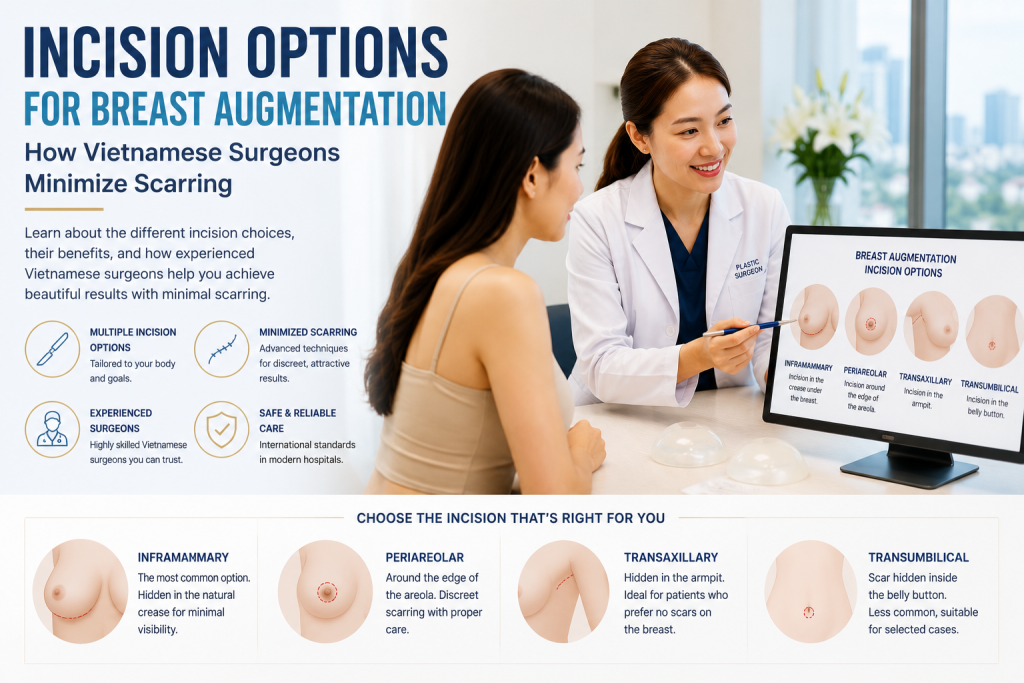
Incision options for breast augmentation in Vietnam include inframammary, periareolar, transaxillary, and transumbilical approaches, helping patients choose the best option for minimal scarring and natural results.
3. Advanced Surgical Technologies Used in Vietnam to Minimize Scarring
Vietnam’s private surgical sector incorporates leading biomedical innovations to replace traditional methods, reduce healing lines, and safeguard delicate tissue. Instead of standard scalpels and manual pocket tearing that can cause irregular tissue stretching, advanced clinics now use high-precision tools.
To ensure clean entry margins, top-tier operating suites across Ho Chi Minh City and Hanoi utilize advanced plasma blades and ultrasonic harmonic scalpels. These instruments employ high-frequency kinetic or thermal energy to incise tissue at a microscopic level, simultaneously sealing micro-vessels upon contact. This significantly reduces intra-operative bleeding, minimizes bruising, and protects the surrounding skin cells from thermal damage, paving the way for a thin, clean healing line.
Furthermore, traditional blind surgeries are replaced by high-definition endoscopic platforms for remote-entry procedures. The real-time, illuminated visualization allows for precise pocket creation, ensuring internal tension is evenly distributed and the healing margins remain stress-free.
Finally, traditional knotted top sutures and basic bandages have been replaced by a complex, multi-layered internal closure methodology. Deep structural layers, like the deep fascia and subcutaneous fat, are securely knitted using robust, self-absorbing internal sutures. This deep structural network absorbs all the mechanical weight and downward pull of the newly placed implant.
The skin surface is then closed using advanced subcuticular stitching techniques, running smoothly just beneath the skin line to eliminate horizontal marks. The surface is finally sealed with Dermabond liquid skin glue (2-Octyl Cyanoacrylate), forming a clear, sterile, waterproof flexible barrier that holds the skin edges in alignment without the need for traditional tape dressings.
To learn more about the complete surgical experience, including implant selection, pricing structures, and pre-operative requirements, read our companion resource: Breast Augmentation in Vietnam: A Complete Guide.
4. Customizing the Incision to Your Specific Body Type
Every individual’s body type, lifestyle habits, and ethnic background influence how their skin handles healing. Expert surgeons adapt their choice of surgical pathway to match these distinct physical profiles.
The Athletic or Low-Body-Fat Profile
Patients with highly developed pectoral musculature or minimal subcutaneous body fat require a strategy that prevents the implant borders from showing while avoiding visible scarring. For these individuals, the inframammary crease pathway is often ideal. It allows the surgeon to perform a precise dual-plane dissection, tucking the upper portion of the implant securely under the muscle while keeping the entry site hidden within the natural lower fold.
The Melanin-Rich or Keloid-Prone Profile
Patients with darker skin tones possess higher concentrations of dermal melanin, which can increase the risk of post-inflammatory hyperpigmentation or keloid formation if a wound experiences excessive stress. For these individuals, minimizing surface tension is paramount. Vietnamese specialists often recommend either the endoscopic transaxillary route—moving the entry point completely away from the breast—or a carefully executed inframammary approach supported by multi-layered internal tension relief and early-intervention preventative scar therapies.
5. Comprehensive Post-Operative Scar Therapy Protocols
The final aesthetic appearance of your incision depends heavily on the care it receives during the maturation phase. The healing process continues for several months after your surgical date, requiring a disciplined post-operative regimen that progresses through distinct therapeutic stages.
During the first two weeks, care focuses on protecting the waterproof surface created by the liquid skin glue, ensuring the wound margins remain clean and completely undisturbed. Once the skin surface has fully closed around the third week, patients transition into the second stage of care by initiating daily application of premium, medical-grade silicone scar sheets or topical silicone gels. Silicone creates an invisible, moisture-retaining layer over the healing tissue, balancing hydration levels at the site. This optimal environment signals the body’s fibroblasts to produce smooth, organized collagen fibers rather than an irregular, raised cluster of scar tissue.
In the third phase, spanning months two through six, more active interventions are introduced. Beginning around week four, under the explicit direction of your care team, you will be taught a structured desensitization and remodeling massage technique. Applying gentle, rhythmic circular pressure across the healing zone helps break up early internal scar adhesions and maintains tissue flexibility, ensuring the area remains soft and moves naturally with your chest wall.
Additionally, fresh healing skin is highly vulnerable to ultraviolet radiation. Exposure to sunlight during the first year can trigger localized overproduction of melanin, causing permanent hyperpigmentation. You must protect the area by applying broad-spectrum, mineral-based SPF 50+ sunscreen daily. If a scar shows early signs of redness or elevation during follow-up evaluations, premium aesthetic centers in Ho Chi Minh City and Hanoi can introduce targeted vascular laser interventions, utilizing Fractional CO2 Lasers or Pulsed Dye Lasers to reduce redness and smooth the skin surface.
6. Suture and Scar Management Comparison Matrix
To help you visualize how each primary option performs across key healing and lifestyle metrics, review the summary comparison below:
| Incision Pathway | Average Length | Surgical Visibility | Risk of Sensation Change | Primary Hidden Location | Best Suited For |
| Inframammary | 3.5 – 4.5 cm | Excellent (Direct vision) | Minimal | Within the lower inframammary breast fold | All implant sizes, breastfeeding preservation, dual-plane placement. |
| Transaxillary | 4.0 – 5.0 cm | High (Via HD endoscope camera) | Minimal | Deep within the natural armpit creases | Patients wanting an unblemished breast surface with zero breast scars. |
| Periareolar | Semi-circle | Good (Direct vision) | Low to Moderate | Along the dark-to-light areolar pigment border | Patients requiring simultaneous minor lifting or areolar resize adjustments. |
7. The Medtour Vietnam Advantage: Seamless Care from Entry to Recovery
Attempting to organize an international surgical journey independently can introduce logistical challenges, particularly when managing multi-stage post-operative healing care. When you trust your treatment path to a dedicated medical travel agency like Medtour Vietnam, you secure a comprehensive support system designed to deliver an optimal aesthetic outcome with total peace of mind.
Our support ecosystem coordinates your care across several key areas:
-
Access to Elite Accredited Specialists: We partner exclusively with the country’s premier, board-certified plastic surgery experts. Our vetted surgeons possess deep experience in advanced, tension-free closure methodologies, ensuring you receive world-class care focused on minimizing visible scarring.
-
Fixed Global Pricing Transparency: Our pre-arranged medical packages provide clear, fixed pricing that covers your complete surgical care, pre-operative clearances, anesthesia fees, international implant devices, and post-operative follow-up visits, protecting you from unexpected medical bills.
-
In-Country Logistics Integration: From airport meet-and-greet services and comfortable private medical transport to local SIM cards and recovery-friendly hotel accommodations, we handle every detail of your travel itinerary so you can focus entirely on a smooth recovery.
-
Continuous Local Advocacy: Your dedicated English-speaking coordinator accompanies you to clinical rounds, translates complex medical terms, and remains available throughout your stay to ensure your recovery needs are met.
Conclusion: Empowering Your Aesthetic Transformation
Choosing the right incision pathway is a foundational step in your breast augmentation planning, allowing you to balance structural accuracy with your long-term aesthetic preferences. By leveraging advanced materials science, high-definition visualization tools, and precise tension-free closing techniques, Vietnam’s leading plastic surgeons allow international patients to achieve beautiful, life-changing contour transformations while keeping postsurgical markings beautifully refined and discreet.
Are you ready to explore the ideal incision framework for your body type and view real patient journeys? Reach out to a dedicated medical travel coordinator at Medtour Vietnam today to schedule your personalized clinical consultation and high-resolution 3D body mapping assessment.
Planning Breast Augmentation in Vietnam?
Get expert guidance on incision options, implant placement, scar minimization, surgeon selection, and treatment planning before you travel.