
Quick Navigation
HIFU in Vietnam: Costs, Top Clinics & Complete Guide
Non-surgical cosmetic enhancements have seen explosive growth globally, with high-intensity focused ultrasound leading the charge for facial rejuvenation. As international travelers and expatriates look for effective, non-invasive alternatives to surgical facelifts, HIFU in Vietnam has emerged as one of the most popular medical aesthetic options in Southeast Asia. Combining medical-grade technology, internationally trained dermatologists, and prices up to 70% lower than Western nations, Vietnam offers a compelling destination for skin tightening and contouring.
This comprehensive guide covers everything you need to know about getting HIFU treatment in Vietnam—from technology variations and realistic costs to choosing accredited clinics and post-treatment care.
What is HIFU and How Does It Work?
High-Intensity Focused Ultrasound (HIFU) is a non-invasive cosmetic technology designed to lift, tighten, and firm sagging skin without incisions, needles, or downtime. Originally developed as a medical treatment for tumors, HIFU was adapted for aesthetic medicine after researchers discovered its precise thermal impact on deep dermal structures.
The Science Behind Ultrasound Lifting
Unlike surface-level treatments such as chemical peels or microdermabrasion, HIFU bypasses the epidermis and targets deeper structural layers of the skin.
-
Targeting the SMAS Layer: HIFU delivers focused ultrasound energy to precise depths, primarily targeting the Superficial Muscular Aponeurotic System (SMAS) layer located approximately 4.5mm beneath the skin surface. This is the exact tissue layer that surgeons tighten during a traditional surgical facelift.
-
Thermal Coagulation Points (TCPs): The ultrasound energy heats the targeted tissue rapidly to temperatures between 60°C and 70°C. This localized heating creates tiny thermal coagulation points without damaging the surrounding tissue or skin surface.
-
Neocollagenesis: The thermal injury triggers a natural healing response. The body initiates a process called neocollagenesis, contracting existing collagen fibers while stimulating fibroblasts to synthesize fresh collagen and elastin over the subsequent three to six months.
The energy works across three key structural layers: the epidermis remains untouched at 0.0mm depth; the dermis is targeted between 1.5mm and 3.0mm to improve fine lines and elasticity; and the SMAS layer is targeted at 4.5mm depth to achieve deep structural lifting and facial contouring.
Primary Aesthetic Applications
-
Facial Lifting & Tightening: Lifts sagging cheeks, restores jawline definition, and reduces jowls.
-
Wrinkle Reduction: Smoothes fine lines around the eyes, forehead, and perioral areas.
-
Double Chin & Neck Contouring: Melts submental fat while tightening loose neck skin (often referred to as “turkey neck”).
-
Eyebrow & Eyelid Elevation: Opens up heavy brows and drooping upper lids.
-
Body Sculpting: Deeper cartridge depths (8mm to 13mm) target localized fat pockets on the abdomen, thighs, and arms.
Why Choose Vietnam for HIFU Treatments?
Vietnam’s private healthcare and aesthetic sector has modernized rapidly over the past decade. Major metropolitan hubs like Ho Chi Minh City (Saigon) and Hanoi feature state-of-the-art aesthetic hospitals and specialized dermatology centers designed for international patients.
Key advantages of seeking treatment in Vietnam include significant cost savings up to 70%, access to KFDA and CE-approved equipment, board-certified dermatologists, zero recovery downtime, and a thriving medical tourism ecosystem.
Cost Efficiency
The primary driver for medical tourists is cost efficiency. Medical equipment manufacturers sell devices globally at standardized rates, but lower labor, real estate, and operational costs in Vietnam allow clinics to offer identical treatments at a fraction of Western prices.
Advanced Medical Infrastructure
Leading Vietnamese private clinics invest heavily in top-tier medical devices imported from South Korea, Europe, and the United States. Many clinics hold international accreditations and adhere to stringent sanitation protocols matching Western standards.
Highly Qualified Practitioners
Dermatology is a competitive medical discipline in Vietnam. Specialist doctors complete extensive university training followed by international fellowships in South Korea, Japan, or Europe. Having your procedure performed directly by a board-certified dermatologist—rather than a technician—ensures higher safety and superior aesthetic outcomes.
Comparing HIFU Devices: Korean HIFU vs. Ultherapy
When researching ultrasound treatments, you will encounter various brand names. While all use focused ultrasound energy, key distinctions exist between standard Korean HIFU systems and premium US-manufactured devices.
Device Categories
-
Korean & Asian HIFU Systems (e.g., Ultraformer III, Shurink, Doublo, LinearZ): These devices dominate the Asian market. They are widely praised for fast shot-delivery times, versatile depth cartridges, and comfortable patient experiences. They provide exceptional skin tightening at budget-friendly price points.
-
Ultherapy (Merz Aesthetics, USA): Ultherapy uses Microfocused Ultrasound with Visualization (MFU-V). It features real-time ultrasound imaging (DeepSEE™ technology), allowing the physician to visualize the skin layers on a screen while delivering treatment.
| Feature | Standard / Korean HIFU (Ultraformer, Shurink) | Ultherapy (USA) |
| Technology | High-Intensity Focused Ultrasound | Microfocused Ultrasound with Visualization (MFU-V) |
| Real-Time Imaging | No (Blind depth delivery based on clinical protocol) | Yes (Real-time visual monitoring of skin layers) |
| Comfort Level | Mild to moderate discomfort | Moderate to significant discomfort |
| Treatment Frequency | 1–2 sessions per year | 1 session every 1.5 to 2 years |
| Average Cost in Vietnam | $250 – $600 | $1,200 – $2,500 |
| Target Audience | Mild-to-moderate laxity, preventive anti-aging | Moderate-to-severe laxity, long-lasting single treatment |
While Korean HIFU devices deliver high satisfaction for preventive maintenance and mild sagging, patients requiring maximum intensity and visual precision often opt for premium platforms. You can read our in-depth comparison on Ultherapy in Vietnam to determine which device fits your aesthetic goals.
Cost of HIFU in Vietnam vs. Global Prices
Understanding treatment costs requires looking at total shot counts, treatment areas, and machine authenticity. In Vietnam, pricing is generally calculated per treatment zone or total line/shot count (e.g., 300 shots for lower face, 500–800 shots for full face and neck).
Price Comparison by Region (USD)
| Treatment Area | Vietnam | United States | Australia / UK | Singapore |
| Lower Face & Jawline | $200 – $350 | $1,200 – $1,800 | $1,000 – $1,500 | $800 – $1,200 |
| Full Face | $300 – $600 | $2,000 – $3,500 | $1,800 – $2,800 | $1,400 – $2,200 |
| Full Face & Neck | $450 – $850 | $3,000 – $4,500 | $2,500 – $3,800 | $2,000 – $3,000 |
| Double Chin Reduction | $150 – $250 | $800 – $1,200 | $700 – $1,000 | $500 – $800 |
Factors Influencing HIFU Pricing in Vietnam
-
Device Authenticity: Medical-grade, FDA-cleared, or KFDA-certified machines (such as Ultraformer III or LinearZ) cost more per session than counterfeit or uncertified Chinese models found in low-end salons.
-
Practitioner Expertise: Procedures conducted by senior board-certified dermatologists carry higher consultation fees than those performed by medical assistants.
-
Geographic Location: Premium clinics located in District 1 of Ho Chi Minh City or Hoan Kiem District in Hanoi charge slightly higher rates due to overhead costs, but offer superior service amenities for international clients.
-
Shot Volume: Comprehensive facial treatments requiring 600+ lines cost proportionately more than quick touch-ups using 200 lines.
Top Aesthetic Clinics for HIFU in Vietnam
Selecting an authentic, accredited clinic is critical for safety and optimal results. Here are top-tier aesthetic centers and hospitals in Vietnam renowned for high standards in non-surgical skin rejuvenation.
Ho Chi Minh City (Saigon)
1. Rohto Aohal Clinic
-
Overview: A premier Japanese-managed aesthetic clinic network operating under the high manufacturing standards of Rohto Pharmaceutical Japan.
-
Specialties: Advanced facial rejuvenation, non-invasive skin tightening, pigment treatments.
-
Equipment: Certified Ultraformer III and genuine Ultherapy systems.
-
Patient Care: Multilingual staff fluent in English, Japanese, and Vietnamese.
2. SIian Skincare & Laser Clinic
-
Overview: Established over a decade ago, SIian is an internationally focused clinic catering primarily to Western expatriates and medical tourists.
-
Specialties: Comprehensive facial restructuring, laser dermatology, non-surgical body contouring.
-
Key Features: Tailored combination therapies integrating HIFU with collagen biostimulators or dermal fillers.
3. FV Hospital – Lifestyle & Cosmetic Center
-
Overview: A full-service, JCI-accredited (Joint Commission International) hospital located in District 7.
-
Specialties: High-complexity aesthetic care, medical-grade skin tightening, combined surgical and non-surgical treatments.
-
Best For: Medical tourists seeking the safety net of a multi-specialty hospital environment.
Hanoi
1. Thu Cúc Aesthetic Hospital
-
Overview: One of Vietnam’s largest and oldest aesthetic hospital chains, recognized for strict hygiene protocols and advanced equipment.
-
Specialties: Comprehensive anti-aging solutions, body contouring, facial sculpting.
-
Key Features: High patient volume, state-of-the-art facilities, and competitive packaging.
2. Kangnam Aesthetic Hospital
-
Overview: A leading center specializing in South Korean aesthetic trends and technology transfers.
-
Specialties: V-line jaw sculpting, Korean HIFU protocols, multi-layer skin rejuvenation.
-
Best For: Patients looking for Korean-style V-line facial shaping and structural lifting.
The HIFU Treatment Process: Step-by-Step
Knowing what to expect during your appointment helps alleviate anxiety and ensures a smooth clinical experience. The standard clinical journey moves sequentially through six structured stages:
-
Initial Consultation & Skin Analysis: The dermatologist evaluates your skin elasticity, subcutaneous fat distribution, and bone structure. They assess whether HIFU alone will meet your expectations or if a combination approach is required.
-
Preparation & Cleansing: The skin is thoroughly cleansed to remove makeup, oils, and environmental impurities. Baseline photographs are taken for progress tracking.
-
Topical Anesthesia: A high-potency topical numbing cream (typically 5% lidocaine) is applied to the treatment area and left for 30 to 45 minutes to minimize thermal discomfort.
-
Grid Mapping & Gel Application: The physician wipes off the numbing cream, draws precise grid lines across the face to mark anatomical landmarks and avoid nerve pathways, and applies a transparent conductive ultrasound gel.
-
Ultrasound Pulse Delivery: The dermatologist places the transducer handpiece against the skin, firing pulses of focused ultrasound energy. Cartridges are swapped during the session to address different structural depths:
-
4.5mm Cartridge: Reaches the SMAS layer for deep lifting.
-
3.0mm Cartridge: Targets the lower dermis to stimulate structural collagen.
-
1.5mm Cartridge: Addresses superficial fine lines and pore tightening.
-
-
Post-Care & Sun Protection: The gel is cleansed away, and a cooling sheet mask, moisturizer, and broad-spectrum SPF 50+ sunscreen are applied before you leave.
What to Expect: Results, Downtime & Side Effects
Pain and Discomfort Levels
HIFU is non-invasive, but it is not completely painless. Sensations vary depending on individual pain thresholds and the energy settings used. Patients typically describe feeling warm, prickling pulses or mild aching deep beneath the skin surface, particularly over bony prominences like the jawline and forehead. Pain is temporary and subsides immediately once the handpiece stops firing.
Recovery Timeline and Downtime
One of HIFU’s greatest advantages is zero surgical downtime. You can resume work, dining out, and normal daily activities immediately after leaving the clinic.
-
Immediate Post-Treatment (Day 1): Mild erythema (redness) and slight swelling may occur, usually resolving within 2 to 4 hours.
-
First Week: The treated area may feel tender to the touch, similar to a light muscle workout. Mild tingling or temporary numbness around the jawline can happen but resolves spontaneously.
-
Weeks 2 to 4: Initial tightening effects appear as thermal contraction settles.
-
Months 2 to 6: Optimal results emerge. As new collagen matures, the skin becomes visibly firmer, jowls lift, and the jawline displays sharper definition.
Side Effects and Risk Profile
When performed by a qualified dermatologist using authentic devices, HIFU is exceptionally safe. Reported risks according to the U.S. Food and Drug Administration (FDA) are rare and mild:
-
Mild Edema (Swelling): Resolves in 24–48 hours.
-
Transient Erythema (Redness): Fades within a few hours.
-
Minor Bruising: Occurs occasionally in sensitive skin types; resolves within 5–7 days.
-
Temporary Nerve Sensitivity: Rare; caused by heat close to superficial nerves. Resolves within 2 to 4 weeks.
Who is an Ideal Candidate for HIFU?
While HIFU produces impressive lifting effects, it is essential to manage expectations. It is an energy-based skin tightening procedure, not a surgical resection.
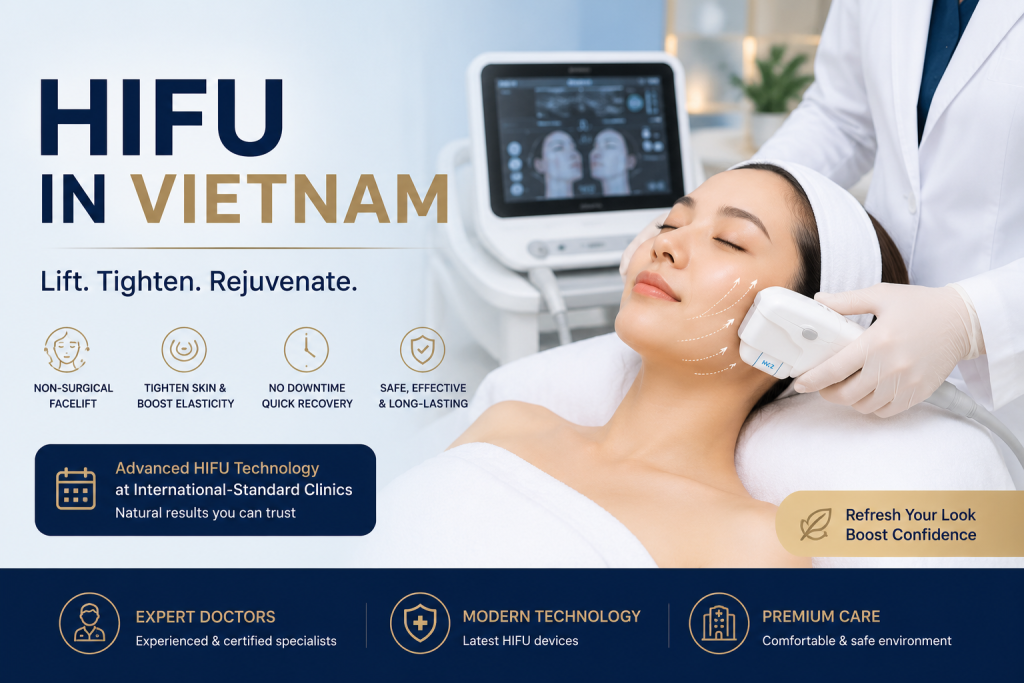
HIFU in Vietnam offers a non-surgical option for facial lifting, skin tightening and rejuvenation using advanced ultrasound technology.
Good Candidates
-
Mild to Moderate Laxity (Ages 30 to 50+): Individuals showing early to moderate signs of skin aging, such as blurring jawlines, mild submental fullness, or sagging cheeks.
-
Patients Seeking Prevention: Younger patients wanting to slow structural collagen loss.
-
Surgery-Averse Individuals: Anyone who wants cosmetic improvement without general anesthesia, scarring, or recovery time.
Poor Candidates
-
Severe Skin Sagging: Patients over 65 with extensive skin laxity and deep structural folds will get limited benefits from ultrasound energy alone. In such cases, surgical procedures outlined in our overview of cosmetic surgery in Vietnam offer more transformative outcomes.
-
Open Wounds or Severe Acne: Active skin infections, cystic acne, or open lesions in the treatment area must be healed prior to treatment.
-
Metallic Implants: Patients with metallic stents, pacemakers, or electrical implants in the face or neck area cannot undergo HIFU.
Combining HIFU with Other Aesthetic Procedures
In modern aesthetic medicine, combining treatments yields better results than relying on a single modality. Vietnamese dermatologists frequently design multi-layered treatment plans to address multiple signs of aging simultaneously.
1. HIFU + Botulinum Toxin (Botox)
-
Synergy: While HIFU lifts structural muscle and deep dermal tissue, Botox relaxes hyperactive expression muscles in the upper face (crow’s feet, forehead lines, frown lines).
-
Protocol: HIFU is performed first, followed by Botox injections during the same session or 2 weeks later.
2. HIFU + Biostimulators (Profhilo / Sculptra)
-
Synergy: HIFU creates thermal points to kickstart collagen production, while injectable biostimulators like Poly-L-lactic acid (Sculptra) or High-Concentration HA (Profhilo) supply deep hydration and structural building blocks.
-
Protocol: Typically scheduled 2 to 4 weeks apart to allow the thermal response to settle.
3. HIFU + Submental Liposuction
-
Synergy: For patients with heavy fat deposits under the chin alongside loose skin, HIFU alone may not fully refine the jawline. Combining focused ultrasound with targeted fat removal creates dramatic profile contours.
-
Protocol: Review our complete guide to liposuction in Vietnam to explore surgical and non-surgical fat reduction combinations.
Pre-Treatment & Post-Treatment Care Guide
To maximize collagen synthesis and prevent adverse reactions, follow these clinical guidelines before and after your HIFU session.
Before Your Appointment
-
Avoid Retinoids: Discontinue topical retinoids (Tretinoin, Retinol), AHAs, BHAs, and harsh exfoliants 3 to 5 days prior to treatment.
-
Limit Sun Exposure: Avoid intense sun exposure, tanning beds, or sunburns for at least one week before your session.
-
Hydrate Well: Ensure adequate water intake in the days leading up to your session; well-hydrated tissue responds better to ultrasound energy delivery.
-
Disclose Medications: Inform your doctor if you take blood thinners, anti-inflammatory medications, or have a history of cold sores.
After Your Session
-
Sun Protection is Mandatory: Apply broad-spectrum SPF 50+ daily and avoid direct sun exposure for 14 days. Thermal energy makes the skin temporarily sensitive to UV-induced hyperpigmentation.
-
Skip Hot Baths and Saunas: Avoid hot tubs, saunas, steam rooms, and intense cardiovascular exercise for 48 hours to prevent excessive facial swelling.
-
Gentle Skincare Routine: Use a mild, hydrating cleanser and soothing barrier repair creams containing ceramides, hyaluronic acid, or centella asiatica.
-
Avoid Cold Compresses: Do not apply ice packs immediately after HIFU unless recommended by your doctor. The controlled heat generated in the skin tissue is the exact stimulus needed to spark collagen production.
How to Plan Your HIFU Trip to Vietnam
Integrating a HIFU treatment into your travel itinerary is straightforward due to the non-invasive nature of the procedure. A typical 4-day medical travel plan works seamlessly:
-
Day 1: Arrival in Ho Chi Minh City or Hanoi and hotel check-in.
-
Day 2: Clinic consultation and HIFU treatment session (takes roughly 1.5 to 2 hours in total).
-
Day 3: City sightseeing, shopping, culinary tours, and relaxation.
-
Day 4: Optional follow-up review, departure, or onward travel to Vietnam’s coastal resorts.
Essential Checklist for International Patients
-
Verify Equipment Authenticity: Ask the clinic for proof of device authenticity, manufacturer certifications, or QR code verification on the machine before starting your treatment.
-
Confirm Doctor Credentials: Ensure the procedure is performed or directly supervised by a licensed dermatologist registered with the Ministry of Health Vietnam.
-
Schedule Early in Your Trip: Schedule your appointment during the first few days of your holiday. This allows you to ask any follow-up questions in person before flying home.
-
Combine with Leisure: Since HIFU requires no recovery time, you can immediately explore Vietnam’s vibrant street food scene, historic landmarks, or resort coastal destinations like Da Nang and Phu Quoc.
Frequently Asked Questions (FAQs)
How many sessions of HIFU do I need?
For most patients, a single session yields noticeable lifting and tightening that lasts 12 to 18 months. Patients with more pronounced skin laxity may benefit from a second consolidation session scheduled 3 to 6 months after the initial treatment.
How long do HIFU results last?
Collagen production peaks around month 3 to 6 post-treatment. Results typically last between 1 and 2 years, depending on your age, baseline collagen levels, lifestyle factors (smoking, sun exposure), and skincare maintenance.
Is HIFU safe for darker skin tones?
Yes. Unlike optical energy lasers, which target melanin and carry a risk of post-inflammatory hyperpigmentation (PIH) in darker skin types (Fitzpatrick types IV–VI), focused ultrasound bypasses the pigment-containing epidermal layer entirely. This makes HIFU safe for all skin tones.
What is the difference between HIFU and Thermage?
HIFU uses ultrasound energy to reach deeper structural layers (up to 4.5mm at the SMAS layer) for structural lifting and jawline sculpting. Thermage uses Radiofrequency (RF) energy to heat the upper and mid-dermal layers (up to 3.0mm) for superficial skin tightening, pore refinement, and smoothing fine wrinkles. Many clinics combine both for comprehensive anti-aging benefits.
Final Verdict
HIFU remains one of the most effective non-invasive skin tightening and facial sculpting options available today. Choosing to undergo HIFU in Vietnam gives you access to cutting-edge technology, certified dermatologists, and international healthcare standards—all while enjoying cost savings of up to 70% compared to Western clinics.
Whether you are looking to define your jawline, lift sagging jowls, or maintain youthful collagen, Vietnam’s aesthetic centers offer a safe, reliable, and cost-effective medical tourism experience. Ensure you select a certified clinic using verified devices, consult with a qualified dermatologist, and enjoy your journey to refreshed, firmer skin.
Interested in HIFU in Vietnam?
Contact us for clinic recommendations, estimated costs and appointment assistance.