
Facial aging is not only about wrinkles. Over time, the face gradually loses volume in areas such as the cheeks, temples, under-eyes, forehead, and around the mouth. These changes can make the face appear tired, hollow, or older even when the skin itself is still relatively firm.
Facial Fat Transfer in Vietnam is becoming an attractive option for international patients who want to restore youthful facial volume using their own body fat. Also known as facial fat grafting, fat injection, or autologous fat transfer, the procedure involves removing a small amount of fat from another part of the body, processing it, and carefully reinjecting it into selected areas of the face.
Unlike temporary dermal fillers, facial fat transfer uses the patient’s own tissue and may provide long-lasting improvement when transplanted fat successfully establishes a new blood supply.
Vietnam has also become increasingly attractive to medical travelers seeking cosmetic surgery because procedures are available at comparatively affordable prices in major cities such as Ho Chi Minh City and Hanoi.
This guide explains Facial Fat Transfer in Vietnam, including how the procedure works, areas that can be treated, expected results, recovery, risks, costs, and how international patients can plan their treatment safely.
Quick Navigation
What Is Facial Fat Transfer?
Facial fat transfer is a cosmetic surgical technique that uses fat harvested from the patient’s own body to restore or enhance facial volume.
According to the Cleveland Clinic, facial fat grafting can help restore volume that has been lost with aging and may be performed as a stand-alone treatment or together with other cosmetic procedures such as facelift or eyelid surgery.
The procedure generally involves three main stages:
- Fat harvesting – fat is removed from an area such as the abdomen, thighs, waist, or hips using liposuction.
- Fat processing – the harvested fat is cleaned and prepared to separate viable fat cells from unwanted fluid, oil, or blood.
- Fat injection – small amounts of prepared fat are injected into selected layers of the face.
The goal is not simply to make the face larger or fuller. Modern facial fat grafting focuses on restoring natural proportions and replacing volume that has been lost through aging, weight loss, or individual facial anatomy.
The American Society of Plastic Surgeons also explains that fat can be harvested by liposuction from a donor area and transferred to the face to enhance fullness, improve shallow contours, and soften facial creases.
For a broader overview of face and body fat grafting, patients can also read our guide to Fat Transfer in Vietnam.
Why Does Facial Volume Loss Make Us Look Older?
Aging affects much more than the surface of the skin.
As we age, several structural changes may occur simultaneously:
- facial fat compartments lose volume;
- some fat pads shift downward;
- facial bones gradually remodel;
- collagen and elastin production decreases;
- skin becomes thinner;
- ligaments and deeper soft tissues change;
- facial shadows become more prominent.
These changes can lead to hollow temples, flatter cheeks, under-eye depressions, deeper nasolabial folds, and a less defined facial contour.
This explains why treating wrinkles alone may not completely rejuvenate an aging face.
In selected patients, restoring volume to areas such as the cheeks and temples can improve facial proportions and create a softer, more youthful appearance.
Fat grafting may therefore be used either as a stand-alone procedure or as part of a more comprehensive facial rejuvenation plan.
What Areas Can Be Treated With Facial Fat Transfer?
One of the advantages of Facial Fat Transfer in Vietnam is that several areas of the face can often be treated during the same procedure.
Cheeks
Cheek volume is an important component of a youthful facial appearance.
As mid-face volume decreases with age, the cheeks may become flatter and the transition between the lower eyelids and cheeks may become more pronounced.
Fat grafting can restore cheek projection and improve the natural curves of the mid-face.
Rather than simply filling a wrinkle, restoring cheek volume may also soften shadows and improve the appearance of surrounding areas.
Temples
Hollow temples can make the upper face appear thinner and more skeletal.
Carefully placed fat can create a smoother contour between the forehead and cheekbone.
Because the temporal region contains important blood vessels and nerves, fat grafting in this area should only be performed by a doctor with detailed knowledge of facial anatomy.
Under-Eye Hollows
The tear trough area can become increasingly visible due to genetics, aging, or loss of mid-face volume.
Small amounts of fat may be used to improve the transition between the lower eyelid and cheek.
However, the under-eye area requires conservative treatment. Excessive volume can produce puffiness or uneven contours.
Forehead
Some patients naturally have a flat or irregular forehead contour.
Fat grafting may be used to create a smoother and more balanced forehead profile.
This treatment is particularly common among patients seeking overall facial contour enhancement rather than correction of individual wrinkles.
Nasolabial Folds
Nasolabial folds extend from the sides of the nose toward the corners of the mouth.
These lines may become more pronounced as cheek volume decreases.
Rather than placing large amounts of fat directly into the folds, surgeons may restore surrounding facial volume to create a more natural improvement.
Chin and Jawline
Small-volume fat grafting may improve mild contour irregularities around the chin or jawline.
However, patients seeking substantial chin projection may require a different treatment such as an implant or another augmentation technique.
Similarly, facial fat grafting cannot replace facelift or neck lift surgery when significant loose skin or jowling is present.
Lips
Fat can also be transferred to the lips.
This provides an alternative to temporary hyaluronic acid fillers for patients seeking soft, natural lip volume.
However, the amount of surviving fat can be less predictable than the volume obtained with injectable fillers.
Facial Fat Transfer vs Dermal Fillers
Both treatments restore facial volume, but they work differently.
| Facial Fat Transfer | Dermal Fillers |
|---|---|
| Uses your own body fat | Uses manufactured injectable material |
| Requires fat harvesting | No liposuction required |
| More invasive | Minimally invasive |
| Longer initial recovery | Usually minimal downtime |
| Potential for long-term results | Usually temporary |
| Useful for multiple areas | Excellent for precise corrections |
| Some fat will be absorbed | Volume is more immediately predictable |
Dermal fillers may be appropriate when a patient wants a small correction with little downtime.
Fat transfer may be more attractive when multiple facial areas require volume restoration or when the patient prefers to use their own tissue.
The American Society of Plastic Surgeons notes that facial fat injection is a more involved procedure than standard injectable fillers because fat must first be harvested through liposuction. However, surviving transferred fat can provide long-term volume. Learn more from the American Society of Plastic Surgeons.
How Does Facial Fat Transfer Work?
Although individual techniques vary between surgeons and hospitals, Facial Fat Transfer in Vietnam generally follows several steps.
Step 1: Consultation and Facial Assessment
Before surgery, the doctor evaluates:
- facial proportions;
- areas of volume deficiency;
- skin quality;
- facial asymmetry;
- previous fillers;
- previous facial surgery;
- medical history;
- medications;
- smoking or nicotine use;
- availability of donor fat.
Standardized photographs may be taken to help with treatment planning.
Patients should clearly explain what changes they want while also allowing the surgeon to assess the face as a whole.
Step 2: Selecting the Donor Area
Fat may be collected from several parts of the body.
Common donor areas include:
- abdomen;
- waist;
- thighs;
- hips;
- flanks.
Only a relatively small amount of fat is generally required for facial treatment.
Step 3: Fat Harvesting
The surgeon removes fat through small incisions using liposuction.
Specialized cannulas may be used to harvest the fat gently and minimize unnecessary damage to fat cells.
Step 4: Fat Processing
The harvested material contains fat cells as well as fluid, blood, and oil.
Before facial injection, it is processed using techniques such as:
- centrifugation;
- filtration;
- washing;
- decanting.
Different surgeons use different preparation methods.
Step 5: Fat Injection
Processed fat is injected into the face through small cannulas.
Instead of placing one large deposit of fat, surgeons typically distribute many small amounts through different tissue planes.
This allows the surgeon to sculpt the facial contour while maximizing contact between the transplanted fat and surrounding tissue.
Step 6: Early Recovery
Depending on the treatment plan and anesthesia, patients may return to their hotel or accommodation the same day or remain for short-term observation.
How Long Does Facial Fat Transfer Last?
Fat transfer can provide long-lasting results, but not all transferred fat survives.
After injection, transplanted fat cells need to establish a blood supply in their new location.
Some successfully integrate into surrounding tissue, while others are gradually absorbed by the body.
A systematic review and meta-analysis published on PubMed examined 27 studies involving 1,011 patients. Reported volume retention ranged from 26% to 83%, with a pooled average of approximately 47%.
This wide variation is important.
Patients should be cautious when a provider promises that nearly all injected fat will permanently survive.
The exact percentage depends on multiple factors, including:
- harvesting technique;
- fat processing method;
- injection technique;
- treatment area;
- blood supply;
- individual healing;
- smoking;
- weight fluctuations.
Once transplanted fat has successfully established itself, it behaves similarly to other fat cells in the body.
Significant weight gain may increase its volume, while major weight loss may reduce it.
Maintaining a relatively stable weight can therefore help preserve the result.
Will I Need More Than One Fat Transfer Session?
Some patients obtain their desired result after one procedure.
Others may need an additional session because a proportion of the transferred fat has been absorbed.
This does not necessarily mean the original surgery failed.
In fact, conservative treatment may be preferable to excessive overfilling during one procedure.
The American Society of Plastic Surgeons notes that outcomes can be less predictable than those of conventional fillers and that additional fat-transfer procedures may sometimes be needed to achieve the desired volume.
Facial Fat Transfer in Vietnam Cost
Cost is one of the major reasons international patients investigate cosmetic treatment in Vietnam.
According to currently published information on our broader Fat Transfer in Vietnam guide, facial fat transfer commonly ranges from approximately USD 600 to USD 1,500, although prices vary substantially depending on the treatment plan.
A useful general estimate is:
| Facial Fat Transfer Treatment | Estimated Cost in Vietnam |
|---|---|
| Small facial area | USD 600–800 |
| One or two facial areas | USD 700–1,000 |
| Multiple facial areas | USD 900–1,300 |
| Extensive/full-face fat grafting | USD 1,200–1,500+ |
These figures are indicative only and should not be considered guaranteed quotations.
What Factors Affect the Cost?
The final price may depend on:
- number of facial areas treated;
- amount of fat required;
- donor area;
- liposuction method;
- surgeon’s experience;
- hospital or clinic;
- anesthesia;
- preoperative tests;
- medications;
- postoperative care;
- combination with other procedures.
International patients should request a personalized quotation before making travel arrangements.
What Should the Quotation Include?
Ask whether the quoted price includes:
- surgeon’s professional fee;
- anesthesia fee;
- operating room;
- fat harvesting;
- fat processing;
- facial injections;
- medical tests;
- medications;
- postoperative appointments.
Patients should also ask whether revision or additional fat grafting would involve a separate fee.
Why Consider Facial Fat Transfer in Vietnam?
Vietnam attracts international cosmetic surgery patients for several practical reasons.
Competitive Pricing
Treatment costs are typically lower than in many Western countries.
Lower local labor and facility costs can contribute to these price differences.
However, patients should never select a provider solely because it offers the cheapest package.
Experienced Cosmetic Surgeons
Facial fat grafting requires technical skill and a sophisticated understanding of three-dimensional facial anatomy.
The surgeon must determine not only how much fat to inject but also where and at what tissue depth.
Modern Private Hospitals
Large Vietnamese cities have private hospitals and specialist cosmetic surgery facilities offering operating rooms, anesthesia, laboratory testing, and postoperative monitoring.
International patients should confirm the exact facility in which their procedure will be performed.
Access to Multiple Cosmetic Procedures
Fat transfer is sometimes combined with:
- facelift;
- neck lift;
- upper eyelid surgery;
- lower eyelid surgery;
- brow lift;
- rhinoplasty.
Patients researching a broader treatment plan can explore our guide to Cosmetic Surgery in Vietnam.
Facial Fat Transfer and Facelift: What Is the Difference?
A facelift and facial fat grafting address different aspects of aging.
A facelift primarily treats:
- loose facial tissues;
- jowls;
- skin laxity;
- lower-face descent;
- neck laxity.
Facial fat transfer primarily treats:
- volume loss;
- hollow temples;
- flat cheeks;
- tear troughs;
- facial deflation.
A patient may have significant facial volume loss but relatively little loose skin. In this case, fat grafting may be sufficient.
Another patient may have both volume loss and tissue descent. Combining a facelift with fat transfer may therefore produce a more comprehensive result.
Cleveland Clinic notes that fat grafting can be performed together with procedures such as facelift and eyelid surgery as part of facial rejuvenation. Read more about facial fat injection at Cleveland Clinic.
Recovery After Facial Fat Transfer
Recovery depends on the amount of fat transferred and whether other procedures were performed simultaneously.
Common temporary effects include:
- swelling;
- bruising;
- tenderness;
- temporary fullness;
- mild facial asymmetry during healing;
- soreness at the donor area.
Days 1–3
Swelling may be most noticeable during the first several days.
The face can appear significantly fuller than the expected final result.
Patients should not judge their outcome at this stage.
Days 4–7
Swelling generally begins to improve.
Bruising may still be visible.
Patients should follow the surgeon’s instructions about sleeping position, facial pressure, washing, and medication.
Week 1–2
Many patients can return to office work or light daily activities.
Visible swelling usually continues to decrease, although subtle puffiness may remain.
Weeks 3–6
Facial contours become more natural as swelling resolves.
Patients may start noticing a better approximation of the long-term result.
Months 3–6
By this stage, early swelling has largely settled and much of the initial fat absorption has occurred.
The remaining volume provides a better indication of the long-term result.
How Long Should Medical Tourists Stay in Vietnam?
Patients traveling specifically for Facial Fat Transfer in Vietnam should allow adequate time for:
- initial consultation;
- preoperative testing;
- surgery;
- early recovery;
- postoperative examination.
For uncomplicated facial fat transfer, a stay of approximately 7–14 days may be practical.
Patients undergoing a facelift, eyelid surgery, or another procedure simultaneously may need a longer stay.
The surgeon should determine when the patient is medically ready to fly.
International travelers should avoid planning intensive sightseeing immediately after surgery.
Is Facial Fat Transfer Safe?
Facial fat grafting is a recognized cosmetic technique, but it is still a surgical procedure and is not completely risk-free.
Possible complications include:
- swelling;
- bruising;
- infection;
- asymmetry;
- contour irregularities;
- excessive fat absorption;
- under-correction;
- over-correction;
- fat necrosis;
- oil cysts;
- prolonged edema;
- need for revision.
A systematic review examining facial fat grafting reported complications including asymmetry, skin irregularities, prolonged swelling, fat necrosis, and infection. The study is available through PubMed.
Rare but serious vascular complications have also been documented.
A more recent systematic review published in 2024 found that severe reported complications included neurological injury and vision loss, with the forehead and temporal areas represented prominently among reported serious events. The authors emphasized that facial fat grafting should be performed by qualified doctors with careful consideration of facial anatomy. Read the systematic review on PubMed.
These complications are uncommon, but their potential severity highlights why surgeon selection is critical.
How to Choose a Surgeon for Facial Fat Transfer in Vietnam
International patients should evaluate several factors before booking surgery.
Verify Medical Qualifications
Ask about:
- medical license;
- specialist training;
- plastic surgery qualifications;
- hospital privileges;
- experience specifically in facial fat grafting.
Ask Who Will Perform the Procedure
Make sure you know the name of the surgeon before traveling.
Avoid choosing treatment solely through sales representatives without speaking to or receiving an assessment from the treating medical team.
Review Similar Before-and-After Cases
Pay attention to:
- cheek contour;
- temple volume;
- under-eye smoothness;
- symmetry;
- facial balance.
Good facial fat grafting should normally look natural rather than obviously overfilled.
Check the Surgical Facility
Ask whether surgery will take place in:
- a licensed hospital;
- a cosmetic surgery hospital;
- an appropriately licensed surgical clinic.
The facility should have suitable equipment and protocols for the type of anesthesia being used.
Discuss the Follow-Up Plan
International patients should know:
- when the first follow-up occurs;
- how many reviews are needed;
- who to contact after returning home;
- what happens if a complication develops.
Who Is a Good Candidate?
Facial fat transfer may be appropriate for adults who:
- have facial volume loss;
- have hollow temples or cheeks;
- want natural-looking rejuvenation;
- have adequate donor fat;
- are medically fit for surgery;
- have realistic expectations;
- understand that some fat will be absorbed.
The procedure may be particularly attractive to patients who prefer their own tissue instead of repeated synthetic filler injections.
Who May Not Be Suitable?
Treatment may need to be postponed or reconsidered in patients with:
- uncontrolled medical conditions;
- active infections;
- certain bleeding disorders;
- insufficient donor fat;
- unstable body weight;
- unrealistic expectations;
- inability to follow postoperative instructions.
Smoking and nicotine exposure may also affect healing and should be discussed openly with the surgeon.
Patients taking medications or supplements that affect blood clotting should disclose them during the consultation rather than stopping them without medical advice.
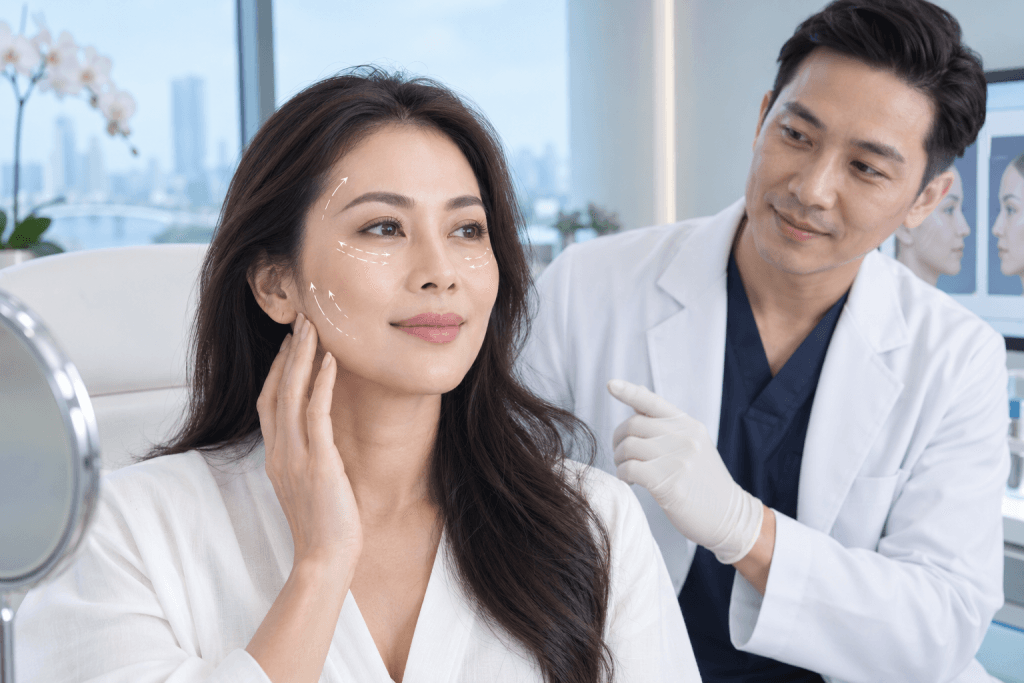
Facial fat transfer in Vietnam can help restore lost volume in areas such as the cheeks, temples, and under-eyes for a softer, more natural rejuvenated appearance.
Frequently Asked Questions About Facial Fat Transfer in Vietnam
How much does Facial Fat Transfer in Vietnam cost?
Prices commonly start at around USD 600, while more extensive facial fat grafting may reach approximately USD 1,500 or more, depending on the hospital, surgeon, treatment areas, and anesthesia.
Is facial fat transfer permanent?
Some of the injected fat is absorbed during healing. Fat cells that successfully establish a new blood supply can remain long term, although aging and weight changes can still affect facial appearance.
How much transferred fat survives?
Published studies show considerable variation. One meta-analysis reported an overall pooled retention of approximately 47%, with individual studies ranging from 26% to 83%.
Is fat transfer better than fillers?
Neither is universally better. Fillers may be more appropriate for small, precise corrections and minimal downtime, while fat transfer may suit patients requiring broader volume restoration.
Where is the fat taken from?
Common areas include the abdomen, thighs, hips, waist, and flanks.
Does facial fat transfer leave scars?
Small access incisions are required for fat harvesting, but they are usually much smaller than conventional surgical incisions.
Can facial fat transfer be combined with a facelift?
Yes. Fat grafting may complement facelift surgery when a patient has both facial sagging and volume loss.
When can I return to work?
Many patients return to non-strenuous work within one to two weeks, depending on swelling, bruising, and the extent of treatment.
When will I see the final result?
The face changes gradually as swelling resolves and some transplanted fat is absorbed. A more reliable assessment is usually possible around three to six months after treatment.
How long should I stay in Vietnam?
For facial fat transfer alone, approximately 7–14 days may be practical for many international patients, although the treating surgeon should provide an individualized recommendation.
Is Facial Fat Transfer in Vietnam Worth Considering?
For suitable patients, Facial Fat Transfer in Vietnam can offer a combination of natural tissue, long-term facial volume restoration, and comparatively affordable treatment costs.
Its main advantage is that the procedure addresses facial aging in three dimensions.
Instead of focusing only on individual wrinkles, fat grafting can restore volume to the cheeks, temples, under-eye region, forehead, and other selected areas to improve overall facial balance.
However, results are not completely predictable.
Some transferred fat will be absorbed, and a second treatment may occasionally be necessary. The procedure also carries medical risks, including rare but serious complications.
Choosing an appropriately qualified surgeon should therefore take priority over choosing the lowest-cost treatment.
The best facial fat transfer results should not make a patient look noticeably “filled.” The aim is to restore volume selectively so that the face looks softer, balanced, and naturally refreshed.
Plan Your Facial Fat Transfer in Vietnam
If you are considering Facial Fat Transfer in Vietnam, start with a personalized assessment based on your facial anatomy, degree of volume loss, skin quality, previous cosmetic procedures, medical history, and treatment goals.
Learn more about the overall procedure in our detailed guide to Fat Transfer in Vietnam.
If you are considering facial fat transfer together with other procedures, you can also explore our overview of Cosmetic Surgery in Vietnam.
With careful planning, realistic expectations, and appropriate medical assessment, facial fat transfer can provide subtle facial rejuvenation while preserving the natural characteristics that make each face unique.
Considering facial fat transfer in Vietnam? Get a personalized treatment plan and cost estimate.