
For US patients considering dental treatment overseas, dental implants in Vietnam for Americans can provide another option for replacing missing teeth or restoring a larger section of the mouth. However, planning implant treatment overseas involves much more than comparing the advertised cost of an implant.
The number of missing teeth, jawbone condition, implant system, type of final restoration, need for bone grafting or sinus augmentation, treatment timeline and follow-up after returning to the United States can all affect the final treatment plan.
This guide explains dental implants in Vietnam for Americans, including indicative 2026 costs in US dollars, implant options, All-on-4 and All-on-6 treatment, one-trip versus two-trip planning, implant systems, travel considerations and aftercare in the US.
If you are still comparing different types of dental treatment, see our complete guide to Dental Work in Vietnam for Americans.
Quick Navigation
Dental Implants in Vietnam for Americans: At a Glance
For Americans considering implant treatment in Vietnam, several practical questions should be clarified before booking flights.
| Topic | What US Patients Should Know |
|---|---|
| Treatment options | Single implants, multiple implants, implant-supported bridges, All-on-4, All-on-6 and full-arch restorations |
| Treatment planning | Clinical examination and dental imaging are normally required before the final treatment plan |
| Number of trips | Some cases may require two visits because of healing between implant placement and final restoration |
| Additional procedures | Bone grafting, sinus augmentation or tooth extraction may be required in selected cases |
| Implant system | Ask for the implant manufacturer, brand/system and treatment records |
| Currency | Compare quotations in VND and/or USD and confirm what is included |
| Aftercare | Ongoing oral hygiene and dental follow-up remain necessary after returning to the US |
| Final diagnosis | Requires appropriate assessment by the treating dental professional |
A preliminary quotation based on photographs or X-rays can help with planning, but it should not be treated as a final clinical diagnosis or treatment plan.
How Much Do Dental Implants in Vietnam Cost for Americans?
The cost of dental implants in Vietnam for Americans varies because implant treatment can range from replacing one missing tooth to complex full-arch rehabilitation.
The final cost can depend on:
- the number of implants;
- implant manufacturer and system;
- type of abutment;
- crown, bridge or prosthetic material;
- condition of the jawbone;
- required extractions;
- diagnostic imaging;
- bone grafting;
- sinus augmentation;
- temporary restorations; and
- complexity of the final restoration.
Based on indicative 2026 pricing available from a VnMedtour dental partner in Vietnam:
| Treatment | Indicative Price (VND) | Approx. USD |
|---|---|---|
| All-on-4 / All-on-6 Dental Implants | 175–260 million VND | $6,730–$10,000 |
| Full-Mouth Rehabilitation | 340–520 million VND | $13,080–$20,000 |
Price note: These are indicative 2026 price ranges provided by a VnMedtour dental partner in Vietnam for general reference. Final costs depend on diagnosis, number of implants, implant system, restorative materials, bone condition and treatment complexity. USD equivalents are approximate and may change with exchange rates.
A generic single-implant price is not included because patients should establish whether an advertised price includes the implant fixture, abutment and final crown.
What Should a Dental Implant Quote Include?
When comparing implant quotations, looking only at the headline price can be misleading.
Ask whether the quotation includes:
- consultation and examination;
- panoramic X-ray;
- CBCT imaging where indicated;
- implant fixture;
- implant abutment;
- temporary restoration where applicable;
- final crown, bridge or full-arch prosthesis;
- tooth extraction;
- bone grafting;
- sinus augmentation;
- anesthesia or sedation where applicable;
- medications;
- postoperative reviews; and
- adjustments to the final restoration.
For full-arch treatment, patients should also ask what material is proposed for both the temporary and definitive prosthesis.
An itemized quotation makes different treatment proposals easier to compare.
What Is a Dental Implant?
A dental implant is a device surgically placed into the jawbone to support a dental restoration such as a crown, bridge or denture.
A dental implant system generally includes an implant body placed in the jaw and an abutment or other restorative connection between the implant and the replacement tooth.
The U.S. Food and Drug Administration (FDA) provides patient information about dental implants, including their potential benefits, risks and important considerations before treatment.
For Americans receiving treatment abroad, another important consideration is what happens after returning to the United States. Knowing the implant system and keeping accurate treatment records can make future maintenance easier.
Types of Dental Implant Treatment Available in Vietnam
Dental implant treatment is not a single standardized procedure. The appropriate approach depends on the number and location of missing teeth, available bone, gum condition, bite and proposed restoration.
Single-Tooth Dental Implant
A single dental implant may be used to replace one missing tooth.
The implant fixture is placed in the jawbone. Once the treating dentist determines that it is ready for restoration, a dental crown can be attached to the implant.
The treatment sequence and timing depend on the patient’s bone condition, implant stability, healing and treatment plan.
For an American travelling to Vietnam for one implant, it is important to establish whether the definitive crown can be completed during the planned trip or whether a later visit will be required.
Multiple Dental Implants
Several missing teeth do not necessarily require one implant for every missing tooth.
Depending on the case, multiple strategically positioned implants may support an implant-supported bridge.
The number and position of implants should be based on clinical and restorative planning rather than choosing a predefined package.
Full-Arch Implant Treatment
Patients who have lost many or all teeth in one arch may be considered for an implant-supported full-arch restoration.
Treatment can involve several implants supporting a fixed dental prosthesis.
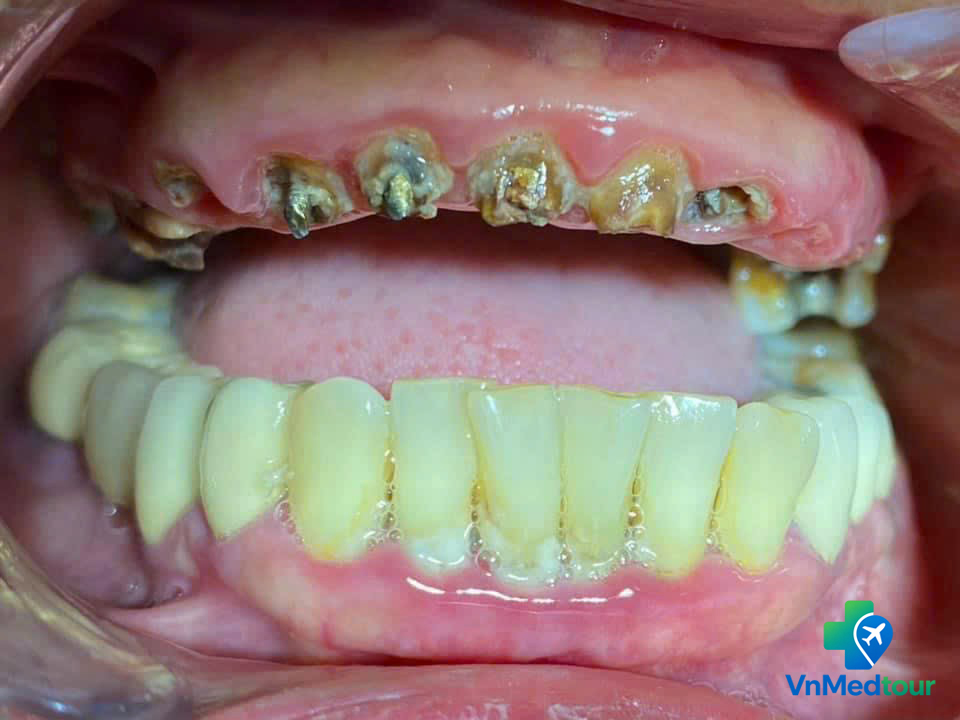
Clinical example before extensive restorative and implant treatment. Individual treatment requirements vary.
All-on-4 Dental Implants
All-on-4 is a full-arch treatment concept in which four strategically positioned implants are used to support a fixed dental restoration.
It may be considered for selected patients requiring extensive tooth replacement. However, All-on-4 is not automatically appropriate for everyone.
Bone anatomy, gum condition, remaining teeth, bite forces, medical history and prosthetic requirements need to be assessed first.
For a more detailed explanation of the procedure, see our guide to All-on-4 Dental Implants in Vietnam.
All-on-6 Dental Implants
All-on-6 generally uses six implants to support a full-arch restoration.
Using more implants does not automatically make All-on-6 better than All-on-4. Implant number and distribution should be determined according to the patient’s anatomy, available bone and restorative plan.
See our dedicated guide to All-on-6 Dental Implants in Vietnam.
All-on-4 vs All-on-6: Which Is Better?
Americans considering full-arch treatment should avoid choosing All-on-4 or All-on-6 based only on an advertised package.
The treating dental professional may need to consider:
- available bone;
- implant distribution;
- condition of remaining teeth;
- upper or lower jaw;
- bite forces;
- proposed prosthesis;
- oral hygiene;
- medical history; and
- long-term maintenance requirements.
The appropriate number and distribution of implants should therefore follow the clinical and restorative treatment plan.
Do You Need a Bone Graft Before Dental Implants?
Not every implant patient needs bone grafting.
However, adequate bone is required to support the proposed implant position. Long-term tooth loss, periodontal disease, previous infection and bone resorption can affect the amount of available bone.
A dental professional may use clinical examination and imaging to evaluate bone condition.
For more information, see our guide to Dental Bone Graft in Vietnam.
For dental implants in Vietnam for Americans, identifying a possible need for grafting before travel is particularly useful because it can affect cost, treatment stages and the number of trips required.
When Is a Sinus Lift Required?
The maxillary sinuses are located above the posterior upper jaw.
In selected patients, there may be insufficient bone height beneath the sinus for the proposed implant position. A dental professional may then consider sinus augmentation.
This does not mean every patient receiving upper-jaw implants needs a sinus lift.
The decision depends on the patient’s anatomy, available bone and planned implant position.
Read our guide to Sinus Lift Surgery in Vietnam.
Dental Implant Treatment Process in Vietnam
For Americans, implant planning should ideally begin before purchasing airline tickets.
Step 1: Send Your Dental Records
If available, patients can provide:
- recent panoramic dental X-ray;
- CBCT scan;
- dental reports;
- photographs of the teeth;
- information about missing teeth;
- details of previous implants, crowns or bridges;
- relevant medical history; and
- current medications.
These records can help a provider perform a preliminary review.
Remote review does not replace an in-person examination.
Step 2: Preliminary Treatment Planning
Based on the available information, the dental provider may be able to indicate:
- possible treatment options;
- approximate number of implants;
- whether additional procedures may be required;
- preliminary cost;
- approximate treatment duration; and
- whether more than one visit to Vietnam may be necessary.
The proposal remains preliminary until an appropriate clinical examination has been completed.
Step 3: Examination and Dental Imaging in Vietnam
After arrival, the dentist assesses the teeth, gums, bite and other relevant clinical factors.
Additional imaging may be required before implant placement.
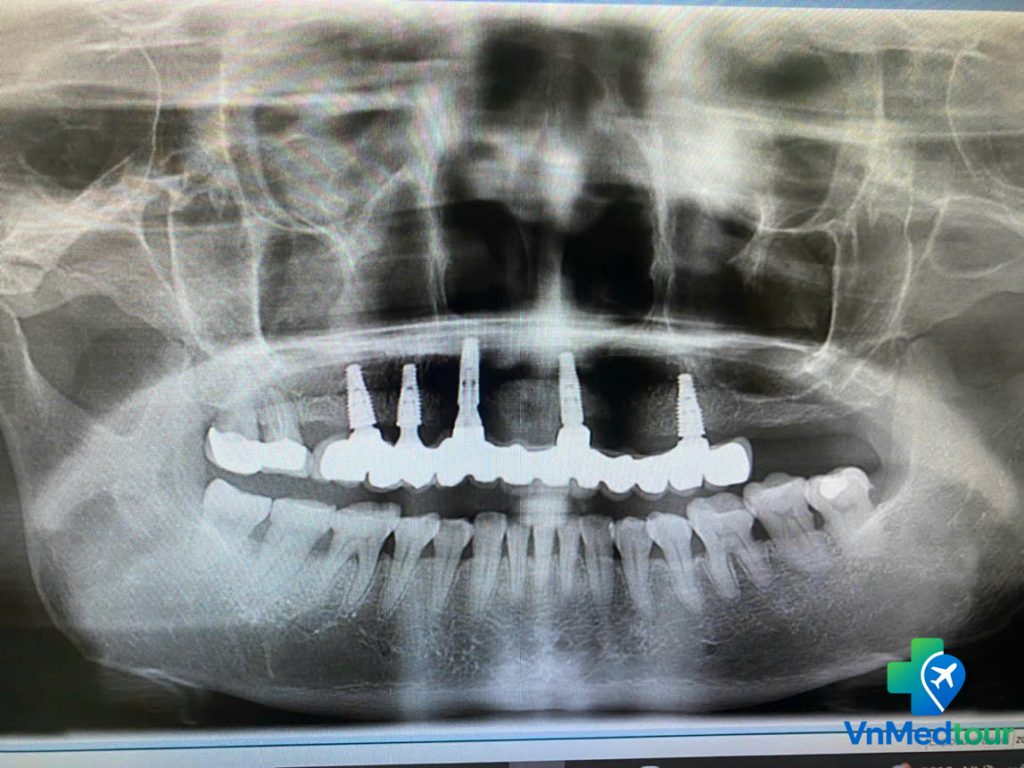
Panoramic dental X-ray showing multiple implants as part of implant and restorative treatment.
Diagnostic imaging helps the treating dental professional evaluate relevant anatomy and develop an appropriate treatment plan.
The final treatment plan can therefore differ from a preliminary quotation prepared from photographs or previous X-rays.
Step 4: Implant Placement
If treatment proceeds, dental implants are placed according to the clinical and restorative plan.
Depending on the individual case, tooth extraction, grafting or other procedures may be performed before or in conjunction with implant placement.
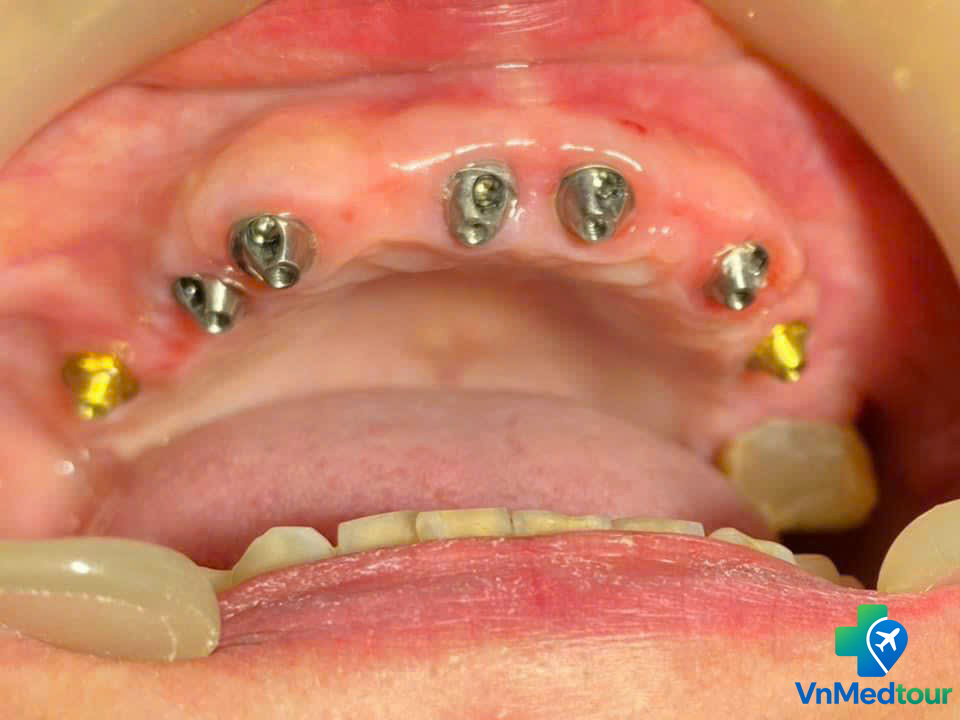
Clinical view of dental implant components used in full-arch restorative treatment.
Step 5: Healing and Osseointegration
After implant placement, the surrounding tissues and bone require time to heal.
The healing period varies according to the patient and treatment.
This is particularly important when planning dental implants in Vietnam for Americans, because the distance between Vietnam and the United States can make a second visit an important part of the overall treatment plan.
Patients should clarify whether they are expected to return to the US during healing and when the next treatment stage is likely to occur.
Step 6: Final Dental Restoration
Once the treating dentist determines that the implants are ready for the planned restoration, the definitive crown, bridge or full-arch prosthesis can be fitted.
The dentist should assess the fit, bite, appearance and ability to maintain hygiene around the restoration.
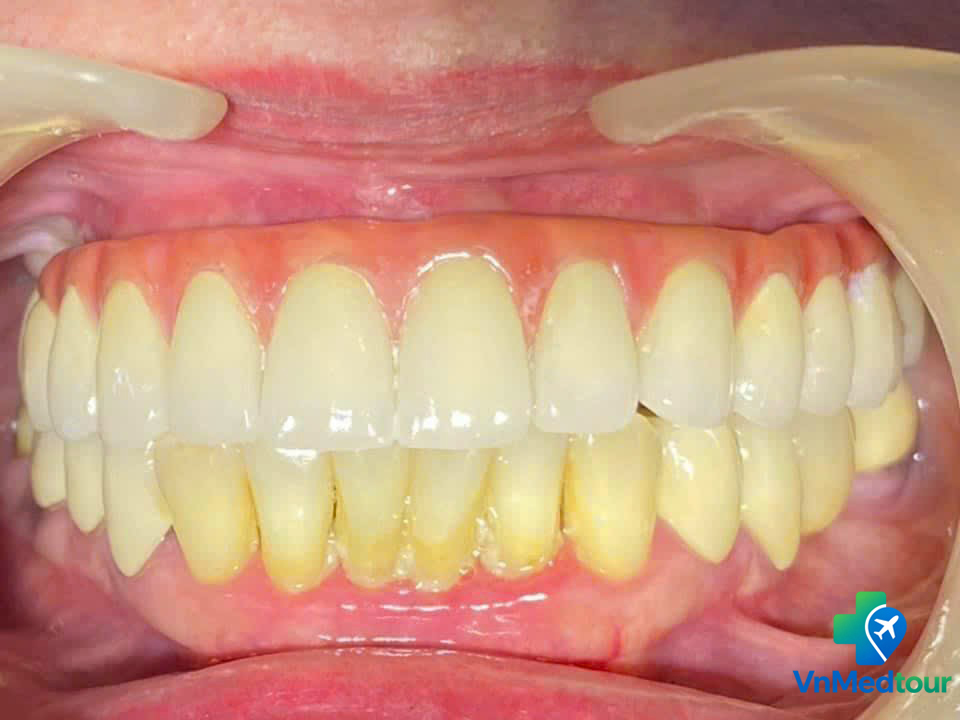
Example of a completed implant-supported dental restoration in Vietnam. Individual treatment plans and results vary.
What Does a Full-Arch Implant Prosthesis Look Like?
Full-arch implant treatment includes both a surgical component and a prosthetic component.
The implants placed in the jaw provide support, while the prosthesis replaces the visible teeth and associated structures according to the restorative design.
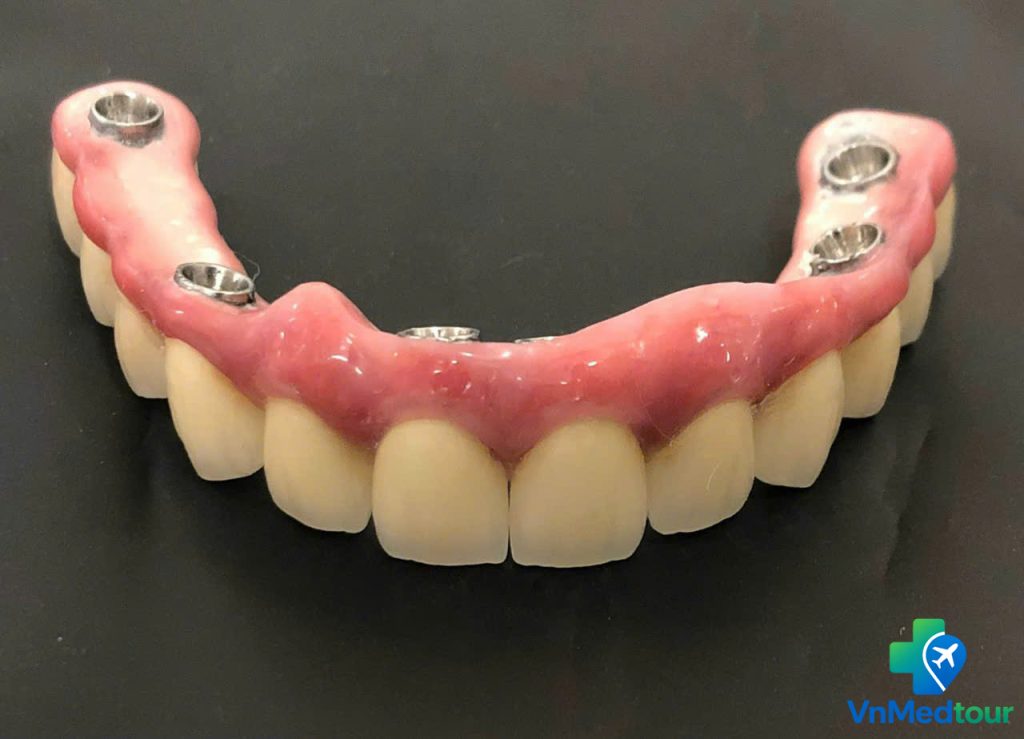
Example of a full-arch dental prosthesis designed to connect to dental implants.
Can Dental Implants in Vietnam Be Completed in One Trip?
Sometimes, but this should not be assumed before clinical assessment.
Selected patients may be suitable for protocols involving implant placement and a temporary restoration during the same treatment period. That does not necessarily mean the definitive restoration can also be completed immediately.
For many Americans, the process may look like this:
Trip 1: Implant Treatment
Examination → imaging → extraction if required → grafting if indicated → implant placement → temporary restoration where appropriate → postoperative review.
Healing Period in the United States
The patient returns home while healing takes place.
Trip 2: Final Restoration
The patient returns to Vietnam for reassessment and completion of the definitive restoration when clinically appropriate.
Before choosing dental implants in Vietnam for Americans, patients should therefore understand the entire treatment schedule rather than only the date of implant surgery.
How Long Should Americans Stay in Vietnam?
There is no universal stay length for implant treatment.
A patient receiving a straightforward single implant and a patient undergoing extensive full-arch rehabilitation may need very different schedules.
Before travelling, ask:
- How many appointments will I need?
- How many days should I allow between appointments?
- Will temporary teeth be provided?
- When is my postoperative review?
- When can I reasonably leave Vietnam?
- Will I need to return for the definitive restoration?
- What happens if the treatment plan changes after examination?
Allowing some flexibility in the itinerary can be useful, particularly for complex treatment.
Choosing an Implant System Before Travelling from the US
The implant system deserves particular attention when treatment is performed overseas.
The FDA recommends that patients ask their dental provider which brand and model of dental implant system is being used and keep that information in their records.
Before agreeing to treatment, ask:
- What is the implant manufacturer?
- What implant brand/system will be used?
- Is the system available internationally?
- Are compatible components available in the United States?
- What implant documentation will I receive?
- Will another dentist be able to identify the system later?
This matters because implant treatment does not end when the final restoration is fitted.
Crowns, bridges and full-arch prostheses can require future maintenance, adjustment, repair or replacement.
For Americans receiving implant treatment overseas, future serviceability in the United States should therefore be considered before treatment.
What Records Should You Bring Back to the United States?
Before leaving Vietnam, request copies of relevant treatment information.
Depending on the procedure, this may include:
- treatment summary;
- implant manufacturer;
- implant brand/system;
- implant identification information where available;
- location of the implants;
- relevant X-rays or scans;
- information about the final restoration;
- restorative materials where applicable;
- surgical information where appropriate;
- invoices; and
- recommended follow-up schedule.
These records can be useful if a dentist in the United States later needs to assess or maintain the implant-supported restoration.
Keep digital copies wherever possible.
How to Choose a Dental Implant Clinic in Vietnam
When considering dental implants in Vietnam for Americans, price should be only one part of the decision.
Dentist Qualifications and Experience
Ask who will actually perform the implant surgery and who will complete the restorative stage.
For complex treatment, ask about experience with the type of implant rehabilitation being proposed.
Diagnostic Planning
Ask what examinations and imaging will be used to assess bone, implant positions and restorative requirements.
Implant System
Request the implant manufacturer and system before agreeing to treatment.
Infection Prevention
Ask about sterilization and infection-control procedures, particularly because implant placement involves oral surgery.
Restorative Materials
For crowns, bridges and full-arch restorations, confirm what material is proposed and whether the final prosthesis is included in the quotation.
Follow-Up
Ask what support is available if a problem develops after returning to the United States.
Risks and Limitations of Dental Implant Treatment
Dental implants are surgical treatment and are not risk-free.
Potential complications can include:
- infection;
- injury to surrounding structures;
- problems with bite or function;
- implant or component loosening;
- implant failure;
- difficulty maintaining oral hygiene;
- sinus-related complications in relevant upper-jaw cases; and
- nerve-related symptoms in certain cases.
Individual health factors may also affect treatment suitability and healing.
Smoking is particularly relevant because it can interfere with healing and implant outcomes.
Patients should provide accurate information about their medical history, medications, allergies and smoking status before treatment.
Dental Tourism Safety for Americans
Travelling overseas for dental treatment introduces additional considerations beyond the dental procedure itself.
Americans planning treatment abroad can review the CDC guidance on medical tourism before travelling.
Important issues include:
- qualifications of the treating professional;
- infection prevention;
- treatment documentation;
- continuity of care;
- travel health;
- possible complications;
- insurance coverage;
- postoperative support; and
- follow-up after returning to the United States.
Patients should also understand what their travel and health insurance policies cover.
Will US Dental Insurance Cover Dental Implants in Vietnam?
Coverage varies between insurance plans.
Patients should not assume that implant treatment performed in Vietnam will automatically be reimbursed by a US dental insurer.
Before treatment, ask your insurer:
- Is overseas dental treatment eligible?
- Are dental implants covered?
- Is preauthorization required?
- What documentation is needed?
- Is there an annual benefit maximum?
- Are overseas invoices accepted?
- Are specific billing or treatment codes required?
Where possible, obtain confirmation before travelling.
An invoice from a Vietnamese dental provider does not itself guarantee reimbursement.
HSA and FSA Considerations
Some Americans considering dental implants in Vietnam for Americans may want to determine whether eligible dental expenses can be paid or reimbursed through an HSA or FSA.
The IRS Publication 502 on Medical and Dental Expenses provides information about medical and dental expenses for US taxpayers.
Eligibility depends on the treatment and applicable tax and plan rules, so patients should also check the requirements of their individual HSA or FSA arrangement.
Follow-Up Care After Returning to the United States
Long-term follow-up deserves particular attention when implant treatment is performed overseas.
Before leaving Vietnam, establish:
- who to contact if a problem develops;
- whether the Vietnamese provider can review records or images remotely;
- what symptoms require prompt dental assessment;
- what maintenance schedule is recommended;
- what implant system was used; and
- what information should be provided to your US dentist.
Receiving the original treatment in Vietnam does not eliminate the need for continuing dental care in the United States.
Maintaining Dental Implants Long Term
Dental implants and implant-supported restorations require ongoing maintenance.
Patients should follow professional advice regarding:
- brushing;
- interdental cleaning;
- cleaning around implant restorations;
- professional dental hygiene;
- routine examinations; and
- monitoring the implants and surrounding tissues.
Full-arch restorations can have different hygiene requirements from a single implant crown. Patients should understand how to clean their specific restoration before leaving Vietnam.
Why Existing Dental Work Matters Before Implant Treatment
In complex cases, the dentist may also need to assess old crowns, bridges and previous restorative work.
Existing restorations are not automatically retained or removed; the decision should depend on their condition and the proposed treatment plan.
Are Dental Implants in Vietnam Worth It for Americans?
For some patients, dental implants in Vietnam for Americans may provide a practical treatment option. For others, receiving treatment closer to home may be more appropriate.
Rather than comparing only an advertised implant price, consider:
Dental treatment + additional procedures + flights + accommodation + number of trips + time away from work + follow-up + future maintenance
This calculation is especially important for a patient considering only one implant.
Someone requiring extensive implant-supported rehabilitation may evaluate the cost and logistics differently from someone who needs a relatively small procedure.
The useful question is therefore not simply:
“How much cheaper are dental implants in Vietnam?”
A better question is:
“Does the complete treatment plan in Vietnam make clinical, financial and logistical sense for me?”
Dental Implants in Ho Chi Minh City, Hanoi or Da Nang?
Vietnam has dental providers serving international patients in its major cities.
Location should be considered together with provider suitability and the proposed treatment plan.
Ho Chi Minh City
Ho Chi Minh City has a large private dental sector and is frequently considered by international patients seeking dental treatment in Vietnam.
Hanoi
Hanoi may be convenient for patients whose travel plans are focused on northern Vietnam.
Da Nang
Da Nang can be considered by patients planning treatment or a longer stay in central Vietnam.
For complex implant treatment, however, provider suitability, treatment planning, implant system and follow-up arrangements should generally take priority over tourism convenience.
How VnMedtour Supports Americans Seeking Dental Implants in Vietnam
VnMedtour helps international patients communicate with dental and healthcare providers in Vietnam.
For dental implants in Vietnam for Americans, the coordination process can include:
- receiving available dental records, photographs and X-rays;
- forwarding the records to a suitable dental provider;
- requesting preliminary treatment information and an indicative quotation where available;
- helping clarify the proposed treatment stages and expected stay;
- coordinating appointments in Vietnam; and
- supporting communication during the treatment process.
VnMedtour does not diagnose dental conditions or determine whether a patient is suitable for implant treatment.
Final diagnosis, implant selection and treatment recommendations are made by the treating dental professional following appropriate clinical assessment.
Frequently Asked Questions About Dental Implants in Vietnam for Americans
Can Americans Get Dental Implants in Vietnam?
Yes. Americans can seek dental implant treatment in Vietnam. Suitability depends on individual clinical factors such as available bone, gum health, medical history and the proposed restoration.
How Much Are Dental Implants in Vietnam for Americans?
Costs depend on the treatment required. Based on the partner pricing referenced in this guide, All-on-4/All-on-6 treatment is approximately $6,730–$10,000, while extensive full-mouth rehabilitation may be approximately $13,080–$20,000. These are indicative ranges rather than guaranteed quotations.
Can Dental Implants in Vietnam Be Completed in One Trip?
Sometimes, but not always. Some implant treatments require a healing period before the definitive restoration is fitted, making a second visit necessary.
Do I Need a Bone Graft?
Not every patient needs bone grafting. The decision depends on available bone, proposed implant position and the overall treatment plan.
Is All-on-4 Better Than All-on-6?
Neither is universally better. The appropriate number and position of implants depend on anatomy, bone condition, bite and prosthetic planning.
How Long Do Dental Implants Take to Heal?
Healing varies according to the patient and treatment. The treating dentist should explain the expected healing period and how this affects the timing of the definitive restoration.
Should I Know Which Implant Brand Is Being Used?
Yes. Ask for the implant manufacturer and system and retain the relevant documentation for your records. This can be particularly useful for future maintenance in the United States.
Can My US Dentist Maintain Implants Placed in Vietnam?
Potentially. Before treatment, ask whether the proposed implant system and compatible components are available in the United States. Keep your implant and restorative records to provide to future dental professionals.
Does US Dental Insurance Cover Dental Implants in Vietnam?
It depends on the individual insurance policy. Confirm overseas treatment eligibility, implant coverage, preauthorization requirements and required documentation directly with your insurer.
Are Dental Implants in Vietnam for Americans Suitable for Everyone?
No. Suitability depends on dental condition, available bone, gum health, medical history, medications, smoking and the proposed restoration. Appropriate clinical assessment is necessary before treatment.

American patient discussing dental implant treatment with a dentist in Vietnam.
Planning Dental Implants in Vietnam from the United States?
If you are considering dental implants in Vietnam for Americans, VnMedtour can help coordinate a preliminary review with a dental provider in Vietnam.
You can provide available dental X-rays, photographs and previous treatment records. Where possible, the provider can review this information and prepare preliminary treatment information and an indicative quotation before you decide whether to travel.
Final diagnosis and treatment recommendations require appropriate clinical assessment by the treating dental professional.
Planning Dental Implants in Vietnam from the United States?
Send VnMedtour your available dental X-rays, photos or previous treatment records.
We can help coordinate a preliminary review with a dental provider in Vietnam
and request an indicative treatment plan and cost estimate before you travel.
Request a Dental Implant Treatment Plan
Final diagnosis and treatment recommendations require appropriate clinical assessment by the treating dental professional.