
For Australians considering dental implants overseas, Vietnam offers access to several tooth-replacement options, including single-tooth implants, implant-supported bridges and full-arch restorations such as All-on-4 and All-on-6. However, choosing where to undergo implant treatment involves more than comparing the advertised price of a dental procedure.
Dental implants require careful clinical assessment, surgical planning, appropriate healing and long-term maintenance. Australians considering treatment in Vietnam must also account for international travel, possible additional procedures, the number of treatment visits and access to follow-up care after returning home.
This guide explains the indicative cost of dental implants in Vietnam for Australians, the differences between common implant procedures, typical treatment stages and the practical considerations involved in arranging dental treatment overseas.
If you are still comparing implants with other dental procedures, read our Dental Work in Vietnam for Australians guide for information about crowns, veneers, orthodontics and broader dental treatment planning.

International patients receive dental implant consultation and treatment planning in Vietnam.
Quick Navigation
1. Why Do Australians Consider Dental Implants in Vietnam?
Replacing missing teeth can involve a substantial financial commitment, particularly when a patient requires several implants or rehabilitation of an entire dental arch. Some Australians explore overseas treatment to obtain additional quotations and compare the overall cost of different treatment approaches.
Dental providers in Vietnam offer implant treatment using a variety of implant systems and restorative materials. Available procedures range from replacing an individual missing tooth to more extensive rehabilitation involving multiple implants and fixed dental prostheses.
However, lower advertised treatment fees do not necessarily translate into lower total costs. International flights, accommodation, additional clinical procedures, subsequent treatment visits and possible corrective care can significantly affect the final expense.
Clinical quality also varies between individual providers. Patients should assess the qualifications of the treating dentist, available diagnostic facilities, infection-prevention procedures and arrangements for managing complications.
The Australian Dental Association advises Australian residents against elective overseas dental treatment. Its concerns include differences in clinical standards, difficulties obtaining long-term maintenance and the potential cost of managing complications after returning to Australia. It recommends obtaining advice from an Australian dentist before considering treatment abroad.
Australians who nevertheless wish to explore dental implants in Vietnam should make their decision based on an independent dental assessment, a detailed treatment proposal and a realistic understanding of the associated risks.
When researching dental implants in Vietnam for Australians, patients should compare not only treatment prices but also clinical qualifications, implant systems, treatment timelines and arrangements for follow-up care.
2. Dental Implants in Vietnam for Australians: 2026 Costs in AUD
The cost of dental implants depends on the number of missing teeth, the implant system, the proposed restoration, available jawbone and the complexity of the procedure.
A single implant supporting one crown involves different clinical requirements from an All-on-4 restoration or comprehensive rehabilitation of both dental arches. Patients requiring extractions, periodontal treatment, bone grafting or sinus augmentation may incur additional expenses.
The following indicative prices are based on quotations supplied by a dental partner of VnMedtour in Vietnam. They are reference prices from one provider, not national average prices.
The cost of dental implants in Vietnam for Australians varies considerably between single-tooth replacement, multiple implants and full-arch rehabilitation. The following prices provide an initial reference for patients planning their treatment budget.
Indicative dental implant costs in Vietnam
| Treatment | Indicative cost (VND) | Approximate cost (AUD) |
|---|---|---|
| All-on-4 / All-on-6 implant package | 175–260 million | A$9,590–14,240 |
| Full-mouth rehabilitation | 340–520 million | A$18,630–28,490 |
| Single-tooth implant | Individual quotation required | Depends on treatment plan |
| Implant-supported bridge | Individual quotation required | Depends on treatment plan |
| Bone grafting or sinus lift | Individual quotation required | Depends on clinical requirements |
Price reference: A dental partner of VnMedtour in Vietnam. AUD conversions use the indicative exchange rate of A$1 = VND 18,252.6 dated 25 September 2026. Actual exchange rates, payment fees and treatment quotations may vary.
The scope of the All-on-4 / All-on-6 package must be confirmed with the dental provider, particularly whether the quotation covers one arch or both arches and which prosthetic materials are included.
What should an implant quotation include?
An implant quotation should clearly distinguish the cost of surgical treatment from the cost of the final restoration. Depending on the proposed procedure, relevant components may include diagnostic examinations, dental imaging, implant fixtures, abutments, temporary restorations, final crowns or bridges, laboratory fees, medication and postoperative reviews.
For full-arch rehabilitation, patients should establish whether extractions, temporary fixed teeth and the final prosthesis are included. They should also ask whether the quoted price may change if additional procedures become necessary following an in-person examination.
An itemised quotation makes it easier to compare treatment proposals from different providers and calculate the total cost of treatment and international travel.
3. Types of Dental Implants Available in Vietnam
Dental implants can support several types of tooth replacement. The appropriate approach depends on the number and position of missing teeth, the condition of the remaining teeth, available bone and the patient’s overall oral health.
Understanding the different types of dental implants in Vietnam for Australians can help patients discuss suitable treatment options with their dentist before making travel arrangements.
3.1. Single-tooth dental implants
A single-tooth implant may be considered when one tooth is missing and the surrounding teeth are suitable for preservation.
A typical implant-supported restoration consists of an implant fixture placed into the jawbone, an abutment and a dental crown. Following implant placement, sufficient healing may be required before the final crown is fitted.
Unlike a conventional tooth-supported bridge, an individual implant generally does not require preparation of the adjacent teeth. However, suitability depends on adequate bone, healthy surrounding tissues and other clinical considerations.
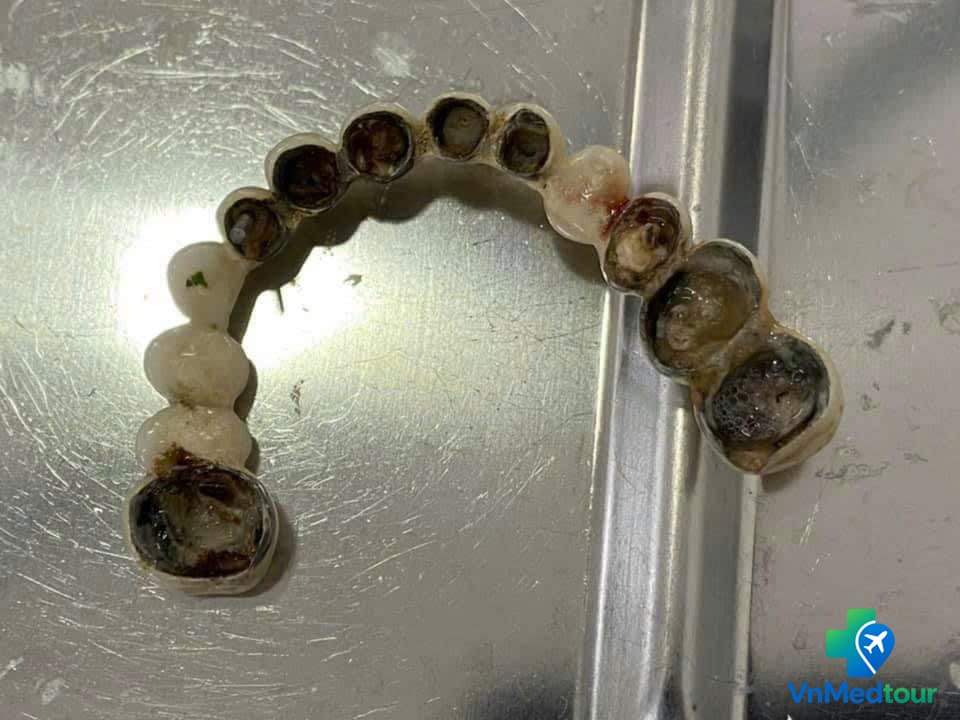
An example of a removed dental bridge with visibly damaged restorations.
Patients should also discuss alternative treatments, including conventional bridges and removable prostheses, before deciding on implant surgery.
For more detailed information, see our Single-Tooth Implant in Vietnam guide, covering implant components, treatment stages and cost considerations.
3.2. Multiple dental implants and implant-supported bridges
Patients missing several adjacent teeth may be suitable for an implant-supported bridge. In selected cases, a bridge can replace several teeth without requiring a separate implant for every missing tooth.
The proposed number and position of implants depend on the patient’s bite, bone condition, available space and restorative requirements.
Treatment planning should consider both the surgical placement of the implants and the design of the final bridge. Patients should ask about the materials used, the expected maintenance requirements and how the restoration could be repaired or replaced in the future.
3.3. All-on-4 dental implants
All-on-4 is a full-arch rehabilitation approach in which four dental implants support a fixed dental prosthesis. It may be considered for selected patients who have lost most or all of their teeth in one dental arch or whose remaining teeth cannot be predictably restored.
Implants are positioned according to the patient’s anatomy and the proposed prosthetic design. In some cases, posterior implants are angled to make use of available bone.
Selected patients may receive a temporary fixed prosthesis soon after surgery. However, immediate placement of temporary teeth does not mean that the final permanent restoration has been completed.
The treatment plan should specify the expected healing period, the timing of the final prosthesis and whether further appointments or international travel will be necessary.
Read our dedicated guide to All-on-4 Dental Implants in Vietnam for a more detailed explanation of the procedure, costs and restorative options.
3.4. All-on-6 dental implants
All-on-6 is another full-arch rehabilitation approach, using six implants to support a dental prosthesis.
The additional implants may provide further support in certain clinical situations, but six implants are not automatically necessary or preferable for every patient.
The choice between All-on-4 and All-on-6 depends on factors such as available bone, anatomical limitations, bite forces, prosthetic design and the treating dentist’s assessment.
Both approaches require careful planning and ongoing maintenance. Patients should request a clear explanation of why a particular configuration has been recommended rather than selecting a treatment based solely on the number of implants.
Our All-on-6 Dental Implants in Vietnam guide explains the procedure and factors that may influence treatment planning.
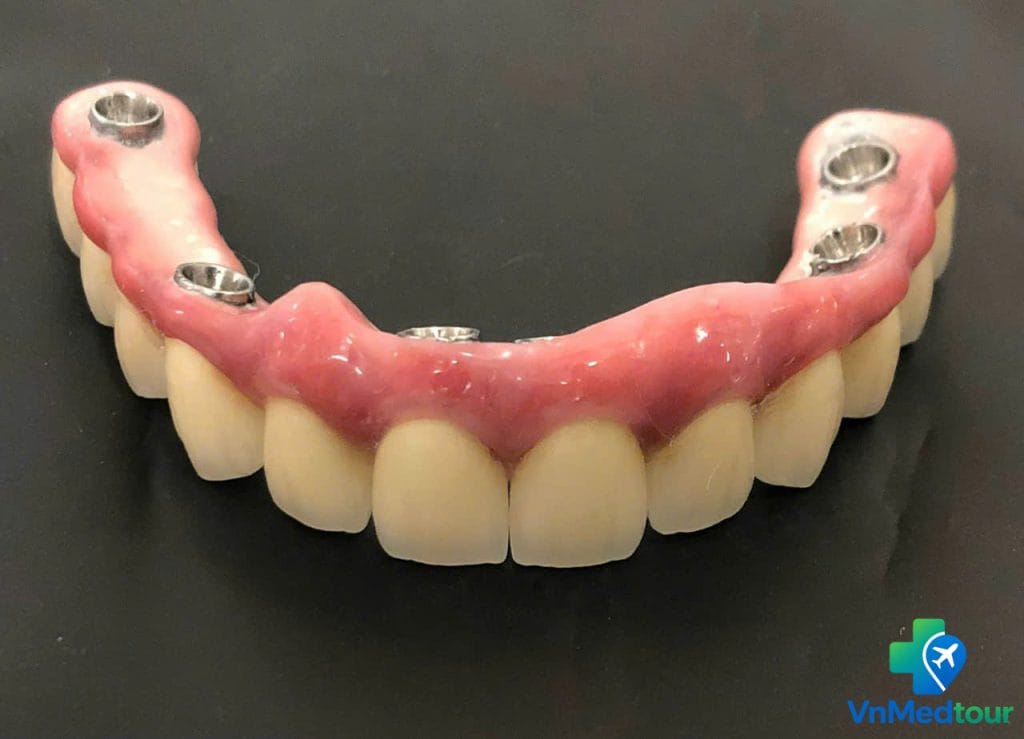
An example of a full-arch implant-supported dental prosthesis.
3.5. Full-mouth dental rehabilitation
Full-mouth rehabilitation may involve treatment of the upper arch, lower arch or both arches. It can include implants, fixed bridges, crowns, extractions, periodontal treatment and other restorative procedures.
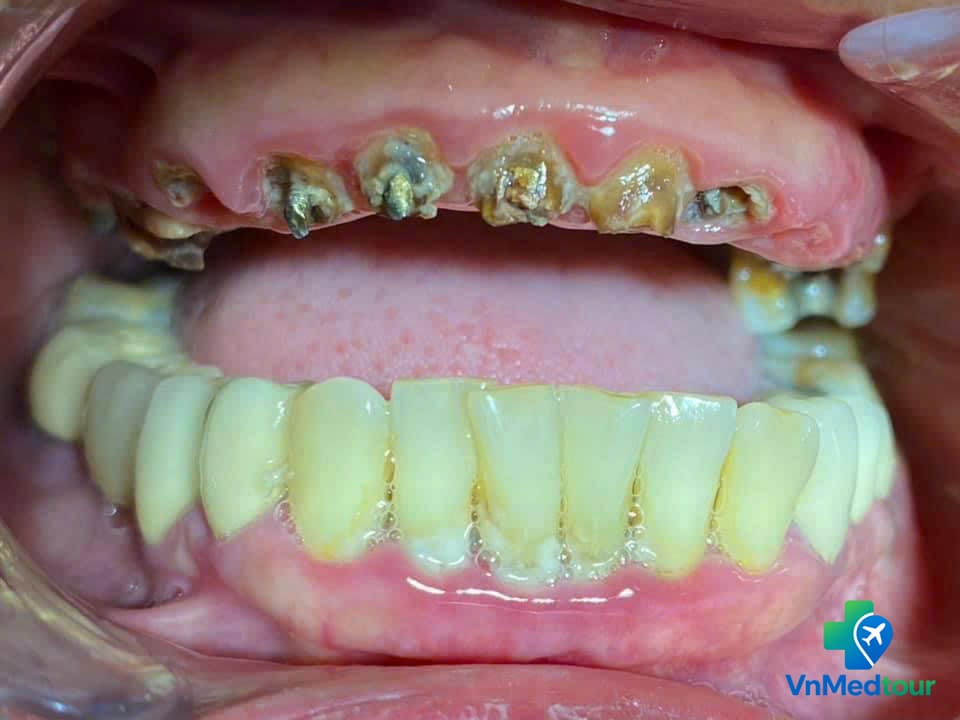
Clinical photograph showing damaged upper teeth before restorative treatment.
Some patients require a combination of implant-supported and tooth-supported restorations. Others may be candidates for complete implant-supported rehabilitation.
These cases require a comprehensive assessment of oral health, bite relationships, available bone and long-term maintenance needs.
For Australians travelling overseas, it is particularly important to understand the entire treatment sequence before committing to the first surgical appointment. Complex rehabilitation may involve several treatment stages and additional international trips.
4. Are You a Suitable Candidate for Dental Implants?
Not everyone with missing teeth is a suitable candidate for dental implant surgery.
Before recommending treatment, the dentist needs to assess the condition of the gums, remaining teeth, jawbone and relevant anatomical structures. Diagnostic examinations may include dental X-rays or three-dimensional imaging when clinically indicated.
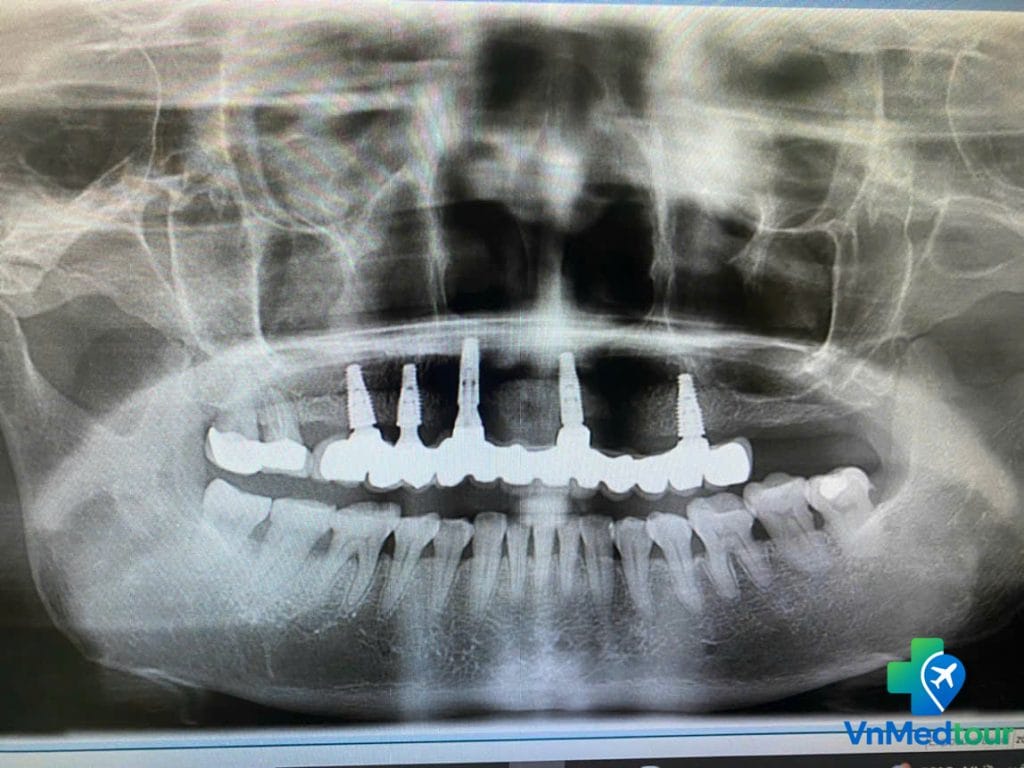
Panoramic dental X-ray illustrating implant positions and surrounding oral structures.
Medical history is also important. Patients should disclose relevant medical conditions, current medications, previous dental treatment and smoking history.
According to the US Food and Drug Administration, overall health can affect implant healing and long-term outcomes. Smoking may interfere with healing, while complications can include infection, injury to surrounding structures and implant failure.
Patients with active gum disease may need periodontal treatment before implant placement. Those with insufficient jawbone may require bone grafting or other preparatory procedures.
A preliminary online assessment can help establish possible treatment options, but it cannot replace an appropriate clinical examination. The final treatment plan should be determined by the treating dental professional.
5. Dental Implant Treatment Timeline: Will Australians Need Two Trips?
One of the most important practical questions for Australians considering dental implants in Vietnam is whether treatment can be completed during a single visit.
The answer depends on the proposed procedure, the condition of the jawbone, the need for additional treatment and the patient’s healing response.
When planning dental implants in Vietnam for Australians, the number of required visits is an important consideration. Some treatment plans involve a separate healing period before the final restoration can be fitted.
Stage 1: Preliminary assessment and treatment planning
Before travelling, patients can provide available dental records, recent imaging, relevant medical information and details of their treatment goals.
A dental provider may use this information to discuss potential treatment options and prepare a preliminary quotation.
However, additional examinations and imaging may be necessary after arrival in Vietnam. The final treatment plan may therefore differ from the preliminary proposal.
Stage 2: Implant placement in Vietnam
Following an appropriate clinical assessment, the treating dentist may proceed with implant surgery.
The procedure involves placing implant fixtures into the jawbone according to the agreed treatment plan. Additional procedures, such as extractions or bone grafting, may be performed when clinically indicated.
Patients should allow sufficient time for postoperative reviews before leaving Vietnam. The appropriate observation period must be determined by the treating dentist.
Stage 3: Healing and implant integration
After implant placement, the surrounding bone needs time to heal and integrate with the implant.
The healing period may take several months, depending on the clinical circumstances. The FDA notes that implant healing can take several months or longer.
During this period, patients should follow the treating dentist’s instructions and attend appropriate follow-up appointments.
Some patients may receive a temporary restoration while healing takes place.
Stage 4: Final restoration
Once the implants have healed sufficiently, the final crown, bridge or full-arch prosthesis can be fitted.
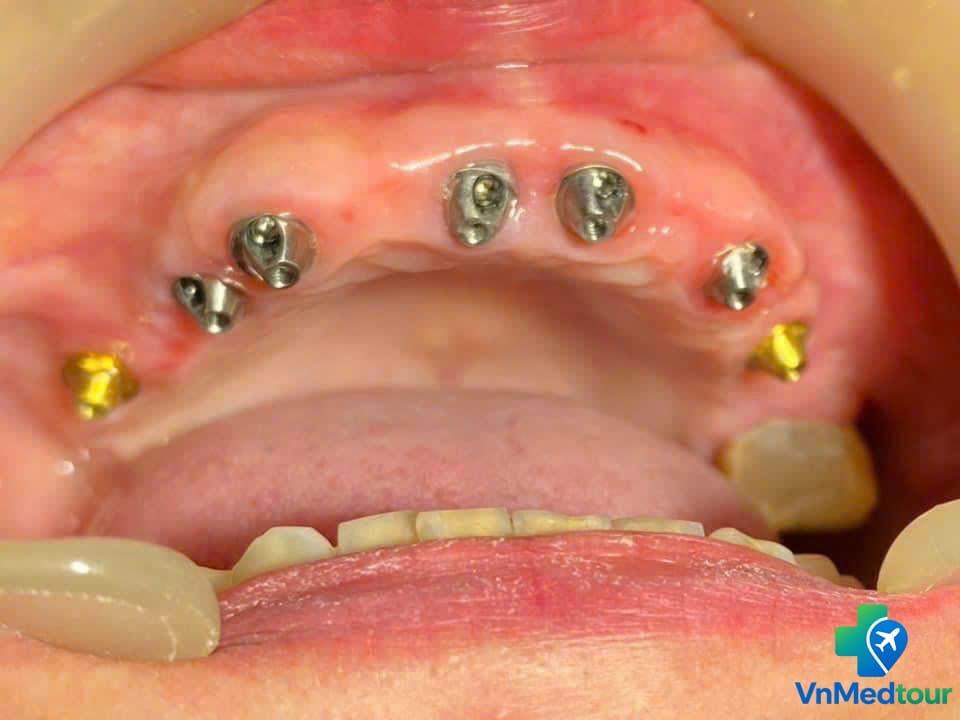
Dental implant abutments prepared for the final prosthetic restoration.
The restorative stage may involve digital scans or impressions, laboratory fabrication, fitting and bite adjustments.
Australians should establish whether this stage requires a second visit to Vietnam and how many appointments are expected.
Can dental implants be completed in one trip?
Selected patients may be suitable for immediate implant placement or immediate loading with a temporary prosthesis. However, these approaches are not appropriate for every patient.
Even when temporary fixed teeth are provided shortly after surgery, the final restoration may still require additional healing and subsequent appointments.
Patients should not book international flights on the assumption that their treatment can be completed within a particular number of days. The treating dentist should recommend the appropriate schedule after reviewing the individual case.
6. Choosing a Dental Implant Clinic in Vietnam
Selecting a clinic for dental implants in Vietnam should involve more than comparing advertised prices or viewing photographs of previous patients.
Patients comparing providers of dental implants in Vietnam for Australians should request detailed information about the proposed treatment, the qualifications of the treating professionals and the availability of postoperative support.
Australians should verify the clinic’s licensing, the qualifications of the treating professionals and the facilities available for implant surgery.
For complex treatment, patients should establish who will perform the surgical and restorative stages. They should also ask whether the clinic has appropriate diagnostic facilities and clear procedures for managing complications.
The Australian Government’s Smartraveller medical tourism guidance recommends researching overseas healthcare providers, checking professional qualifications and understanding the potential consequences of treatment complications.
Questions to ask before selecting a clinic
-
Who will perform the implant surgery, and what are their qualifications and relevant experience?
-
Which implant system and restorative materials are proposed?
-
What diagnostic examinations and imaging will be required?
-
Does the quotation include temporary and final restorations?
-
How many appointments and international trips are expected?
-
What arrangements are available if complications occur?
-
Will complete treatment records and implant component information be provided?
-
How will long-term maintenance be managed after returning to Australia?
Patients should request written answers to important questions before accepting a treatment proposal.
7. Choosing an Implant System That Can Be Maintained in Australia
Long-term maintenance is an important consideration for Australians receiving dental implants overseas.
Implant systems use specific components and prosthetic connections. If a restoration requires repair or replacement in the future, an Australian dentist may need information about the exact implant manufacturer, model and compatible components.
The FDA recommends asking which implant brand and model will be used and keeping this information for future reference.
Before proceeding with treatment, patients should discuss the proposed implant system with a dental professional in Australia who may provide ongoing care.
They should also request complete treatment records, including implant identification information and relevant imaging, before leaving Vietnam.
Patients should not assume that every Australian dental clinic will be able or willing to maintain an implant system placed overseas. The Australian Dental Association specifically identifies incompatible components and difficulties obtaining corrective care as potential problems associated with overseas dental treatment.
8. Planning Your Dental Implant Trip from Australia
Dental implants in Vietnam for Australians require coordination between clinical treatment and international travel.
Patients travelling from Sydney, Melbourne, Brisbane, Perth or other Australian cities should obtain a preliminary treatment proposal before finalising their itinerary.
Ho Chi Minh City and Hanoi are two possible destinations for international dental treatment. The choice should depend primarily on the selected dental provider, proposed procedure and required appointments.
Patients should consider staying within reasonable travelling distance of their chosen clinic, particularly when postoperative reviews are scheduled.
Before booking flights
An examination with an Australian dentist can provide an independent assessment of the proposed treatment and identify existing dental problems that may require attention.
Patients should also establish whether their treatment involves one visit or several visits to Vietnam.
Those requiring bone grafting, extensive extractions or full-mouth rehabilitation may need a different treatment schedule from patients receiving a straightforward single implant.
The treating dentist should advise on the appropriate recovery period and whether further examinations are necessary before international travel.
Understanding the total travel budget
The complete cost of dental implant treatment overseas includes more than the clinical quotation.
Patients should account for international flights, accommodation, local transport, meals, insurance, additional appointments and possible subsequent trips.
They should also consider the financial consequences of unexpected complications or changes to the proposed treatment plan.
Comparing complete treatment and travel budgets, rather than advertised starting prices alone, provides a more realistic basis for making financial decisions.
9. Medicare, Private Health Insurance and Travel Insurance
Australian patients should establish their insurance arrangements before committing to dental implant treatment in Vietnam.
According to the Australian Government’s Medicare guidance, Medicare does not cover healthcare costs overseas and generally does not cover most dental services in Australia.
Private health insurance arrangements vary. Patients should contact their insurer and obtain written confirmation of any applicable overseas dental benefits, limitations or exclusions.
Standard travel insurance may not cover planned dental treatment or complications arising from elective procedures.
Smartraveller advises Australians considering medical tourism to check whether their insurance covers the proposed procedure, postoperative complications and medical evacuation. Patients should disclose their treatment plans and carefully review the policy’s Product Disclosure Statement.
10. Recovery and Dental Implant Aftercare in Australia
Dental implants require long-term maintenance after the surgical and restorative stages have been completed.
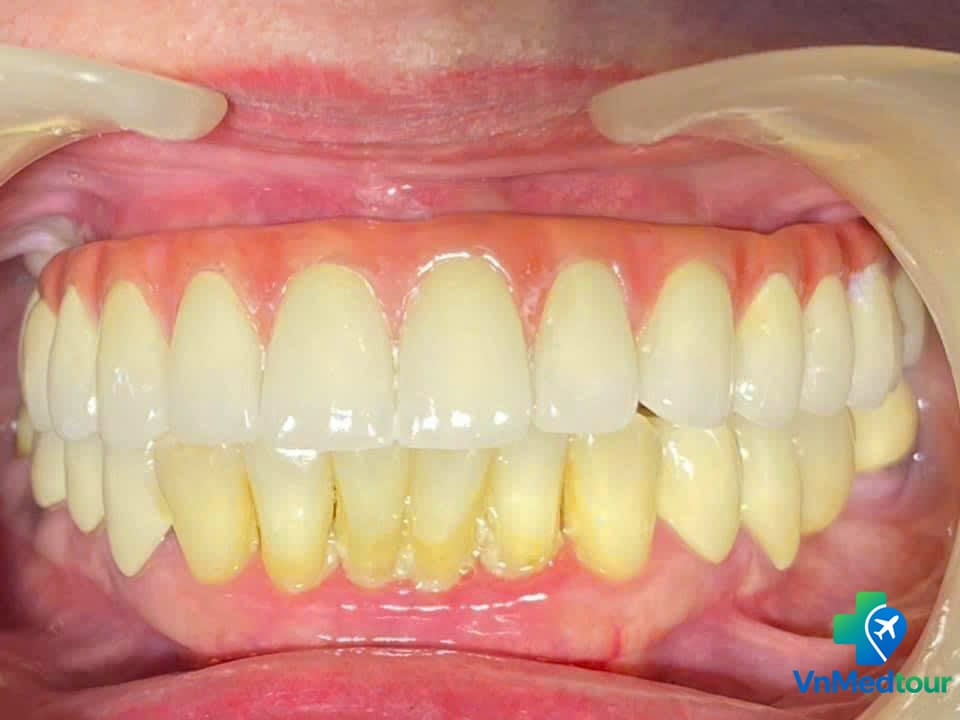
Clinical photograph of an upper dental restoration.
Patients should follow the treating dentist’s instructions regarding oral hygiene, eating, medication and postoperative appointments.
Regular dental examinations and professional maintenance remain important after returning to Australia. Patients with implant-supported bridges or full-arch prostheses should receive appropriate instructions for cleaning around the implants and prosthetic components.
Before leaving Vietnam, patients should obtain copies of their treatment records, relevant imaging and information about the implant system and restorative materials used.
They should also establish how the Vietnamese provider will communicate with their Australian dentist if further information is required.
Persistent or worsening pain, significant swelling, fever, implant mobility or other concerning symptoms should prompt professional assessment. Patients experiencing complications after returning home should seek appropriate local dental or medical care rather than relying exclusively on remote communication with the overseas clinic.
11. How VnMedtour Assists Australian Dental Implant Patients
VnMedtour works with dental partners in Vietnam to assist international patients seeking information about dental implants and other restorative procedures.
Australians considering treatment can begin by providing information about their missing teeth, previous dental treatment, available X-rays, relevant medical history and preferred travel dates.
VnMedtour can assist with preliminary enquiries, requesting treatment quotations, clarifying proposed treatment schedules and coordinating appointments with partner dental providers.
Depending on the individual case, the dental provider may recommend additional examinations or imaging before confirming the final treatment plan.
VnMedtour facilitates communication and appointment arrangements. Diagnosis, treatment recommendations, clinical decisions and final quotations remain the responsibility of the treating dental professionals.
Patients interested in combining implants with other restorative procedures can also consult our complete guide to dental work in Vietnam.
12. Frequently Asked Questions About Dental Implants in Vietnam for Australians
How much do dental implants cost in Vietnam for Australians?
The cost depends on the number of implants, the implant system, the type of restoration and any additional procedures required. Patients should obtain an itemised quotation and account for international travel and follow-up expenses.
Can Australians receive All-on-4 or All-on-6 dental implants in Vietnam?
Dental providers in Vietnam offer both All-on-4 and All-on-6 treatment approaches. Suitability depends on an individual assessment of oral health, available jawbone, medical history and restorative requirements.
Will I need to travel to Vietnam twice for dental implants?
Possibly. Many implant treatment plans involve a surgical stage followed by a healing period before the final restoration. The number of required visits depends on the individual treatment plan.
Can I receive temporary teeth immediately after implant surgery?
Selected patients may be suitable for immediate loading with a temporary prosthesis. However, this approach is not appropriate for everyone, and the final restoration may require additional healing and appointments.
Can my Australian dentist maintain implants placed in Vietnam?
This depends on the implant system, the availability of compatible components, the treatment records and whether the Australian dentist agrees to provide ongoing care. Patients should discuss maintenance arrangements before travelling.
Does Medicare cover dental implants in Vietnam?
No. Medicare does not cover healthcare costs incurred overseas. Patients should check directly with their private health insurer regarding any applicable overseas dental benefits.
What happens if an implant develops complications after I return to Australia?
Patients should seek appropriate assessment from a local dental professional and provide their treatment records. They should also contact the treating clinic in Vietnam to discuss the complication and any applicable aftercare arrangements.
Can I obtain a dental implant quotation before travelling?
A preliminary quotation may be possible using available dental records, photographs and recent imaging. However, the final treatment plan and quotation generally require an appropriate clinical examination.
13. Request a Personalised Dental Implant Quotation
Considering dental implants in Vietnam? VnMedtour can help Australian patients request preliminary treatment information and quotations from dental partners in Vietnam.
To begin your enquiry, provide details of your dental concerns, available dental records or X-rays, relevant previous treatment and preferred travel dates.
Our team can assist with communication and appointment coordination. The final treatment plan, treatment eligibility and quotation will depend on the treating dental professional’s clinical assessment.
Planning Dental Implants in Vietnam?
Interested in dental implants in Vietnam for Australians?
VnMedtour can help you request a preliminary treatment assessment
and quotation from a dental partner in Vietnam.
Preliminary quotations are subject to clinical assessment.
No obligation to proceed.