
Quick Navigation
The Ultimate Guide to Nose Thread Lift in Vietnam: Non-Surgical Rhinoplasty, Hiko Lift, and Global Costs
The central focus of facial symmetry and harmony is undeniably the nose. Positioned directly at the center of the face, even minor structural variations in the nasal bridge, tip, or dorsum can dramatically alter a person’s overall profile. In anthropometric studies, particularly regarding East Asian and Southeastern Asian facial features, the nasal architecture frequently exhibits a lower, flatter dorsum, a wider alar base, and a less defined or downward-drooping nasal tip (nasal ptosis).
To achieve better facial balance, many individuals seek to augment the nasal bridge and elevate the nasal tip to create a more refined, higher profile.
Historically, altering the anatomy of the nose required a traditional surgical rhinoplasty. This invasive procedure involves open or closed surgical approaches, the breaking or shaving of nasal bones, the harvesting and placement of autologous cartilage grafts (such as septal, ear, or rib cartilage), or the insertion of permanent synthetic implants like silicone or Gore-Tex.
While surgery offers permanent structural modifications, it also brings significant downsides: a high financial barrier, general anesthesia risks, potential implant displacement, long-term extrusion risks, and weeks of recovery characterized by facial bruising and severe swelling.
Today, advances in minimally invasive cosmetic medicine have introduced a groundbreaking alternative. Nose Thread Lift—clinically known as a non-surgical rhinoplasty, a Hiko nose lift, or lunch-break nasal sculpting—has revolutionized modern facial aesthetics. This sophisticated technique completely bypasses the surgical scalpel.
Instead, it utilizes specialized, bio-absorbable polymer sutures designed to act as internal structural tents, instantly raising the nasal bridge and rotating the nasal tip to improve structural definition from within.
As the costs of private cosmetic procedures continue to climb across Western countries like the United States, Canada, and Australia, international patients are looking to Southeast Asia for premium solutions. Vietnam has rapidly emerged as a leading global destination for high-end, minimally invasive cosmetic treatments. By pairing internationally certified aesthetic dermatologists and plastic surgeons with state-of-the-art clinical facilities and highly competitive pricing packages, the country attracts thousands of medical travelers every year.
This comprehensive, highly detailed, and SEO-optimized guide provides an exhaustive analysis of the scientific foundations, clinical step-by-step protocols, and structural benefits of choosing a Nose Thread Lift in Vietnam, empowering you to invest confidently in your personal aesthetic journey.
What is a Nose Thread Lift?
To fully understand why this micro-invasive treatment is so effective, it is essential to examine the biomedical engineering and specific materials behind modern nasal suspension sutures. A nose thread lift is a minimally invasive procedure engineered to sharpen the nasal dorsum, narrow the appearance of the nasal bridge, and lift a drooping nasal tip without the structural risks or permanent changes of a surgical operation.
The technique involves inserting medical-grade polymer threads directly into the midline subcutaneous layer of the nose, specifically along the nasal bridge and through the columella (the tissue strip separating the nostrils). Unlike threads used for general facial lifting, nasal threads are uniquely engineered for this specific area.
They are thicker and feature multi-directional, microscopic cogs or a unique molded, barbed structure designed to stack on top of one another. When guided through a blunt-tipped micro-cannula, these cogs anchor securely into the dense nasal tissue. Once in place, the threads act like a tiny structural pillar or scaffold, providing excellent vertical support that pushes the skin upward to sharpen the bridge and lift the tip.
The technology behind bio-absorbable polymers has advanced significantly. Premium aesthetic clinics in Vietnam offer three main classes of biocompatible materials, each tailored to meet specific anatomical needs:
1. Polydioxanone (PDO) Threads
PDO threads are the most widely used and foundational material in non-surgical nasal augmentation. Originally developed for complex cardiovascular and pediatric surgeries due to their high tensile strength, PDO sutures break down safely in human tissue over six to eight months through standard hydrolysis. According to official consumer safety updates from the U.S. Food and Drug Administration (FDA), these polymers degrade predictably without leaving any toxic residues or long-term foreign material behind.
PDO threads are highly valued for their ability to deliver an instant, mechanical lift while prompting a rapid localized healing response that boosts early collagen production.
2. Poly-L-Lactic Acid (PLLA) Threads
PLLA threads focus on deep cellular restoration and progressive volume enhancement. PLLA is a powerful biocompatible material widely recognized for its long-term biostimulatory properties. Clinical research published by the National Center for Biotechnology Information (NCBI) demonstrates that PLLA significantly increases dermal thickness by safely encouraging native tissue renewal.
As the PLLA polymer slowly dissolves over 12 to 18 months, it continuously encourages surrounding fibroblasts to produce fresh collagen, naturally strengthening and firming the nasal profile from within.
3. Polycaprolactone (PCL) Threads
PCL threads are considered the gold standard for long-lasting, non-surgical nasal sculpting. Boasting a highly complex chemical structure, PCL breaks down at a much slower rate, offering stable structural support for up to 18 to 24 months.
Throughout this extended degradation timeline, PCL maintains a continuous release of collagen-inducing signals. This results in a highly durable, natural-looking lift that stays intact long after the physical threads have been completely cleared by the body.
The Hiko Nose Lift: Concept and Vector Design
When international patients search for terms like non-surgical rhinoplasty or Hiko nose lift, they are looking for a specialized approach to nasal refinement. The word “Hiko” originates from a combination of Asian aesthetic terms meaning “high nose.” This technique focuses on two primary mechanical vectors to reshape the nose:
-
The Dorsal Vector (Bridge Augmentation): Multiple rigid, cogged threads are inserted through the tip of the nose and pushed horizontally along the nasal bridge toward the glabella (the area between the eyebrows). Stacking these threads creates a clean, vertical scaffolding that lifts the nasal bridge, making it appear straighter, higher, and narrower without widening the nose. This is a significant advantage over liquid nose jobs using dermal fillers, which can sometimes spread sideways and create a wide or “avatar” nose effect over time.
-
The Columellar Vector (Tip Rotation and Elevation): To fix a drooping nasal tip or a flat columella, threads are inserted vertically through the base of the nose and pushed upward into the nasal tip. This vertical stack acts like a structural support pillar, pushing the tip of the nose upward and forward. This improves the angle between the nose and the upper lip (the nasolabial angle), creating a crisper, more refined, and youthful nasal profile.
Comparing Nasal Rejuvenation Procedures
Choosing the right treatment for nasal refinement can be difficult given the variety of choices available. To help clarify your options, the table below contrasts a non-surgical nose thread lift with common alternative treatments, outlining their distinct clinical characteristics, longevity, and recovery profiles:
| Clinical Feature | Dermal Fillers (Liquid Nose Job) | Nose Thread Lift | Surgical Rhinoplasty (Surgery) |
| Primary Mechanism | Hyaluronic acid gel volumization | Subdermal suspension & structural scaffolding | Bone fracturing, cartilage grafting & reshaping |
| Invasiveness | Minimal (Simple injections) | Minimally Invasive (Micro-cannula) | Highly Invasive (Open/closed surgical incisions) |
| Anesthesia Required | None / Topical numbing cream | Local Infiltration Anesthesia | General Anesthesia or Deep IV Sedation |
| Procedure Time | 15 to 20 minutes | 30 to 45 minutes | 2 to 4 hours |
| Risk of Migration | High (Can spread sideways/widen bridge) | None (Cogs anchor securely in place) | None (Permanent structural alteration) |
| Vascular Danger | High risk of skin necrosis/blindness | Extremely Low (Avoids deep arteries) | Standard surgical risks (Infection, bleeding) |
| Recovery Downtime | 1 to 2 days | 1 to 3 days (Minimal swelling) | 10 to 14 days (Splints and bandages required) |
| Longevity of Results | 6 to 12 months | 12 to 24 months (PCL/PLLA) | Permanent (Lifetime result) |
| Average Cost Range | $600 – $1,500 per session | $1,200 – $2,200 | $5,000 – $12,000 |
While liquid rhinoplasty with dermal fillers is a popular option, it carries a higher risk of accidental vascular occlusion (blocking a blood vessel), which can lead to serious complications like skin necrosis or vision loss if the filler enters the facial arteries.
Clinical safety reviews compiled by the American Society of Plastic Surgeons (ASPS) emphasize that thread lifting offers a much safer profile for nasal bridge refinement because the threads are placed into a safer tissue plane using a blunt cannula, completely avoiding the risks of gel migration or vascular blockages.
The Clinical Protocol: What to Expect in Vietnam
Choosing a Nose Thread Lift in Vietnam ensures an organized, internationally standard clinical protocol designed around patient safety, precise facial mapping, and natural-looking outcomes.
Step 1: Pre-Treatment Structural Analysis
Your journey begins with a private, in-depth consultation with a trained aesthetic physician. The doctor carefully evaluates your facial proportions, examining your nasal profile, skin thickness, and bridge height. Using specialized markers, the doctor maps the exact entry point—typically a single, tiny point at the tip of the nose—and charts the horizontal and vertical pathways the threads will follow to create an elegant, balanced lift.
Step 2: Sterile Field Preparation and Local Anesthesia
The nose and surrounding facial areas are thoroughly prepped with a medical-grade antiseptic solution to maintain a completely sterile environment. To ensure total patient comfort, a local anesthetic (such as a lidocaine and epinephrine blend) is gently injected into the entry point and along the nasal bridge and columella. This effectively numbs the entire nose, making the procedure virtually painless.
Step 3: Precise Micro-Invasive Suture Deployment
Using a fine, blunt-tipped micro-cannula, the specialist guides the polymer threads through the single entry point at the tip of the nose. Because a blunt cannula is used rather than a sharp needle, it glides past blood vessels and nasal structures without tearing them, which significantly reduces post-procedure bruising or swelling. Once the threads are perfectly positioned along the pre-mapped pathways, the cannula is gently withdrawn, leaving the structural cogs securely engaged within the tissue matrix.
Step 4: Structural Tensioning and Shape Sculpting
The physician applies precise, artistic tension to the threads, stacking them to raise the nasal bridge and lifting the nasal tip until optimal symmetry and definition are achieved. Once the desired shape is locked into place, the exposed ends of the threads are trimmed flush just beneath the skin’s surface, leaving no visible traces or scars behind.
Step 5: Immediate Post-Treatment Recovery
A small, discreet protective tape may be applied to the tip of the nose to keep the area clean and protected. The entire procedure is completed within 30 to 45 minutes. Because it requires no general anesthesia or surgical stitches, you can comfortably walk out of the clinic immediately after your session and return to your hotel to relax.
Strategic Integration of Advanced Aesthetic Ecosystems
A nose thread lift represents just one facet of Vietnam’s rapidly expanding medical tourism network. Elite clinics throughout the country offer comprehensive, multi-layered treatment plans that combine localized facial rejuvenation with advanced anti-aging procedures to optimize patient outcomes.
For example, international patients seeking holistic facial harmony often coordinate multiple treatments. To explore the full spectrum of advanced surgical alternatives, pricing structures, and permanent facial profile enhancement options, you can read our comprehensive review on the broader landscape of cosmetic surgery in Vietnam.
Furthermore, patients looking to correct aging across the entire face often pair nasal profile treatments with advanced periorbital adjustments. If you are experiencing sagging brow lines, heavy upper eyelids, or deep under-eye wrinkles, you can learn how top doctors refresh the upper third of the face by reading our companion guide on eye thread lift in Vietnam.
Additionally, for patients eager to understand the general technical differences between various thread lift procedures—such as comparing specific thread brands, selecting proper facial anchors, or reviewing comprehensive before-and-after protocols—you can dive into our main resource on thread lift in Vietnam.
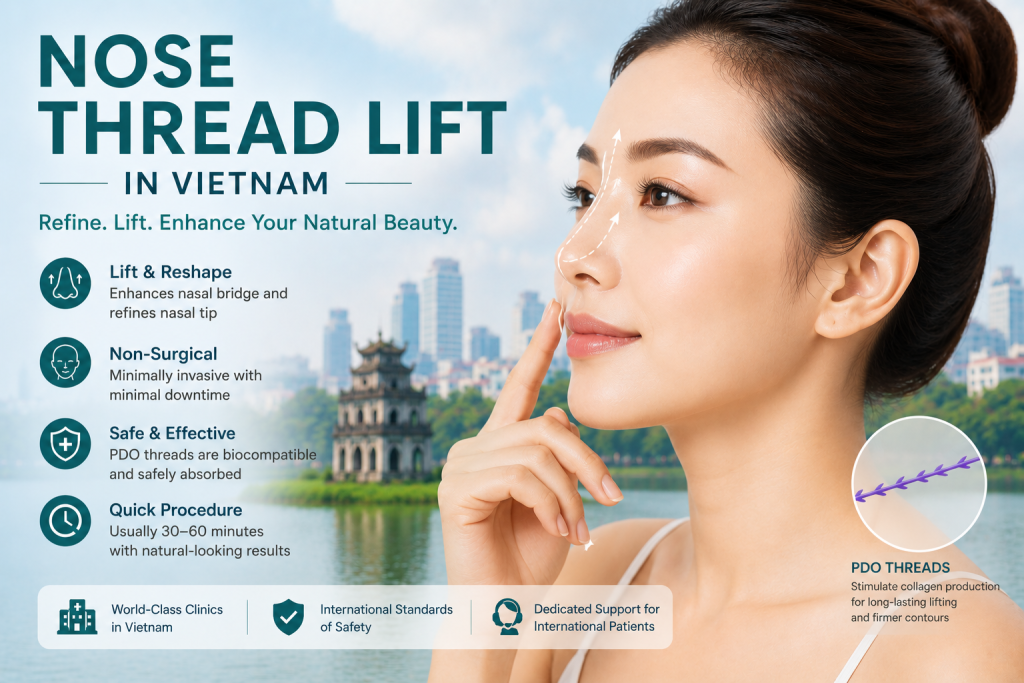
Nose thread lift in Vietnam is a minimally invasive cosmetic procedure that uses PDO threads to enhance nose shape, improve bridge definition, and create a more refined facial profile without surgery.
Why Vietnam is a Premier Hub for Nose Thread Lifts
Vietnam has rapidly earned international acclaim as a premier hub for minimally invasive cosmetic medicine, attracting medical travelers from across the globe due to several key advantages:
-
World-Class Medical Talent: Premier aesthetic clinics in major metropolitan hubs like Hanoi and Ho Chi Minh City are spearheaded by highly accomplished, board-certified dermatologists and plastic surgeons. Many of these specialists have completed advanced fellowships and international training programs in cosmetic centers like South Korea, Japan, and Western Europe, bringing global standards of precision and artistry to every patient.
-
Premium, Globally Certified Materials: Reputable Vietnamese clinics prioritize patient safety by using only top-tier, internationally approved thread brands. These medical-grade polymers carry official CE marks in Europe, FDA registration in the United States, and strict approval from Vietnam’s Ministry of Health, guaranteeing excellent biocompatibility, predictable absorption, and long-lasting results.
-
State-of-the-Art Clinical Environments: Vietnam’s premier aesthetic facilities are equipped with modern procedure rooms, advanced sterilization technologies, and dedicated international patient departments that adhere to strict international healthcare guidelines.
-
Outstanding Financial Value: The most remarkable benefit for international medical travelers is the significant cost savings available without making any compromises on clinical safety, professionalism, or treatment quality. A premium nose thread lift that might cost anywhere from $2,500 to $4,500 in the United States or Australia is routinely available at elite clinics in Vietnam for between $1,200 and $2,200. This major price difference is due entirely to lower local operational overhead and favorable currency exchange rates, allowing you to enjoy a luxury medical experience and a relaxing holiday at a fraction of Western costs.
Essential Post-Treatment Guidelines and Longevity Care
To ensure your newly transferred threads anchor perfectly and stimulate the maximum amount of fresh collagen growth, it is important to follow a few straightforward post-treatment guidelines during the brief healing phase:
-
Handle Your Nose with Care: Avoid touching, squeezing, or rubbing your nose for the first two weeks following the procedure. Be especially gentle when washing your face or applying skincare products to prevent moving the threads out of alignment.
-
Avoid Wearing Heavy Glasses: Try not to rest heavy eyeglasses or sunglasses directly on the bridge of your nose for the first three to four weeks. If you must wear glasses, try taping them lightly to your forehead or switch to contact lenses to keep weight off the newly treated nasal bridge.
-
Optimize Your Sleeping Position: For the first five to seven days following your procedure, sleep flat on your back with your head elevated on two soft pillows. This simple adjustment keeps pressure off your face and prevents accidental rubbing against your pillows while the threads are settling.
-
Pause Strenuous Physical Activities: Avoid high-impact workouts, heavy lifting, steam rooms, and hot saunas for the first two weeks. Keeping your heart rate and blood pressure at normal levels supports quick, smooth healing and prevents internal bruising.
Summary
A Nose Thread Lift in Vietnam provides a highly effective, safe, and beautifully natural alternative to traditional, invasive surgery. By utilizing advanced, bio-absorbable polymer threads to instantly elevate the nasal bridge, refine the tip, and continuously generate fresh, healthy collagen, this treatment gives you a refreshed, balanced, and vibrant appearance with minimal downtime.
Combined with Vietnam’s elite medical infrastructure, internationally trained specialists, and highly accessible all-inclusive pricing, it is easy to see why the country has become a top choice for premium facial rejuvenation. Investing in a Hiko nose lift in Vietnam is an excellent way to restore your natural confidence and celebrate a refreshed, youthful look.
Considering a Nose Thread Lift in Vietnam?
VnMedtour can help you connect with trusted cosmetic clinics and experienced doctors in Vietnam for nose thread lift consultation, treatment planning, and international patient support.
Send us your photos, age, nose condition, previous cosmetic treatment history, and preferred travel dates so our team can help check suitable options, estimated costs, and doctor availability.
Note: Suitability for nose thread lift depends on nasal structure, skin thickness, treatment goals, and doctor assessment.