
Quick Navigation
The Ultimate Guide to Buttock Thread Lift in Vietnam: Non-Surgical Gluteal Rejuvenation and Global Costs
Achieving anatomical symmetry, definition, and youthful contouring is a cornerstone of modern facial and body optimization. While facial procedures often dominate aesthetic conversations, body contouring—specifically the shape, lift, and volume of the gluteal region—has seen a massive surge in global demand. Statistically, the structural architecture of the buttocks can lose its firmness due to natural aging, significant weight fluctuations, genetic factors, or the progressive breakdown of structural collagen and elastin over time. This tissue laxity often leads to gluteal ptosis (sagging of the buttock tissue), a flattened posterior profile, and a loss of the defined lower gluteal fold that defines an athletic, youthful figure.
For many years, patients looking to correct gluteal ptosis turned to invasive surgical procedures. The most well-known of these is the Brazilian Butt Lift (BBL), which involves large-scale liposuction to harvest fat from areas like the abdomen or thighs, processing that fat, and reinjecting it into the gluteal muscles. Another common surgical option is the placement of permanent silicone gluteal implants.
While these surgeries can provide dramatic and long-lasting changes, they carry serious drawbacks and risks. Traditional gluteal surgery requires general anesthesia, carries high financial costs, and involves an intensive recovery period of four to six weeks during which patients cannot sit directly on their buttocks. Most importantly, clinical safety tracking from groups like the American Society of Plastic Surgeons (ASPS) highlights that the BBL has historically carried one of the highest mortality rates among elective cosmetic surgeries due to the risk of fatal pulmonary fat embolisms.
To address these concerns, modern minimally invasive aesthetic medicine has introduced a brilliant alternative: the Buttock Thread Lift (frequently searched by patients as a butt thread lift). This innovative non-surgical treatment completely bypasses major surgical cuts and deep tissue trauma.
Instead, it places heavy-duty, medical-grade bio-absorbable polymer sutures into the subdermal layers of the gluteal region. These specialized threads act as an internal support system, instantly lifting sagging skin, reshaping flat profiles, and kicking off long-term collagen production to naturally firm the tissue from within.
As elective medical costs continue to climb across Western nations like the United States, Australia, Canada, and the United Kingdom, international patients are looking to Southeast Asia for world-class, affordable solutions. Vietnam has rapidly secured its position as a leading global hub for high-end medical tourism and minimally invasive body sculpting. By pairing internationally certified plastic surgeons and aesthetic dermatologists with state-of-the-art clinical environments and highly competitive pricing, the country attracts thousands of medical travelers every year.
This comprehensive, highly detailed, and SEO-optimized guide provides an exhaustive analysis of the science, clinical protocols, structural benefits, and financial values of choosing a Buttock Thread Lift in Vietnam, empowering you to invest confidently in your personal aesthetic journey.
What is a Buttock Thread Lift?
To truly appreciate the effectiveness of a non-surgical gluteal suspension, it helps to understand the biomedical engineering and material science behind modern body lifting sutures. A buttock thread lift is a minimally invasive treatment engineered to lift sagging skin, improve global skin texture, and restore a youthful, rounded shape to the buttocks without the risks of surgery.
Because the skin and fat layers in the gluteal region are significantly thicker and heavier than facial tissues, standard facial rejuvenation threads cannot be used. Instead, body contouring requires heavy-duty, long-lasting, and high-tensile medical sutures. These specialized body threads are much thicker and are engineered with unique structures—such as molded 3D barbs, bidirectional cogs, or continuous spiral nodes—that anchor firmly into the deep subcutaneous fat and superficial fascia sheets of the buttocks.
When carefully deployed through a specialized micro-cannula, these cogs engage securely with the dense structural tissues. Once locked into place, the threads act like a mechanical mesh or supportive hammock, allowing the physician to lift sagging tissues upward and reshape the flat contours of the posterior profile.
Premium medical tourism clinics in Vietnam offer three main classes of fully bio-absorbable polymer materials, each tailored to meet specific anatomical needs:
1. Polydioxanone (PDO) Threads
PDO threads are the most widely used and foundational material in non-surgical body lifting. Originally developed for complex cardiovascular and pediatric surgeries due to their high tensile strength, PDO sutures break down safely in human tissue within six to eight months through standard hydrolysis. According to official consumer safety updates from the U.S. Food and Drug Administration (FDA), these polymers degrade predictably without leaving any toxic residues or long-term foreign material behind.
PDO body threads deliver an instant mechanical lift while prompting a rapid localized healing response that boosts early collagen production in the lower gluteal fold.
2. Poly-L-Lactic Acid (PLLA) Threads
PLLA threads focus on deep cellular restoration and progressive volume enhancement. PLLA is a powerful biocompatible material widely recognized for its long-term biostimulatory properties. Clinical research published by the National Center for Biotechnology Information (NCBI) demonstrates that PLLA significantly increases dermal thickness by safely encouraging native tissue renewal.
As the PLLA polymer slowly dissolves over 12 to 18 months, it continuously encourages surrounding fibroblasts to produce fresh Type I and Type III collagen, naturally thickening, smoothing, and firming the gluteal profile from within.
3. Polycaprolactone (PCL) Threads
PCL threads are considered the gold standard for long-lasting, non-surgical body contouring. Boasting a highly complex chemical structure, PCL breaks down at a much slower rate, offering stable structural support for up to 18 to 24 months.
Throughout this extended degradation timeline, PCL maintains a continuous release of collagen-inducing signals. This results in a highly durable, natural-looking lift and a noticeable reduction in skin laxity that stays intact long after the physical threads have been completely cleared by the body.
Mechanical Vectors: Designing the Ideal Gluteal Contour
When international patients plan a non-surgical butt thread lift in Vietnam, expert physicians focus on three primary mechanical vectors to address individual anatomical concerns and shape a beautiful silhouette:
-
The Vertical Projection Vector (The Lift): Heavy-duty, bidirectional cogged threads are inserted from the upper outer quadrant of the hip area and directed down into the mid-to-lower gluteal tissue. Applying upward tension on these anchoring threads pulls the sagging lower cheek tissue upward, raising the entire gluteal profile and restoring a tight, athletic shape.
-
The Medial Rounding Vector (The Inward Shape): To correct a flat or square-shaped buttock, threads are placed in a fan-like pattern or a concentric mesh configuration. This draws outer tissues slightly inward toward the midline, creating a rounder, more projectable, and feminine silhouette from the side view.
-
The Sub-Gluteal Crease Eraser (The Definition): Multiple smooth or mini-screw biostimulatory threads are placed directly along the lower gluteal fold (where the buttock meets the upper thigh). This localized network triggers intense collagen production, firming up loose, creased skin and smoothing out cellulite dimples to create a clean, crisp bottom border.
Comparing Advanced Gluteal Contouring Options
Choosing the right procedure to reshape your buttocks depends on your aesthetic goals, anatomical needs, and budget. The table below compares a minimally invasive buttock thread lift against alternative surgical and cosmetic procedures:
| Clinical Feature | Dermal / Sculptra Fillers | Buttock Thread Lift | Surgical BBL or Implants |
| Primary Mechanism | Liquid poly-L-lactic acid volumization | Subdermal suspension & mechanical scaffolding | Large-scale fat grafting or silicone implant placement |
| Invasiveness | Minimal (Simple injections) | Minimally Invasive (Micro-cannula) | Highly Invasive (Surgical incisions & lipo) |
| Anesthesia Required | Local numbing cream | Local Infiltration Anesthesia | General Anesthesia or Deep Sedation |
| Procedure Time | 30 to 45 minutes | 45 to 60 minutes | 3 to 5 hours |
| Risk of Fat Embolism | None | None (Safely avoids deep muscle layers) | High historical risk if performed incorrectly |
| Recovery Downtime | 1 to 2 days | 2 to 4 days (Minimal swelling) | 4 to 6 weeks (No sitting on buttocks) |
| Longevity of Results | 18 to 24 months | 12 to 24 months (PCL/PLLA) | Permanent / Long-term (Varies by fat survival) |
| Average Cost Range | $3,500 – $8,000 (Requires multiple vials) | $1,800 – $3,500 | $6,000 – $15,000 |
While liquid volume treatments using PLLA fillers (like Sculptra) are an excellent non-surgical option, they require an immense volume of product to treat a large area like the buttocks, often making them financially unrealistic.
Conversely, as noted in clinical trials by the National Institutes of Health (NIH), a heavy-duty buttock thread lift achieves an immediate mechanical lift and structural reshaping at a fraction of the cost, making it a highly accessible and safe option for moderate gluteal sagging.
The Clinical Protocol: What to Expect in Vietnam
Opting for a Buttock Thread Lift in Vietnam guarantees an organized, internationally standard clinical protocol designed around patient safety, sterile field management, and precise body contouring.
Step 1: Comprehensive Body Mapping and Vector Design
Your procedure begins with an in-depth clinical consultation. Standing in front of an aesthetic grid, you and your surgeon discuss your body goals. The doctor carefully evaluates your skin elasticity, tissue weight, and areas of sagging. Using surgical markers, the doctor maps out the exact insertion points across the upper hips and charts the precise pathways the threads will take to create a beautiful, balanced lift.
Step 2: Local Infiltration Anesthesia
The entire gluteal and upper thigh region is thoroughly prepped with a medical-grade antiseptic solution. To ensure a completely pain-free experience, a local anesthetic (such as a lidocaine and epinephrine blend) is gently injected into the marked entry sites and along the planned thread pathways. This effectively numbs the target area, meaning you remain completely awake and comfortable during the session.
Step 3: Precise Micro-Cannula Insertion and Thread Deployment
Using a specialized, long, blunt-tipped micro-cannula, the specialist guides the heavy-duty polymer threads into the targeted subcutaneous planes. Because a blunt-tipped cannula is used rather than a sharp needle, it easily pushes past blood vessels and nerves without puncturing them, which keeps post-treatment bruising and swelling to an absolute minimum. Once the threads are perfectly positioned along the mapped pathways, the cannula is withdrawn, leaving the structural cogs engaged within the tissue matrix.
Step 4: Tension Adjustment and Shape Sculpting
The surgeon applies precise manual tension to the exposed ends of the threads, pulling them upward to lift sagging tissues and lock in the desired contour. Once perfect symmetry and projection are achieved, the remaining ends of the threads are trimmed flush just beneath the skin’s surface, leaving no visible scars or traces behind.
Step 5: Post-Treatment Care and Immediate Recovery
The tiny insertion points are dressed with sterile, waterproof mini-bandages. The entire procedure takes just 45 to 60 minutes. Because it does not require general anesthesia or surgical stitches, you can comfortably stand up immediately after the session, walk out of the clinic, and return to your hotel to rest.
Strategic Integration of Advanced Aesthetic Ecosystems
A buttock thread lift represents just one facet of Vietnam’s rapidly expanding medical tourism network. Elite clinics throughout the country offer comprehensive, multi-layered treatment plans that combine localized body rejuvenation with advanced facial adjustments to optimize patient outcomes.
For example, international patients seeking holistic transformations often coordinate multiple procedures. To explore the full spectrum of advanced surgical alternatives, pricing structures, and permanent facial profile enhancement options, you can read our comprehensive review on the broader landscape of cosmetic surgery in Vietnam.
Furthermore, patients looking to correct structural balance on both the body and face often pair gluteal treatments with advanced nasal profile adjustments. If you are experiencing a low nasal bridge or a drooping nasal tip, you can learn how top doctors refresh the center of the face by reading our companion guide on Hiko nose thread lift in Vietnam.
Additionally, for patients eager to understand the general technical differences between various thread lift procedures—such as comparing specific thread brands, selecting proper facial anchors, or reviewing comprehensive before-and-after protocols—you can dive into our main resource on thread lift in Vietnam.
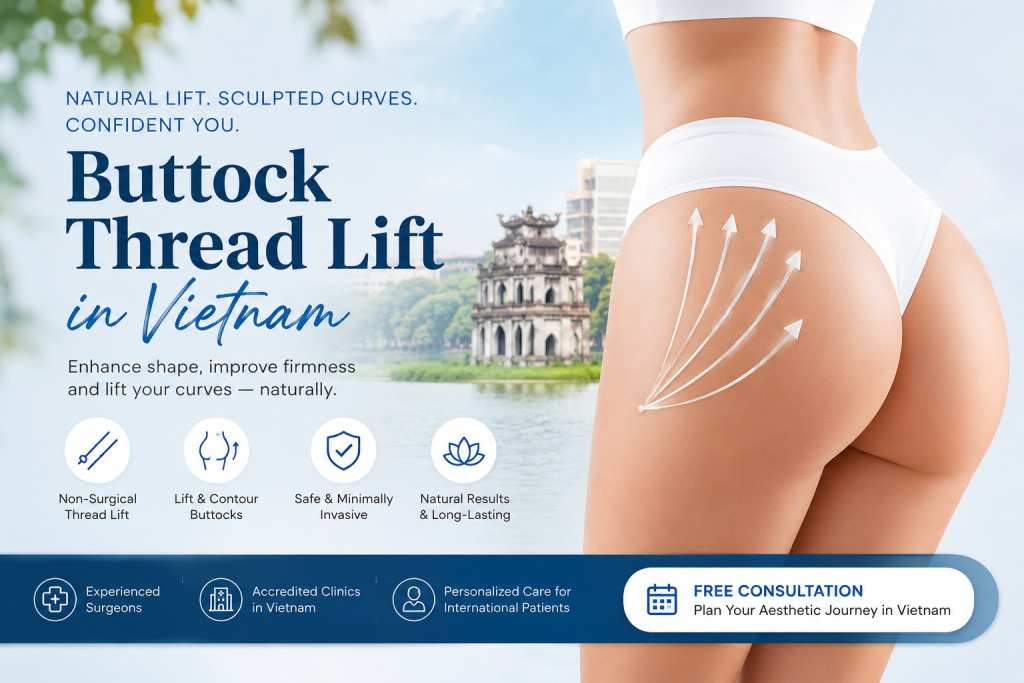
Buttock Thread Lift in Vietnam offers a non-surgical way to lift, contour, and enhance the buttocks with minimal downtime, making Vietnam a popular destination for affordable aesthetic treatments.
Why Vietnam is a Premier Destination for a Buttock Thread Lift
Vietnam has rapidly earned international acclaim as a premier hub for minimally invasive cosmetic medicine, attracting medical travelers from across the globe due to several key advantages:
-
Board-Certified Plastics Specialists: Elite aesthetic centers in major metropolitan hubs like Hanoi and Ho Chi Minh City are spearheaded by accomplished, board-certified plastic surgeons and dermatologists. Many of these specialists have completed advanced fellowships and international training programs in cosmetic centers like South Korea, Japan, and Western Europe, bringing global standards of precision and artistry to every patient.
-
Premium, Globally Certified Materials: Reputable Vietnamese clinics prioritize patient safety by using only top-tier, internationally approved thread brands. These medical-grade polymers carry official CE marks in Europe, FDA registration in the United States, and strict approval from Vietnam’s Ministry of Health, guaranteeing excellent biocompatibility, predictable absorption, and long-lasting results.
-
State-of-the-Art Clinical Environments: Vietnam’s premier aesthetic facilities are equipped with modern procedure rooms, advanced sterilization technologies, and dedicated international patient departments that adhere to strict international healthcare guidelines.
-
Outstanding Financial Value: The most remarkable benefit for international medical travelers is the significant cost savings available without making any compromises on clinical safety, professionalism, or treatment quality. A premium buttock thread lift that might cost anywhere from $4,500 to $7,500 in the United States or Australia is routinely available at elite clinics in Vietnam for between $1,800 and $3,500. This major price difference is due entirely to lower local operational overhead and favorable currency exchange rates, allowing you to enjoy a luxury medical experience and a relaxing holiday at a fraction of Western costs.
Essential Post-Treatment Guidelines and Longevity Care
To ensure your newly transferred body threads anchor perfectly and stimulate the maximum amount of fresh collagen growth, it is important to follow a few straightforward post-treatment guidelines during the brief healing phase:
-
Be Mindful of How You Sit: For the first seven to ten days following your procedure, try to minimize long periods of direct sitting. When you must sit, use a soft, donut-shaped pillow or a rolled towel placed under your lower thighs to shift your body weight off the main part of your buttocks.
-
Wear a Support Garment: Your physician will likely recommend wearing a soft, breathable compression garment or supportive shapewear for the first two to three weeks. This gentle, continuous support helps hold the lifted tissues in their ideal positions and dramatically speeds up the recovery process.
-
Optimize Your Sleeping Position: For the first week following your procedure, sleep comfortably on your stomach (prone position) or your side. Avoiding sleeping flat on your back keeps direct pressure off the newly placed threads while they anchor into place.
-
Pause Strenuous Physical Activities: Avoid high-impact workouts, heavy squats, lunges, steam rooms, and hot saunas for the first three weeks. Keeping your heart rate and blood pressure at normal levels supports quick, smooth healing and prevents internal bruising.
Summary
A Buttock Thread Lift in Vietnam provides a highly effective, safe, and beautifully natural alternative to traditional, invasive surgery. By utilizing heavy-duty, bio-absorbable polymer threads to instantly lift sagging tissues, round out flat profiles, and continuously generate fresh, healthy collagen, this treatment gives you a refreshed, firm, and vibrant silhouette with minimal downtime.
Combined with Vietnam’s elite medical infrastructure, internationally trained specialists, and highly accessible all-inclusive pricing, it is easy to see why the country has become a top choice for premium body rejuvenation. Investing in a buttock thread lift in Vietnam is an excellent way to restore your natural confidence and celebrate a refreshed, youthful look.
Considering a Buttock Thread Lift in Vietnam?
Let VnMedtour help you connect with trusted clinics and doctors in Vietnam for a safe, personalized consultation and treatment plan.