
Dental crowns in Vietnam offer international patients affordable, high-quality restorative dentistry with zirconia, porcelain, and E.max crown options at modern clinics.
Quick Navigation
Dental Crowns in Vietnam: 2026 Costs, Types, Procedure & Treatment Guide
Dental crowns are a common restorative dental treatment used to repair damaged teeth, restore chewing function, and improve the appearance of a smile. For international patients, dental crowns in Vietnam can offer access to modern restorative dentistry at potentially lower costs than private dental treatment in Australia, the United States, the United Kingdom, and Canada.
Vietnamese dental clinics offer several crown materials, including zirconia, E.max lithium disilicate, and porcelain-fused-to-metal (PFM). Each option has different aesthetic properties, mechanical characteristics, and clinical applications.
However, choosing a dental crown is not simply about finding the cheapest material. The condition of your natural tooth, bite forces, treatment requirements, and the dentist’s experience are all important.
This guide covers dental crown costs in Vietnam in 2026, the different types of crowns, treatment procedures, expected timelines, potential risks, and practical advice for patients planning dental treatment abroad.
1. What Are Dental Crowns?
A dental crown is a custom-made restoration that covers a prepared tooth to restore its shape, strength, function, and appearance.
Crowns are commonly recommended when a tooth is too damaged or weakened for a conventional filling to provide adequate support.
According to the American Dental Association (ADA), dental crowns can help restore broken teeth, protect weakened teeth, support dental bridges, and improve the appearance of certain discolored or irregularly shaped teeth.
Dental crowns may be made from:
- Zirconia ceramic
- E.max lithium disilicate glass-ceramic
- Porcelain fused to metal (PFM)
- Other dental ceramics
- Metal alloys
A crown can also be attached to a dental implant to replace a missing tooth. However, implant-supported crowns involve a different treatment process from crowns placed over natural teeth.
When Is a Dental Crown Necessary?
Your dentist may recommend a crown if you have:
- A severely decayed or fractured tooth
- A large filling with insufficient remaining tooth structure
- A weakened tooth after root canal treatment
- Significant tooth wear
- A damaged or failing existing crown
- A tooth requiring substantial restoration of its shape or appearance
Not every damaged tooth needs a full crown. Depending on the condition of the tooth, a filling, onlay, or veneer may preserve more natural tooth structure.
2. Types of Dental Crowns Available in Vietnam
Several crown materials are available in Vietnam. Understanding their differences can help you discuss suitable options with your dentist.
Zirconia Crowns
Zirconia crowns are made from zirconium dioxide, a strong metal-free ceramic widely used in restorative dentistry.
Modern zirconia comes in different formulations, ranging from materials that prioritize mechanical strength to more translucent versions designed for aesthetic restorations.
Advantages:
- High mechanical strength in many formulations
- Metal-free construction
- Suitable for many front and back teeth
- Good wear resistance when properly finished
- Available in different shades and translucency levels
Limitations:
- Some stronger zirconia formulations are less translucent.
- Aesthetic results depend on material selection and laboratory work.
- Crowns may still fracture or develop other complications.
- Appropriate polishing and bite adjustment are essential.
Zirconia is often considered for molars because of its mechanical properties, although suitable formulations can also provide natural-looking front-tooth restorations.
For more information about zirconia types, costs, and clinical applications, read our detailed guide to zirconia crowns in Vietnam.
E.max Crowns
E.max crowns commonly refer to restorations made from lithium disilicate glass-ceramic, including IPS e.max CAD and IPS e.max Press.
Lithium disilicate is known for its aesthetic versatility and ability to reproduce the translucency of natural teeth.
According to dental material manufacturer Ivoclar, IPS e.max CAD is designed for various all-ceramic restorations, including suitable anterior and posterior crowns.
Advantages:
- Natural-looking translucency
- Metal-free material
- Excellent aesthetic potential
- Multiple shade options
- Established applications in restorative dentistry
Limitations:
- Not ideal for every bite condition
- Requires appropriate restoration thickness and design
- Material selection must account for grinding and chewing forces
- Final appearance can be influenced by the underlying tooth color
E.max is frequently considered for visible teeth but can also be suitable for selected posterior restorations.
Explore the benefits, costs, durability, and treatment considerations in our guide to E.max crowns in Vietnam.
Porcelain-Fused-to-Metal (PFM) Crowns
PFM crowns combine a metal framework with an outer layer of tooth-colored porcelain.
They have been used in dentistry for decades and may remain a practical option for patients seeking a balance between cost, function, and appearance.
Advantages:
- Established clinical history
- Metal framework provides structural support
- Often less expensive than premium all-ceramic crowns
Limitations:
- The metal framework can affect translucency.
- A dark margin may become visible if gums recede.
- The outer porcelain may chip.
- Certain patients may have material-specific sensitivities.
PFM crowns can be appropriate in selected situations, although many patients prefer metal-free ceramic alternatives for visible teeth.
3. Dental Crown Cost in Vietnam in 2026
Cost is one of the main reasons international patients consider dental treatment in Vietnam.
The final price depends on the crown material, clinic, laboratory, condition of the tooth, and any additional treatment required.
Dental Crown Price Comparison
The following prices are indicative planning estimates rather than confirmed quotations from a particular clinic.
| Dental Crown Type | Estimated Cost per Tooth (USD) |
|---|---|
| Porcelain-fused-to-metal (PFM) | $150–$250 |
| Full-contour zirconia | $300–$450 |
| E.max lithium disilicate | $350–$550 |
| Layered zirconia | $400–$600 |
Prices are approximate and subject to change. A final quotation requires assessment by the treating dental provider.
What Affects the Cost?
Several factors may influence your total dental crown treatment cost:
Crown material: Different ceramic systems and laboratory techniques have different costs.
Tooth condition: Extensive decay or fractures may require additional restorative treatment.
Root canal treatment: Teeth with certain pulp or infection problems may need endodontic treatment before receiving a crown.
Core build-up: A tooth with significant structural loss may require reconstruction before crown placement.
Diagnostic examinations: Dental X-rays or other imaging may be necessary.
Temporary crowns: A temporary restoration may be needed while the permanent crown is fabricated.
Laboratory fees: Digital milling, ceramic processing, and customized aesthetic work can affect pricing.
Are Dental Crowns Cheaper in Vietnam?
Dental crowns in Vietnam may cost less than comparable private dental treatment in some Western countries.
However, international patients should compare complete treatment plans rather than advertised prices alone.
Before booking, ask whether the quotation includes examination, imaging, tooth preparation, temporary crowns, laboratory fabrication, final placement, and follow-up visits.
Patients needing several crowns may find that the overall cost difference is more significant. Nevertheless, the suitability and quality of treatment should always come before price.
4. E.max vs. Zirconia vs. PFM: Which Crown Is Best?
There is no universally superior dental crown material.
The best choice depends on tooth location, remaining tooth structure, aesthetic expectations, bite forces, and the dentist’s clinical assessment.
| Feature | E.max | Zirconia | PFM |
|---|---|---|---|
| Material | Lithium disilicate ceramic | Zirconium dioxide ceramic | Porcelain over metal |
| Metal-free | Yes | Yes | No |
| Aesthetics | High translucency potential | Varies by formulation | Good, but metal may affect appearance |
| Strength | Suitable for indicated restorations | Often higher in many formulations | Supported by metal framework |
| Front teeth | Frequently considered | Suitable with appropriate selection | Possible |
| Molars | Suitable for selected cases | Commonly used | Established option |
| Main consideration | Aesthetics, design and bite | Strength, translucency and bite | Metal and porcelain limitations |
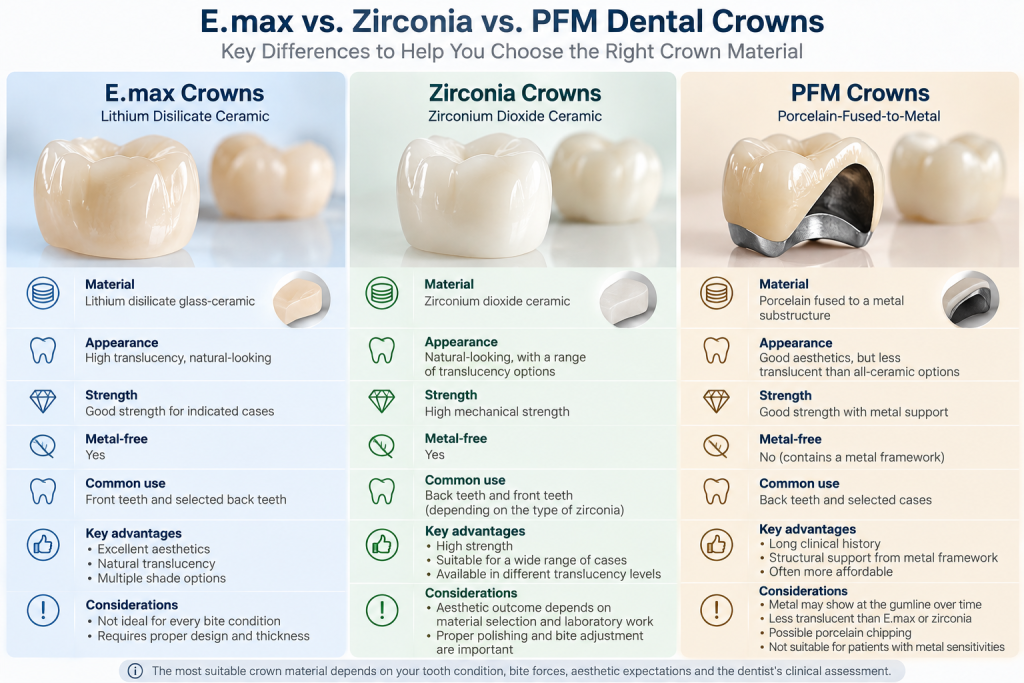
Illustrative comparison of E.max, zirconia and porcelain-fused-to-metal (PFM) dental crowns. Material selection depends on tooth location, aesthetic goals and individual clinical needs.
Which Crown Looks More Natural?
E.max is often selected when natural-looking translucency is a priority.
However, modern translucent zirconia can also provide attractive results. The final appearance depends on the ceramic formulation, tooth shade, restoration thickness, and laboratory craftsmanship.
Which Crown Is Stronger?
Many zirconia formulations have higher laboratory-measured flexural strength than lithium disilicate.
However, strength measurements alone do not determine clinical longevity. Crown design, cementation, tooth preparation, and patient habits also influence outcomes.
Which Crown Is Better for Molars?
Zirconia is frequently considered for molars because of its mechanical properties.
E.max may also be appropriate for selected posterior teeth when clinical conditions and material requirements are satisfied.
Patients who grind their teeth should discuss their bite and protective options with their dentist.
5. Dental Crowns vs. Veneers, Onlays and Fillings
A full-coverage crown is not always the most conservative treatment.
Before preparing a tooth, the dentist should assess whether another restoration could preserve more healthy tissue.
Dental Crowns vs. Veneers
A dental crown covers most or all of the visible prepared tooth, while a conventional porcelain veneer mainly covers the front surface.
Veneers may be appropriate for cosmetic improvements when sufficient healthy tooth structure remains.
Crowns are more commonly considered when a tooth requires substantial structural restoration.
Dental Crowns vs. Onlays
An onlay restores part of a tooth, including one or more chewing cusps.
When clinically suitable, it can preserve more natural tooth structure than a full crown.
Dental Crowns vs. Fillings
Fillings are commonly used for smaller defects. Crowns may be recommended when damage is extensive or remaining tooth walls need greater protection.
Because preparing a tooth for a crown is generally irreversible, patients should understand why full coverage is being recommended.
6. Dental Crown Procedure in Vietnam: Step by Step
A conventional dental crown usually requires several clinical and laboratory stages.
Watch: Dental Crown Procedure – 3D Animation
Watch VnMedtour’s educational 3D animation to understand the main stages of dental crown treatment, from tooth preparation and digital impressions to temporary crown placement and final restoration.
This AI-generated animation is for educational purposes only. Actual treatment steps may vary depending on individual clinical needs.
Step 1: Dental Examination
The dentist examines your teeth, gums, existing restorations, and bite.
Dental X-rays may be recommended to evaluate decay, roots, and other underlying conditions.
The dentist determines whether the tooth is restorable and whether a crown is appropriate.
Step 2: Treatment Planning and Material Selection
You and your dentist discuss suitable crown materials, appearance, costs, and expected treatment duration.
For visible teeth, shade matching is especially important.
Step 3: Tooth Preparation
The dentist removes decay or defective restorative material as necessary and prepares the tooth to accommodate the crown.
Local anesthesia is commonly used when appropriate.
The amount of tooth reduction depends on the selected material, tooth condition, and restoration design.
Step 4: Digital Scan or Dental Impression
A digital intraoral scan or conventional impression records the prepared tooth and surrounding teeth.
The dentist also records the bite and selects the appropriate shade.
Step 5: Temporary Crown Placement
If the permanent crown is not ready immediately, a temporary crown may be placed.
This helps protect the prepared tooth and maintain function and appearance while the final restoration is produced.
Step 6: Crown Fabrication
The dental laboratory or digital manufacturing system produces the crown according to the prescribed material and design.
Different materials require different manufacturing procedures, such as milling, pressing, crystallization, or sintering.
Step 7: Final Crown Placement
The dentist checks the crown’s fit, shade, contact points, and bite.
Once the restoration is considered suitable, it is cemented or adhesively bonded using an appropriate clinical protocol.
Final bite adjustments may be necessary.
7. How Long Does Dental Crown Treatment Take in Vietnam?
Treatment duration is particularly important for patients traveling from overseas.
For straightforward cases, a preliminary stay of approximately 5–7 days may be reasonable when using a conventional laboratory workflow.
However, this is not a guaranteed treatment timeline.
The number of appointments depends on the tooth condition, crown material, laboratory schedule, and whether additional procedures are required.
Can You Get a Dental Crown in One Day?
Some dental clinics offer same-day crowns using CAD/CAM technology.
This involves digital scanning, computer-assisted design, and on-site manufacturing.
Same-day treatment is not available for every material or clinical situation, and not every dental provider offers this service.
When Might You Need More Time?
Treatment may take longer if you require:
- Root canal treatment
- Gum treatment
- Multiple crowns
- Complex bite adjustments
- Replacement of failed restorations
- Additional laboratory modifications
International patients should avoid scheduling their return flight before the clinic confirms the expected treatment plan.
8. How Long Do Dental Crowns Last?
Dental crowns are designed for long-term function, but they do not last indefinitely.
Some crowns remain functional for many years, while others require earlier replacement.
Their lifespan depends on:
- Crown material and design
- Remaining natural tooth structure
- Quality of preparation and placement
- Oral hygiene
- Gum health
- Teeth grinding
- Bite forces
- Regular dental examinations
Can Dental Crowns Break?
Yes. Ceramic crowns can chip or fracture, especially under excessive forces or unfavorable conditions.
A crown may also loosen, develop marginal problems, or need replacement because of decay affecting the supporting tooth.
Can You Get Cavities Under a Crown?
Yes. Although ceramic and metal crown materials do not develop dental decay, the natural tooth beneath the crown remains vulnerable.
Plaque control around crown margins is essential.
Do Dental Crowns Require Special Care?
Crowns generally require the same fundamental oral hygiene practices as natural teeth, including regular brushing, interdental cleaning, and dental examinations.
Patients with bruxism may benefit from a protective night guard when recommended by their dentist.
9. Risks and Possible Complications
Dental crown treatment is common, but patients should understand its potential risks.
Tooth sensitivity: Temporary sensitivity may occur after preparation or placement.
Pulp irritation: Tooth preparation can occasionally lead to pulp-related complications, and further treatment may be necessary.
Crown fracture: Ceramic restorations can chip or break.
Bite discomfort: A crown may require adjustment if it interferes with normal chewing.
Gum irritation: Poor plaque control or restoration-related problems can contribute to inflammation.
Crown loosening: Cement failure or problems with the supporting tooth may cause a crown to become loose.
Recurrent decay: The underlying tooth can still develop cavities.
Persistent pain, swelling, difficulty biting, or crown movement should be assessed by a dentist promptly.
A dental crown cannot guarantee that the underlying tooth will remain healthy indefinitely.
10. Choosing a Dental Clinic in Vietnam
Selecting a dental provider is one of the most important decisions when planning treatment abroad.
Rather than comparing prices alone, consider the following factors.
Dentist Qualifications and Experience
Ask who will perform your treatment and whether they have relevant experience in restorative dentistry.
Complex cases may require additional expertise in prosthodontics, endodontics, or periodontics.
Crown Materials and Laboratory Standards
Ask the clinic to identify the proposed crown material and, where relevant, its manufacturer.
Terms such as “premium porcelain” or “high-quality ceramic” do not provide enough information to identify the actual material.
Clear Treatment Quotations
Request a quotation that explains what is included and which procedures may cost extra.
Additional treatment should be discussed and approved before it is performed.
Infection Prevention and Patient Safety
Ask about sterilization procedures, clinical hygiene, and infection-control practices.
Warranty and Follow-Up
Some clinics offer crown warranties, but terms vary.
A warranty should not be interpreted as a guarantee of clinical longevity.
International patients should also ask how the provider handles complications or adjustments after they return home.
11. Planning Your Dental Trip to Vietnam
Vietnam has private dental providers in major cities, including Hanoi and Ho Chi Minh City.
Choosing the right location depends on your treatment needs, travel schedule, and the availability of a suitable dental team.
Before Traveling
If available, prepare:
- Recent dental X-rays
- Photographs of the affected teeth
- Information about existing crowns or dental implants
- Previous treatment records
- A list of medications and relevant medical conditions
- Your preferred travel dates
These records may help a dental provider prepare an initial assessment.
However, final treatment decisions generally require an in-person examination.
How Long Should You Stay?
For uncomplicated crown treatment, several days may be sufficient.
More complex cases may require additional appointments or a longer stay.
Allow time for the final fitting and any necessary adjustments before departure.
Can You Combine Dental Treatment With Tourism?
Some patients combine dental appointments with sightseeing.
However, dental treatment should take priority, particularly if additional procedures or complications affect the schedule.
Patients should follow the treating dentist’s advice regarding eating, physical activity, and travel.
12. Getting Dental Crowns in Vietnam With VnMedtour
VnMedtour assists international patients seeking information and appointment coordination for dental treatment in Vietnam.
Our role is to help patients communicate with suitable providers, understand preliminary treatment options, and organize aspects of their medical tourism journey.
How We Assist International Patients
1. Initial Inquiry
Share your dental concerns, photographs, available X-rays, and preferred travel dates.
2. Preliminary Case Review
Where available, your information can be shared with a dental provider for an initial assessment.
3. Treatment Options and Estimated Costs
We help communicate the provider’s preliminary recommendations, estimated costs, and appointment requirements.
4. Appointment Coordination
Once you decide to proceed, VnMedtour can assist with scheduling and communication.
5. In-Person Dental Examination
The treating dentist confirms the diagnosis and explains the final treatment plan.
6. Treatment and Aftercare
The dental provider performs the treatment and provides clinical aftercare instructions.
VnMedtour is a patient coordination service, not the treating dental provider. All diagnoses, clinical decisions, procedures, and treatment outcomes remain the responsibility of the licensed dental professionals involved.
13. Frequently Asked Questions About Dental Crowns in Vietnam
How much does a dental crown cost in Vietnam?
Indicative prices may range from approximately $150 to $600 per tooth, depending on the material and provider. Additional procedures can increase the total cost.
Are dental crowns in Vietnam safe?
Safety depends on the individual provider, dentist’s qualifications, infection prevention, materials, and clinical assessment. Patients should evaluate each clinic carefully.
Is getting a dental crown painful?
Local anesthesia is commonly used during tooth preparation when appropriate. Some temporary sensitivity may occur afterward.
How many appointments are required?
Conventional treatment often involves at least two appointments, although some suitable cases can be completed through a same-day digital workflow.
Can I get dental crowns in Vietnam in one week?
Some uncomplicated cases can be completed within approximately one week. More complex treatment may require additional time.
Which is better, E.max or zirconia?
Neither is universally better. E.max offers strong aesthetic potential, while many zirconia formulations provide higher mechanical strength. The best material depends on your clinical needs.
Do I need a root canal before a crown?
Not necessarily. Root canal treatment is only recommended when the condition of the dental pulp or other clinical findings justify it.
Can a crowned tooth still decay?
Yes. The natural tooth beneath the crown can develop decay, particularly near the crown margins.
Can I replace an old dental crown in Vietnam?
In many cases, yes. The dentist must first assess the condition of the underlying tooth and determine whether another crown is appropriate.
What if my crown breaks after I return home?
Contact a local dentist for assessment and inform the original treating clinic. Keep your treatment records and review any applicable warranty terms.
Conclusion: Are Dental Crowns in Vietnam Right for You?
Dental crowns in Vietnam may be a practical option for international patients seeking to restore damaged teeth, improve chewing function, or replace existing restorations.
Zirconia, E.max, and PFM crowns each have different characteristics. The most appropriate option depends on your dental condition, aesthetic expectations, and bite requirements.
Although treatment costs may be lower than in some other countries, clinical suitability, tooth preservation, material quality, and long-term care should remain the priorities.
Before traveling, request a preliminary assessment, clarify the expected treatment duration, and confirm the total cost with your dental provider.
Medical Disclaimer
This article is for general educational and medical tourism planning purposes only. It does not replace professional dental examination, diagnosis, or individualized treatment advice. Treatment suitability, costs, duration, risks, and outcomes vary between patients. Prices are indicative estimates and should be confirmed with the treating provider before booking.
Medically reviewed by MSc, MD, Doctor Dang Tien Dat
Get Your Perfect Smile with Dental Crowns in Vietnam
Affordable, durable, and natural-looking crowns by expert dentists. Restore your smile with MedtourVietnam today.