
Quick Navigation
Revision Liposuction in Vietnam: The Ultimate Guide to Corrective Body Contouring
While primary liposuction remains one of the most widely performed aesthetic surgeries globally, the reality of body sculpting is that it requires an extraordinary level of surgical precision. When a primary procedure is performed by an under-qualified practitioner, utilizing outdated equipment, or when unpredictable tissue healing occurs, patients can be left with highly distressing aesthetic deformities. These typically present as severe skin irregularities, asymmetry, contour depressions, or residual, unaddressed fat pockets.
For patients suffering from sub-optimal outcomes, Revision Liposuction (also known as corrective lipoplasty or secondary liposuction) offers a definitive clinical pathway to restore anatomical harmony. Today, Vietnam has emerged as an elite global hub for revision plastic surgery, drawing international medical tourists who require world-class surgical expertise to correct complex deformities at a fraction of Western medical costs. This comprehensive manual provides an exhaustive clinical overview of undergoing revision liposuction in Vietnam.
1. What is Revision Liposuction? (The Clinical Challenge)
From a surgical standpoint, revision liposuction is profoundly different from a primary fat-extraction procedure. In a primary operation, the surgeon works with pristine, virgin subcutaneous tissue where fat layers are distinct, soft, and predictable to aspirate.
Conversely, a secondary or corrective procedure requires operating on tissue that has been structurally altered. The defining characteristics of a revision case include:
-
Dense Subdermal Fibrosis (Scar Tissue): The primary surgery inevitably leaves behind a dense network of internal scar tissue. This fibrous matrix is highly resistant to standard mechanical cannulas and requires specialized energy-assisted tech to safely break down.
-
Altered Vascular and Lymphatic Networks: The micro-circulation in the treated zone has already been compromised once. A revision surgeon must possess deep anatomical familiarity to prevent localized skin ischemia (tissue necrosis) or prolonged lymphedema.
-
Superficial Adhesions: In cases where over-resection occurred, the dermis may have adhered directly to the underlying muscle fascia, creating deep indents that require advanced fat grafting (lipofilling) rather than simple extraction.
Because of these inherent complexities, revision lipoplasty is widely considered one of the most technically demanding procedures in aesthetic surgery. It is not merely about fat removal; it is an intricate process of micro-sculpting, tissue release, and structural redistribution.
2. Common Contour Deformities Addressed by Revision Surgery
International patients seeking corrective surgery in Vietnam generally present with one or more of the following clinical indicators:
Asymmetry and Disproportion
This occurs when unequal volumes of adipose tissue are extracted from corresponding sides of the body (e.g., left vs. right flanks). This discrepancy disrupts the natural silhouette and requires precise calculation to achieve bilateral balance.
Contour Irregularities and “Washboard” Rippling
If a primary surgeon uses large cannulas too close to the superficial skin layer, or applies uneven negative pressure, the skin surface can develop permanent valleys, ridges, and a bumpy, “washboard” texture.
The “Step-Off” Deformity
A step-off occurs when a primary surgeon fails to properly feather or blend the margins of the treated zone into the adjacent, untreated body areas. This creates an abrupt, unnatural ridge or “shelf” that clearly demarcates where the lipo began and ended.
Severe Over-Resection (The “Hollowed-Out” Look)
Driven by the misconception that “more is better,” aggressive over-extraction can completely deplete the protective layer of superficial subcutaneous fat. This leaves the patient looking emaciated, with skin that appears structurally stuck to the muscle walls.
Surgical Context: While revision cases often involve widespread, complex regional corrections across the body, some patients only require minor structural touch-ups on a singular, isolated spot. If your primary dissatisfaction is isolated to a tiny, specific pocket that was simply missed, you may want to read about the less invasive alternative: mini liposuction in Vietnam.
3. Why International Patients Choose Revision Liposuction in Vietnam
When a primary surgery fails, the emotional and financial stakes for a secondary procedure are incredibly high. Patients cannot afford to make a mistake twice. International medical travelers are increasingly choosing top-tier hospitals in Ho Chi Minh City and Hanoi for several critical reasons:
Elite Corrective Specialists
Because Vietnam’s domestic aesthetic market has boomed over the last two decades, elite Vietnamese plastic surgeons see an exceptionally high volume of complex cases. Top-ranked specialists hold active memberships in the International Society of Aesthetic Plastic Surgery (ISAPS) and have completed rigorous, multi-year fellowships in global plastic surgery capitals like Seoul, Paris, and Taipei. They are uniquely trained in the meticulous art of tissue reconstruction.
Mandatory Hospital-Based Infrastructure
Unlike many Western nations where liposuction is frequently performed in private, outpatient day-clinics or office-based surgical suites, Vietnamese law mandates that major aesthetic procedures must be executed within fully licensed, comprehensive general or specialized hospitals. These facilities feature advanced intensive care units (ICUs), full-time anesthesiologists, and multi-disciplinary teams, ensuring maximum safety for complex, multi-hour revision surgeries.
State-of-the-Art Technology
Vietnamese institutions are equipped with the latest international hardware necessary to navigate dense scar tissue safely. This includes third-generation ultrasound devices, advanced laser lipolysis workstations, and closed-loop fat processing systems for immediate structural fat grafting.
4. Advanced Surgical Approaches and Techniques Used in Vietnam
To correct a botched primary outcome, Vietnamese surgeons utilize a multi-pronged technical strategy that combines precision tissue breakdown with structural volume replacement:
VASER Ultrasound-Assisted Liposuction (UAL)
Standard power-assisted or manual liposuction is often ineffective against dense, post-surgical scar tissue. Vietnamese surgeons heavily rely on VASER technology. VASER delivers targeted ultrasound waves that induce acoustic cavitation. This energy specifically liquefies remaining targeted fat cells and loosens hard fibrous bands while leaving blood vessels, nerves, and collagen structures entirely unharmed. This allows for smooth, uniform fat extraction in a previously traumatized plane.
Autologous Structural Fat Grafting (Lipofilling)
For valleys, depressions, and hollowed-out deformities, extraction alone is not enough. Surgeons must refill the defects. Fat is gently harvested from a secondary reserve zone (such as the inner thighs), processed in a sterile centrifuge to isolate pure, viable adipose stem cells, and then meticulously re-injected into the contour depressions using micro-cannulas. This creates a smooth, continuous skin profile.
Rigorous Internal Tissue Release (Subcision)
Where the skin has abnormally adhered to the underlying muscle fascia due to deep scar tissue, the surgeon performs specialized subcision. Using specialized, blunt-tipped instruments, the restrictive scar tissue is carefully released internally, lifting the skin and creating a space that can then be smoothly contoured or grafted.
5. Cost Comparison: Total Price of Revision Liposuction in Vietnam
Revision liposuction is invariably more expensive than primary liposuction worldwide because it takes double the operative time, requires advanced technology, and demands highly specialized surgical expertise. However, due to favorable macroeconomic factors in Vietnam—such as lower operational overhead, lower malpractice insurance structures, and competitive local currency rates—the absolute cost remains highly accessible for international patients.
The following matrix illustrates the average market costs for multi-zone revision liposuction across premier medical tourism destinations:
| Country / Healthcare Hub | Average Revision Cost (USD) | Infrastructure & Tech Fees | Average Cost Savings Index |
| United States (Beverly Hills / New York) | $9,000 – $18,000 | Frequently billed separately ($3,000+) | Baseline (0%) |
| Australia (Sydney / Brisbane) | $8,500 – $15,000 | High private operating theater rates | 5% – 15% Savings |
| United Kingdom (Harley Street, London) | $8,000 – $14,000 | Often excludes post-op garments | 10% – 20% Savings |
| Thailand (Bangkok International Hospitals) | $4,500 – $7,500 | Inclusive of standard overnight stay | 50% – 60% Savings |
| Vietnam (JCI-Accredited Centers) | $2,500 – $5,000 | All-Inclusive Packages (Hospital, Anesthesia, Follow-up) | 70% – 75% Savings |
Financial Transparency: It is vital to note that these financial savings do not equate to a compromise in safety. Top Vietnamese hospitals maintain identical sterile standards to Western nations, utilizing FDA-approved tech and adhering to international protocols. For a deep dive into how standard primary pricing structures look across the country’s top clinics, see the market report on liposuction in Vietnam cost, clinics, what to expect.
6. Managing Complex Regional Corrections: A Case Study on Lower-Body Revisions
When a primary liposuction goes wrong on the lower body, it often presents a massive aesthetic challenge. This is especially true for the gluteal fold and lower extremities, where skin elasticity is highly sensitive to volumetric changes.
Correcting the Gluteal and Subgluteal Region
If a primary surgeon aggressively removes too much fat from the subgluteal “banana roll” or the lower hips, the entire buttock can lose its structural shelf, leading to premature sagging (ptosis), severe asymmetry, or a flattened profile. Correcting this requires a dual approach: removing residual fat clusters from the outer flanks to recreate a tapered waistline, and using high-definition fat grafting to restore volume and roundness to the gluteal architecture. To read a comprehensive breakdown of how this highly specialized zone is managed by local experts, explore the guide to buttocks liposuction in Vietnam.
7. Strict Medical Safety Standards & Patient Screening Protocols
To ensure an uncompromised clinical outcome, premier medical institutions in Vietnam operating under the strict supervision of the Ministry of Health and international bodies like Joint Commission International (JCI) implement rigid patient safeguards:
-
The 6-to-12 Month Mandatory Waiting Period: A revision liposuction cannot be performed immediately after a failed primary surgery. Vietnamese surgeons strictly enforce a mandatory waiting period of at least 6 to 12 months post-primary op. This ensures that all initial post-operative swelling has completely resolved, internal scar tissue has fully matured and softened, and localized blood supply has stabilized. Operating too early dramatically elevates the risk of skin necrosis and infection.
-
Comprehensive Pre-Surgical Diagnostic Imaging: Prior to marking the skin, advanced diagnostic clear-checks are mandatory. This includes localized soft-tissue ultrasound imaging to map out the exact depth, thickness, and location of the internal scar tissue layers and residual fat deposits.
-
Advanced Anesthesia Management: Because revision cases can take significantly longer due to tedious scar dissection, dedicated cardiac monitoring and advanced, protective general anesthesia protocols are handled exclusively by board-certified anesthesiologists.
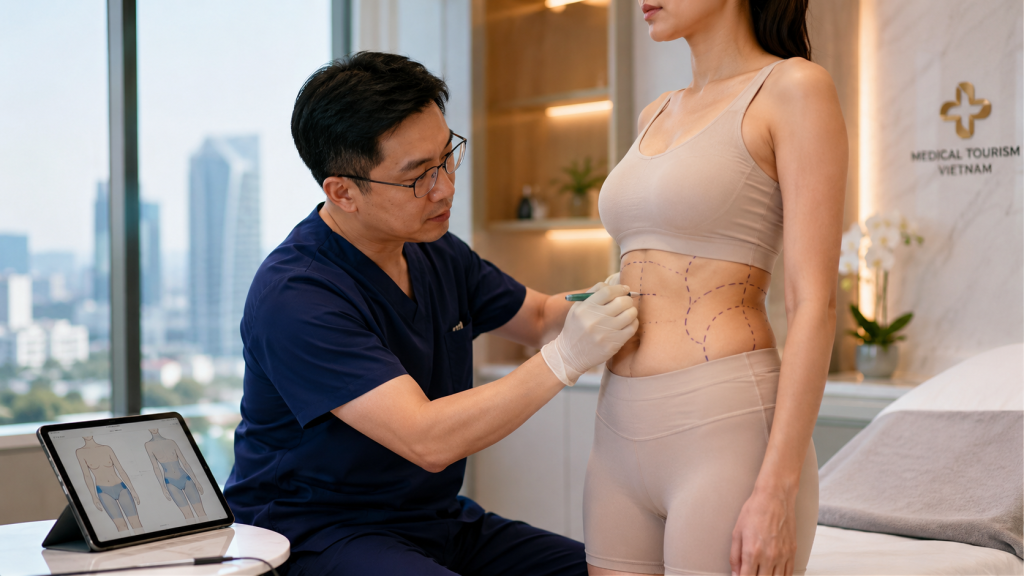
A cosmetic surgeon in Vietnam evaluates and marks correction zones for revision liposuction, helping patients improve contour irregularities, asymmetry, and previous liposuction results.
8. The Corrective Patient Journey & Strategic Recovery Protocol
Because of the extensive tissue manipulation required to break down dense scar tissue, the recovery timeline for a revision case requires a high level of patient compliance:
Phase 1: The Complex Mapping Consultation
Your Vietnamese surgeon will perform a comprehensive physical assessment while you are standing. They will palpate the skin to identify areas of hard fibrosis, trace out areas of fat deficiency (valleys), and mark zones of residual fat excess (peaks). This detailed mapping acts as a structural blueprint for the operating room.
Phase 2: Immediate Post-Operative Care (Days 1 – 3)
Following the surgery, patients typically remain in the hospital’s recovery wing for 24 hours for close observation of tissue perfusion. Mild to moderate swelling, deep bruising, and localized soreness are expected. Closed-system surgical drains may be placed temporarily to prevent seromas (fluid accumulation under the skin).
Phase 3: The Specialized Compression Regimen (Weeks 1 – 6)
Wearing a medical-grade, custom-fitted compression garment is absolutely paramount in a revision case. Because the skin has been detached from its old, irregular scar tissue attachments, the garment provides the necessary external pressure to ensure that the skin re-adheres to the deep muscle fascia in a perfectly flat, uniform configuration.
Phase 4: Post-Surgical Lymphatic Massage (Weeks 2 – 8)
To expedite the breakdown of newly forming scar tissue and accelerate fluid clearance, specialized manual lymphatic drainage (MLD) massages are highly recommended. Elite medical centers in Vietnam partner with dedicated post-op physical therapists who specialize in post-liposuction rehabilitation.
9. Frequently Asked Questions (FAQs)
Can revision liposuction fix all irregularities from a botched primary surgery?
While revision liposuction can achieve dramatic, life-changing improvements in contour symmetry, flatness, and overall body proportions, patients must maintain realistic expectations. If a primary surgery caused profound, full-thickness skin damage or complete loss of elasticity, a combination of revision lipo and excisional skin grafting (like a tummy tuck or body lift) may be required for optimal results.
How many days do I need to stay in Vietnam for a revision case?
Due to the intricate nature of secondary healing, international medical travelers should plan to stay in Vietnam for 10 to 14 days. This allows ample time for the initial pre-op consultations, the procedure, and multiple post-operative check-ups to monitor healing progress before flying home.
Are the results of fat grafting during a revision procedure permanent?
When autologous fat is transferred to correct depressions, a percentage of the transferred fat (typically 30% to 50%) is naturally reabsorbed by the body during the first three months. However, the fat cells that successfully establish a localized blood supply survive permanently. Maintaining a stable body weight ensures these long-term results remain beautiful and consistent.
Considering Revision Liposuction in Vietnam?
VnMedtour helps you explore experienced surgeons, corrective treatment options, estimated costs, and recovery support for revision liposuction in Vietnam.
Share your previous surgery details and photos to receive personalized guidance for correcting uneven or unsatisfactory liposuction results.