
MRI scans in Vietnam are increasingly sought after by both local residents and international patients who need accurate, non-invasive medical imaging at an affordable cost. With modern radiology departments, advanced MRI machines, and experienced radiologists, Vietnam has become a reliable destination for diagnostic imaging in Southeast Asia.
This comprehensive guide explains what an MRI scan is, when it is needed, the types of MRI available in Vietnam, costs, safety considerations, and why many international patients choose Vietnam for MRI examinations.
Quick Navigation
What Is an MRI Scan?
MRI (Magnetic Resonance Imaging) is a medical imaging technique that uses strong magnetic fields and radio waves to create highly detailed images of organs, soft tissues, bones, and nerves inside the body. Unlike CT scans or X-rays, MRI does not use ionizing radiation, making it a safer option for repeated imaging.
MRI scans are particularly valuable for diagnosing conditions involving:
-
Brain and nervous system
-
Spine and spinal cord
-
Muscles, ligaments, and joints
-
Internal organs
-
Blood vessels
-
Tumors and soft-tissue abnormalities
Why Do Patients Need MRI Scans?
Doctors may recommend an MRI scan to:
-
Detect tumors or abnormal growths
-
Evaluate neurological symptoms (headache, seizures, weakness)
-
Diagnose spine disorders such as herniated discs
-
Assess joint injuries and sports injuries
-
Examine organs such as the liver, uterus, prostate, or kidneys
-
Monitor chronic conditions or treatment response
-
Plan surgery or guide treatment decisions
Because of its high image resolution, MRI is often the gold standard for soft-tissue imaging.
Types of MRI Scans Available in Vietnam
Vietnamese hospitals and diagnostic centers offer a wide range of MRI examinations comparable to international standards.
1. Brain and Head MRI
Used to diagnose:
-
Brain tumors
-
Stroke
-
Multiple sclerosis
-
Infections and inflammation
2. Spine MRI
Commonly performed for:
-
Neck, thoracic, and lumbar spine pain
-
Disc herniation
-
Spinal stenosis
-
Nerve compression
3. Joint and Musculoskeletal MRI
Ideal for:
-
Knee, shoulder, hip, and ankle injuries
-
Ligament and tendon tears
-
Sports-related trauma
4. Abdominal and Pelvic MRI
Used to evaluate:
-
Liver, pancreas, kidneys
-
Uterine fibroids and gynecological conditions
-
Prostate disorders
-
Gastrointestinal abnormalities
5. Cardiac MRI
A specialized scan for:
-
Heart structure and function
-
Cardiomyopathy
-
Congenital heart disease
6. MRI With Contrast
Contrast-enhanced MRI improves visualization of:
-
Tumors
-
Blood vessels
-
Inflammatory processes
Contrast agents used in Vietnam comply with international safety guidelines.
MRI Technology in Vietnam
Many hospitals in Vietnam are equipped with 1.5 Tesla and 3.0 Tesla MRI machines, which are widely used in advanced healthcare systems worldwide.
Key Features:
-
High-resolution imaging
-
Faster scan times
-
Improved diagnostic accuracy
-
Reduced motion artifacts
Advanced MRI software allows detailed imaging of complex organs and supports early disease detection.
Cost of MRI Scans in Vietnam
One of the main reasons patients choose Vietnam is affordability.
Average MRI Scan Costs
-
Basic MRI (single region): USD 150 – 300
-
MRI with contrast: USD 250 – 500
-
Specialized MRI (cardiac, whole spine): USD 400 – 700
Prices may vary depending on:
-
Body part scanned
-
Use of contrast
-
MRI machine strength (1.5T vs 3.0T)
-
Hospital or diagnostic center
Compared to costs in the US, UK, or Australia (often USD 1,000 – 3,000 per scan), MRI scans in Vietnam can be 60–80% more affordable.
What Is Included in the MRI Cost?
Most MRI scan packages in Vietnam typically include:
-
Radiologist consultation
-
MRI examination
-
Image acquisition and processing
-
Written radiology report
-
Digital images (CD or online access)
Some hospitals also offer English medical reports, especially for international patients.
MRI Scan Procedure: What to Expect
Before the Scan
-
Complete a safety questionnaire
-
Remove metal objects (jewelry, watches, cards)
-
Inform staff of implants, pacemakers, or pregnancy
-
Fasting may be required for certain scans
During the Scan
-
The patient lies on a movable table
-
The table slides into the MRI scanner
-
Loud knocking sounds are normal (ear protection provided)
-
Scan duration: 20–60 minutes
After the Scan
-
No recovery time needed
-
Normal activities can usually resume immediately
-
Results are often available within 24–48 hours
Is MRI Safe?
MRI is considered very safe for most patients.
Safety Advantages:
-
No radiation exposure
-
Non-invasive
-
Suitable for repeated follow-up scans
Important Considerations:
-
Patients with certain metal implants may not be eligible
-
Claustrophobic patients can request open MRI or mild sedation
-
Contrast MRI may require kidney function assessment
Vietnamese radiology departments strictly follow international MRI safety protocols.
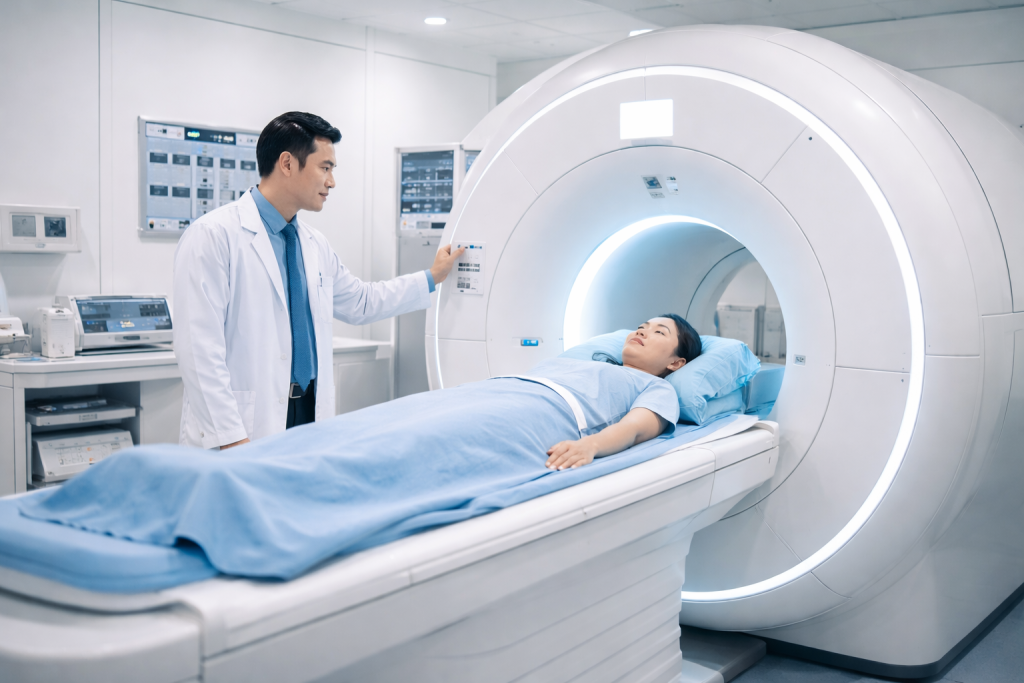
MRI scans in Vietnam are performed in modern radiology departments, offering accurate, radiation-free diagnostic imaging with international-standard equipment and experienced medical staff.
MRI for International Patients in Vietnam
Vietnam has become increasingly popular among international patients seeking diagnostic imaging.
Benefits for International Patients:
-
Short waiting times
-
Affordable pricing
-
Modern equipment
-
English-speaking staff at international hospitals
-
Ability to combine imaging with specialist consultations
Many patients travel to Vietnam for MRI scans as part of a medical check-up, second opinion, or pre-treatment evaluation.
How Long Should You Stay in Vietnam for an MRI?
For most MRI scans:
-
1–2 days are sufficient
-
Same-day scan and next-day results are common
Patients undergoing multiple tests or consultations may stay longer depending on medical needs.
MRI vs CT Scan in Vietnam
| MRI | CT Scan |
|---|---|
| No radiation | Uses X-ray radiation |
| Best for soft tissues | Best for bones and trauma |
| Longer scan time | Faster scan |
| Higher cost than CT | Usually cheaper |
Doctors in Vietnam carefully select the appropriate imaging method based on clinical indication.
Quality of Radiologists and Reporting
Radiologists in Vietnam often receive training locally and abroad. Many have experience interpreting complex MRI studies and collaborating with international patients.
For medical tourism patients, hospitals can provide:
-
English reports
-
DICOM files for overseas doctors
-
Teleconsultation support
This makes it easier to continue treatment or obtain second opinions abroad.
Why Choose Vietnam for MRI Scans?
Vietnam offers an excellent balance of quality, affordability, and accessibility:
-
Advanced MRI technology
-
Skilled radiologists
-
International-standard hospitals
-
Affordable diagnostic costs
-
Minimal waiting time
-
Safe travel environment
For patients seeking reliable imaging without long delays or high expenses, Vietnam is a strong choice.
Final Thoughts
MRI scans in Vietnam provide accurate, safe, and cost-effective diagnostic imaging for a wide range of medical conditions. Whether you are a local resident, an expatriate, or an international medical traveler, Vietnam offers modern MRI facilities that meet global standards at a fraction of the cost seen in many Western countries.
If you need a precise diagnosis, follow-up imaging, or part of a comprehensive medical check-up, an MRI scan in Vietnam can be a smart and practical solution.
Book an MRI Scan in Vietnam
Send your symptoms and any previous reports. We’ll recommend a trusted MRI center in Vietnam and provide a clear price estimate and available time slots.