
In modern medicine, early and accurate diagnosis is the most critical factor in successfully managing complex healthcare conditions, particularly cancer, neurological disorders, and cardiovascular diseases. Among the most advanced nuclear medicine imaging techniques available today, the Positron Emission Tomography (PET) scan—frequently combined with Computed Tomography as a PET/CT scan—is the gold standard for metabolic mapping. By tracking cellular-level metabolic activity, a PET scan can detect pathological changes long before structural abnormalities become visible on traditional structural imaging.
As medical infrastructure rapidly develops across Southeast Asia, Vietnam has emerged as a premier, highly efficient hub for advanced diagnostic imaging and specialized medical tourism. International patients, expatriates, and overseas Vietnamese are increasingly traveling to major medical centers in Hanoi and Ho Chi Minh City to access high-end clinical services. Choosing a PET scan in Vietnam allows patients to undergo screening on cutting-edge, high-resolution diagnostic systems operated by Western-trained nuclear medicine specialists, all at a fraction of the cost found in Western nations or traditional regional medical hubs like Singapore.
For comprehensive diagnostic screening, many patients choose to pair metabolic evaluations with advanced structural imaging, such as a localized MRI scan in Vietnam, providing oncology teams with a multi-parametric view of the body’s internal systems. This comprehensive guide explores the deep technical aspects, cost structures, clinical workflows, and top-tier medical facilities available for patients seeking a PET scan in Vietnam.
Quick Navigation
1. Understanding a PET Scan in Vietnam: The Science of Metabolic Imaging
To understand the immense clinical value of a PET scan, it helps to distinguish it from standard radiological modalities like X-rays, CT scans, or ultrasound. While standard modalities focus primarily on structural anatomy (the size, shape, and physical location of an organ or tumor), a PET scan maps out cellular physiology and metabolic function.
The underlying science relies on the fact that diseased cells—especially rapidly dividing malignant cancer cells—exhibit a much higher metabolic rate than healthy cells. To capture this activity, a tiny, safe amount of a radioactive pharmaceutical agent (known as a radiotracer) is introduced into the patient’s bloodstream.
The most widely utilized radiotracer in clinical molecular imaging is Fluorodeoxyglucose (18F-FDG). Chemically, 18F-FDG is a glucose analog. Because actively multiplying tumor cells consume vast quantities of sugar to fuel their rapid growth, they aggressively absorb the 18F-FDG molecules. Once inside the cells, the radiotracer emits subatomic particles called positrons. These positrons interact with surrounding electrons, triggering an annihilation event that releases dual gamma rays traveling in exactly opposite directions.
The high-sensitivity detectors inside the circular ring of the PET scanner capture these simultaneous gamma rays. Sophisticated reconstruction algorithms convert this raw data into detailed 3D metabolic maps. Areas with unusually intense radiotracer concentration are designated as metabolic “hotspots,” signaling potential sites of malignancy, active inflammation, or neurological abnormalities. By fusing these images with a simultaneous CT scan, the medical team can pinpoint the exact anatomical location of these hotspots down to the millimeter.
2. Core Indications for Ordering a PET Scan in Vietnam
Nuclear medicine teams utilize PET/CT systems across three primary branches of specialized medicine: Oncology, Cardiology, and Neurology.
Oncology (Cancer Detection and Management)
Oncology is the primary field where PET/CT scans deliver their greatest clinical impact. For patients navigating a cancer diagnosis, a PET scan provides critical data across every stage of the treatment journey:
-
Early Staging: Accurately determining whether a primary tumor has metastasized to distant lymph nodes, bones, or soft tissue organs. This prevents under-staging and assists tumor boards in tailoring therapy appropriately.
-
Treatment Response Monitoring: Evaluating whether a tumor is responding to chemotherapy or targeted radiation. If a tumor’s metabolic activity drops significantly on a post-treatment PET scan, it indicates the therapeutic regimen is working, even if the physical mass has not yet shrunk in size.
-
Recurrence Surveillance: Differentiating between residual scar tissue left behind by past surgeries and an active, recurring tumor mass.
Because managing advanced malignancies requires a multi-faceted clinical approach, premier imaging facilities work in direct alignment with highly specialized, full-scale regional oncology programs, such as the comprehensive oncology in Vietnam departments found at top-tier international medical networks.
Neurology (Brain and Cognitive Mapping)
In neurology, the brain’s primary fuel source is glucose. By mapping regional cerebral glucose metabolism, a brain PET scan offers invaluable diagnostic insights:
-
Dementia Differentiation: Identifying specific, localized metabolic deficits to help clinicians accurately differentiate between Alzheimer’s disease, Frontotemporal Dementia (FTD), and Dementia with Lewy Bodies.
-
Refractory Epilepsy Mapping: Pinpointing the exact, hyper-irritable epileptic focus in the brain tissue for patients who do not respond well to anti-seizure medications, mapping out the precise target for corrective neurosurgery.
Cardiology (Myocardial Viability Studies)
For patients with severe coronary artery disease or a history of myocardial infarction (heart attack), a cardiac PET scan is the ultimate diagnostic standard for assessing myocardial viability. It determines whether areas of the heart muscle that show impaired motion are permanently scarred or are simply “hibernating” due to restricted blood flow. If the tissue shows active glucose uptake, it indicates the muscle is viable and will benefit significantly from surgical interventions like coronary artery bypass grafting (CABG) or stenting.
3. Financial Breakdown: Cost of a PET Scan in Vietnam Compared Globally
The primary factor driving international patients, regional expatriates, and medical tourists to choose Vietnam for advanced diagnostics is the excellent cost-to-quality ratio. High-tech nuclear medicine imaging in Western countries can be financially restrictive due to high healthcare overhead, extensive operational insurance costs, and administrative fees.
In the United States, a comprehensive whole-body 18F-FDG PET/CT diagnostic scan routinely costs between $3,500 and $6,000 out-of-pocket. In Australia, patients can expect to pay between $2,200 and $3,500, while regional hubs like Singapore range from $1,800 to $2,600. Even in Thailand, a standard session sits between $1,200 and $1,800.
By comparison, premium clinics and international hospitals in Vietnam offer the exact same whole-body protocols using modern multi-slice and digital imaging arrays for $850 to $1,250 (approximately 21 to 26 million VND). According to international cost comparative analyses published by VietNamNet Global, localized advanced diagnostics run roughly one-fourth of the cost seen in neighboring medical hubs like Singapore.
This significant pricing advantage stems from lower localized operational overhead, competitive pharmaceutical radiotracer synthesis via local cyclotron networks, and structured government pricing guidelines aimed at keeping advanced healthcare accessible. The money saved often allows patients to comfortably cover their travel expenses, luxury recuperation stays, and any necessary follow-up clinical consultations.
4. Top Hospitals Providing a PET Scan in Vietnam
Vietnam’s healthcare infrastructure has advanced rapidly, with major public and private health networks investing heavily in state-of-the-art diagnostic equipment from leading global medical technology companies like Siemens Healthineers, GE Healthcare, and Philips.
Vinmec International Hospital Network
As a premier private healthcare provider in Vietnam, the Vinmec network features cutting-edge nuclear medicine infrastructure. Their flagship campuses—such as Vinmec Times City International Hospital in Hanoi and Vinmec Central Park in Ho Chi Minh City—are equipped with advanced, high-resolution PET/CT scanners. Operating under strict Joint Commission International (JCI) patient safety guidelines, Vinmec provides full-scale English-speaking care, seamlessly coordinating imaging results with their on-site oncology, neurology, and surgical divisions. Detailed insights into their clinical equipment and workflows can be explored on the official Vinmec Clinical Guide.
Cho Ray Hospital (Ho Chi Minh City)
As one of the largest and most historically prominent tertiary referral hospitals in Vietnam, Cho Ray Hospital houses a highly advanced Nuclear Medicine Center. Cho Ray was an early pioneer in introducing PET/CT imaging to southern Vietnam and operates its own on-site cyclotron unit to synthesize fresh, highly stable radiotracers daily. Notably, the center recently expanded its capabilities by successfully manufacturing specialized targeted radiopharmaceuticals like Ga-68 PSMA and Ga-68 Dotatate domestically, as detailed by Tuoi Tre News.
Military Central Hospital 108 (Hanoi)
Located in the heart of Hanoi, Hospital 108 features one of the most technologically advanced diagnostic imaging departments in the country. The hospital operates state-of-the-art digital PET/CT systems that utilize ultra-fast time-of-flight (TOF) technology. This allows their clinical teams to capture exceptionally clear images using lower radiotracer dosages, making it an excellent option for pediatric patients or individuals requiring frequent follow-up scans.
5. The Step-by-Step Clinical Protocol for a PET Scan in Vietnam
A PET/CT scan follows a precise, time-sensitive clinical protocol that demands absolute compliance to ensure accurate results.
Step 1: Crucial Pre-Scan Preparation (24 Hours Prior)
To ensure that cells absorb the 18F-FDG tracer optimally, patients must follow a strict preparation routine starting 24 hours before their scheduled appointment:
-
Low-Carbohydrate Diet: Patients must eat a strict no-sugar, low-carbohydrate diet (focusing solely on proteins and non-starchy vegetables) for the preceding 24 hours. This minimizes competing natural glucose levels in the bloodstream.
-
Avoid Strenuous Exercise: Strenuous physical activity, heavy lifting, or intense workouts are strictly prohibited for 24 hours prior to the scan. Intense muscle contraction causes the radiotracer to accumulate heavily in healthy skeletal muscles, creating background noise that can mask target lesions.
-
Strict Fasting: A total fast (no food, coffee, tea, juices, or mints) is required for 6 to 8 hours before the scan. Patients are highly encouraged to drink plenty of plain, unflavored water to stay well-hydrated.
Step 2: The On-Site Uptake & Resting Phase (The “Quiet Hour”)
Upon arriving at the medical facility, a nurse will check the patient’s resting blood glucose level via a quick finger-prick test. The ideal blood sugar range for an accurate scan is under $150\text{ mg/dL}$ ($8.3\text{ mmol/L}$). If blood sugar is too high, the test may need to be rescheduled, as natural glucose will crowd out the 18F-FDG radiotracer.
Once cleared, a technician will insert a peripheral intravenous (IV) line and administer the precise, customized dose of the radiotracer. The patient is then escorted to a private, dimly lit relaxation room for the uptake phase, which lasts exactly 45 to 60 minutes. During this “Quiet Hour,” the patient must remain completely still and quiet—avoiding reading, using smartphones, talking, or moving around. This ensures the tracer distributes evenly throughout the body’s baseline systems rather than accumulating in active vocal cords, eyes, or skeletal muscle tissue.
Step 3: Inside the Scanner Array
After the uptake phase is complete, the patient is led to the scanner room and positioned flat on their back on the motorized imaging bed. The technician will position the bed to glide smoothly through the large, circular opening of the PET/CT machine.
First, the machine performs a rapid, low-dose CT scan to establish structural landmarks and density data for attenuation correction. Immediately following, the PET scanner systematically captures the emission data, moving section by section from the base of the skull down to the mid-thighs. The entire scanning process takes between 20 and 30 minutes. The procedure is completely painless, non-invasive, and silent. The primary requirement is that the patient lies perfectly still to prevent blurriness in the final images.
Step 4: Post-Scan Care and Radiotracer Elimination
Once the scan is complete, the medical team reviews the raw images to ensure there are no motion artifacts. The IV line is removed, and the patient is free to leave, eat normally, and resume all daily activities immediately.
Because a radioactive pharmaceutical tracer was introduced, patients are advised to drink at least 1 to 2 liters of water throughout the remainder of the day. The kidneys flush out the remaining radiotracer naturally through urine, and the radioactive isotope decays completely within 12 to 24 hours. As a standard safety precaution, patients are advised to avoid close, prolonged physical contact with pregnant women and infants for 24 hours post-procedure.
6. Patient Safety and Radiotracer Quality Control for a PET Scan in Vietnam
A common concern among international patients relates to radiation safety and the strict quality controls governing nuclear pharmaceuticals in developing healthcare markets.
Vietnam’s nuclear medicine operations follow rigorous international guidelines managed by the Ministry of Health and verified by the International Atomic Energy Agency (IAEA). The radiotracer production facilities (cyclotrons) operating in Hanoi and Ho Chi Minh City maintain strict Current Good Manufacturing Practice (cGMP) standards. Every singular batch of 18F-FDG undergoes real-time automated safety testing to confirm:
-
Radiochemical Purity: Ensuring greater than 95% of the radioisotope is bound correctly to the glucose carrier.
-
Sterility and Apyrogenicity: Verifying that the injection fluid is completely free of microbial contamination or fever-inducing endotoxins.
Regarding radiation exposure, a modern PET/CT scan combines a targeted, low-dose CT array with an optimized isotope injection volume, resulting in an average total radiation exposure of approximately $7\text{ mSv}$ to $12\text{ mSv}$. This exposure level is well within safe, globally established clinical boundaries and is comparable to natural background environmental radiation exposure accumulated over a few years.
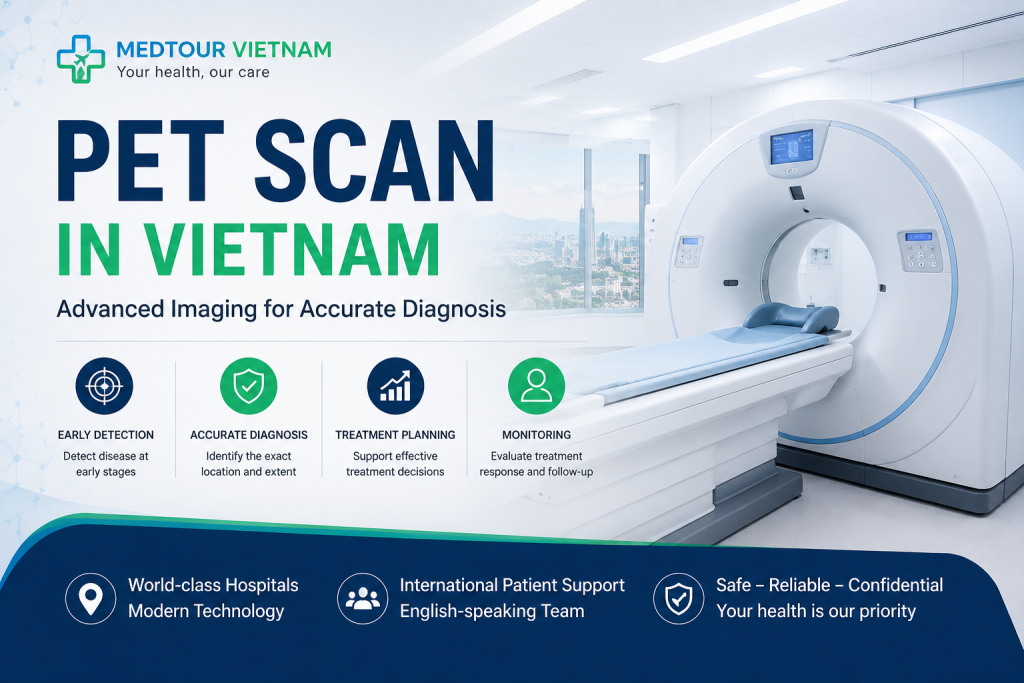
PET Scan in Vietnam helps detect cancer, evaluate disease progression, and monitor treatment response using advanced PET/CT imaging technology available at leading hospitals in Vietnam.
Conclusion
Securing a PET scan in Vietnam offers international patients, expatriates, and medical travelers an exceptional combination of clinical accuracy, advanced diagnostic technology, and substantial financial savings. By choosing top-tier, JCI-aligned private hospital networks or major tertiary academic imaging hubs, patients gain access to advanced diagnostic capabilities managed by expert clinical teams.
When smoothly integrated into a proactive diagnostic screening itinerary or combined with larger, specialized treatment plans, traveling to Vietnam for medical care ensures you receive world-class diagnostic support without facing extensive waitlists or prohibitive medical bills. This allows you to confidently prioritize your long-term health and well-being.
Need a PET Scan in Vietnam?
Medtour Vietnam can help international patients arrange PET/CT scans at trusted hospitals in Vietnam, including appointment booking, hospital coordination, English support, and guidance before your visit.
Fast support for medical records review, estimated cost, and appointment availability.