
Quick Navigation
Mastectomy in Vietnam: Clinical Standards, Oncoplastic Innovations, and the Medical Tourism Landscape
Breast cancer has emerged as the leading oncological challenge for women in Vietnam. According to data from the International Agency for Research on Cancer (GLOBOCAN), Vietnam records over 24,500 new diagnoses and upwards of 10,000 deaths annually, accounting for nearly 29% of all female cancer cases in the country. Within the multidisciplinary treatment matrix required to achieve clinical remission, surgical intervention remains the foundational pillar. Among these interventions, mastectomy (the surgical removal of the entire breast tissue) stands as a definitive, time-tested approach for many stages of the disease.
However, the clinical paradigm of mastectomy in Vietnam has undergone a profound evolution. No longer limited to the simple, radical ablation of diseased tissue to ensure survival, contemporary Vietnamese surgical oncology focuses heavily on a dual-objective framework: Oncological Safety (complete tumor clearance) and Aesthetic Reconstruction (minimizing psychological trauma and preserving physical symmetry).
Today, Vietnam’s advanced surgical capabilities, combined with an exceptionally competitive cost structure, have transformed the country into an emerging destination for high-quality, affordable breast cancer surgeries within the global medical tourism sector.
1. Understanding Mastectomy: Clinical Classifications
A mastectomy is a major surgical procedure performed to remove breast tissue as a primary treatment or preventative measure against breast cancer. The specific surgical technique prescribed depends heavily on tumor size, localization, staging, genetic mutations, and axillary lymph node involvement.
In Vietnamese oncology centers, the procedure is categorized into several primary methodologies:
-
Modified Radical Mastectomy (MRM): This technique involves the complete removal of the entire breast parenchyma, including the nipple-areola complex (NAC), the overlying skin envelope, and the fascia of the pectoralis major muscle, accompanied by an Axillary Lymph Node Dissection (ALND). MRM remains the standard of care for locally advanced breast cancers, which still represent a significant portion of initial presentations in Vietnam.
-
Skin-Sparing Mastectomy (SSM): In this approach, the underlying breast tissue, sub-mammary fold, and NAC are excised, but the natural outer skin envelope of the breast is carefully preserved. SSM is highly favored when patients elect to undergo immediate breast reconstruction, as it provides an intact biological pocket for implants or autologous tissue.
-
Nipple-Sparing Mastectomy (NSM): A highly specialized variation where all breast tissue is meticulously dissected away, but the outer skin, areola, and the nipple itself are preserved. This is indicated for early-stage tumors located a safe distance from the nipple or for prophylactic (preventative) cases in individuals carrying high-risk genetic mutations, such as BRCA1 or BRCA2.
According to clinical guidelines outlined by the American Cancer Society, the decision to undergo a total mastectomy versus a breast-conserving surgery (lumpectomy) relies on a careful evaluation of the tumor-to-breast ratio, patient preference, genetic predisposition, and the accessibility of adjuvant post-operative radiation therapy.
2. Epidemiological Dynamics and Patient Profiles in Vietnam
The epidemiological landscape of breast cancer in Vietnam exhibits unique demographic and clinical characteristics that distinguish it sharply from Western countries, directly dictating how mastectomies are planned and executed.
The Challenge of Patient Youthfulness
In Western nations, breast cancer is predominantly a disease of post-menopausal women, with the median age of diagnosis often exceeding 60. Conversely, the median age of breast cancer patients in Vietnam is significantly younger, concentrated heavily within the 40–50 age demographic, with a notable uptick in cases among women under 35.
Undergoing a radical mastectomy during these prime years of career development, marriage, and child-rearing inflicts an immense psychological burden. This demographic reality has driven Vietnamese surgeons to pioneer oncoplastic techniques that prioritize body image preservation alongside cancer eradication.
Staging Trends and the Multidisciplinary Approach
Public health campaigns, increased health literacy, and widespread screening programs have substantially improved early detection across Vietnam, boosting the proportion of early-stage (Stage 0, I, and II) diagnoses to approximately 76%. However, nearly a quarter of patients still present with advanced, large, or multi-focal tumors (Stage III and IV) that necessitate total mastectomy over breast conservation.
For advanced presentations, surgery is rarely a standalone solution. Vietnamese oncology boards employ neoadjuvant (pre-operative) systemic therapies—such as chemotherapy, targeted biological therapies, or immunotherapy—to shrink massive tumors prior to heading to the operating room. To explore how systemic therapies, radiation, and surgical interventions are structurally integrated, patients can review the comprehensive guide on Breast Cancer Treatment in Vietnam.
3. Top-Tier Healthcare Infrastructure for Mastectomy in Vietnam
Vietnam features a robust, tiered medical infrastructure split between ultra-high-volume public oncology hospitals and premium, internationally accredited private medical institutions. This ecosystem ensures world-class surgical execution tailored to varied patient needs.
The Public Sector Giants
Public hospitals in Vietnam manage an extraordinary clinical volume, giving their surgical teams unparalleled manual dexterity and experiential expertise. Institutions like the National Cancer Hospital (Hospital K) in Hanoi and the Ho Chi Minh City Oncology Hospital operate on thousands of breast cases annually. Surgeons in these centers are highly adept at managing complex pathology and routinely perform sophisticated microvascular autologous reconstructions.
The Premium Private and International Sectors
For international medical tourists and expatriates seeking seamless, personalized care pathways without wait times, private institutions such as Vinmec International Hospital, FV Hospital (JCI-accredited in Ho Chi Minh City), and Tam Anh General Hospital offer premium clinical environments. These facilities feature Western-trained, bilingual oncologists, state-of-the-art operating suites, advanced accelerated rehabilitation protocols, and dedicated international patient coordination departments.
4. The Oncoplastic Revolution: Immediate Breast Reconstruction
The most significant paradigm shift in Vietnamese breast surgery over the past decade is the widespread adoption of Oncoplastic Surgery and Immediate Breast Reconstruction (IBR). Instead of leaving an oncological patient with a flat, permanently scarred chest wall to be addressed years later through delayed reconstruction, multidisciplinary teams operate concurrently.
As soon as the surgical oncologist finishes removing the malignant tissue and mapping the lymph nodes, a specialized plastic and reconstructive surgeon steps in to rebuild the breast mound while the patient remains under the same anesthesia.
Reconstructive Modalities Utilized in Vietnam
1. Alloplastic (Implant-Based) Reconstruction
The surgeon places a cohesive silicone gel implant or a temporary tissue expander underneath the pectoralis major muscle or in a pre-pectoral position using acellular dermal matrix (ADM). This method offers shorter operative times, zero donor-site morbidity (no wounds created on other parts of the body), and a predictable recovery trajectory. However, it carries a higher long-term risk of capsular contracture and lacks the natural ptosis (sag) of a biological breast.
2. Autologous (Tissue-Flap) Reconstruction
This approach relies on the patient’s own tissue to rebuild the breast mound. The Latissimus Dorsi (LD) Flap transposes an island of skin, fat, and muscle from the upper back to the chest, often paired with a small implant. Alternatively, the Deep Inferior Epigastric Perforator (DIEP) Flap stands as the gold standard of autologous reconstruction. Surgeons harvest a section of skin and excess fat from the lower abdomen while completely sparing the rectus abdominis muscle. Using microvascular surgery under a high-powered operating microscope, the tiny blood vessels are meticulously connected to the internal mammary vessels of the chest.
Clinical Insight: Autologous tissue matches the warmth, softness, and natural movement of a real breast perfectly. Because it uses the patient’s own living tissue, the reconstructed breast ages naturally with the patient, eliminating long-term implant-related complications.
5. Standardized Surgical Workflow: What Patients Can Expect
Navigating a mastectomy requires a structured, multi-phase medical journey. Vietnamese hospitals adhere to strict international clinical protocols to ensure optimal perioperative safety.
Phase 1: Pre-Operative Assessment & Planning
The patient’s case file is evaluated by a multidisciplinary Tumor Board—consisting of surgical oncologists, medical oncologists, radiologists, pathologists, and plastic surgeons—to finalize the surgical roadmap. High-resolution breast MRI, CT scans, or PET-CTs are reviewed to determine precise tumor boundaries, and complete cardiac, pulmonary, hepatic, and metabolic screenings are conducted to ensure the patient can safely tolerate prolonged general anesthesia.
Phase 2: Intra-Operative Execution
The procedure begins with general endotracheal anesthesia. The primary surgical team performs the mastectomy according to the pre-planned approach, ensuring margins are completely clear of malignant cells. To avoid the lifelong complications of removing all axillary lymph nodes, a Sentinel Lymph Node Biopsy (SLNB) is performed using radioactive tracers or blue dye. These nodes are examined immediately via intraoperative frozen section analysis. If free of cancer, the remaining axillary nodes are left intact, preventing secondary lymphedema. Finally, the reconstructive team completes the implant placement or microvascular flap transfer before placing surgical drains and closing the incisions.
Phase 3: Post-Operative Recovery & Rehabilitation
The inpatient stay typically ranges from 3 to 5 days for a standard mastectomy, extending to 7 to 10 days for complex microvascular autologous reconstructions. Surgical drains remain in place for 1 to 2 weeks post-discharge and are monitored daily until fluid output drops below 20–30 mL per 24 hours. Under strict medical supervision, structured shoulder mobility and range-of-motion exercises are initiated by day 2 to prevent arthrofibrosis (“frozen shoulder”) and minimize scar tissue adhesion.
6. Financial Analysis: Vietnam’s Competitive Advantage in Medical Tourism
The compelling economic value proposition of receiving specialized surgical care in Vietnam is a primary driver for regional medical tourism and the return of overseas Vietnamese (Viet Kieu).
The table below provides a realistic cost comparison of mastectomy and reconstructive options across several global healthcare markets (compiled in USD based on standard international hospital private-pay pricing):
| Country | Standalone Mastectomy | Mastectomy + Implant Reconstruction | Mastectomy + Autologous Microvascular Flap (DIEP) |
| United States | $12,000 – $18,000 | $25,000 – $40,000 | $50,000 – $80,000 |
| Singapore | $8,000 – $11,000 | $15,000 – $22,000 | $30,000 – $42,000 |
| Thailand | $4,500 – $6,500 | $9,000 – $13,000 | $18,000 – $25,000 |
| Vietnam (Int’l Sector) | $2,000 – $3,500 | $4,500 – $7,000 | $9,000 – $14,000 |
This vast cost differential does not imply a compromise in clinical quality. Instead, it reflects lower operational overhead, localized labor costs for medical personnel, and strict government regulations on pharmaceutical pricing within Vietnam, allowing international patients to access elite surgical care at a fraction of Western costs.
7. Clinical Complications and Proactive Post-Surgical Management
While mastectomy is a highly routine, safe surgical intervention, it carries inherent medical risks that require vigilant clinical management and cooperative patient care.
-
Seroma Accumulation: The most common localized complication is a seroma—a collection of clear, yellowish bodily fluid that pools in the dead space left by the removed breast tissue. They are easily managed in an outpatient setting via sterile needle aspiration.
-
Flap or Skin Envelope Necrosis: In skin- or nipple-sparing mastectomies, the thin remaining dermal layers can suffer from compromised microvascular blood supply, leading to localized tissue necrosis. This risk increases exponentially in patients with a history of heavy smoking, poorly controlled diabetes mellitus, or prior local radiation therapy.
-
Secondary Lymphedema: When an Axillary Lymph Node Dissection (ALND) is required, the disruption to the regional lymphatic drainage channels can cause a chronic, progressive swelling of the arm on the affected side.
To mitigate lymphedema risks, Vietnamese physical therapy teams emphasize lifelong protective protocols established by organizations like the National Lymphedema Network, such as avoiding blood pressure cuffs or blood draws on the affected arm, wearing graduated medical compression sleeves during air travel, and immediately treating even minor skin abrasions with antiseptics to prevent deep infections.
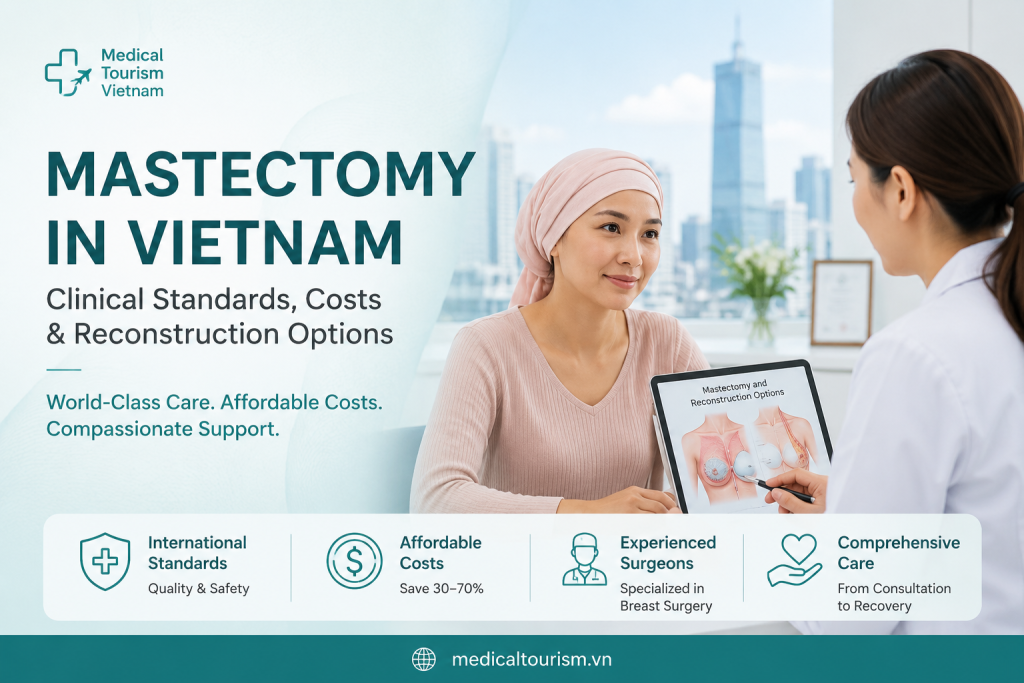
Mastectomy in Vietnam offers international patients access to experienced breast surgeons, modern hospitals, and breast reconstruction options at competitive costs.
8. Holistic Rehabilitation and Psychological Restructuring
True clinical recovery from a mastectomy extends far beyond the closure of a cutaneous incision; it encompasses a complex journey of psychological adaptation, identity reclamation, and somatic healing.
External Solutions for Structural Balance
For women who choose not to undergo surgical reconstruction, external options are highly effective. Medical-grade mastectomy bras paired with weighted silicone external breast prostheses are widely available across major urban centers in Vietnam. These prostheses balance weight distribution across the shoulder girdle, preventing postural misalignment, chronic neck pain, and compensatory scoliosis while restoring a natural aesthetic appearance under clothing.
For patients who completed breast reconstruction but lost the nipple-areola complex, advanced medical centers offer 3D Areola Medical Tattooing. Utilizing specialized micropigmentation techniques, medical tattooists create realistic depth, shading, and texture, providing an invaluable final step toward emotional closure.
Psycho-Oncology and Community Support
The emotional trauma of a mastectomy can trigger deep body dysmorphia, anxiety, and depression. Recognizing this, premium Vietnamese healthcare facilities increasingly incorporate dedicated psycho-oncologists into their care pathways.
Furthermore, community-driven organizations like the Breast Cancer Network Vietnam (BCNV) provide a vital peer-to-peer ecosystem. These networks connect newly diagnosed individuals with long-term survivors, offering wig libraries, therapeutic support circles, and a shared space to process the emotional transition of life after surgery.
Conclusion
Mastectomy in Vietnam has evolved far beyond basic survival surgery. Today, the field blends strict oncological control with advanced reconstructive artistry, allowing women to emerge from cancer treatment with their health preserved and their physical identity intact.
Backed by elite microvascular surgeons, world-class medical facilities, and highly accessible pricing, Vietnam stands out as a top-tier option for international patients seeking high-quality breast cancer care. Ultimately, the recipe for success remains early detection. Consistent breast self-examinations and regular screening mammograms from age 40 are essential to catching the disease early, ensuring a smoother surgical experience and an excellent long-term quality of life.
Get Personalized Support
Planning Mastectomy in Vietnam?
Send us your diagnosis, medical reports, preferred city, and whether you are considering breast reconstruction. Our team will help you find suitable hospitals and estimate the expected treatment cost.