
Vietnam’s rapid evolution into Southeast Asia’s premier medical tourism and luxury wellness destination is no longer a secret. While international travelers historically visited the country for affordable dental care, cosmetic surgery, or traditional spa retreats, a new paradigm of advanced biohacking and preventive medicine is taking center stage. Modern wellness seekers demand treatments backed by rigorous clinical science, rapid delivery, and measurable physiological outcomes.
At the epicenter of this technological shift is Red Light Therapy in Vietnam—scientifically referred to as photobiomodulation (PBM), low-level laser therapy (LLLT), or cold laser therapy.
From busy executives recovering from long-haul flights in Ho Chi Minh City to endurance athletes training in Da Nang, choosing Red Light Therapy in Vietnam is transforming how international visitors approach cellular rejuvenation, pain management, and circadian alignment. This comprehensive guide explores the bio-physics of light healing, clinical applications in medical retreats, synergistic treatment stacks, and how to access world-class photobiomodulation across Vietnam.
Quick Navigation
1. Understanding Photobiomodulation: The Science of Cellular Light Energy
To appreciate why Red Light Therapy in Vietnam has become a non-negotiable component of modern longevity retreats, one must understand how light interacts with human biochemistry at the microscopic level.
Unlike sunlight—which contains destructive ultraviolet (UV) radiation capable of causing DNA strand breaks, photoaging, and skin carcinogenesis—photobiomodulation utilizes extremely targeted, non-thermal light spectrums. These fall specifically within the “optical window” of human tissue, spanning from 630 to 850 nanometers (nm).
-
Red Light (630nm – 670nm): Possesses a shorter wavelength, making it highly absorbable by superficial skin layers, epidermal cells, and mucosal membranes. It is primarily utilized for collagen synthesis, wound healing, and treating dermatological conditions.
-
Near-Infrared Light (810nm – 850nm): Possesses longer wavelengths that invisibly penetrate deep into subcutaneous fat, skeletal muscle tissue, joint capsules, bone matrix, and even cross the blood-brain barrier.
The Mitochondrial Engine: How PBM Generates ATP
At the molecular level, photobiomodulation acts as a direct catalyst for cellular respiration. Human cells rely on mitochondria to convert nutrients into Adenosine Triphosphate (ATP)—the universal energy currency of life.
-
The Cytochrome c Oxidase Receptor: Located within the electron transport chain of the inner mitochondrial membrane is a crucial chromophore (light-absorbing molecule) called cytochrome c oxidase (Unit IV).
-
Displacing Inhibitory Nitric Oxide: Under physiological stress, fatigue, or aging, cells overproduce Nitric Oxide (NO). Nitric oxide competitively binds to cytochrome c oxidase, displacing oxygen and halting ATP production, which leads to cellular oxidative stress.
-
Photon Absorption & Energy Surge: When red and near-infrared light photons strike cytochrome c oxidase, the physical energy breaks the bond between nitric oxide and the enzyme. Oxygen immediately re-binds to cytochrome c oxidase.
-
Metabolic Cascade: This reaction restores membrane potential, dramatically accelerates ATP synthesis, releases reactive oxygen species (ROS) in beneficial signaling quantities, and triggers downstream gene transcription factors responsible for cellular repair and anti-inflammatory protein release.
Rigorous scientific documentation published by authorities such as the National Center for Biotechnology Information (NCBI) verifies that photobiomodulation effectively suppresses pro-inflammatory cytokines while elevating anti-inflammatory markers across systemic pathology models.
2. Key Health Benefits of Red Light Therapy for Medical Tourists
When international patients arrive for multi-week health itineraries, experience with Red Light Therapy in Vietnam delivers targeted solutions for a wide array of physiological concerns:
Dermatological Renewal & Anti-Aging
As humans age, fibroblast activity slows down, leading to a loss of structural collagen, skin thinning, and wrinkle formation. Red light (630–660nm) penetrates the dermis to stimulate fibroblast proliferation. Clinical trials demonstrate a marked increase in collagen density, improved skin elasticity, reduced hyperpigmentation, and accelerated recovery following invasive dermatological procedures like microneedling or fractional CO2 laser resurfacing.
Accelerated Muscle Repair & Performance Optimization
Near-infrared light (810–850nm) targets deep neuromuscular structures. By boosting microcirculation and oxygen delivery to fatigued muscle groups, RLT suppresses skeletal muscle micro-inflammation, reduces delayed onset muscle soreness (DOMS), and flushes metabolic waste products like lactic acid.
Joint Health & Chronic Pain Management
For patients suffering from osteoarthritic knee pain, spinal degeneration, or chronic tendonitis, near-infrared photobiomodulation offers a drug-free analgesic effect. PBM decreases local prostaglandin levels, relaxes muscular guarding, and aids in cartilage matrix maintenance.
Circadian Rhythm Reset & Jet Lag Recovery
Traveling across 5 to 12 time zones severely disrupts the body’s central circadian clock housed in the suprachiasmatic nucleus (SCN) of the brain. High-intensity red light exposure during early morning hours inhibits daylight-inappropriate melatonin release, stimulates natural cortisol alignment, and significantly reduces post-flight mental fatigue and brain fog.
Cognitive Enhancement & Neuroprotective Support
Transcranial near-infrared light (810nm) penetrates the cranial vault, enhancing cerebral blood flow, boosting brain-derived neurotrophic factor (BDNF), and stimulating neuro-mitochondrial respiration. It is increasingly utilized in wellness retreats to address executive burnout, chronic stress, and cognitive fatigue.
3. Comparative Analysis: Red Light Therapy Spectrum & Mechanics
Understanding the distinction between light wavelengths helps patients choose the right treatment configuration for their personal health goals.
| Feature / Metric | Red Light Spectrum | Near-Infrared (NIR) Spectrum |
| Wavelength Range | 630 nm – 670 nm | 810 nm – 850 nm |
| Visual Appearance | Bright, vibrant ruby red | Invisible to human eye (faint violet glow) |
| Penetration Depth | 1 mm – 3 mm (Epidermis & Dermis) | 5 mm – 50 mm (Muscles, Joints, Bone) |
| Primary Target | Fibroblasts, keratinocytes, capillaries | Myocytes, chondrocytes, neural tissue |
| Main Clinical Goal | Collagen, acne, fine lines, wound healing | Deep inflammation, joint pain, muscle repair |
| Target Audience | Aesthetic & skin rejuvenation patients | Athletes, biohackers, chronic pain sufferers |
4. Advanced Biohacking Protocols: Synergistic Treatment Stacks
The most sophisticated medical wellness retreat centers offering Red Light Therapy in Vietnam do not present photobiomodulation as a standalone treatment. Instead, longevity specialists design integrative medical protocols that combine photobiomodulation with other advanced modalities to achieve exponential physiological benefits.
To gain a complete perspective on how top-tier Vietnamese destinations combine modern technology with traditional healing modalities, consult our master guide on Wellness Retreats in Vietnam: The Complete Guide.
The “Fire & Ice” Protocol: Red Light Therapy + Whole-Body Cryotherapy
Combining sub-zero freezing temperatures with warm photobiomodulation creates a metabolic circulatory pump:
-
Phase 1 (Systemic Shock): The patient enters a whole-body cryotherapy chamber at -110°C to -140°C for 2 to 3 minutes. Extreme cold induces rapid peripheral vasoconstriction, driving blood flow away from extremities and into core organs while releasing anti-inflammatory norepinephrine and endorphins.
-
Phase 2 (Cellular Reperfusion): Immediately following cryotherapy, the patient steps into a full-body Red Light Therapy panel room. Near-infrared photons induce rapid vasodilatation, driving warm, oxygen-rich blood back into peripheral tissues. The ATP surge from photobiomodulation accelerates the cellular uptake of nutrients carried by the fresh blood flow.
Read our complete medical breakdown of cold-exposure modalities in our dedicated review of Cryotherapy in Vietnam.
The “Cellular Oxygen” Protocol: Red Light Therapy + Hyperbaric Oxygen Therapy (HBOT)
While photobiomodulation empowers the cell’s mitochondria to process energy, Hyperbaric Oxygen Therapy increases the raw chemical fuel (oxygen) available to those mitochondria:
-
HBOT Saturation: Inside a hyperbaric chamber pressurized to 1.5 – 2.0 ATA, the patient breathes 100% pure medical-grade oxygen. This physical pressure forces oxygen to dissolve directly into blood plasma, lymph fluids, and cerebrospinal fluid, reaching ischemic tissues that red blood cells cannot access.
-
Photobiomodulation Utilization: Following HBOT, sessions of Red Light Therapy in Vietnam unbind nitric oxide from cytochrome c oxidase. The light energy ensures that the abundance of plasma-dissolved oxygen is instantly converted into maximal ATP energy without cellular bottlenecking.
Discover clinical applications, facility locations, and medical pricing for hyperbaric treatments in our comprehensive feature on HBOT in Vietnam.
5. Economic Advantages: Medical Tourism Cost Comparison
A primary driver for international health travelers seeking Red Light Therapy in Vietnam is the substantial economic savings without compromising medical standards or equipment quality. High-end clinics in Ho Chi Minh City and Hanoi utilize medical-grade, FDA-cleared LED panels and light chambers imported directly from leading manufacturers in Europe and North America.
Below is an average cost comparison for advanced biohacking therapies in Vietnam compared to Western health destinations:
| Modality / Treatment | Average Cost in USA / UK (USD) | Average Cost in Vietnam (USD) | Patient Savings (%) |
| Full-Body Red Light Session (20 mins) | $90 – $150 | $30 – $50 | 60% – 70% |
| Whole-Body Cryotherapy Session | $75 – $120 | $35 – $55 | 50% – 60% |
| Hyperbaric Oxygen Therapy (60 mins) | $250 – $450 | $80 – $140 | 65% – 70% |
| 5-Day Biohacking Recovery Package | $2,000 – $3,500 | $700 – $1,100 | 60% – 68% |
6. Where to Access Red Light Therapy in Vietnam
Facilities offering photobiomodulation infrastructure are expanding rapidly across Vietnam’s main urban and resort destinations:
Ho Chi Minh City: The Hub of Advanced Biohacking
As the country’s central medical and commercial engine, Ho Chi Minh City (particularly District 1, District 2/Thao Dien, and District 7) houses the highest concentration of specialized longevity clinics providing Red Light Therapy in Vietnam. Facilities here feature full-body light beds, targeted face and joint panels, and integrative blood diagnostics tailored for expatriates and medical tourists.
Hanoi: Clinical Precision & Rehabilitative Health
The capital city excels in integrating photobiomodulation into clinical rehabilitation and aesthetic wellness. Located primarily around Tay Ho and Hoan Kiem districts, centers offering Red Light Therapy in Vietnam frequently combine RLT with traditional East Asian medicine, such as medical acupuncture and cupping, to offer a balanced approach to wellness.
Da Nang & Hoi An: Coastal Longevity Retreats
For patients seeking a relaxing holiday alongside health treatments, Da Nang and Hoi An offer beachfront luxury resorts featuring dedicated biohacking suites. Visitors can undergo daily morning photobiomodulation sessions before spending their afternoon relaxing along the central coastline.
Phu Quoc Island: Sanctuary Medical Spas
Phu Quoc’s high-end wellness resorts have embraced integrative preventive medicine. Wellness packages on the island frequently integrate daily light therapy with hydrotherapy, sunrise yoga, and customized anti-inflammatory nutrition programs.
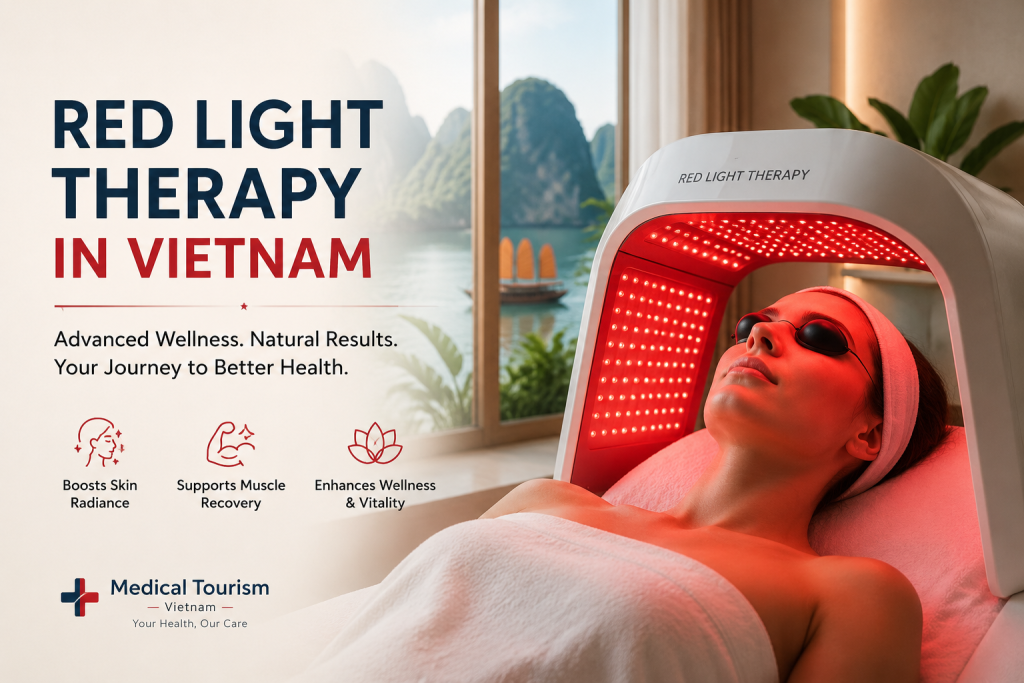
Red Light Therapy in Vietnam offers non-invasive LED light treatment to support skin rejuvenation, muscle recovery and overall wellness at modern clinics in Vietnam.
7. What to Expect During a Professional Session
For first-time patients, undergoing a professional medical-grade session of Red Light Therapy in Vietnam is straightforward, soothing, and entirely non-invasive:
-
Initial Clinical Assessment: A trained medical consultant evaluates your medical history, primary objectives (e.g., skin renewal, systemic anti-inflammation, athletic recovery), and determines the optimal light dose ($J/cm^2$), wavelength combination, and treatment duration.
-
Preparation & Clothing: Patients change into minimal attire or swimwear to ensure maximum skin exposure. Direct photon contact with the skin surface is critical for optimal light absorption.
-
Ocular Protection: Specialized opaque safety goggles are provided to shade the eyes from intense LED brightness. While red light within moderate intensity is generally safe for eyes, high-output medical arrays require protective eyewear.
-
The Treatment Process: The patient stands or lies comfortably in front of a high-output LED panel array or inside an enclosed full-body light canopy. The equipment emits a warm, soothing ambient glow. Sessions last between 15 to 20 minutes.
-
Post-Treatment Protocols: There is zero downtime, discomfort, or redness. Patients can immediately resume their daily schedule, head out for sightseeing, or proceed to secondary treatments like massage or hydrotherapy.
8. Frequently Asked Questions (FAQ)
Is Red Light Therapy clinically safe for all skin types?
Yes. Photobiomodulation produces zero ultraviolet (UV) radiation and causes no thermal tissue damage or photo-burning. It is cleared by regulatory agencies such as the U.S. Food and Drug Administration (FDA) and is safe across all Fitzpatrick skin types (I through VI).
How many photobiomodulation sessions should I schedule during my trip?
While a single 20-minute session provides an immediate boost in microcirculation, mood, and mental alertness, structural long-term benefits—such as increased collagen density or chronic joint pain relief—typically require 3 to 5 sessions per week over a 2- to 3-week stay.
Can I combine Red Light Therapy with traditional Vietnamese herbal medicine?
Absolutely. Many international clients combine morning photobiomodulation sessions with afternoon traditional treatments, such as Dao Red herbal baths, ginger-infused hot stone massage, or cupping therapy, to merge scientific technology with traditional natural healing.
Conclusion: Elevating Your Health with Red Light Therapy in Vietnam
Whether you are aiming to accelerate recovery from travel fatigue, reverse cellular skin damage, or optimize long-term physiological performance, Red Light Therapy in Vietnam represents a powerful, scientifically verified addition to your wellness itinerary. By combining clinical-grade photobiomodulation technology with affordable pricing and world-class hospitality, Vietnam continues to solidify its status as a top global destination for integrative medical retreats.
Experience Red Light Therapy in Vietnam
Connect with trusted providers and receive personalized support for your treatment in Vietnam.