
For millions of people worldwide suffering from chronic back and neck pain, Degenerative Disc Disease (DDD) is a debilitating condition that severely degrades quality of life. When conservative management strategies such as physical therapy, lifestyle modifications, and epidural steroid injections fail to provide relief, surgical intervention becomes the definitive pathway to reclaiming a pain-free life.
Historically, spinal fusion surgery was considered the gold standard. However, the advent of Artificial Disc Replacement (ADR)—also known as total disc arthroplasty—has revolutionized spine care by preserving the natural motion of the vertebral segments and reducing the incidence of adjacent segment disease (ASD).
Despite the outstanding success rate of motion-preserving spine surgeries, the cost of undergoing ADR in developed countries like the United States, Australia, Canada, or the United Kingdom remains prohibitively expensive. Total out-of-pocket expenses easily range from $30,000 to well over $80,000. This massive financial barrier has propelled the growth of global medical tourism. Among emerging healthcare hubs in Asia, Artificial Disc Replacement in Vietnam has captured significant attention from international patients. Vietnam offers a unique value proposition: state-of-the-art medical technology, JCI-accredited facilities, highly trained orthopedic surgeons, and a cost structure that is 70% to 80% lower than Western countries.
Quick Navigation
1. What is Artificial Disc Replacement (ADR)?
Artificial Disc Replacement (ADR) is a sophisticated surgical procedure designed to replace a painful, diseased, or herniated spinal disc with an advanced mechanical device. Unlike spinal fusion, which locks two or more vertebrae together and eliminates motion, an artificial disc is designed to mimic the natural movement, flexibility, and shock-absorbing capacity of a healthy human disc. The implant consists of medical-grade materials, typically a combination of biocompatible metals (such as cobalt-chromium or titanium alloy) and an ultra-high-molecular-weight polyethylene (UHMWPE) core.
Depending on the patient’s pathology, ADR is categorized into two primary anatomical procedures:
-
Cervical Disc Replacement (CDR): Aimed at treating discs in the neck region (C3 through C7). It is highly effective for patients suffering from cervical radiculopathy or myelopathy, where herniated discs compress nerve roots leading to chronic arm pain, numbness, and muscle weakness.
-
Lumbar Disc Replacement (LDR): Aimed at the lower back (typically L4-L5 or L5-S1), which bears the majority of the body’s mechanical load. This is a technically demanding procedure that requires specialized surgical approaches. You can read a detailed breakdown of this procedure here: Lumbar Disc Replacement in Vietnam.
Biomechanics Spotlight: Motion Preservation vs. Fusion Pressure
In a healthy spine, mechanical loads are distributed smoothly across all vertebral levels. When a segment is fused, the adjacent levels must compensate for the lost range of motion. Biomechanical formulas indicate that the dynamic load $P$ transferred to neighboring discs increases significantly after fusion, accelerating degeneration. ADR maintains natural kinematics, optimizing the load vector distribution and protecting the remaining healthy spine.
2. Why Choose Artificial Disc Replacement in Vietnam?
Over the past decade, Vietnam’s healthcare system has undergone a massive modernization effort, particularly in the field of Orthopaedic Surgery. Today, top-tier Vietnamese hospitals are fully capable of executing complex, motion-preserving spinal reconstructions that rival those performed in Western academic medical centers.
Unmatched Cost Savings of 70% to 80%
The primary driver for international patients seeking spine surgery in Vietnam is affordability. Due to lower domestic operating costs, highly favorable currency exchange rates, and subsidized healthcare infrastructure, complex spinal arthroplasty procedures are accessible at a fraction of Western prices. This allows self-paying or underinsured patients to receive world-class care without facing medical bankruptcy.
JCI-Accredited Infrastructure & Sterilization Standards
Leading medical hubs in Ho Chi Minh City and Hanoi feature ultra-modern private hospitals that hold Joint Commission International (JCI) accreditation—the gold standard for global healthcare quality. These facilities feature laminar flow positive-pressure operating suites, strict infection-control protocols, and advanced intensive care units (ICUs) designed to ensure patient safety and minimize the risk of surgical site infections (SSIs) to under 1%.
Cutting-Edge Intraoperative Technology and Robotics
Spine centers in Vietnam are equipped with state-of-the-art surgical navigation systems. Technologies such as the O-arm surgical imaging system, StealthStation navigation, and ROSA Spine robotic systems are actively used. These tools provide real-time, high-definition 3D imaging during surgery, allowing surgeons to place the mechanical disc with sub-millimeter precision, protecting vital neural pathways.
Internationally Trained Spine Surgeons
Vietnam’s elite spine specialists are active members of prestigious global organizations such as AO Spine and the North American Spine Society (NASS). Many have completed rigorous clinical fellowships in Germany, France, South Korea, and the United States, bringing back advanced surgical methodologies, particularly the highly complex anterior retroperitoneal approach used in lumbar disc surgeries.
3. Cost Comparison: Vietnam vs. The World
The economic advantage of choosing Vietnam for your spine care is clear. The following table highlights the estimated total cost (in USD) for a single-level disc replacement procedure, including implant hardware, surgeon fees, hospital stay, anesthesia, and immediate post-operative rehabilitation:
| Destination | Cervical Disc Replacement (CDR) | Lumbar Disc Replacement (LDR) | Average Wait Time |
| United States | $35,000 – $45,000 | $55,000 – $85,000 | 1 to 3 months (insurance pending) |
| United Kingdom | £18,000 – £25,000 | £25,000 – £35,000 | 6 to 12+ months (via public NHS) |
| Australia | $28,000 – $38,000 AUD | $45,000 – $60,000 AUD | Multiple months in public system |
| Thailand | $12,000 – $16,000 | $18,000 – $24,000 | 1 to 3 days |
| Vietnam | $8,000 – $11,000 | $12,000 – $16,000 | Immediate (Within 1 week) |
By electing to have your surgery in Vietnam, you can expect to save over $30,000 to $50,000, allowing you to invest in premium FDA-approved implants, extended physical therapy, or a comfortable post-operative recuperation stay in a luxury resort.
4. Comprehensive Medical Protocol for Foreign Patients
Traveling abroad for major spinal surgery requires a meticulously planned, multi-step medical journey to guarantee success and safety:
-
Pre-Travel Virtual Evaluation (Telehealth): Patients submit their medical history, physical assessment records, and high-resolution MRI or CT scans (completed within the last 6 months). Vietnamese spine experts review these records to confirm patient candidacy (ensuring there is no severe osteoporosis, facet joint arthrosis, or spinal instability that would contraindicate ADR).
-
On-Site Diagnostic Verification: Upon arrival in Vietnam, the patient undergoes a thorough medical clearance protocol. This includes a Dual-Energy X-ray Absorptiometry (DEXA) bone density scan, dynamic flexion/extension X-rays of the spine, comprehensive blood work, and cardiology clearance.
-
The Surgical Procedure: Performed under general anesthesia with continuous Intraoperative Neuromonitoring (IONM) to monitor spinal cord integrity. For CDR, an anterior cervical approach is utilized, entering through a minor, cosmetically discrete incision along a natural neck crease. For LDR, an anterior lumbar interbody approach is used, avoiding any disruption of the major back muscles and allowing rapid post-operative recovery.
-
In-Patient Recovery: The patient remains in a luxury private hospital room for 3 to 5 days. Experienced physical therapists initiate gentle mobilization on day 2 to encourage blood flow, prevent deep vein thrombosis (DVT), and help the patient adapt to their new implant safely.
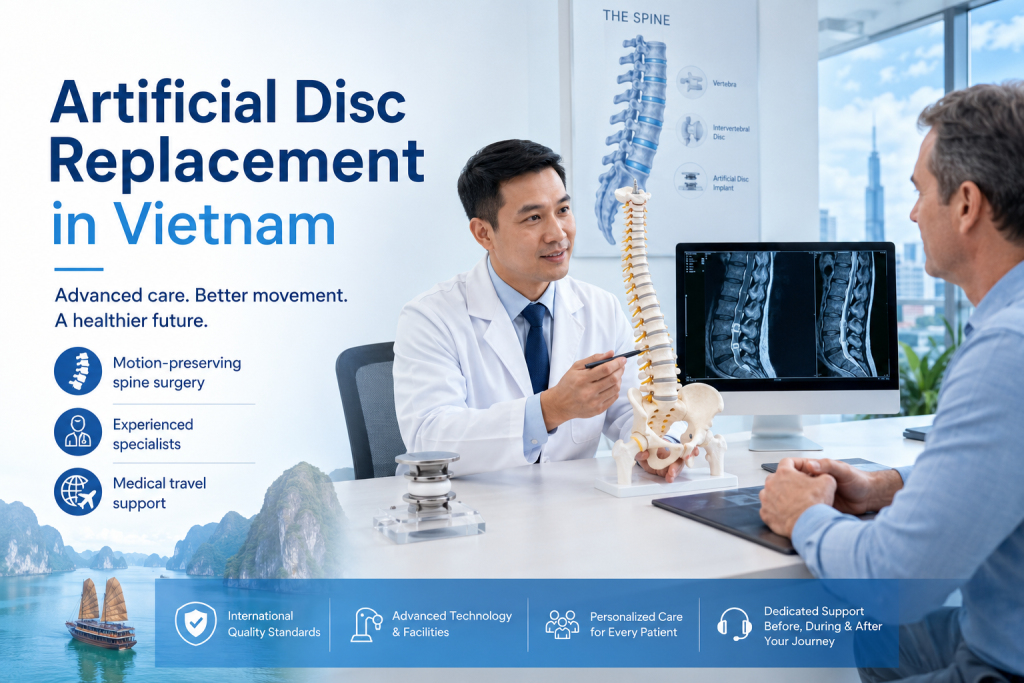
Artificial disc replacement in Vietnam offers international patients access to experienced spine specialists, advanced imaging, motion-preserving surgery, modern implants, and personalized medical travel support.
5. FDA-Approved Premium Implants Used in Vietnam
Vietnamese hospitals utilize only top-tier, clinically proven artificial disc implants imported directly from leading American and European medical device manufacturers. All implants carry clear regulatory clearance from the United States Food and Drug Administration (FDA.gov) and the European CE mark:
-
Mobi-C (Zimmer Biomet): A highly popular cervical implant featuring a mobile-core design that adjusts to the patient’s unique neck movement. It is FDA-approved for both one- and two-level cervical disc replacements.
-
ProDisc-C & ProDisc-L (Centinel Spine): Utilizing a classic, highly stable ball-and-socket design with over 20 years of robust clinical safety data, these implants are famous for their wear resistance and long-term mechanical reliability.
-
M6-C & M6-L (Orthofix): A next-generation artificial disc designed to closely replicate the natural anatomical structure of a healthy human disc. It features a compressible nuclear core and a woven fiber annulus that provides progressive resistance to motion, mimicking natural shock-absorption characteristics.
6. Rehabilitation, Recovery, and Wellness Tourism in Vietnam
Spinal arthroplasty success is heavily dependent on post-operative physical rehabilitation. After discharging from the hospital, patients are advised to remain in Vietnam for 10 to 14 days. This window is critical for surgical incision monitoring, suture removal, and structured physical therapy.
Vietnam is uniquely suited for medical recovery. The warm, tropical climate is ideal for joint and muscle recovery. Patients can choose to spend their rehabilitation period in high-end wellness resorts in coastal cities like Da Nang, Nha Trang, or Phu Quoc. Specialized physical therapists will guide you through progressive core-stabilization exercises, helping your body adapt to the restored spinal alignment without placing excessive strain on the healing surgical site.
Crucial Medical Safety Note: To ensure patient safety regarding cabin pressure and deep vein thrombosis risks on long-haul flights, your lead surgeon must perform a final physical evaluation and issue an official “Fit to Fly” certificate. This is typically scheduled 14 days after your procedure.
7. Frequently Asked Questions (FAQs)
How long does an artificial disc implant last?
Modern third-generation artificial discs are designed for extreme longevity. Laboratory wear-testing and long-term clinical registries indicate that devices like Mobi-C or ProDisc can easily last 40 to 50 years under normal physiological loads, meaning the vast majority of patients will never require a revision surgery in their lifetime.
What is the success rate of ADR in Vietnam?
Top-tier Vietnamese orthopedic departments report a clinical success rate of over 95% for single-level ADR procedures, as measured by patient-reported outcome measures (PROMs) such as the Oswestry Disability Index (ODI) and Visual Analog Scale (VAS) for pain. Complication rates, including implant migration or infection, are maintained at under 1%, matching the standards of elite European clinics.
Is it easy for foreigners to obtain a visa for medical treatment in Vietnam?
Yes, Vietnam offers an incredibly streamlined Electronic Visa (E-visa) system for citizens of over 80 countries, allowing stays of up to 90 days. For medical travelers, professional facilitators like Medical Tourism Vietnam will provide official medical invitation letters from our partner hospitals to guarantee a swift and smooth visa approval process.
Conclusion
Living with chronic neck or lower back pain is no longer a life sentence, and escaping it should not mean financial ruin. Choosing to undergo Artificial Disc Replacement in Vietnam provides access to highly skilled spine surgeons, state-of-the-art robotic navigation systems, and internationally accredited hospitals at a fraction of the cost of Western healthcare. By combining premium FDA-approved medical hardware with Vietnam’s world-famous hospitality and beautiful recovery resorts, you can safely restore your mobility and return to an active, pain-free life. Contact a trusted medical facilitator today to schedule your virtual consultation with Vietnam’s leading spine specialists.
Considering Artificial Disc Replacement in Vietnam?
Get expert guidance on spine specialists, artificial disc replacement options, estimated costs, hospital selection, and medical travel planning in Vietnam.