
For active adults over the age of 40, losing the ability to read fine print, view digital screens comfortably, or see clearly at a distance can feel frustrating. While reading glasses and bifocals offer a temporary fix, modern ophthalmic surgery provides a permanent solution: Refractive Lens Exchange (RLE).
Also known as Clear Lens Exchange (CLE) or Lens Replacement Surgery, RLE replaces the eye’s aging natural lens with a technologically advanced intraocular lens (IOL). This restores sharp vision across all distances—near, intermediate, and far—while permanently eliminating the possibility of ever developing cataracts.
For medical tourists from Australia, the United States, Europe, and the UK, getting RLE with premium trifocal lenses at home often involves prohibitive out-of-pocket pricing ranging from $4,500 to $9,000 USD per eye (totaling up to $18,000 USD for both eyes).
Vietnam has rapidly emerged as a leading international hub for advanced refractive and lens replacement surgery. By pairing Western-trained ophthalmic surgeons, Ministry of Health-accredited private hospitals, and state-of-the-art diagnostic platforms, Refractive Lens Exchange in Vietnam delivers world-class visual restoration for just $1,200 to $3,500 USD per eye—saving overseas patients up to 60% to 70% without compromising surgical safety or visual outcome.
Whether you are looking to treat severe presbyopia, high hyperopia, or high myopia, this ultimate guide covers everything you need to know about getting Refractive Lens Exchange in Vietnam: costs, lens options, surgical techniques, top eye hospitals, and travel logistics.
Quick Navigation
What Is Refractive Lens Exchange (RLE)?
Refractive Lens Exchange is an advanced surgical procedure designed to correct high refractive errors and age-related loss of near focusing power (presbyopia).
Technically, RLE is identical to modern cataract surgery. The key distinction is that while cataract surgery replaces a lens that has already turned cloudy and opaque, RLE replaces a clear or early-aging natural lens before dense cataracts form.
During the procedure, an ophthalmic surgeon gently removes your natural crystalline lens using ultrasonic energy (phacoemulsification) or femtosecond laser precision. In its place, a permanent, biocompatible artificial intraocular lens (IOL) is inserted through a micro-incision measuring less than 2.5 millimeters.
According to clinical research published by the American Academy of Ophthalmology, RLE is an ideal alternative for patients who are not suitable candidates for corneal laser vision correction (such as LASIK or SMILE) due to thin corneas, high hyperopia, or early lens hardening.
Why Choose RLE Surgery? Key Benefits for Active Adults
RLE has become one of the fastest-growing elective eye procedures globally due to its unique structural and optical advantages:
-
Complete Independence from Glasses: By selecting premium trifocal or extended depth of focus (EDOF) intraocular lenses, over 90% to 95% of patients achieve full visual freedom from reading glasses, computer glasses, and distance specs.
-
Permanent Correction: Unlike corneal laser procedures (LASIK/PRK), which alter the shape of the outer window of the eye while the internal lens continues to age, RLE replaces the internal lens entirely. The visual correction is permanent and will not regress.
-
Cataract Prevention: Because your natural crystalline lens is removed, you will never develop cataracts in your lifetime.
-
Broad Treatment Scope: RLE can simultaneously treat presbyopia, hyperopia (farsightedness), myopia (nearsightedness), and astigmatism in a single 15-minute procedure.
To understand how RLE compares with other non-lens or laser-based corrections, explore our comprehensive guide to Presbyopia Treatment in Vietnam.
Intraocular Lens (IOL) Options: Choosing the Right Lens in Vietnam
The success of Refractive Lens Exchange relies heavily on selecting the correct intraocular lens for your eye anatomy, visual habits, and career demands. Accredited eye hospitals in Vietnam source authentic, FDA-cleared, and CE-marked IOLs directly from leading global manufacturers such as Carl Zeiss (Germany), Alcon (USA), and Johnson & Johnson (USA).
1. Trifocal Intraocular Lenses (The Gold Standard)
-
Popular Models: Zeiss AT LISA tri, Alcon PanOptix, FineVision.
-
How They Work: Trifocal IOLs split incoming light into three distinct, precise focal points: Distance (driving, watching TV), Intermediate (working on desktop computers, reading car dashboards), and Near (reading smartphone text, menus, books).
-
Best For: Patients who want complete independence from reading glasses across all daily distances.
2. Extended Depth of Focus (EDOF) Lenses
-
Popular Models: Alcon Clareon Vivity, Johnson & Johnson Tecnis Symfony.
-
How They Work: Instead of splitting light into separate points, EDOF lenses stretch light to create a continuous, smooth range of focus from distance through intermediate ranges.
-
Best For: Patients who drive frequently at night or prioritize computer/intermediate tasks, as EDOF lenses produce significantly fewer night-vision halos or glare compared to traditional multifocal designs.
3. Toric IOLs (Astigmatism Correction)
-
Both Trifocal and EDOF lenses are available in Toric versions. Toric IOLs are custom-engineered to align with your specific corneal astigmatism axis, correcting irregular corneal curvature during the lens exchange.
During your pre-operative consultation, your surgeon will analyze your corneal topography and optical biometry to recommend the precise IOL power and design. You can browse our complete suite of sub-specialized eye care services on our Ophthalmology Procedures in Vietnam service directory.
Cost Comparison: Refractive Lens Exchange in Vietnam vs. Global Pricing
Cost efficiency remains a primary driver for overseas patients choosing Vietnam for complex ophthalmic procedures. Operating costs, facility overhead, and clinical staffing in Vietnam are significantly lower than in Western nations, allowing accredited eye centers to offer premium European and American lens technology at a fraction of Western prices.
The table below illustrates average costs for Refractive Lens Exchange (per eye, including premium Trifocal IOL) across major global medical hubs:
| Country / Region | Average Cost Per Eye (USD) | Cost for Both Eyes (USD) | Relative Financial Savings |
| United States | $4,500 – $9,000 | $9,000 – $18,000 | Base Price |
| Australia | $4,200 – $8,500 | $8,400 – $17,000 | Base Price |
| United Kingdom | $4,800 – $8,800 | $9,600 – $17,600 | Base Price |
| Singapore | $3,500 – $6,000 | $7,000 – $12,000 | 25% – 35% |
| South Korea | $2,800 – $5,000 | $5,600 – $10,000 | 40% – 45% |
| Thailand | $2,500 – $4,500 | $5,000 – $9,000 | 50% – 55% |
| VIETNAM | $1,200 – $3,500 | $2,400 – $7,000 | 60% – 70% SAVINGS |
What Is Included in Your Vietnam RLE All-Inclusive Package?
When scheduling RLE surgery in Vietnam through accredited medical travel partners, your quoted price typically covers an all-inclusive, transparent package:
-
Pre-Surgical Ophthalmic Testing: High-definition corneal topography (Pentacam HR), optical biometry (Zeiss IOLMaster 700), optical coherence tomography (OCT) of the retina and optic nerve, and specular microscopy.
-
Surgeon & Facility Fees: Senior board-certified refractive surgeon, specialized nursing team, and sterile cleanroom operating suite.
-
Authenticated Lens Implants: Premium Zeiss, Alcon, or Johnson & Johnson Trifocal/EDOF IOLs with official manufacturer serialization.
-
Post-Op Medications & Care Kits: Antibiotic eye drops, steroid drops, artificial tears, protective sleeping eye shields, and sunglasses.
-
Follow-Up Visits: All post-operative clinical evaluations during your stay in Vietnam.
-
Medical Translation: Personal English-speaking medical coordinator to assist you at every appointment.
Step-by-Step Surgical Journey for Medical Tourists
Undergoing Refractive Lens Exchange in Vietnam is a smooth, highly structured outpatient process designed specifically for international visitors:
Phase 1: Pre-Travel Virtual Case Review
Before booking flights, you submit recent optical prescriptions, eye test records, and medical history. Ophthalmic specialists review your data, confirm your initial candidacy for RLE, discuss lens preferences, and provide a transparent cost estimate.
Phase 2: Comprehensive In-Person Screening (Day 1)
Upon arriving in Hanoi or Ho Chi Minh City, you undergo a 2-to-3-hour diagnostic screening at the eye hospital:
-
Optical Biometry (Zeiss IOLMaster 700): Measures axial length, anterior chamber depth, and corneal curvature down to fractions of a millimeter to ensure exact IOL power calculations.
-
Retinal OCT Scan: Evaluates the macula to ensure there are no underlying retinal diseases (such as macular degeneration) that could limit multifocal lens performance.
-
Corneal Wavefront Mapping: Assesses higher-order aberrations to choose between Trifocal or EDOF lens designs.
Phase 3: Outpatient RLE Surgery (Day 2 or Day 3)
-
Duration: 15 to 20 minutes per eye.
-
Anesthesia: Local numbing eye drops (no painful needles or general anesthesia).
-
Technique: The surgeon makes a micro-incision (2.2 mm), gently breaks up and removes the aging lens using ultrasonic phacoemulsification or femtosecond laser pulses, and inserts the folded artificial IOL. The lens unfolds naturally into position inside the capsular bag. No stitches are required as the incision self-seals.
-
Timing: Surgeons typically operate on both eyes on the same day or separate them by 24 to 48 hours based on clinical preference.
Phase 4: Recovery & Sightseeing (Days 4 to 7)
-
Day 1 Post-Op: In-clinic checkup to evaluate lens positioning, eye pressure, and early visual acuity. Most patients report dramatically clearer vision within 24 hours.
-
Days 3 to 5: Final post-operative clearance exam before flying home. Overseas visitors can comfortably explore Vietnam’s vibrant urban landmarks wearing light UV-protective sunglasses.
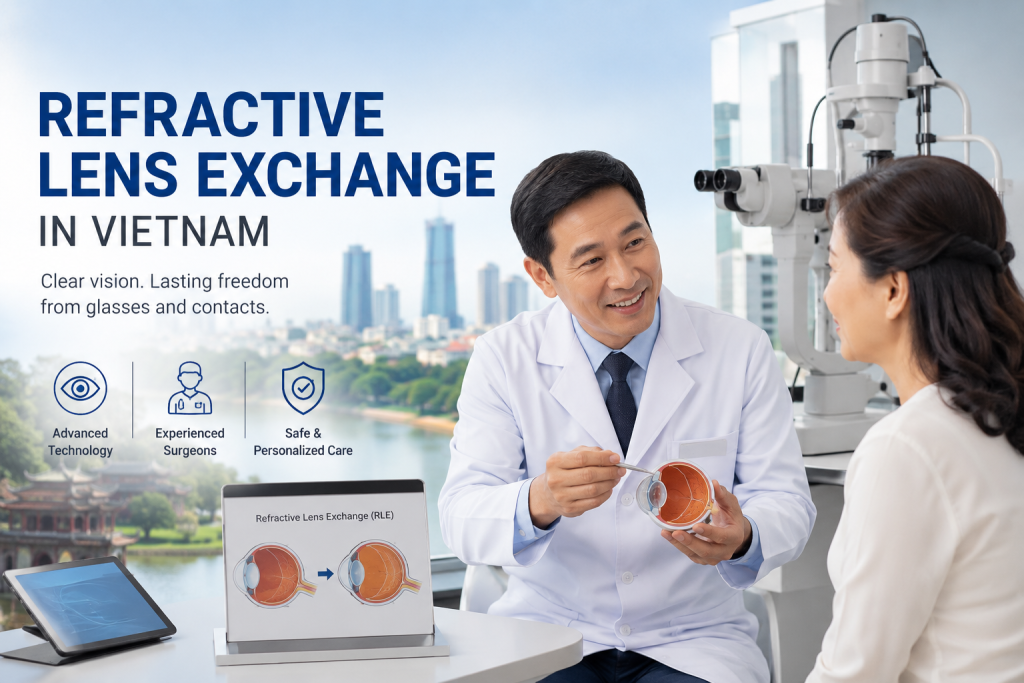
Refractive lens exchange in Vietnam provides a lens-based vision correction option for suitable patients seeking clearer vision and reduced dependence on glasses or contact lenses.
Evaluating Top Eye Hospitals & Surgical Standards in Vietnam
Achieving exceptional multi-distance visual outcomes requires rigorous pre-operative planning and advanced surgical technology. Clinical research published by the European Society of Cataract and Refractive Surgeons (ESCRS) emphasizes that precise optical biometry and strict sterile protocols are paramount to eliminating post-operative refractive errors and infection risks.
When evaluating eye hospitals in Vietnam, ensure the clinic adheres to these core international benchmarks:
-
Hospital Accreditation & Licensing: Top private eye centers operate under direct licensing from the Vietnamese Ministry of Health, with key facilities holding international quality accreditations such as Joint Commission International (JCI) or ISO medical certifications.
-
Cutting-Edge Surgical & Diagnostic Suites: Leading centers feature the exact same surgical technologies utilized in top Western clinics, including Femtosecond lasers (Alcon LenSx, Zeiss VisuMax, Johnson & Johnson Catalys) and advanced diagnostics (Zeiss Pentacam HR, IOLMaster 700).
-
Highly Specialized Refractive Surgeons: Leading Vietnamese refractive specialists perform thousands of lens replacement and cataract procedures each year. Many hold clinical fellowships or active memberships in prestigious global organizations, including the American Academy of Ophthalmology (AAO) and the International Society of Refractive Surgery (ISRS).
Post-Operative Care, Safety Guidelines & Risk Mitigation
Refractive Lens Exchange is a safe outpatient procedure when performed by an experienced specialist. Following proper aftercare protocols ensures rapid visual neuroadaptation and protects against infection.
Essential Aftercare Protocols
-
Medicated Eye Drops: Apply prescribed antibiotic and anti-inflammatory eye drops strictly according to your surgeon’s schedule for 3 to 4 weeks.
-
Sleeping Protection: Wear protective plastic eye shields while sleeping during the first week to prevent accidental eye rubbing.
-
Water & Hygiene Precautions: Avoid getting tap water, soap, or shampoo directly in your eyes for 10 to 14 days; avoid swimming pools, saunas, and hot tubs for 4 weeks.
-
UV Protection: Wear polarized, UV-blocking sunglasses outdoors to protect healing ocular tissue from bright sunlight and environmental dust. Post-operative guidelines from Mayo Clinic emphasize protecting eyes from direct trauma and debris during early recovery.
Potential Risks & How They Are Managed
-
Night-Vision Dysphotopsia (Halos/Glare): Common during the initial 3 to 6 months as your brain adapts (neuroadaptation) to light distribution from trifocal optics. Modern EDOF and Trifocal lenses minimize these effects over time.
-
Posterior Capsule Opacification (PCO): A natural clouding of the membrane holding the new lens that can occur months or years post-surgery in 10% to 15% of patients. PCO is easily permanently corrected in 5 minutes using a quick, painless YAG laser in-clinic procedure.
-
Dry Eye Symptoms: Temporary post-operative dry eye is managed effectively with preservative-free artificial lubricating drops.
Frequently Asked Questions (FAQs)
1. Is Refractive Lens Exchange permanent?
Yes. RLE provides permanent visual correction. The artificial intraocular lens does not age, degrade, or lose focusing power over time. Furthermore, because your natural lens is removed, you will never develop cataracts in the future.
2. How many days should I stay in Vietnam for RLE surgery?
We recommend planning a total stay of 5 to 7 days. This provides sufficient time for your initial diagnostic screening, outpatient surgery, Day 1 post-op checkup, and a final safety evaluation before your flight home.
3. Will I be completely free from glasses after RLE?
Over 90% to 95% of patients who choose premium Trifocal IOLs achieve total independence from reading glasses, computer specs, and distance glasses. In rare instances, reading extremely fine print in dim light may benefit from mild, low-power reading aids.
4. Is RLE surgery painful?
No. The procedure is performed using topical numbing eye drops. You remain awake and comfortable throughout the 15-minute surgery, feeling only mild pressure. Post-operative discomfort is minimal and easily managed with prescribed eye drops.
Plan Your Refractive Lens Exchange in Vietnam
Eliminating reading glasses and restoring sharp, multi-distance vision does not require exorbitant Western healthcare costs. Choosing Refractive Lens Exchange in Vietnam grants you access to senior board-certified refractive surgeons, world-class diagnostic technology, authenticated European and American trifocal lenses, transparent pricing, and warm hospitality.
Explore our full directory of Ophthalmology Procedures in Vietnam or learn more about alternative vision options in our detailed guide to Presbyopia Treatment in Vietnam.
Contact our medical tourism specialists today to schedule your virtual evaluation and receive a personalized vision restoration plan for your Refractive Lens Exchange in Vietnam!
Considering Refractive Lens Exchange in Vietnam?
Get personalized guidance on RLE options, experienced eye surgeons, and trusted hospitals in Vietnam.