
Full mouth dental implants can provide a fixed tooth-replacement option for patients who have lost most or all of their teeth, have multiple failing teeth, or require extensive dental reconstruction.
For international patients, full mouth dental implants in Vietnam may be considered because treatment is available across a range of implant systems, restorative materials and full-arch techniques, including All-on-4 and All-on-6.
However, “full mouth dental implants” does not refer to one standard procedure. Some patients require treatment in only one arch, while others need reconstruction of both the upper and lower jaws. The number of implants, need for extractions or bone grafting, choice of prosthetic material and treatment timeline can therefore vary considerably.
This guide explains the main full-mouth implant options available in Vietnam, how treatment is planned, what affects the cost, how long treatment may take and what international patients should consider before travelling.
For a broader introduction to implant treatment, see our guide to dental implants in Vietnam.
Quick Navigation
What Are Full Mouth Dental Implants?
Full mouth dental implants are used to replace most or all missing or non-restorable teeth using dental implants placed in the jawbone to support fixed or removable prosthetic teeth. According to the American Dental Association’s MouthHealthy resource, dental implants are placed in the jawbone and can support crowns, bridges or dentures.
Unlike traditional removable dentures, implant-supported restorations obtain support from implants anchored in the jaw.
Depending on the patient’s dental condition, treatment may involve:
- one complete upper arch;
- one complete lower arch;
- both upper and lower arches;
- several implants supporting a fixed bridge;
- an All-on-4 restoration;
- an All-on-6 restoration;
- or a combination of implants and conventional restorative dentistry.
The phrase full mouth dental implants is therefore often used broadly.
A patient may search for “full mouth implants” even when only one arch requires implant-supported reconstruction.
For patients with extensive tooth loss, full mouth dental implants in Vietnam may provide several treatment options depending on the condition of each jaw and the amount of available bone.
Full Mouth vs Full Arch Dental Implants
These two terms are often used interchangeably, but they do not always mean exactly the same thing.
Full arch dental implants
A full arch restoration replaces most or all teeth in one jaw.
For example:
- full upper arch;
- full lower arch.
Full mouth dental implants
Full mouth rehabilitation usually refers to extensive reconstruction involving both jaws, although the term is also commonly used by patients searching for complete tooth replacement.
This distinction matters when comparing treatment plans and prices.
A quotation for one full arch should not automatically be interpreted as the cost of replacing teeth in both jaws.
Who May Be Considered for Full Mouth Dental Implants?
Full mouth implant treatment may be discussed when a patient has:
- multiple missing teeth;
- extensive tooth decay;
- several teeth with a poor prognosis;
- advanced periodontal damage;
- failing crowns or bridges;
- difficulty using removable dentures;
- extensive previous dental work that can no longer be maintained;
- or significant functional and aesthetic concerns involving many teeth.
However, extraction of all remaining teeth is not automatically the best option.
If some natural teeth have a reasonable long-term prognosis, the dentist may recommend preserving them rather than removing them solely to simplify implant treatment.
This is why proper examination and imaging are important before deciding on full-mouth reconstruction.
Full Mouth Dental Implant Options in Vietnam
Patients considering full mouth dental implants in Vietnam may be offered different full-arch approaches rather than a single standard procedure.
There are several ways to restore an entire dental arch.
The appropriate option depends on available bone, bite, remaining teeth, medical history, implant positioning and the type of final prosthesis required.
1. All-on-4 Dental Implants
All-on-4 uses four strategically positioned implants to support a complete fixed dental arch.
The technique may be considered in selected patients who require replacement of most or all teeth in one jaw.
One attraction of the concept is that a full arch can be supported by fewer implants than some conventional full-arch approaches.
However, not every patient is suitable for four implants, and treatment planning should be based on individual anatomy and prosthetic requirements.
Read more about All-on-4 dental implants in Vietnam.
2. All-on-6 Dental Implants
All-on-6 generally uses six implants to support a fixed full-arch restoration.
Using additional implants may provide a different distribution of support, although the appropriate number of implants depends on the individual case rather than a simple “more is better” principle.
Bone availability, implant position, occlusion and prosthetic design must all be considered.
See our dedicated guide to All-on-6 dental implants in Vietnam.
3. Implant-Supported Full Arch Bridge
Some patients receive a full-arch bridge supported by a number of implants selected according to their anatomy and treatment plan.
This does not necessarily follow a branded All-on-4 or All-on-6 protocol.
For example, the dentist may recommend a different number or distribution of implants based on:
- bone volume;
- implant stability;
- jaw anatomy;
- position of remaining teeth;
- bite forces;
- restorative space;
- and prosthetic design.
This is one reason international patients should avoid choosing a treatment solely from an advertised package name.
4. Multiple Individual Implants and Bridges
Full-mouth reconstruction can also involve several implants combined with smaller implant-supported bridges.
This approach may be suitable in some cases where treatment is divided into different sections of the mouth rather than using one continuous full-arch prosthesis.
For patients replacing only one missing tooth, our guide to single tooth implants in Vietnam explains how the treatment differs from full-arch rehabilitation.
Full Mouth Dental Implants in Vietnam: Before and After
Clinical photographs can help patients understand the stages involved in extensive implant rehabilitation.
The images below illustrate a full-arch dental restoration involving the upper jaw.
They should not be interpreted as proof that every full-mouth implant case follows the same treatment plan or produces the same result.
Before Treatment
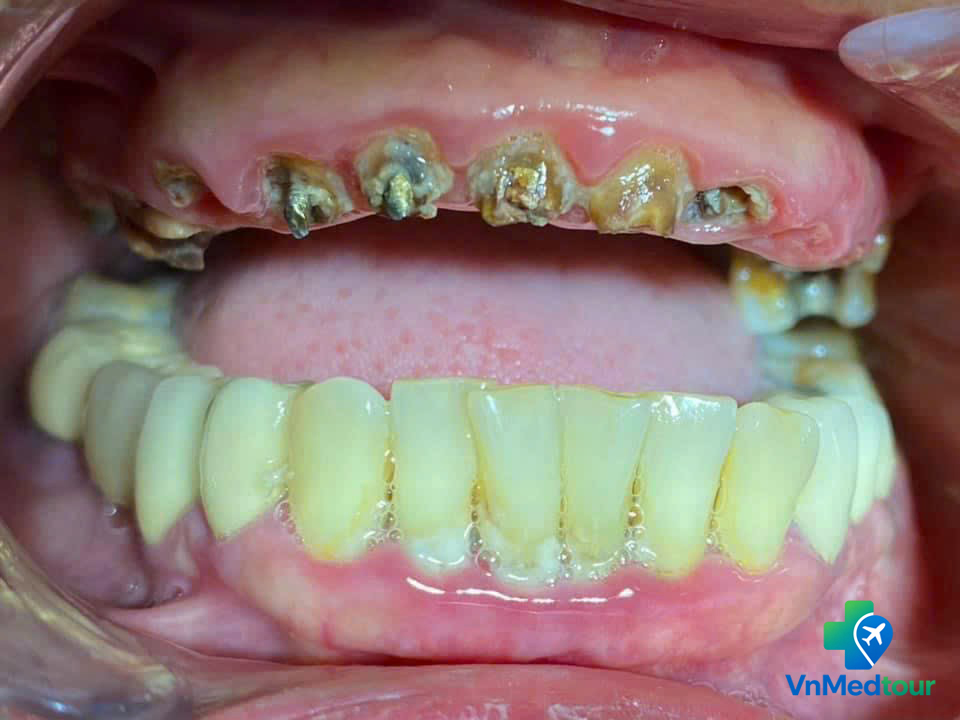
Dental condition before extensive implant-supported restoration in Vietnam.
The initial clinical appearance may include damaged teeth, old restorations, missing teeth or teeth that require further evaluation before a definitive treatment plan is made.
The dentist must determine which teeth can reasonably be preserved and which have a poor prognosis.
Previous Dental Restoration
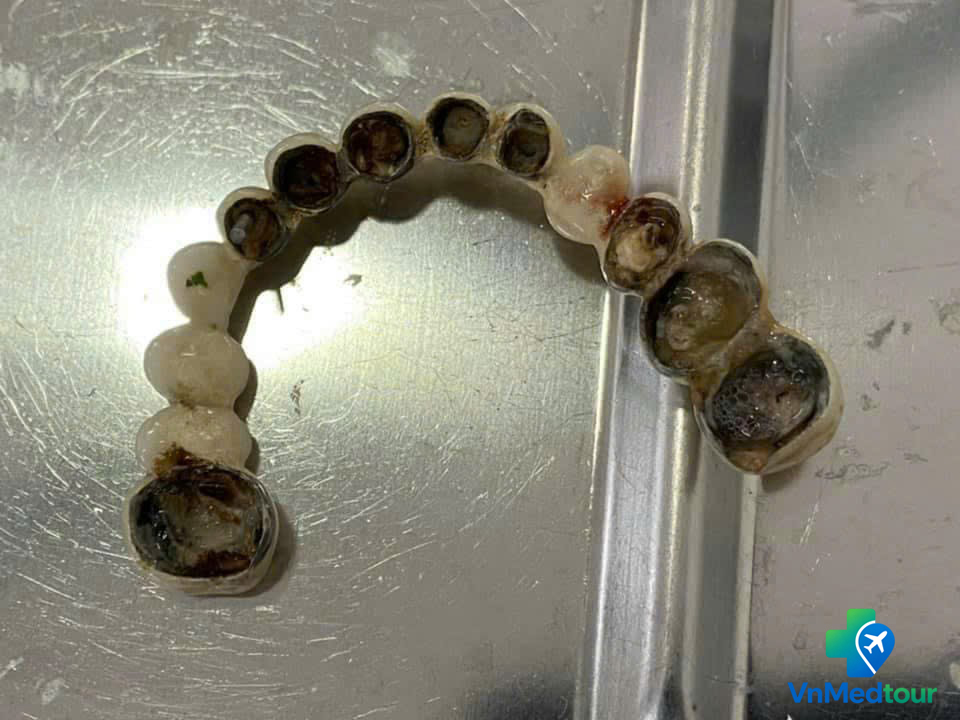
Previous dental restoration removed during full-arch rehabilitation.
Older crowns or bridges sometimes need to be removed before the underlying teeth and supporting structures can be fully assessed.
This step can reveal conditions that are not always visible from photographs alone.
Implant Restorative Stage
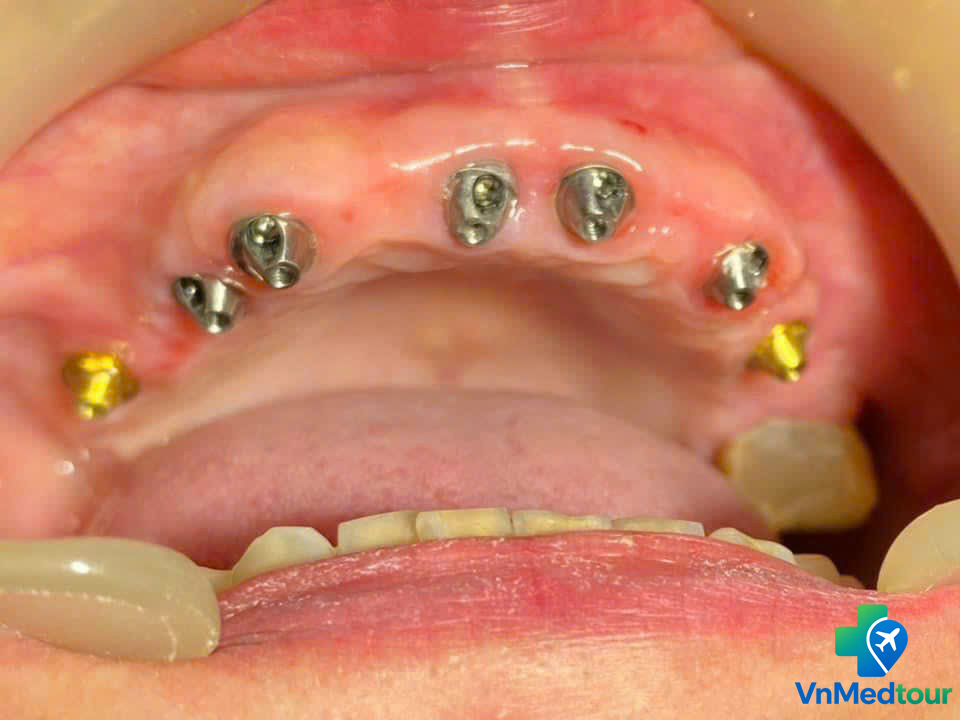
Implant-supported restorative stage during full-arch dental treatment.
After implant placement and appropriate healing, implant components are used to connect the implants with the prosthetic restoration.
The exact sequence varies according to implant stability and the treatment protocol used.
Dental Implant X-Ray
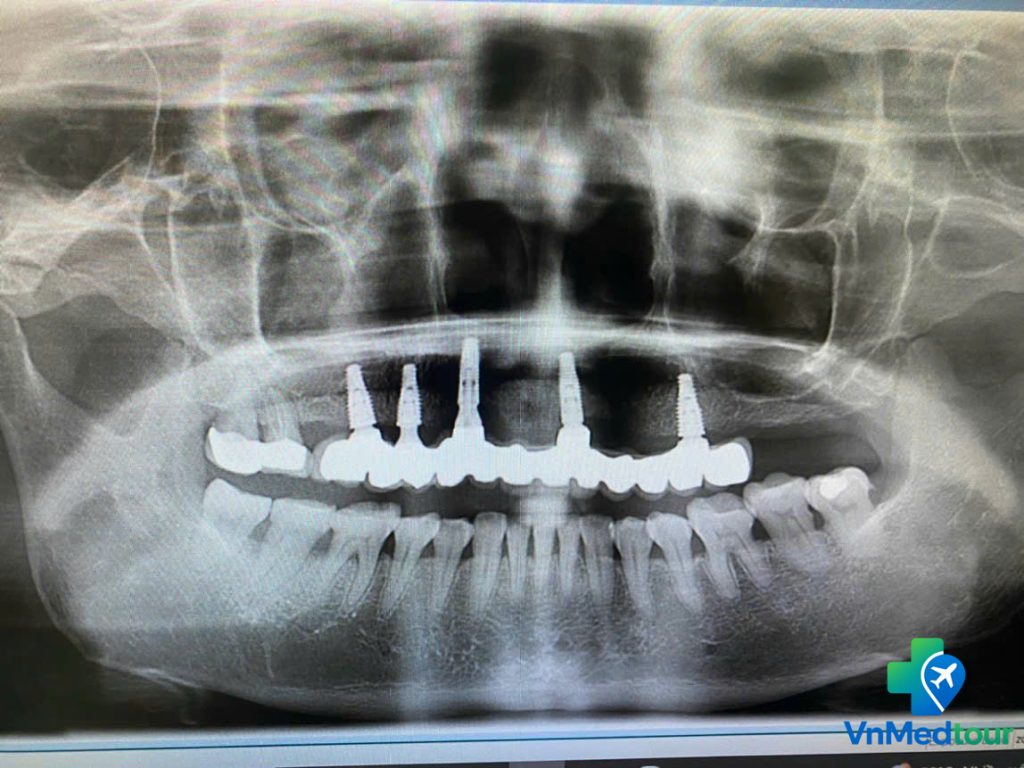
Panoramic dental X-ray showing implant-supported rehabilitation.
Dental imaging plays an important role in implant assessment and treatment planning.
Patients considering extensive implant treatment may be asked to provide an existing panoramic X-ray or CBCT scan before travelling.
However, further imaging may still be required during the in-person assessment.
Final Full-Arch Restoration
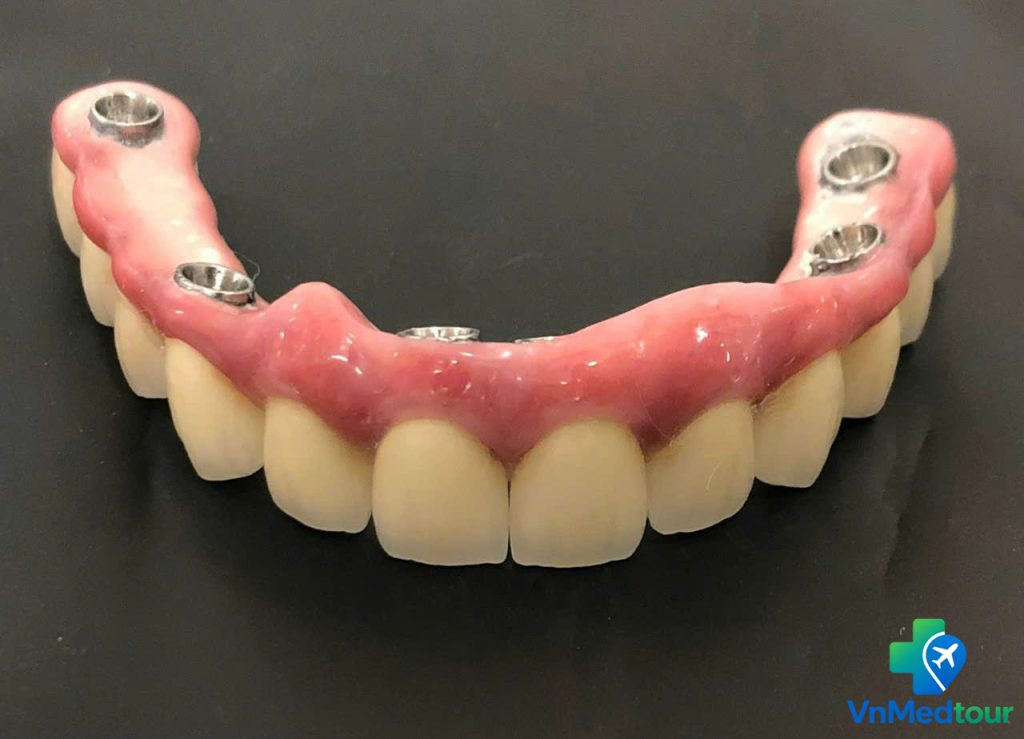
Full-arch implant-supported dental restoration.
A full-arch prosthesis is designed to restore multiple teeth as one integrated restoration.
The final design may vary in material, shape, shade and method of attachment.
After Treatment
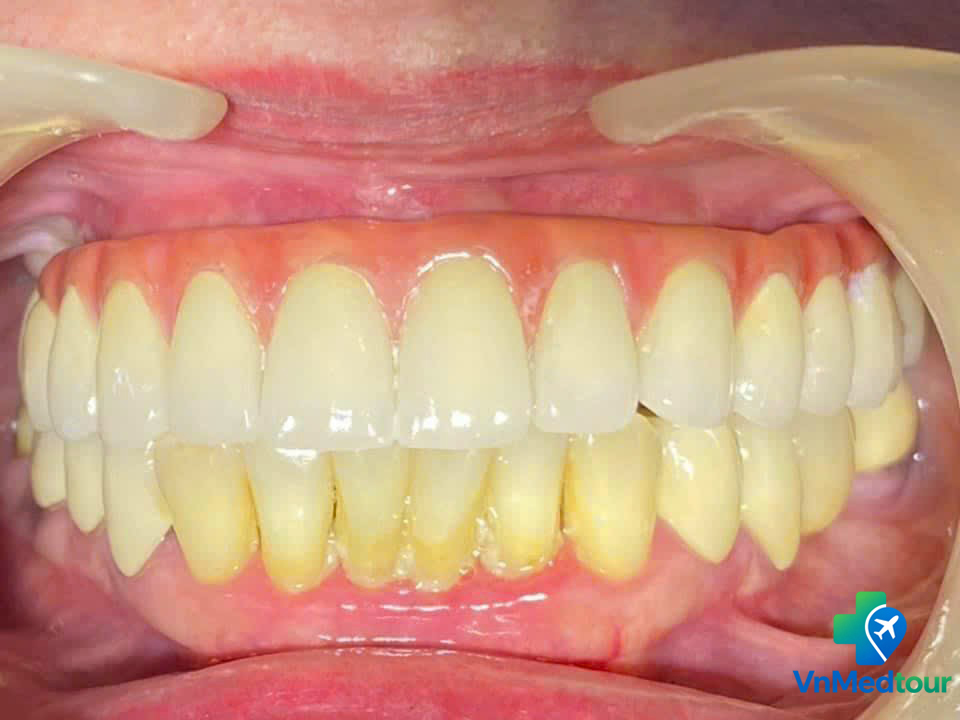
Result after full-arch implant-supported restoration in Vietnam. Individual outcomes vary.
Before-and-after photographs can demonstrate changes in appearance, but they should not be used to predict another patient’s outcome.
Bone condition, gum health, bite, implant positioning and healing all influence the final result.
How Is Full Mouth Implant Treatment Planned?
Treatment normally begins with a comprehensive assessment.
Step 1: Initial Case Review
International patients may initially send:
- clear photographs of their teeth;
- panoramic dental X-ray;
- CBCT scan, if available;
- information about missing teeth;
- previous dental treatment;
- medical history;
- current medication;
- smoking history;
- and preferred travel dates.
This information may allow a dental provider to offer preliminary guidance.
However, remote review does not replace an in-person examination.
Step 2: Clinical Examination in Vietnam
After arrival, the dentist may assess:
- teeth and gums;
- periodontal health;
- existing restorations;
- bite;
- available restorative space;
- jaw relationship;
- and oral hygiene.
The dentist can then compare these findings with diagnostic imaging.
Step 3: CBCT or Dental Imaging
Three-dimensional imaging may be used to evaluate:
- bone height;
- bone width;
- anatomical structures;
- implant positioning;
- and areas where bone augmentation may be considered.
Patients with insufficient bone may require additional treatment.
You can read more about bone grafting for dental implants in Vietnam.
Step 4: Extractions if Required
Teeth with a poor prognosis may be removed before or during implant placement.
Not every remaining tooth necessarily needs extraction.
The treatment plan should identify:
- which teeth are being retained;
- which are being removed;
- and why.
This is particularly important for patients considering removal of a large number of natural teeth.
Step 5: Implant Placement
The planned implants are surgically positioned in the jaw.
The number of implants required differs between patients.
A full-arch restoration may be supported by four, six or another number of implants depending on the treatment strategy.
Step 6: Temporary Teeth
Some patients may receive a temporary fixed restoration shortly after implant placement if the clinical conditions allow it.
Others may require a different temporary solution while the implants heal.
Patients should therefore ask explicitly:
- Will I receive fixed temporary teeth?
- When will they be fitted?
- What material are they made from?
- Can I eat normally with them?
- Are temporary teeth included in the quotation?
Step 7: Healing
Dental implants usually require a healing period before the definitive restoration is completed. Guy’s and St Thomas’ NHS Foundation Trust explains that implant treatment often involves several stages, including implant placement, healing and later restorative treatment.
During this period, patients must follow the dentist’s instructions regarding:
- diet;
- cleaning;
- smoking;
- oral hygiene;
- medication;
- and follow-up care.
For international patients, this healing period often determines whether a second trip to Vietnam will be required.
Step 8: Final Prosthesis
Once the implants and surrounding tissues are ready for final restoration, the dentist may take:
- digital scans;
- conventional impressions;
- bite records;
- photographs;
- and other measurements.
A trial stage may be used before the final teeth are manufactured.
The final restoration is then fitted and adjusted.
How Many Implants Are Needed for a Full Mouth?
There is no single number that applies to every patient.
One arch may sometimes be restored using:
- four implants;
- six implants;
- or another implant configuration.
Patients requiring treatment in both jaws may therefore receive different numbers of implants in the upper and lower arches.
The recommended number depends on factors such as:
- available bone;
- implant position;
- bone quality;
- opposing teeth;
- bite forces;
- prosthetic design;
- and the treating dentist’s clinical approach.
Patients should ask their dentist why a specific implant configuration has been recommended.
Full Mouth Dental Implants Cost in Vietnam
The cost of full mouth dental implants in Vietnam varies considerably because treatment may involve one or both arches and different numbers of implants.
The total cost of full-mouth implant treatment varies widely because the phrase can describe very different procedures.
A quotation should ideally specify each major treatment component.
| Cost factor | Why it matters |
|---|---|
| Number of arches treated | One arch costs less than treating both jaws |
| Number of implants | Four, six or more implants may be used |
| Implant system | Implant brands and components vary in price |
| Tooth extractions | Multiple or complex extractions may add cost |
| Bone grafting | Additional bone procedures increase treatment complexity |
| Sinus procedures | Some upper-jaw cases may require additional surgery |
| Temporary teeth | Temporary fixed prostheses may be separately priced |
| Final material | Zirconia, hybrid and other prosthetic materials differ in cost |
| Sedation or anaesthesia | Requirements differ by patient and clinic |
| Additional dental work | Gum treatment or other procedures may be required |
Patients comparing quotations should therefore ask for an itemised treatment plan, rather than comparing only a headline price.
A low advertised price may not necessarily include:
- diagnostic imaging;
- extractions;
- temporary teeth;
- bone grafting;
- final prosthesis;
- sedation;
- follow-up care;
- or replacement components.
For general implant pricing and treatment information, see our main guide to dental implants in Vietnam.
How Long Does Full Mouth Implant Treatment Take?
The timeline for full mouth dental implants in Vietnam depends on whether extractions, bone grafting, temporary teeth and a healing period are required.
Full-mouth implant treatment often involves several stages.
A typical international treatment journey may include:
First trip
- consultation;
- dental imaging;
- extractions if required;
- implant placement;
- temporary restoration;
- postoperative review.
Healing period
The patient may return home while the implants heal.
Second trip
- assessment of healing;
- impressions or digital scanning;
- bite registration;
- trial fitting;
- manufacture of final teeth;
- final fitting.
The exact schedule depends on the individual case.
Patients should not book non-refundable travel solely on the basis of a generic implant timeline.
Can Full Mouth Dental Implants Be Completed in One Trip?
Sometimes parts of treatment can be completed during one visit, especially when immediate temporary teeth are possible.
However, the final restoration may still require a second treatment stage after healing.
Patients should distinguish between: having temporary fixed teeth fitted quickly and having the definitive final prosthesis completed. They are not necessarily the same stage.
Before travelling, ask the clinic:
- How many trips are expected?
- How many days should I stay during each trip?
- Will I leave the first trip with fixed temporary teeth?
- When will the final teeth be fitted?
- What happens if healing takes longer than expected?
What Materials Are Used for the Final Teeth?
Full-arch restorations can be made using different materials and designs.
Options may include:
- zirconia-based restorations;
- acrylic or composite hybrid restorations;
- metal-supported prostheses;
- or other implant-supported designs.
Material choice can influence:
- cost;
- weight;
- repairability;
- aesthetics;
- wear;
- and maintenance.
International patients should ask for the exact material and laboratory specification included in their quotation.
“Permanent teeth” is too broad a description on its own.
Bone Grafting and Full Mouth Dental Implants
Some patients have enough bone for implant placement without additional augmentation.
Others may have bone loss caused by:
- long-term tooth loss;
- periodontal disease;
- previous infection;
- trauma;
- or anatomical limitations.
The dentist may therefore recommend bone grafting before or during implant surgery.
Bone grafting can affect both cost and timeline.
Our guide to bone grafting for dental implants in Vietnam explains this topic in greater detail.
Risks and Important Considerations
Dental implants are surgical treatment and are not guaranteed to succeed in every patient.
Potential problems can include:
- infection;
- delayed healing;
- implant failure;
- gum inflammation;
- bone loss around implants;
- prosthetic complications;
- loosening or fracture of components;
- bite problems;
- and the need for maintenance or repair.
Individual risk can also be affected by factors such as smoking, medical conditions, medication, periodontal disease and oral hygiene.
Patients should disclose their complete medical and dental history before treatment.
What Happens After You Return Home?
Aftercare is particularly important for dental tourists.
Before leaving Vietnam, patients should understand:
- how to clean around the implant bridge;
- what type of toothbrush or interdental cleaning is recommended;
- how frequently professional reviews are needed;
- what symptoms require dental attention;
- who to contact if a problem develops;
- and whether a local dentist can provide routine maintenance.
Implant-supported teeth still require ongoing professional and home care.
They should not be viewed as maintenance-free replacement teeth.
Full Mouth Dental Implants in Vietnam for Australian Patients
Australia is an important source market for dental tourism to Vietnam, particularly because travel between Australia and major Vietnamese cities is relatively accessible.
However, Australian patients should consider the complete treatment journey rather than comparing procedure prices alone.
Important factors include:
- number of trips;
- flights and accommodation;
- time away from work;
- aftercare in Australia;
- treatment documentation;
- implant components used;
- and how complications would be managed after returning home.
Australian patients can read our dedicated guide to dental implants in Vietnam for Australians.
For patients comparing a wider range of dental treatments, see dental work in Vietnam for Australians.
Full Mouth Implants vs Other Dental Treatment
Full-mouth implants are only one possible approach to extensive dental rehabilitation.
Depending on the patient’s condition, alternatives may include:
- preserving natural teeth;
- crowns and bridges;
- partial dentures;
- complete dentures;
- implant-supported overdentures;
- single implants;
- or a combination of treatments.
The most aggressive treatment is not automatically the best treatment.
Where natural teeth can be predictably preserved, patients should discuss the advantages and disadvantages of retaining them.
For an overview of other dental procedures available to international patients, see our guide to dental work in Vietnam.
Questions to Ask Before Choosing Full Mouth Dental Implants
Before confirming treatment, ask the provider:
- Which teeth can be saved?
- Which teeth need to be removed?
- Why are they being removed?
- How many implants are recommended?
- Why is that number appropriate?
- Which implant brand will be used?
- Will I need bone grafting?
- Will I have fixed temporary teeth?
- What material will be used for the final restoration?
- How many trips are required?
- How long should I stay in Vietnam?
- What exactly is included in the quotation?
- What happens if an implant fails?
- Who pays for additional treatment if complications occur?
- What aftercare is available after I return home?
- Will I receive copies of my implant records and treatment information?
These questions make it easier to compare treatment plans on clinical details rather than price alone.
How to Request a Preliminary Full Mouth Implant Treatment Plan
Patients planning treatment in Vietnam can usually obtain a more useful preliminary assessment if they provide adequate information from the beginning.
You can prepare:
- panoramic dental X-ray taken recently;
- CBCT scan if available;
- clear photographs showing the upper and lower teeth;
- age;
- medical history;
- current medications;
- smoking status;
- previous implant treatment;
- preferred city in Vietnam;
- and expected travel dates.
Based on this information, VnMedtour can help coordinate an initial enquiry with dental providers in Vietnam and request information about:
- possible treatment approaches;
- estimated number of implants;
- expected treatment stages;
- estimated cost;
- recommended length of stay;
- and additional records required.
A final diagnosis and treatment plan should be confirmed by the treating dentist following an appropriate clinical examination.
Frequently Asked Questions
How much do full mouth dental implants cost in Vietnam?
The cost depends on whether one or both arches are treated, the number and brand of implants, extractions, bone grafting, temporary teeth and the material used for the final restoration.
Patients should request an itemised quotation rather than relying on a single advertised price.
Are full mouth dental implants the same as All-on-4?
No.
All-on-4 is one method of supporting a full dental arch using four implants. Full-mouth implant treatment is a broader term and may involve All-on-4, All-on-6 or another implant configuration.
Are All-on-6 implants better than All-on-4?
Neither approach is automatically appropriate for every patient.
The number and position of implants should be determined according to the patient’s bone, bite and prosthetic requirements.
Can I have all my teeth removed and replaced with implants?
Possibly, but removing restorable natural teeth should not be treated as a routine shortcut.
A dentist should first determine whether existing teeth have a reasonable prognosis.
Do full mouth dental implants require two trips to Vietnam?
Many international patients require more than one treatment stage because implants need time to heal before the final restoration is completed.
The exact number of visits depends on the individual treatment plan.
Can I get temporary teeth immediately?
Some patients may be suitable for an immediate temporary restoration, but this depends on implant stability and other clinical factors.
It should be confirmed by the treating dentist.
Do dental implants last forever?
Implants and implant-supported restorations require ongoing maintenance and can experience biological or mechanical complications.
Long-term oral hygiene and regular dental reviews remain important.
Considering Full Mouth Dental Implants in Vietnam?
If you are considering full-mouth or full-arch dental implants in Vietnam, send VnMedtour your recent dental X-ray or CBCT scan together with clear photographs of your teeth.
We can help coordinate an initial review with dental providers in Vietnam and request preliminary information about your possible treatment plan, estimated cost and recommended treatment timeline before you arrange your trip.
Final treatment recommendations must be confirmed by the treating dentist following an in-person clinical assessment.