
Achieving a flat, firm, and contoured abdomen is a common cosmetic goal, yet it is often one of the most challenging to attain. Major life milestones—such as pregnancy, fluctuating hormonal shifts, or massive weight loss—can leave behind physical changes that no amount of clean eating or targeted core workouts can reverse. Once the underlying structural abdominal muscles separate and the overlying skin stretches beyond its natural biological elasticity, surgery becomes the only definitive medical solution.
If you are exploring surgical options to restore your midsection, you have likely encountered two primary procedures: the mini tummy tuck (partial abdominoplasty) and the full tummy tuck (standard abdominoplasty). Both surgeries are designed to sculpt the abdominal wall, but they target entirely different anatomical concerns, require distinct incision lengths, and involve completely different recovery timelines.
Choosing the wrong procedure can lead to suboptimal aesthetic results or unnecessary surgical downtime. This comprehensive guide provides a detailed, side-by-side comparison of a mini tummy tuck vs. full tummy tuck, helping you determine exactly which procedure aligns with your unique anatomy, aesthetic goals, and budget.
Quick Navigation
1. Defining the Core Anatomy of Abdominal Sagging
Before comparing surgical techniques, it is essential to understand the biological factors that contribute to a soft or protruding midsection. When plastic surgeons evaluate a patient for abdominal contouring, they look at three distinct anatomical layers:
-
The Skin: Has the skin lost its elasticity, resulting in sagging or a “hanging apron” of tissue?
-
The Subcutaneous Fat: Is there persistent, localized fat situated between the skin and the muscle wall?
-
The Abdominal Muscles: Have the rectus abdominis muscles (the “six-pack” muscles) separated along the midline?
This muscle separation, clinically known as diastasis recti, frequently occurs during pregnancy or due to significant visceral weight gain. When these muscles stretch apart, the internal abdominal organs push forward, creating a permanent, outward “pouch” or “pooch” that cannot be corrected by diet or exercise.
Understanding where your specific anatomical concerns lie is the first step in resolving the debate of a mini tummy tuck vs. full tummy tuck for your body.
2. What is a Mini Tummy Tuck (Partial Abdominoplasty)?
A mini tummy tuck is a highly targeted, less invasive variation of the traditional abdominoplasty. It is designed specifically to address minor tissue laxity and localized fat deposits that are strictly confined to the lower third of the abdomen, below the belly button (navel).
The Surgical Mechanics of a Mini Abdominoplasty
During a mini tummy tuck, the plastic surgeon makes a single, relatively short horizontal incision just above the pubic mound. This incision is typically similar in length and location to a standard Caesarean section (C-section) scar.
Unlike a traditional abdominoplasty, the surgeon does not disconnect or reposition the belly button. The skin and subcutaneous fat are lifted only up to the navel. If minor muscle separation exists below the belly button, the surgeon can perform localized muscle plication (tightening) on the lower rectus abdominis wall. The excess skin flap is then pulled downward, the redundant tissue is excised, and the remaining skin is sutured closed.
Ideal Candidates for a Mini Tummy Tuck
According to clinical guidelines outlined by the American Society of Plastic Surgeons (ASPS), the ideal candidate for a partial abdominoplasty exhibits:
-
Good overall skin elasticity in the upper abdomen, with no sagging skin above the belly button.
-
A persistent “pouch” or loose skin confined entirely to the lower pelvic region.
-
Mild to no diastasis recti (muscle separation) above the navel.
-
A stable, healthy body weight close to their target goal.
3. What is a Full Tummy Tuck (Standard Abdominoplasty)?
A full tummy tuck is a comprehensive, structural reconstruction of the entire anterior abdominal wall. It is the gold standard for restoring a midsection that has undergone extensive tissue stretching across both the upper and lower abdominal zones.
The Surgical Mechanics of a Full Abdominoplasty
A full abdominoplasty is a major surgical event executed under general anesthesia. It requires a longer horizontal incision spanning from hip bone to hip bone, positioned strategically low so it can be concealed by swimwear or underwear.
To address the entire abdomen, the surgeon must make a secondary incision around the belly button to release it from the surrounding skin. The skin and fat are then fully lifted off the abdominal wall all the way up to the lower ribcage.
This extensive access allows the surgeon to perform comprehensive muscle plication, placing heavy-duty, permanent sutures along the entire length of the rectus abdominis muscles to repair severe diastasis recti. Once the muscle wall is pulled together into a firm, flat internal corset, the skin flap is pulled down, the excess tissue is trimmed away, and a new opening is crafted for the belly button to emerge in a natural, youthful position.
Ideal Candidates for a Full Tummy Tuck
A full abdominoplasty is highly recommended for individuals who have experienced:
-
Significant skin laxity, stretch marks, and sagging tissue across both the upper and lower abdomen.
-
Severe muscle separation (diastasis recti) resulting from multiple pregnancies or massive weight loss.
-
A desire for dramatic waistline narrowing and comprehensive body contouring.
If you are considering traveling overseas to access world-class care for this life-changing procedure, explore our definitive guide on undergoing a tummy tuck in Vietnam to learn about JCI-accredited facilities, costs, and safe clinical protocols.
4. Mini Tummy Tuck vs. Full Tummy Tuck: Side-by-Side Comparison
To help you visualize the distinct differences between these two procedures, let’s examine their key clinical and operational parameters side-by-side:
| Clinical Parameter | Mini Tummy Tuck (Partial) | Full Tummy Tuck (Standard) |
| Primary Target Area | Lower abdomen only (below the navel) | Entire abdomen (upper and lower zones) |
| Incision Length | Short (similar to a C-section scar) | Long (hip-to-hip) |
| Belly Button Involvement | None (remains untouched) | Yes (freed, repositioned, and reshaped) |
| Muscle Repair (Plication) | Limited to the lower abdominal wall | Comprehensive (full-length rectus repair) |
| Anesthesia Type | Local anesthesia with sedation or general | General anesthesia |
| Average Surgery Duration | 1 to 2 hours | 3 to 5 hours |
| Average Recovery Window | 1 to 2 weeks | 4 to 6 weeks |
| Optimal Destination Option | Good for local or minor medical travel | Highly popular for dedicated medical tourism |
5. Key Decision Factors: Which One Do You Really Need?
When deciding between a mini tummy tuck vs. full tummy tuck, you must objectively evaluate your physical anatomy alongside your personal lifestyle and recovery constraints.
1. The Location of Excess Skin
Pinch the skin above your belly button. If you have noticeable loose skin, fold-over tissue, or prominent stretch marks above your navel, a mini tummy tuck will not satisfy your goals. Pulling only the lower skin down would cause the upper skin to bunch or stretch unevenly, resulting in an unnatural distortion of the belly button. You will require a full abdominoplasty to address the upper abdominal tissue.
2. The Degree of Muscle Separation (Diastasis Recti)
If your abdominal wall has suffered severe structural damage from pregnancy or massive weight fluctuations, your core strength is compromised. A mini tummy tuck cannot reach or repair muscle separation in the upper stomach. To rebuild a flat, functional core and relieve chronic lower back pain associated with weak abdominal muscles, a full tummy tuck is biologically necessary.
3. Scar Placement and Tolerance
While everyone desires a shorter scar, a shorter incision severely limits what the surgeon can achieve. If you have substantial skin laxity, trying to squeeze that tissue out through a mini-incision can create puckering or dog-ears (pockets of tissue) at the corners of the scar. A longer, well-placed hip-to-hip scar from a full tummy tuck allows for a beautifully flat, smooth, and natural-looking contour.
4. Recovery Timeline and Lifestyle Constraints
Because a mini tummy tuck involves less tissue disruption, the recovery is dramatically shorter. Many patients can return to light desk work within a week. A full tummy tuck, however, is a major surgical procedure that demands 2 to 3 weeks of strict rest before returning to work, and up to 6 weeks before resuming strenuous exercise.
For international patients planning their surgical journey, understanding how these procedures fit into a comprehensive trip is vital. Review the broader logistical frameworks, safety standards, and customized clinical support available for cosmetic surgery in Vietnam.
6. The Post-Operative Recovery Journey
Regardless of whether you undergo a partial or full abdominoplasty, adhering to strict post-operative care protocols is crucial for optimizing scar healing, managing swelling, and ensuring a safe recovery.
Recovery from a Mini Tummy Tuck
During the first few days, you will experience mild soreness and bruising, easily managed with oral pain medications. You will wear a specialized, light elastic compression garment for 2 to 4 weeks to control mild fluid retention. While you must avoid heavy lifting, you will be able to walk upright and perform basic daily activities almost immediately.
Recovery from a Full Tummy Tuck
Because the abdominal muscles are extensively repaired and tightened during a full abdominoplasty, you will feel a significant “tightness” in your core. For the first 7 to 10 days, you will need to walk with a slight forward bend to avoid putting tension on your incision line.
You will likely have temporary surgical drains placed under the skin to prevent fluid buildup (seromas). These are typically removed within 1 to 2 weeks. Wearing a medical-grade, high-compression binder is mandatory for 6 to 8 weeks to support your newly constructed contours and assist with lymphatic drainage.
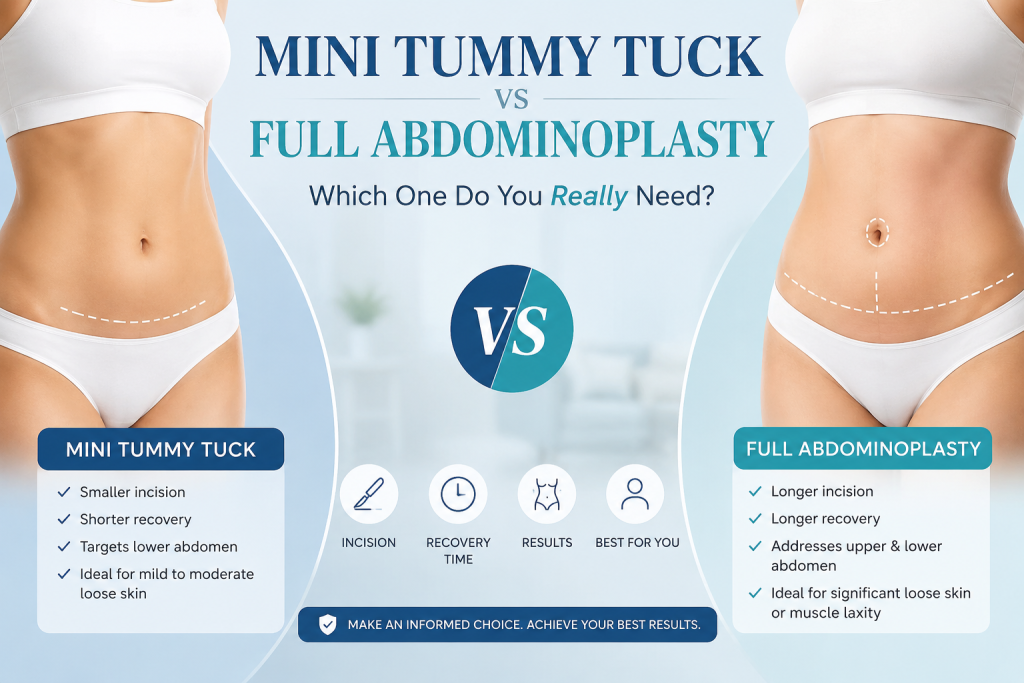
Mini tummy tuck vs full abdominoplasty: compare incision size, abdominal coverage, recovery time, and suitability before choosing the right procedure.
7. Maximizing Your Transformation: The “Mommy Makeover” Option
For many women, abdominal stretching is rarely an isolated concern. Childbirth and breastfeeding often cause simultaneous changes in the breasts, including volume loss, sagging (ptosis), or asymmetrical changes.
If you require a full abdominoplasty to repair your core, undergoing a single standalone surgery may only solve half of the equation. To address multiple areas of the body at once, elite plastic surgeons recommend grouping complementary procedures into a singular, well-coordinated surgical session known as a Mommy Makeover.
By combining a full tummy tuck with breast contouring (such as a breast lift or breast augmentation with premium implants) and targeted liposuction, you achieve a comprehensive, head-to-toe rejuvenation.
From an operational and financial perspective, bundling these procedures into a singular package is incredibly efficient:
-
Single Recovery Window: You undergo general anesthesia once and go through a single, consolidated recovery period rather than healing from multiple separate surgeries over several years.
-
Optimized Costs: You save thousands of dollars on duplicate hospital fees, operating room rentals, and anesthesia services.
If you want to understand how these highly coordinated combination protocols are safely structured for international patients, check out our complete guide to mommy makeover surgery in Vietnam.
8. Navigating Your Consultation: Essential Questions to Ask
Before committing to any surgical path, a formal, in-person or virtual clinical consultation with a board-certified plastic surgeon is mandatory. To advocate for your safety and ensure you receive the correct procedure, bring this checklist of questions to your consultation:
-
Based on my skin elasticity and muscle separation, am I a true candidate for a mini tummy tuck, or do I require a full abdominoplasty to achieve a flat stomach?
-
Do I have diastasis recti, and if so, will you be repairing it across the entire length of my abdominal wall?
-
What is the estimated length and exact placement of the horizontal incision? Will it be low enough to hide under standard bikini bottoms?
-
Do you utilize surgical drains for this procedure, and what is your protocol for post-operative wound care?
-
What are your credentials, and are you a registered member of recognized national or international plastic surgery associations, such as the American Society of Plastic Surgeons or the Vietnam Society of Aesthetic Plastic Surgery (VSAPS)?
Final Verdict: Making Your Choice
The debate of a mini tummy tuck vs. full tummy tuck ultimately comes down to a realistic assessment of your physical starting point.
If your concerns are strictly limited to a minor, stubborn pocket of loose skin or fat below the navel, and your core muscles remain strong, a mini tummy tuck offers a beautifully targeted solution with a swift recovery. However, if you are dealing with significant sagging skin above the navel, stretch marks, or stretched-out core muscles from pregnancy or weight changes, a full abdominoplasty is the only procedure capable of delivering the dramatic, flat, and structurally sound waistline you deserve.
Partnering with an experienced, authoritative medical travel platform ensures that your clinical evaluation is precise, your hospital meets international safety benchmarks, and your surgical journey is completely seamless from start to finish.
Mini or Full Tummy Tuck?
Get a personalised recommendation and cost estimate from a cosmetic surgeon in Vietnam.