
Cardiac arrhythmias – irregular or abnormal heart rhythms – affect millions of people worldwide. While some arrhythmias are harmless, others can lead to dizziness, fainting, heart failure, stroke, and even sudden cardiac arrest. For many patients, Cardiac Ablation is the most effective long-term treatment, offering a cure rather than symptom relief.
In recent years, Vietnam has rapidly developed into a strong destination for cardiac ablation, thanks to internationally trained electrophysiologists, modern EP labs, affordable treatment, and excellent patient outcomes. Patients from Australia, Singapore, Malaysia, Middle East, Europe, and North America increasingly choose Vietnam for arrhythmia treatment.
This article provides everything you need to know about Cardiac Ablation in Vietnam, including the procedure, types, success rates, risks, cost comparison, top hospitals, and what international patients can expect.
Quick Navigation
⭐ 1. What Is Cardiac Ablation?
Cardiac Ablation (also called Catheter Ablation) is a minimally invasive procedure used to treat abnormal electrical pathways in the heart. The doctor uses catheters to deliver energy—either heat (radiofrequency) or cold (cryoablation)—to destroy small areas of defective heart tissue causing irregular rhythms.
It is performed through tiny punctures, not open-heart surgery.
✔ Ablation can effectively treat:
-
Atrial fibrillation (AFib)
-
Supraventricular tachycardia (SVT)
-
Atrial flutter
-
Ventricular tachycardia (select cases)
-
AV nodal reentrant tachycardia (AVNRT)
-
Accessory pathways (e.g., Wolff-Parkinson-White syndrome – WPW)
✔ Main goal:
Restore normal heart rhythm without long-term dependency on medication.
⭐ 2. Why Vietnam Is Becoming a Top Destination for Cardiac Ablation
Vietnam has invested heavily in cardiology and electrophysiology over the past decade. Today, it stands as one of Asia’s most affordable yet highly competent locations for cardiac ablation.
⭐ 2.1. Internationally Trained Electrophysiologists
Many Vietnamese EP specialists trained in:
-
United States
-
France
-
Germany
-
Japan
-
South Korea
-
Singapore
These doctors perform hundreds to thousands of ablation cases annually, ensuring high success rates.
⭐ 2.2. Modern Electrophysiology (EP) Labs
Vietnam’s top hospitals use:
-
3D mapping systems: Carto 3, EnSite Precision, Rhythmia
-
Intracardiac echocardiography (ICE)
-
Multi-electrode catheters
-
Contact force catheters
-
Cryoablation balloons
-
Radiofrequency ablation systems
-
Advanced fluoroscopy machines
These technologies match those used in Singapore, Seoul, Tokyo, and Sydney.
⭐ 2.3. Affordable Pricing (50–80% cheaper)
| Country | Cardiac Ablation Cost |
|---|---|
| USA | $40,000 – $60,000 |
| Australia | $20,000 – $35,000 |
| Singapore | $18,000 – $28,000 |
| South Korea | $12,000 – $22,000 |
| Vietnam | $5,000 – $8,000 |
Cost depends on arrhythmia type and tools used, but Vietnam remains one of the most cost-effective choices.
⭐ 2.4. Short Waiting Time – Fast Scheduling
In Western countries, patients may wait weeks or months.
In Vietnam:
-
Emergency cases treated immediately
-
Elective cases scheduled within days
-
Pre-op evaluation completed quickly
⭐ 2.5. Strong English-Speaking Support
Major hospitals have:
-
International patient coordinators
-
English-speaking EP specialists
-
WhatsApp/Email communication
-
Detailed post-care instructions in English
⭐ 3. Who Needs Cardiac Ablation?
You may be a candidate if you experience:
-
recurrent palpitations
-
rapid heartbeat
-
irregular heartbeat
-
fainting (syncope)
-
shortness of breath
-
dizziness
-
fatigue or exercise intolerance
✔ Ablation is recommended when:
-
Medication doesn’t work
-
Medication causes side effects
-
Arrhythmia is causing heart failure
-
You prefer a long-term solution
-
Arrhythmia carries a stroke or sudden death risk
⭐ 4. Types of Cardiac Ablation Available in Vietnam
Vietnam provides all internationally recognized ablation types.
⭐ 4.1. Radiofrequency Ablation (RFA)
Uses heat energy to destroy arrhythmia-causing tissue.
Effective for:
-
SVT
-
Atrial flutter
-
AVNRT
-
WPW
-
Many atrial arrhythmias
Most common ablation technique.
⭐ 4.2. Cryoablation (Freezing Therapy)
Uses extreme cold to block arrhythmia pathways.
Benefits:
-
less pain
-
reduced risk of damaging healthy tissue
Often used for:
-
AVNRT
-
Atrial flutter
-
Pulmonary vein isolation (PVI) in AFib
⭐ 4.3. Pulmonary Vein Isolation (PVI) for Atrial Fibrillation
This is the most advanced ablation type.
Ablation targets the pulmonary veins, where AFib typically originates.
Vietnam uses:
-
Contact force catheters
-
Cryoablation balloons
-
3D mapping
Success rate for paroxysmal AFib: 70–85%
⭐ 4.4. Ventricular Tachycardia (VT) Ablation
Performed for certain life-threatening arrhythmias.
Available in specialized EP centers only.
⭐ 5. How Cardiac Ablation Is Performed
Procedure duration: 1–3 hours
Anesthesia: local + sedation (sometimes general anesthesia)
⭐ Step-by-step process
1️⃣ Pre-Procedure Evaluation
-
ECG
-
Holter monitor
-
Echocardiogram
-
Blood tests
-
Medication review
-
CT scan (for AFib cases)
2️⃣ Local Anesthesia
Only groin area is numbed.
3️⃣ Catheter Insertion
Catheters are inserted into the femoral vein and guided to the heart.
4️⃣ 3D Mapping
A detailed electrical map is created using Carto/EnSite/Rhythmia systems.
5️⃣ Ablation
Radiofrequency or cryoenergy is applied to destroy abnormal tissue.
6️⃣ Testing
Arrhythmia is re-tested to ensure it doesn’t reappear.
7️⃣ Recovery
Patients typically stay 1 night in the hospital.
⭐ 6. Recovery After Cardiac Ablation
✔ Hospital stay: 1 day
✔ Return to normal activities: 2–5 days
✔ Full recovery: 1–2 weeks
Patients may feel:
-
mild chest discomfort
-
fatigue
-
temporary palpitations (common)
Follow-up:
-
ECG at 1 month
-
EP consult
-
Anticoagulation if AFib
-
Anti-arrhythmic meds for 1–3 months
⭐ 7. Success Rates of Ablation in Vietnam
Approximate success rates (similar to USA/Singapore):
| Condition | Success Rate |
|---|---|
| SVT | 95–98% |
| WPW | 90–95% |
| Atrial Flutter | 95% |
| AVNRT | 95–98% |
| Paroxysmal AFib | 70–85% |
| Persistent AFib | 60–75% |
Vietnam’s outcomes match global standards.
⭐ 8. Risks of Cardiac Ablation (Rare)
Complications happen in <3% of cases:
-
bleeding
-
infection
-
bruising
-
vascular injury
-
stroke (very rare, <0.5%)
-
cardiac tamponade (rare)
-
pulmonary vein stenosis (AFib only)
Vietnamese EP centers follow strict safety protocols to reduce risks.
⭐ 9. Cost of Cardiac Ablation in Vietnam (2025)
Prices vary by arrhythmia type & technology used.
| Type | Price (USD) |
|---|---|
| SVT/AVNRT Ablation | $3,500 – $5,000 |
| Atrial Flutter Ablation | $3,500 – $5,500 |
| WPW | $4,000 – $5,500 |
| AFib Ablation (PVI) | $6,500 – $12,000 |
| Ventricular Tachycardia | $7,000 – $15,000 |
This is 50–80% cheaper than Singapore, Korea, or Australia.
Cost includes:
-
EP lab use
-
mapping systems
-
catheters
-
anesthesia
-
monitoring
-
hospital stay
⭐ 10. Best Hospitals for Cardiac Ablation in Vietnam
🏥 Ho Chi Minh City
-
Tam Anh General Hospital (TAH)
-
Vinmec Central Park
-
University Medical Center HCMC (UMC)
-
Cho Ray Hospital
-
FV Hospital
🏥 Hanoi
-
Tam Anh Hospital Hanoi
-
Vinmec Times City
-
108 Military Central Hospital
-
Bach Mai Hospital – Vietnam National Heart Institute
-
Hanoi Heart Hospital
🏥 Da Nang
-
Vinmec Da Nang
-
Da Nang General Hospital
These centers have EP labs, 3D navigation systems, and trained electrophysiologists.
⭐ 11. Why International Patients Choose Vietnam for Ablation
-
Affordable, transparent pricing
-
Modern EP labs and technology
-
Internationally trained EP specialists
-
High success rates
-
Low complication rates
-
Short waiting time
-
Full English-language support
-
Strong aftercare & monitoring
Vietnam offers world-class electrophysiology at a reasonable cost.
⭐ 12. Patient Journey: Cardiac Ablation in Vietnam
🟦 Step 1: Online consultation
Provide medical reports, ECG, Holter, medications.
🟦 Step 2: Treatment plan
EP specialist reviews and recommends ablation type.
🟦 Step 3: Travel arrangement
Airport pickup available.
🟦 Step 4: In-hospital evaluation
-
ECG
-
blood tests
-
echocardiogram
-
consent
-
anesthesia clearance
🟦 Step 5: Ablation procedure
Performed in EP lab (1–3 hours).
🟦 Step 6: Post-procedure monitoring
One night in hospital.
🟦 Step 7: Discharge
Follow-up instructions + medications.
🟦 Step 8: Ongoing aftercare
Remote check-ins via WhatsApp or email.
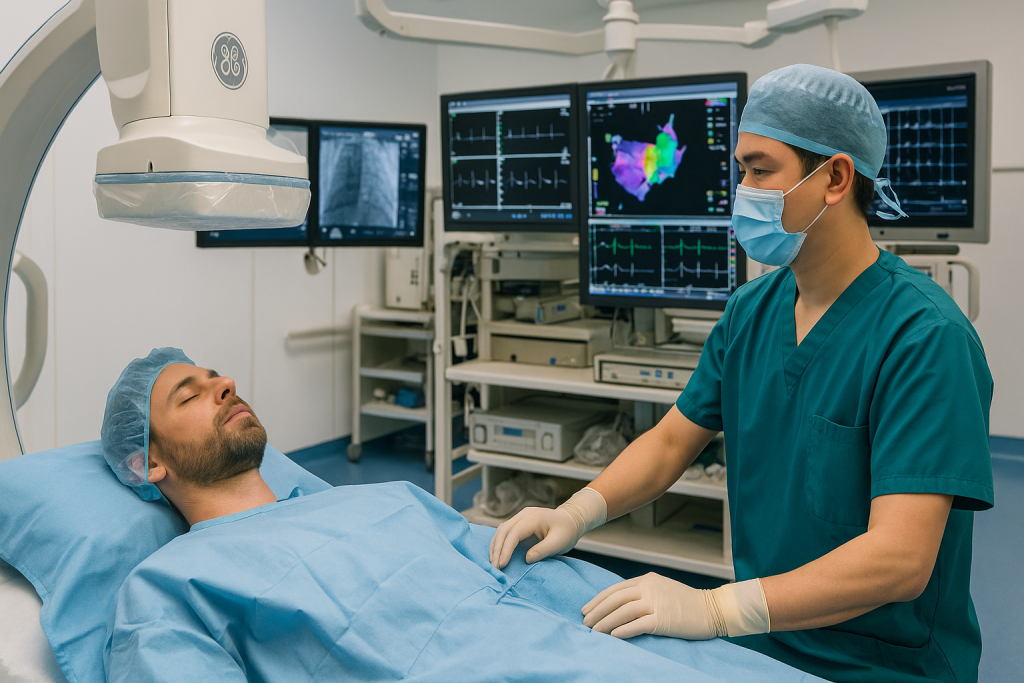
Vietnam offers advanced, affordable cardiac ablation performed by highly trained electrophysiologists in modern EP labs.
⭐ 13. Conclusion
Cardiac Ablation in Vietnam offers international patients a safe, modern, and cost-effective solution to arrhythmias such as AFib, SVT, WPW, and atrial flutter. With advanced EP technology, highly skilled electrophysiologists, and significantly lower treatment costs, Vietnam has become one of Asia’s most trusted destinations for arrhythmia treatment.
For those seeking long-term rhythm correction, improved quality of life, and professional medical care, Vietnam delivers excellent outcomes with affordable pricing and exceptional patient support.
Need Cardiac Ablation in Vietnam?
Send us your medical reports and get a clear treatment plan from Vietnam’s top electrophysiologists with fast scheduling.