
Reader Question:
“I’m 28 years old with nearly –6 diopters of myopia and 1 diopter of astigmatism. Which surgical methods are suitable, and what should I prepare?”
— Anh Thi, Lâm Đồng
Answer:
Myopia surgery corrects nearsightedness by reshaping the curvature of the cornea, enabling clear vision without glasses.
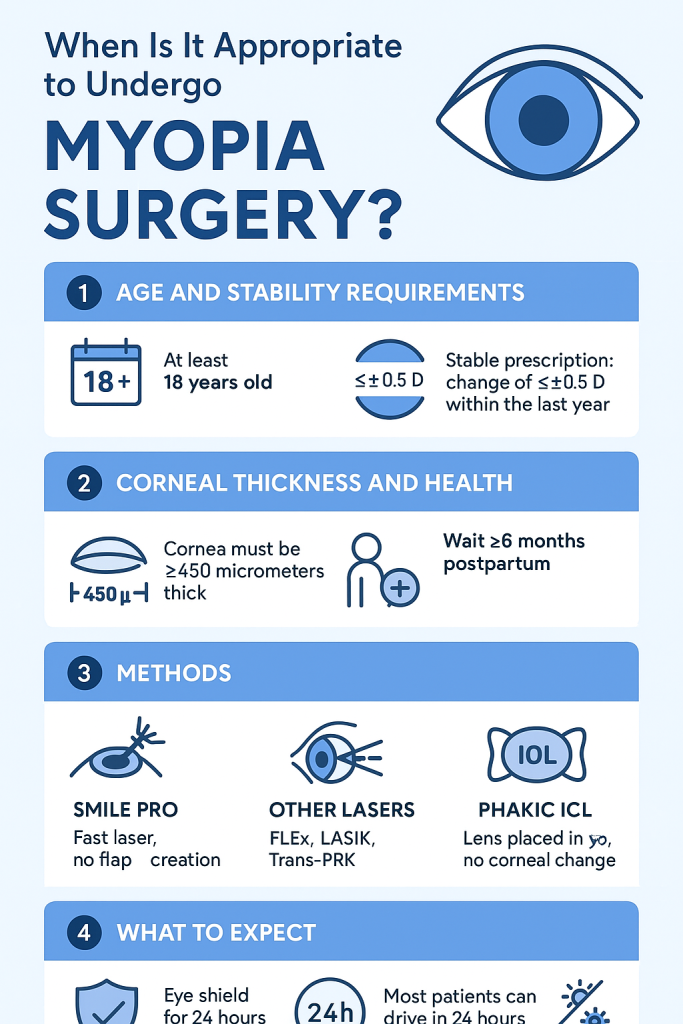
1. Age and Stability Requirements
-
Ideal candidates are at least 18 years old.
-
Your prescription must be stable, changing by no more than ±0.5 diopter within the past year.
2. Corneal Thickness and Health
-
Higher myopia requires more corneal tissue removal.
-
The cornea must be at least 450 micrometers thick to ensure surgical safety.
-
You must be free from acute or chronic eye diseases—such as keratitis, corneal dystrophy, keratoconus, or retinal hemorrhage.
-
Pregnant or breastfeeding women should wait at least 6 months after childbirth to allow stable hormone levels and refractive error.
3. Surgery Methods
✔️ Corneal Procedures
-
SMILE Pro (Small Incision Lenticule Extraction Pro):
-
The most advanced, creating no flap, which avoids associated risks like flap dislocation or wrinkles.
-
Laser time is only 10 seconds per eye, with a small incision and minimal scarring.
-
Offers reduced dry eye and a more comfortable recovery.
-
✔️ Other Corneal Lasers – FLEx, LASIK, Trans-PRK
-
These involve flap creation or stromal reshaping.
-
Useful for patients with less severe myopia but involve more postoperative discomfort and transient dryness.
✔️ Phakic ICL (Implantable Collamer Lens) – Intraocular Method
-
Instead of reshaping the cornea, a thin, customized lens is inserted behind the iris, in front of the natural lens—through a 2–3 mm incision.
-
Safe for high myopia or thin corneas, preserving corneal strength and avoiding dry eye issues.
-
The lens is long-lasting and can be replaced or adjusted over time.
4. Diagnosis & Preoperative Testing
To qualify, you’ll undergo:
-
Refractive measurement (sphere and cylinder).
-
Corneal topography (e.g., Pentacam), assessing thickness and structure.
-
Biomechanical evaluation (e.g., Corvis ST) to test corneal strength.
-
Retinal exam (Optos) to check for thinning or degeneration—especially with high myopia.
-
Blood tests, ultrasound, and anesthesia evaluation.
After clearance, the process from pre-op to discharge can be completed within an hour at top eye centers.
5. What to Expect After Surgery
-
Temporary discomfort like watering or grittiness is common just after the procedure.
-
You’ll need a protective eye shield for 24 hours, even during sleep.
-
By 24 hours post-op, most patients can drive or fly—but avoid dusty places and strong light for the following weeks.
-
Vision generally stabilizes rapidly, often within a day with SMILE Pro.
✔️ Summary of Candidacy and Procedures
| Requirement | Details |
|---|---|
| Age | ≥ 18 years |
| Stable glasses prescription | ≤ ± 0.5 D change per year |
| Corneal thickness | ≥ 450 micrometers |
| Free of eye disorders | No active keratitis, keratoconus, etc. |
| Postpartum wait time | ≥ 6 months if breastfeeding |
🏥 Best Candidates & Methods
-
SMILE Pro is favored for its fast laser time (~10 seconds) and quick recovery.
-
Phakic ICL is best for severe myopia or thin corneas, preserving corneal integrity.
-
Other laser methods (LASIK, Trans-PRK) remain applicable for certain prescriptions.
Expert**
Dr. Đinh Trung Nghĩa, Deputy Director, High-Tech Eye Center, Tam Anh General Hospital, Ho Chi Minh City.
Considering Myopia Surgery in Vietnam?
Discover if you’re eligible for SMILE Pro, LASIK, or Phakic ICL with a free consultation. We’ll connect you to Vietnam’s top eye surgeons and guide your journey—from testing to recovery.