
Atherectomy is an advanced, minimally invasive cardiovascular procedure used to remove hardened plaque from narrowed arteries, helping restore healthy blood flow and reduce the risk of serious complications such as heart attack, stroke, or limb ischemia. In Vietnam, atherectomy has become an increasingly important part of modern interventional cardiology, supported by experienced specialists, advanced catheterization laboratories, and internationally aligned treatment protocols.
As Vietnam continues to invest in high-quality cardiovascular care, atherectomy is now performed at major public and private hospitals for both local and international patients, particularly in cases where standard balloon angioplasty alone is not sufficient.
Quick Navigation
What Is Atherectomy?
Atherectomy is a catheter-based procedure designed to remove or modify atherosclerotic plaque inside an artery. Unlike balloon angioplasty, which compresses plaque against the arterial wall, atherectomy directly targets plaque by cutting, sanding, or vaporizing it.
The procedure is commonly used for:
-
Severely calcified arterial lesions
-
Long or complex blockages
-
Arteries that are difficult to treat with balloons or stents alone
Atherectomy may be performed in:
-
Coronary arteries (supplying the heart)
-
Peripheral arteries (most commonly in the legs)
It is often combined with balloon angioplasty or stent placement to achieve optimal long-term results.
Why Choose Atherectomy in Vietnam?
Vietnam has rapidly developed its interventional cardiology capabilities over the past decade, making it an increasingly attractive destination for advanced vascular procedures.
Key Advantages of Atherectomy in Vietnam
-
Modern cardiac catheterization laboratories (Cath Labs)
-
Interventional cardiologists trained in Japan, South Korea, Europe, and the US
-
Access to internationally used atherectomy devices
-
Treatment protocols aligned with global cardiology guidelines
-
Significantly lower costs compared to Western countries
-
Short waiting times
-
Dedicated services for international patients
For patients with complex arterial disease who require advanced plaque modification, Vietnam offers a strong balance of medical quality and affordability.
How Atherectomy Works
During atherectomy, a cardiologist inserts a thin catheter into a blood vessel, usually through the wrist (radial artery) or groin (femoral artery). Using real-time imaging guidance, the catheter is advanced to the site of blockage.
Depending on the device used, the catheter may:
-
Cut plaque with a rotating or directional blade
-
Grind calcified plaque into microscopic particles
-
Use laser energy to break down plaque
After plaque removal or modification, the artery is widened, allowing improved blood flow. In many cases, a balloon or stent is then placed to maintain vessel patency.
Types of Atherectomy Available in Vietnam
Vietnamese hospitals offer several types of atherectomy, selected based on plaque characteristics and artery location.
Rotational Atherectomy
This technique uses a diamond-coated rotating burr that spins at very high speed to grind away hardened calcium deposits.
Common uses:
-
Severely calcified coronary artery disease
-
Lesions resistant to balloon angioplasty
Directional Atherectomy
Directional atherectomy employs a cutting blade that removes plaque from a specific side of the artery.
Common uses:
-
Peripheral artery disease (PAD)
-
Large or irregular plaques in leg arteries
Orbital Atherectomy
Orbital atherectomy uses an eccentrically rotating crown that sands plaque while preserving healthy vessel tissue.
Advantages:
-
Effective for heavily calcified arteries
-
Uniform plaque modification
Laser Atherectomy
Laser atherectomy uses high-energy laser pulses to vaporize plaque into microscopic particles.
Common uses:
-
In-stent restenosis
-
Long or complex arterial lesions
-
Peripheral vascular disease
Conditions Commonly Treated With Atherectomy in Vietnam
Atherectomy is frequently used to treat:
-
Coronary artery disease (CAD)
-
Peripheral artery disease (PAD)
-
Critical limb ischemia
-
Calcified femoral or popliteal artery disease
-
Restenosis after previous stent placement
Treatment decisions are individualized based on imaging results, plaque characteristics, and overall patient health.
Who Is a Suitable Candidate for Atherectomy?
Atherectomy is not required for every patient with arterial disease. It is usually recommended when plaque characteristics make standard angioplasty less effective.
Suitable Candidates Often Include:
-
Patients with heavily calcified arteries
-
Individuals with long or complex blockages
-
Patients with failed or suboptimal balloon angioplasty
-
Selected coronary and peripheral artery disease cases
-
Patients who are medically stable for catheter-based procedures
Before treatment in Vietnam, patients undergo comprehensive evaluation to confirm suitability.
Atherectomy Procedure in Vietnam: Step by Step
Pre-Procedure Assessment
Patients typically undergo:
-
Clinical evaluation by a cardiologist
-
Blood tests
-
ECG and echocardiography
-
CT angiography or diagnostic angiography
Procedure Day
-
Performed in a Cath Lab
-
Local anesthesia with mild sedation
-
Catheter inserted via wrist or groin
-
Atherectomy device used to remove or modify plaque
-
Balloon angioplasty and/or stent placement if required
⏱️ Procedure time: usually 1–2 hours
Post-Procedure Care
-
Monitoring in a cardiac recovery unit
-
Compression at the access site
-
Antiplatelet and anticoagulant medications
-
Early mobilization
Most patients stay in hospital 1–2 days.
Cost of Atherectomy in Vietnam
One of the main reasons international patients choose Vietnam is cost savings without compromising medical standards.
Average Atherectomy Costs in Vietnam (USD)
-
Peripheral atherectomy: USD 2,500 – 4,500
-
Coronary atherectomy: USD 3,500 – 6,500
Factors Affecting Cost
-
Type of atherectomy device
-
Number of arteries treated
-
Use of balloons or stents
-
Hospital type (public vs private)
-
Length of hospital stay
In many Western countries, the same procedures may cost USD 15,000 – 30,000 or more.
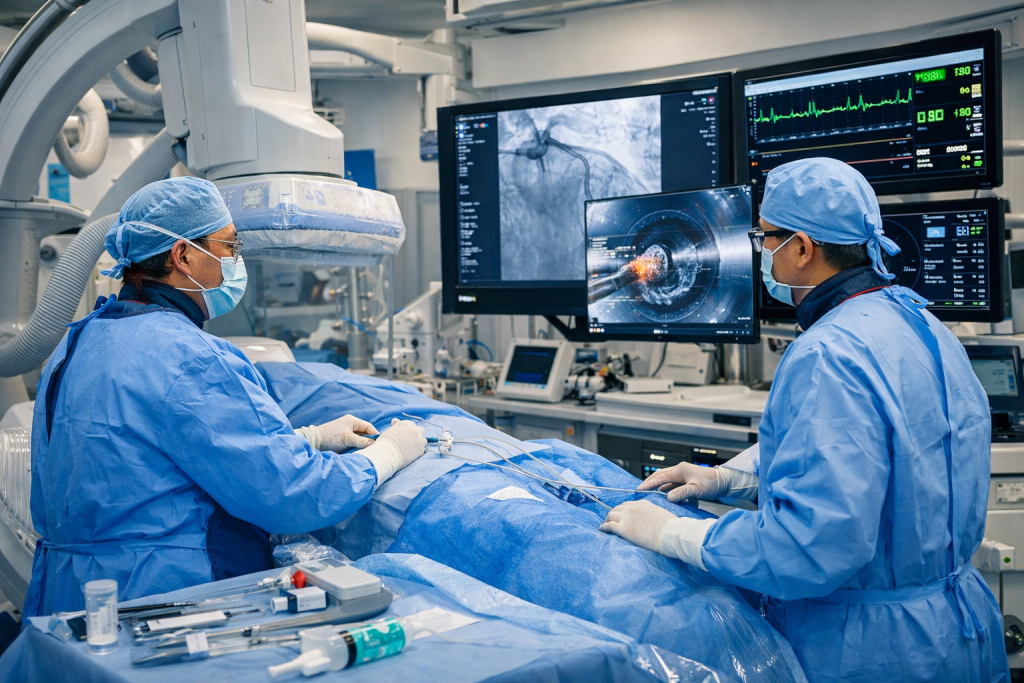
Advanced atherectomy treatment at international-standard cardiology centers in Vietnam
Safety Standards and Clinical Outcomes
Vietnamese cardiology centers follow strict safety and quality protocols:
-
International interventional cardiology guidelines
-
Continuous imaging and hemodynamic monitoring
-
Modern complication management systems
-
Multidisciplinary heart teams
When performed by experienced specialists, atherectomy has high procedural success rates and low complication risk.
Public vs Private Hospitals for Atherectomy in Vietnam
Public Hospitals
-
Highly experienced cardiologists
-
Lower procedural costs
-
High patient volumes
Private and International Hospitals
-
English-speaking medical teams
-
Shorter waiting times
-
Modern facilities and private rooms
-
Personalized care for international patients
International patients often prefer private hospitals for comfort, communication, and coordination.
Recovery and Long-Term Management
Recovery Timeline
-
Mobilization within 24 hours
-
Return to light activities in a few days
-
Full recovery typically within 1–2 weeks
Long-Term Care Includes
-
Antiplatelet medication
-
Lifestyle modification (diet, exercise, smoking cessation)
-
Management of diabetes, hypertension, and cholesterol
-
Cardiac or vascular rehabilitation
-
Follow-up imaging and consultations
Vietnam offers affordable long-term follow-up care for cardiovascular patients.
International Patient Support in Vietnam
Hospitals and medical tourism providers commonly assist with:
-
Pre-arrival medical record review
-
Treatment planning and cost estimates
-
Visa and travel assistance
-
Airport pickup and hospital transfers
-
Language interpretation
-
Post-procedure follow-up planning
These services help international patients receive treatment smoothly and with confidence.
Who Should Consider Atherectomy in Vietnam?
Atherectomy in Vietnam is well suited for:
-
Patients with complex or calcified arterial disease
-
Individuals seeking cost-effective advanced heart care
-
International patients medically fit for travel
-
Patients requiring combined interventional procedures
-
Long-term vascular disease management cases
Remote consultations are often available to assess eligibility before travel.
Future of Atherectomy and Interventional Cardiology in Vietnam
Vietnam continues to invest in:
-
Advanced Cath Lab technology
-
New atherectomy and imaging devices
-
Hybrid cardiovascular procedures
-
Specialist training and international collaboration
-
AI-assisted imaging and procedural planning
These developments are strengthening Vietnam’s role as a regional hub for advanced interventional cardiology.
Conclusion
Atherectomy in Vietnam offers a reliable combination of modern interventional cardiology, skilled specialists, international safety standards, and affordable costs. For patients with heavily calcified or complex arterial disease, atherectomy provides an effective solution to restore blood flow and improve long-term outcomes.
As cardiovascular care in Vietnam continues to advance, atherectomy is becoming an increasingly important option for both domestic and international patients seeking high-quality, minimally invasive vascular treatment.
Get an Atherectomy Plan & Cost Estimate in Vietnam
Share your diagnosis, symptoms, and recent tests (ECG, Echo, CT Angio/Coronary Angio) to receive a confidential hospital recommendation and quote.