
Hyperbaric Oxygen Therapy (HBOT) has rapidly transitioned from a specialized medical intervention into one of the most sought-after modalities in biohacking, post-surgical recovery, and holistic longevity. As Southeast Asia’s medical travel sector expands, accessing HBOT in Vietnam has become a premier choice for international travelers, expatriates, and wellness enthusiasts seeking state-of-the-art care at accessible rates.
By offering world-class hospital facilities, Joint Commission International (JCI) accredited standards, and luxury health sanctuaries at 50% to 70% lower costs than in Western nations or Singapore, scheduling HBOT in Vietnam presents an unbeatable value proposition. This comprehensive guide covers everything you need to know about receiving HBOT in Vietnam—from clinical science and top-tier facilities to transparent pricing and integrating hyperbaric treatment into your health travel itinerary.
Quick Navigation
1. Understanding Hyperbaric Oxygen Therapy (HBOT)
Hyperbaric Oxygen Therapy is a non-invasive medical procedure where a patient breathes 100% pure medical-grade oxygen while inside a pressurized chamber. Under normal atmospheric pressure at sea level (1.0 ATA), oxygen is primarily carried throughout the body bound to hemoglobin in red blood cells.
During a standard session of HBOT in Vietnam, atmospheric pressure inside the chamber is increased to between 1.3 ATA and 3.0 ATA (Atmospheres Absolute). According to Henry’s Law of physics, increasing ambient pressure forces oxygen to dissolve directly into blood plasma, central nervous system fluid, lymph, and deep cellular tissues, elevating plasma oxygen concentration up to 15 times above baseline.
Hard Chambers vs. Soft (Mild) Chambers
When researching options for HBOT in Vietnam, it is essential to distinguish between the two primary types of hyperbaric chambers available across medical centers and wellness spas:
-
Hard Monoplace/Multiplace Chambers (Clinical Grade): Constructed from rigid steel or acrylic, these chambers reach pressures between 2.0 ATA and 3.0 ATA using pure 100% oxygen. They are regulated as medical devices by international bodies such as the U.S. Food and Drug Administration (FDA) and the Undersea and Hyperbaric Medical Society (UHMS).
-
Soft/Mild Hyperbaric Chambers (mHBOT): Portable, inflatable chambers operating at 1.3 to 1.5 ATA using ambient air enriched with an oxygen concentrator (~24%–95% oxygen). These are primarily utilized in wellness resorts, sports facilities, and holistic centers offering HBOT in Vietnam for general relaxation, muscle recovery, and anti-aging maintenance.
2. Primary Medical & Wellness Applications
The physiological impact of oxygen supersaturation extends far beyond basic respiration. Patients undergoing a multi-session regimen of HBOT in Vietnam benefit from systemic tissue repair, dampening of inflammatory cytokines, stimulation of collagen synthesis, and mobilization of peripheral stem cells.
A. Clinical & Reconstructive Indications
-
Accelerated Post-Surgical Healing: Performing HBOT in Vietnam significantly reduces post-operative swelling, bruising, and incision hypoxia following complex plastic surgery, orthopedic procedures, or reconstructive operations.
-
Non-Healing Diabetic Wounds & Ulcers: By overcoming localized tissue ischemia, hyperbaric oxygen restores cellular repair mechanisms in chronic diabetic foot ulcers and radiation-induced soft tissue damage.
-
Neurological Rehabilitation: Clinical evidence published by leading institutions like the Mayo Clinic indicates that hyperbaric treatment can support neural plasticity during stroke recovery, traumatic brain injury (TBI) rehabilitation, and sudden sensorineural hearing loss.
-
Decompression Sickness & Gas Embolism: As the foundational clinical application for hyperbaric medicine, high-pressure chambers remain the gold standard treatment for divers experiencing decompression sickness along coastal regions.
B. Wellness, Longevity & Performance Enhancement
-
Anti-Aging & Cellular Longevity: Pioneering clinical trials demonstrate that structured hyperbaric protocols can elongate telomere length and reduce senescent cell buildup in aging populations.
-
Cognitive Optimization & Brain Fog: Oxygenating cerebral tissues enhances mental clarity, concentration, and executive function, making executive-level HBOT in Vietnam increasingly popular among digital nomads and global professionals.
-
Athletic Recovery: High-performance athletes utilize hyperbaric chambers to flush metabolic waste, accelerate lactic acid clearance, and repair micro-tears in muscular tissue after intensive training.
3. Integrating Hyperbaric Therapy into Vietnam’s Wellness Ecosystem
One of the distinct advantages of booking HBOT in Vietnam is the ability to seamlessly pair clinical hyperbaric treatments with a broader holistic health holiday. Hyperbaric therapy works synergistically with thermal detoxification, mindfulness practices, and physical movement.
To build a fully restored mind and body, many international visitors integrate a multi-session protocol of HBOT in Vietnam with specialized retreat experiences across the country:
-
Holistic Sanctuary Integration: Learn how hyperbaric oxygen fits into comprehensive health travel by exploring our ultimate guide to Wellness Retreats in Vietnam.
-
Thermal Mineral Healing: Enhance vascular circulation and joint mobility by pairing your hyperbaric regimen with natural hot springs; read our Mineral Healing Guide to Hot Springs in Vietnam.
-
Stress Reduction & Mental Clarity: Complement cellular oxygenation with deep mental relaxation through our curated Meditation Retreats in Vietnam Guide.
-
Physical Mobility & Somatic Alignment: Balance your body’s energy and flexibility by joining world-class instructors detailed in our overview of Yoga Retreats in Vietnam.
4. Top Hospitals & Clinics Offering HBOT in Vietnam
Vietnam’s major urban hubs—Hanoi, Ho Chi Minh City, and Da Nang—house state-of-the-art hyperbaric medical facilities staffed by bilingual medical professionals trained in Europe, Japan, and North America.
1. Vinmec International Hospital Network (Hanoi & Ho Chi Minh City)
As Vietnam’s premier private hospital system accredited by Joint Commission International (JCI), Vinmec features dedicated hyperbaric medicine departments. Their facilities utilize modern multiplace and monoplace hard chambers capable of handling both acute clinical conditions and high-end executive wellness programs for patients seeking HBOT in Vietnam.
-
Best For: Complex medical cases, post-surgical recovery, and certified JCI clinical standards.
-
Key Features: Full English support, resident hyperbaric specialists, and direct integration with intensive care and plastic surgery departments.
2. Institute of Hyperbaric Oxygen Therapy (Ho Chi Minh City)
Established as a pioneer in hyperbaric research and clinical application in Southern Vietnam, this specialized center focuses exclusively on hyperbaric protocols. They provide tailored therapy plans for neurological conditions, circulatory disorders, skin regeneration, and chronic fatigue.
-
Best For: Focused multi-session protocols and affordable specialized care for HBOT in Vietnam.
-
Key Features: Decades of clinical experience, high patient throughput, and customized pressure staging.
3. FV Hospital (District 7, Ho Chi Minh City)
Located in the expatriate hub of Phu My Hung, FV Hospital is a French-founded, JCI-accredited institution. Its comprehensive rehabilitation and post-operative departments offer access to hyperbaric therapy integrated with international nursing care and Western diagnostic imaging.
-
Best For: Expatriates, international tourists, and seamless insurance handling.
4. Military Institute of Hyperbaric Medicine & Navy Medical Centers (Da Nang & Coastal Centers)
Given Vietnam’s extensive coastline, maritime medical institutes in coastal regions maintain high-capacity multiplace chambers. While primarily serving naval personnel and commercial divers, many of these facilities provide public access for severe clinical indications requiring HBOT in Vietnam.
5. Cost Comparison: HBOT in Vietnam vs. Global Destinations
Cost is a major driving factor for international health travelers. In countries like the United States, Australia, or Singapore, non-insured hyperbaric sessions can be cost-prohibitive—especially considering that effective therapeutic protocols often require 10 to 30 consecutive sessions.
Choosing HBOT in Vietnam provides significant financial savings without compromising on equipment quality, safety standards, or medical expertise.
Price Breakdown per Session (USD)
| Country | Mild HBOT (1.3–1.5 ATA) | Clinical Hard Chamber (2.0–3.0 ATA) | 10-Session Package (Hard Chamber) |
| Vietnam | $35 – $60 | $70 – $130 | $650 – $1,200 |
| United States | $150 – $250 | $350 – $900 | $3,500 – $8,500 |
| Australia | $120 – $200 | $300 – $600 | $2,800 – $5,500 |
| Singapore | $140 – $220 | $280 – $500 | $2,600 – $4,800 |
| Thailand | $60 – $100 | $150 – $250 | $1,400 – $2,300 |
Financial Advantage: A complete 20-session anti-aging or post-surgical recovery protocol of HBOT in Vietnam typically costs less than 3 to 4 single sessions in the United States or Europe. This price differential allows travelers to comfortably cover luxury hotel accommodations, local transport, and wellness activities while saving substantially overall.
6. What to Expect During an HBOT Session in Vietnam
If you are undergoing hyperbaric oxygen therapy for the first time, knowing what to expect during your appointment for HBOT in Vietnam ensures a smooth and stress-free experience.
-
Step 1: Pre-Session Medical Screening (15–20 minutes)
A physician evaluates your medical history, checks your eardrums, measures blood pressure, and verifies that you have no contraindications such as untreated pneumothorax or acute sinus congestion.
-
Step 2: Preparation & Chamber Entry (5–10 minutes)
You will change into 100% pure cotton clothing provided by the clinic to prevent static spark risks. All electronic devices, lighters, and petroleum-based cosmetics must be stored outside the chamber.
-
Step 3: Pressurization Phase (10–15 minutes)
As the technician slowly increases pressure to the target depth (e.g., 2.0 ATA), the temperature inside warms slightly. You will feel pressure in your ears similar to taking off in an airplane. Equalize your ears by swallowing, yawning, or performing the Valsalva maneuver.
-
Step 4: Treatment Phase (45–60 minutes)
Once at target pressure, you relax, breathe pure oxygen through a comfortable mask or hood, read, listen to music, or rest inside the chamber.
-
Step 5: Depressurization & Post-Check (10–15 minutes)
The technician gradually reduces chamber pressure back to normal atmospheric level. Your ears will pop naturally as the temperature cools. A final blood pressure check concludes your session of HBOT in Vietnam.
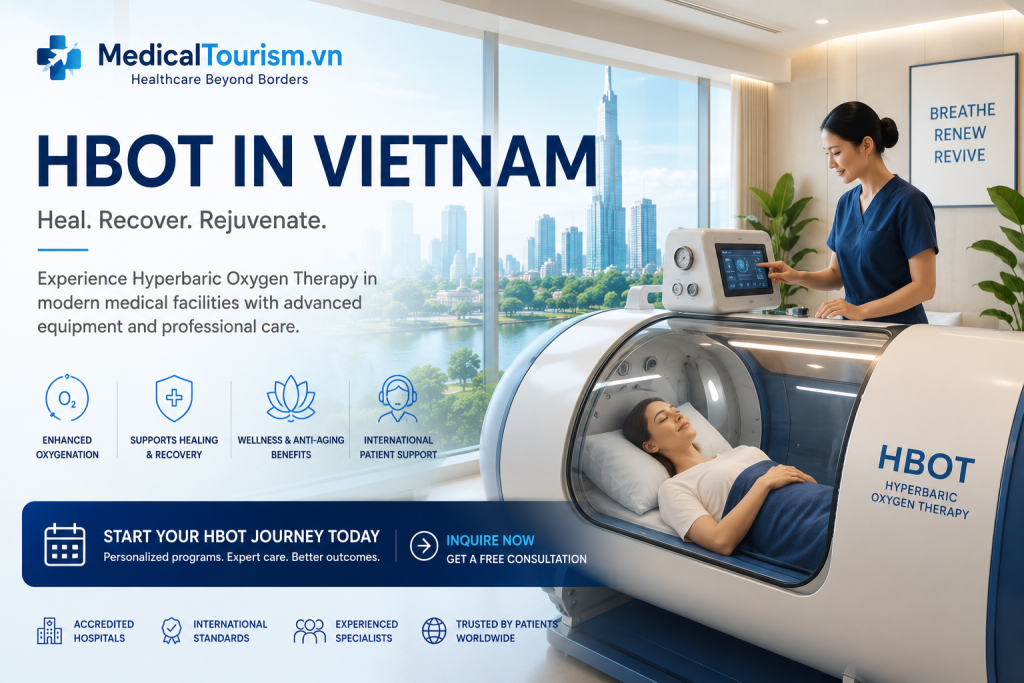
HBOT in Vietnam offers hyperbaric oxygen therapy in modern medical facilities with professional supervision, advanced equipment, and personalized support for international patients.
7. Safety Standards, Contraindications & FAQs
While hyperbaric oxygen therapy is exceptionally safe when administered by trained medical personnel, proper screening protocols remain mandatory.
Absolute & Relative Contraindications
-
Absolute Contraindication: Untreated Pneumothorax (collapsed lung). The atmospheric pressure changes during depressurization can cause a life-threatening expansion of trapped air.
-
Relative Contraindications (Requires Medical Clearance):
-
Severe upper respiratory infections, acute sinusitis, or blocked Eustachian tubes.
-
History of ear surgery or ruptured tympanic membranes.
-
Uncontrolled high fever or active seizure disorders.
-
Certain chemotherapy agents (e.g., Bleomycin, Doxorubicin, Cisplatin).
-
Pregnancy (unless treating acute carbon monoxide poisoning).
-
Frequently Asked Questions (FAQs)
Does hyperbaric therapy hurt?
No. The treatment itself is completely painless. You will only feel a mild sensation of fullness in your ears during the initial 10 to 15 minutes of pressurization, which is easily relieved by swallowing or yawning.
How many sessions of HBOT in Vietnam will I need?
The number of sessions depends on your specific health goals:
-
Post-Surgical Recovery: 5 to 10 sessions.
-
Anti-Aging & Cellular Longevity: 20 to 40 sessions spread over 4 to 6 weeks.
-
Athletic Recovery & Brain Fog: 3 to 5 sessions.
-
Chronic Non-Healing Wounds: 20 to 30+ sessions.
Will the hospital staff speak English?
Yes. Premier private hospitals and specialized centers offering HBOT in Vietnam cater heavily to international patients and maintain fluent English-speaking doctors, nursing staff, and patient coordinators.
8. Plan Your HBOT Journey with Medtour Vietnam
Navigating healthcare options abroad requires clear coordination, verified clinical quality, and transparent pricing. At Medtour Vietnam, we streamline your medical travel experience from start to finish.
Whether you are looking to accelerate recovery after cosmetic surgery, embark on a multi-week anti-aging protocol, or integrate HBOT in Vietnam into a luxury retreat, our dedicated medical concierge team is ready to assist.
-
Consultation: Contact our medical specialists to discuss your health goals and receive a personalized treatment plan for HBOT in Vietnam.
-
Seamless Coordination: We manage hospital bookings, physician consultations, airport transfers, and language support across Hanoi, Ho Chi Minh City, and Da Nang.