
Quick Navigation
CTA Scan in Vietnam: Advanced Coronary and Vascular Imaging for Precise Cardiovascular Diagnostics
Cardiovascular and neurovascular disorders represent a critical segment of global healthcare challenges. According to standard clinical registries maintained by the World Heart Federation (WHF), early and highly accurate tracking of arterial narrowing, plaque buildup, and structural vascular anomalies is the absolute cornerstone of preventing major cardiovascular events like myocardial infarctions (heart attacks) and ischemic strokes.
For decades, evaluating the internal lumen of blood vessels required invasive conventional catheter angiography, a procedure involving a major access puncture, local sedation, and an inherent risk of vascular wall damage.
The development of high-resolution diagnostic radiology has introduced an elite, non-invasive alternative: Computed Tomography Angiography (CTA Scan). By pairing advanced multi-slice computed tomography with a synchronized intravenous iodinated contrast injection, radiologists can create highly detailed, three-dimensional reconstructions of a patient’s entire arterial architecture in just a few seconds.
Despite its incredible diagnostic value, accessing a specialized coronary or neurological CTA scan in many Western countries is often blocked by major systemic hurdles. Patients routinely face staggering out-of-pocket medical bills, rigid health insurance pre-authorization protocols, and months of stressful waiting list delays just to secure a slot on a high-slice scanner.
As globalized medicine evolves, proactive individuals are bypassing these institutional delays by choosing Southeast Asia for advanced diagnostic imaging. A professional CTA scan in Vietnam provides an exceptional alternative: a seamless combination of ultra-high-slice imaging technology, Western-trained cardiovascular radiologists, and international quality protocols—delivered at a highly optimized fraction of Western clinical costs.
Why Travel to Vietnam for a Diagnostic CTA Scan?
Choosing an international destination for high-complexity diagnostic radiology requires examining technical precision, operational speed, and financial viability. Premium private medical networks in Vietnam offer structural advantages that make them a preferred choice for international travelers:
1. Immense Economic Optimization
In nations like the United States, Australia, or the United Kingdom, a standalone coronary or neurological CTA scan—inclusive of contrast media, facility fees, and expert radiological reading—can easily cost between $2,000 and $4,500 USD. In Vietnam, equivalent imaging protocols utilizing identical high-tier multi-slice technology range from $250 to $550 USD. This represents an 80% to 90% cost reduction without compromising diagnostic safety, material tracking, or clinical reporting precision.
2. Immediate Diagnostic Availability
When managing potential vascular conditions, waiting months for an imaging appointment introduces significant health risks and immense psychological stress. Private international hospitals in Vietnam operate under optimized access systems. International patients can routinely book, complete, and receive comprehensive 3D radiological reports within 24 to 48 hours of their initial clinical consultation.
3. Part of a Holistic Preventive Infrastructure
Vascular health is fundamentally connected to systemic health. International medical travelers rarely view a CTA scan as an isolated test; instead, they use it as a cornerstone for a full systemic evaluation.
Integrating a specialized vascular review into a broader, multi-organ evaluation via a structured health check up in vietnam provides an exceptionally efficient framework for long-term health tracking and risk prevention.
For patients prioritizing an itinerary in the northern capital—known for combining world-class hospital care with deeply restorative cultural travel—you can access top JCI-accredited imaging centers through our definitive complete guide to health check ups in hanoi.
Advanced Imaging Infrastructure: Multi-Slice CT Technology
A common concern among foreign patients is whether more affordable diagnostic care abroad implies older medical equipment or less accurate reporting. In Vietnam’s private international hospital networks, the technological infrastructure matches the world’s leading academic medical centers.
Leading radiology departments across Vietnam operate under strict international safety rules and choose state-of-the-art imaging ecosystems manufactured by premier medical brands, including Siemens Healthineers (Germany), GE Healthcare (USA), and Philips (Netherlands). Premium clinical facilities deploy advanced configurations that ensure incredible diagnostic accuracy:
-
128-Slice to 640-Slice Ultra-Fast CT Scanners: Traditional scanners struggle with heart motion, requiring heavy use of beta-blockers to artificially slow a patient’s heart rate. Vietnam’s elite imaging centers utilize 256-slice and 640-slice systems (such as the Aquilion ONE or Siemens Somatom series). These systems feature ultra-high temporal resolution capable of imaging the entire heart in a single heartbeat, completely eliminating motion artifacts and capturing exceptionally sharp images even in patients with irregular heart rates.
-
Advanced Dual-Source Imaging: This technology utilizes two independent X-ray tubes and detectors simultaneously, delivering sub-millimeter spatial resolution. This allows radiologists to map out extremely subtle, non-calcified “soft” lipid plaques—the exact type of unstable plaque most likely to rupture and cause sudden cardiac events.
-
AI-Driven Radiation Dose Reduction: Modern imaging suites deploy advanced iterative reconstruction software. This technology lowers radiation exposure by up to 75% to 80% compared to conventional legacy CT systems, maintaining absolute image sharpness while protecting long-term patient health.
Cross-Disciplinary Imaging Integration
While a CTA scan is the gold standard for mapping the interior lumen of moving blood vessels and calcified structures, certain soft-tissue evaluations, neurological reviews, or radiation-free joint tracking are better suited for resonant magnetic fields.
If your medical team recommends a complementary high-field structural evaluation alongside your vascular check, you can learn about premium 3T imaging infrastructure through our detailed guide to mri scan in vietnam.
Clear Comparison Matrix of Diagnostic CTA Scan Services
To provide complete transparency for international patients, the following responsive, scrollable matrix outlines the operational, financial, and technical frameworks of advanced vascular CT imaging compared between Western medical systems and Vietnam’s private international networks:
Primary Diagnostic Applications of CTA Scanning
Computed Tomography Angiography is an incredibly versatile imaging tool used to evaluate several distinct vascular networks across the body:
1. Coronary CTA (Coronary Artery Evaluation)
This is the most frequent application for international patients. A coronary CTA scans the vessels that supply blood directly to the heart muscle. It provides a highly detailed view of the coronary arteries, allowing specialists to calculate a precise Calcium Score and accurately locate any blockages caused by calcified or non-calcified plaques. It is an invaluable tool for ruling out significant coronary artery disease (CAD) without resorting to an invasive surgical catheterization.
2. Carotid and Neurovascular CTA (Stroke Prevention)
This protocol focuses on the carotid arteries in the neck and the Circle of Willis inside the brain. It is highly recommended for patients with a family history of stroke, chronic hypertension, or unexplainable dizzy spells. The high-resolution scan can instantly spot critical narrowing (stenosis), vascular dissections, or hidden cerebral aneurysms before they lead to life-threatening complications.
3. Pulmonary CTA (Pulmonary Embolism Tracking)
Designed to evaluate the arterial pathways of the lungs, a pulmonary CTA is the absolute gold standard for immediately isolating a pulmonary embolism (a blood clot that has traveled to the lungs). It allows emergency and pulmonary specialists to map out lung perfusion with incredible speed and accuracy.
4. Abdominal Aorta and Peripheral CTA
This scan maps the body’s largest blood vessel—the aorta—as well as the arterial branches supplying the kidneys, intestines, and lower extremities. It is a critical diagnostic tool for identifying abdominal aortic aneurysms (AAA) or evaluating peripheral artery disease (PAD) in patients experiencing severe leg pain while walking.
The Clinical Process: What to Expect During Your CTA Scan
Understanding the clinical workflow helps build confidence and lowers anxiety before your appointment. Private medical centers in Vietnam follow a highly structured, patient-centric protocol:
1. Pre-Procedural Screening and Preparation
Before scheduling the scan, your medical team verifies your safety by reviewing critical baseline metrics. You will undergo a quick blood test to evaluate your Serum Creatinine and Estimated Glomerular Filtration Rate (eGFR). This step is essential because your kidneys must be functioning properly to safely process and clear the iodinated contrast material.
Patients are asked to fast from solid food for 4 hours prior to the scan to ensure optimal imaging conditions, though drinking plain water is highly encouraged to keep the body well-hydrated.
2. Stabilizing Heart Rate Metrics
For a coronary CTA scan, achieving a steady, resting heart rate (ideally under 60–65 beats per minute) helps ensure the sharpest possible images. If your heart rate is elevated due to travel anxiety, a physician may administer a mild, short-acting oral or intravenous beta-blocker shortly before the procedure. This is a standard, safe step that ensures the ultra-fast scanner syncs perfectly with your cardiac cycle.
3. Contrast Injection and Scanning Execution
You will lie comfortably on a motorized scanner table. A specialized nurse inserts a small IV cannula into a vein in your arm, connecting it to an automated dual-barrel contrast injector. As the scanner table gently moves into the wide, well-lit ring, the automated injector delivers the iodinated contrast dye, closely followed by a saline flush.
During the injection, you may experience a brief, completely normal warm sensation spreading through your body or a metallic taste in your mouth. The actual scanning process takes less than 10 to 15 seconds, during which the technician will ask you to hold your breath to prevent any movement blur.
4. Post-Scan Observation and Final Reporting
Once the scan is complete, the IV line is removed, and you will rest comfortably in an observation lounge for 15 to 30 minutes. The clinical team monitors you briefly to ensure you feel fine and can answer any questions. You are encouraged to drink plenty of fluids over the next 24 hours to help your kidneys quickly flush out the contrast media.
Meanwhile, advanced multi-slice software reconstructions are sent directly to a senior radiologist for detailed analysis, with complete digital image sets and written reports delivered to you shortly after.
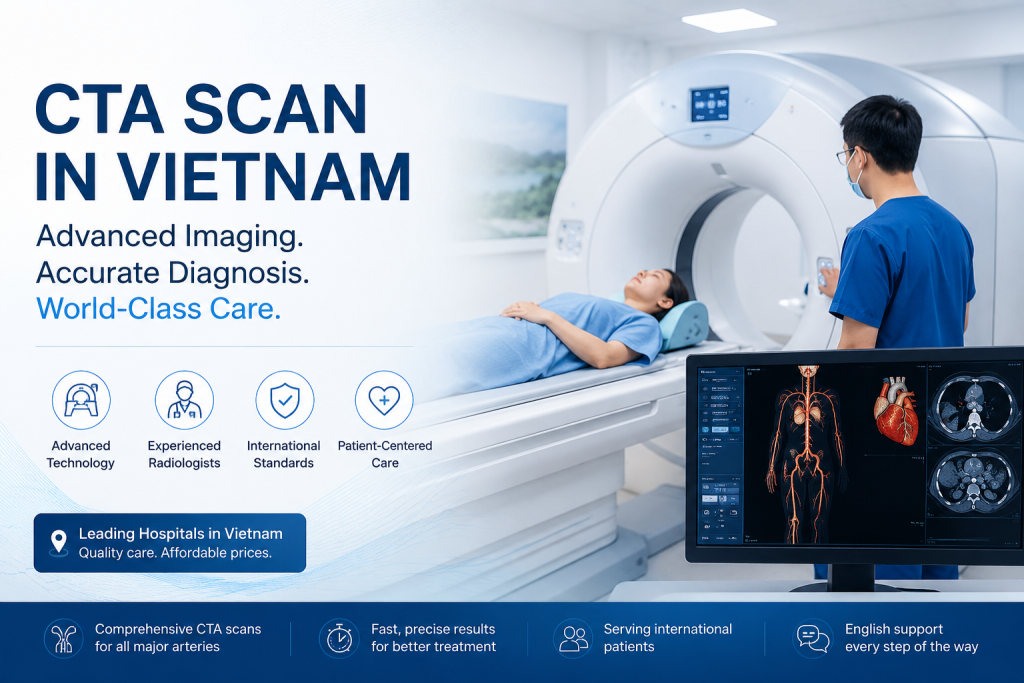
CTA Scan in Vietnam at modern hospitals with advanced imaging technology, experienced radiologists, and affordable care for international patients
Patient Safety, Contrast Management, and Quality Control
For international medical travelers, radiological safety and diagnostic accuracy are non-negotiable. Leading diagnostic blocks and core imaging centers across Vietnam operate under strict medical guidelines mandated by global professional bodies like the American College of Radiology (ACR) and the European Society of Radiology (ESR).
Every contrast-enhanced procedure clears a strict clinical quality assurance protocol:
-
Premium Non-Ionic Contrast Media: Clinics exclusively utilize advanced, low-osmolar, non-ionic contrast agents. These modern materials drastically lower the risk of allergic skin reactions or contrast-induced kidney issues compared to older diagnostic dyes.
-
Automated Extravasation Detection: Contrast injection systems feature real-time pressure sensors that instantly stop the flow if any fluid shifts outside the vein, completely preventing local tissue irritation.
-
Independent Dual-Read Systems: Every complex coronary or neurological vascular reconstruction undergoes an independent dual-read workflow by two senior imaging specialists, ensuring absolute reporting accuracy before your final files are signed off.
The Crucial Role of Dedicated Medical Tourism Facilitators
While private international hospitals in Vietnam provide world-class imaging technology, managing a medical itinerary from abroad can introduce logistical and administrative hurdles. Partnering with a professional medical tourism facilitator ensures a smooth, stress-free experience.
A dedicated healthcare agency coordinates every detail of your diagnostic journey:
-
Clinical Profile Matching: Reviewing your health history and medical requests ahead of time to match your specific health goals with the country’s most accomplished cardiovascular radiologists and high-slice imaging centers.
-
End-to-End Travel Logistics: Arranging private airport vehicle transfers, booking medical-friendly hotel accommodations located close to your clinic, and managing your appointment times efficiently to respect your schedule.
-
Fully Transparent, Bundled Pricing: Consolidating facility fees, advanced multi-slice imaging costs, contrast media materials, specialist reading honorariums, and bilingual translation support into one clear, upfront price with zero hidden fees.
By leaving the logistical details to a trusted local facilitator, global citizens avoid administrative stress and can focus entirely on what matters most: early prevention, accurate diagnostic insights, and an enjoyable travel experience.
Summary
Securing a diagnostic CTA scan in Vietnam represents a smart, proactive investment for the modern healthcare consumer. By bringing together advanced 256/640-slice imaging technology, expert international safety protocols, and certified cardiovascular radiologists with transparent, affordable pricing, Vietnam empowers global citizens to take full control of their vascular health. This provides clear diagnostic peace of mind without the heavy financial burdens or prolonged scheduling delays common in Western medical networks.
Need a CTA Scan in Vietnam?
VnMedtour can help you arrange CTA scan appointments at trusted hospitals in Vietnam, with English support, clear pricing, and guidance before your visit.