
Colorectal cancer remains one of the most prevalent yet highly preventable malignancies worldwide. According to global health data from the World Health Organization (WHO), early detection via routine screening drastically improves long-term survival rates, transforming a potentially life-threatening condition into a highly treatable, manageable health event. Despite this clinical reality, millions of patients in Western nations delay or entirely avoid this vital screening due to prohibitive out-of-pocket expenses, long insurance approval wait times, and fear of procedural discomfort.
Fortunately, the landscape of globalized healthcare is shifting. International medical travelers are increasingly choosing Southeast Asia for advanced gastrointestinal procedures.
A professional colonoscopy in Vietnam offers an elite medical alternative: a seamless fusion of world-class endoscopic technology, Western-trained gastroenterologists, and state-of-the-art conscious sedation protocols—delivered at a fraction of Western clinical costs.
Quick Navigation
Why Travel to Vietnam for a Colonoscopy?
The decision to undergo an endoluminal procedure abroad is driven by distinct operational, financial, and clinical benefits that leading medical hubs in Vietnam consistently deliver to international patients:
1. Significant Economic Savings
In the United States, Australia, or the United Kingdom, an elective preventive colonoscopy routinely costs between $2,500 and $4,500 when factoring in facility fees, specialist honorariums, and anesthesiology overheads. In sharp contrast, a premium, international-tier colonoscopy in Vietnam ranges from $250 to $600 USD. This represents a radical 75% to 85% cost reduction without compromising a single metric of clinical safety, material sterile processing, or diagnostic accuracy.
2. Zero Waiting Lists
Navigating public healthcare systems in Western countries often subjects asymptomatic, preventive screening candidates to months-long administrative backlogs. In Vietnam, international patients can effortlessly coordinate and book a comprehensive endoscopic evaluation within a few days of contact, ensuring timely diagnostic intervention.
3. Comprehensive Dual Screenings
Gastroenterologists frequently recommend evaluating the entire digestive tract concurrently to minimize sedation exposures. International travelers often pair their lower gastrointestinal screening with a highly protective gastroscopy in vietnam safe modern affordable to map the upper GI mucosal lining, rule out acid reflux vectors, and check for H. pylori infections in a single clinical session.
International Hospital Standards and Diagnostic Technology
A common misconception among foreign patients is that highly affordable medical care in emerging markets implies outdated technology or relaxed sterilization governance. In Vietnam’s private international medical network, the clinical operational reality is precisely the opposite.
Leading tertiary facilities and specialized digestive centers are actively accredited by the Joint Commission International (JCI), ensuring absolute adherence to strict patient handling, infection control, and diagnostic reporting protocols. Furthermore, endoscopy units utilize advanced imaging ecosystems sourced directly from premier global manufacturers like Olympus (Japan) and Fujifilm.
A core technological standard across elite Vietnamese clinics is Narrow Band Imaging (NBI). Unlike traditional white-light endoscopy, NBI filters out ambient light frequencies to target specific wavelengths absorbed by hemoglobin. This illuminates the micro-vascular networks feeding mucosal tissues, allowing endoscopists to instantly differentiate between benign tissues and pre-cancerous neoplastic polyps that are invisible to standard imaging hardware, thereby facilitating immediate identification and treatment.
Seamless Cross-Platform Healthcare Integration
For many international patients, a colonoscopy is not an isolated event but a targeted component of a broader, proactive lifestyle assessment. Leading private hospitals in Vietnam structure their endoscopy blocks to integrate smoothly with executive wellness profiles.
If you are coordinating a comprehensive health review, scheduling your endoscopic screening alongside a full metabolic and multi-slice imaging sequence via a structured health check up in vietnam provides an exceptionally efficient roadmap for long-term health management.
To cater to the highly localized footprints of international clinical networks, these screening portfolios are distributed across the nation’s primary medical hubs:
-
The Southern Metro Complex: If your travel plans anchor you within Vietnam’s primary commercial epicenter, you can explore the region’s premier private diagnostic platforms and oncology screening hubs through our curated guide to health check ups in ho chi minh city.
-
The Northern Capital Network: For patients looking to pair precise diagnostic imaging with a richer cultural or traditional holistic recovery itinerary, you can access top-tier JCI hospital listings and booking pathways via our complete handbook to health check ups in hanoi.
Clear Comparison Matrix of Colonoscopy Services
To ensure absolute transparency regarding what international patients can expect, the following responsive, scrollable matrix delineates the technical, financial, and operational framework of colonoscopy procedures across Western and Vietnamese standards:
Step-by-Step Breakdown of the Colonoscopy Procedure
Understanding the operational sequence of a colonoscopy is essential for minimizing patient hesitation. Elite facilities in Vietnam follow standardized medical pathways designed to ensure maximum physical safety and psychological comfort:
1. Pre-Procedural Colon Preparation (The Evening Prior)
The diagnostic accuracy of a colonoscopy depends entirely on the cleanliness of the bowel wall. International patients receive a specialized, high-grade bowel cleansing kit along with detailed English instructions. This preparation is managed comfortably in the patient’s hotel room the afternoon or evening before the procedure. By consuming a balanced, fluid-clearing solution, the gastrointestinal tract is thoroughly evacuated, ensuring the endoscopist has an unobstructed view of the mucosal architecture.
2. Advanced Conscious Sedation (Twilight Anesthesia)
Many patients associate older colonoscopy techniques with pain or intense cramping. Modern Vietnamese hospitals utilize advanced conscious sedation, often referred to as “twilight anesthesia.” Managed by a dedicated, board-certified anesthesiologist, a mild, short-acting sedative (such as Propofol) is administered intravenously. The patient drifts into a deep, relaxed sleep state, experiencing zero pain, zero structural awareness, and zero memory of the intervention. This approach ensures excellent patient comfort while keeping physiological vital signs stable.
3. Endoluminal Examination and Real-Time Polypectomy
Once sedation is established, the gastroenterologist gently introduces a highly flexible, lubricated optoelectronic endoscope through the lower GI tract. The scope transmits real-time, high-definition video to ultra-large monitors in the surgical theater.
If the specialist identifies a colorectal polyp (a small tissue growth that could eventually transform into an adenocarcinoma over a 5-to-10-year window), they immediately deploy a microscopic surgical snare through the scope’s internal channel. The polyp is cleanly and painlessly excised on the spot, then preserved in formalin for formal histopathology analysis and laboratory biopsy.
4. Post-Procedure Recovery and Detailed Reporting
The endoscope is slowly withdrawn, and the sedation delivery is ceased. Because modern anesthetic agents clear the metabolic system rapidly, the patient wakes up naturally within 5 to 10 minutes in a private recovery bay.
After a brief, 45-minute rest period and a complimentary post-procedure snack, the consulting gastroenterologist provides a detailed, line-by-line review of the preliminary findings. The patient leaves the clinic with high-resolution digital color prints of their intestinal tract, clear aftercare instructions, and copy-ready electronic health records.
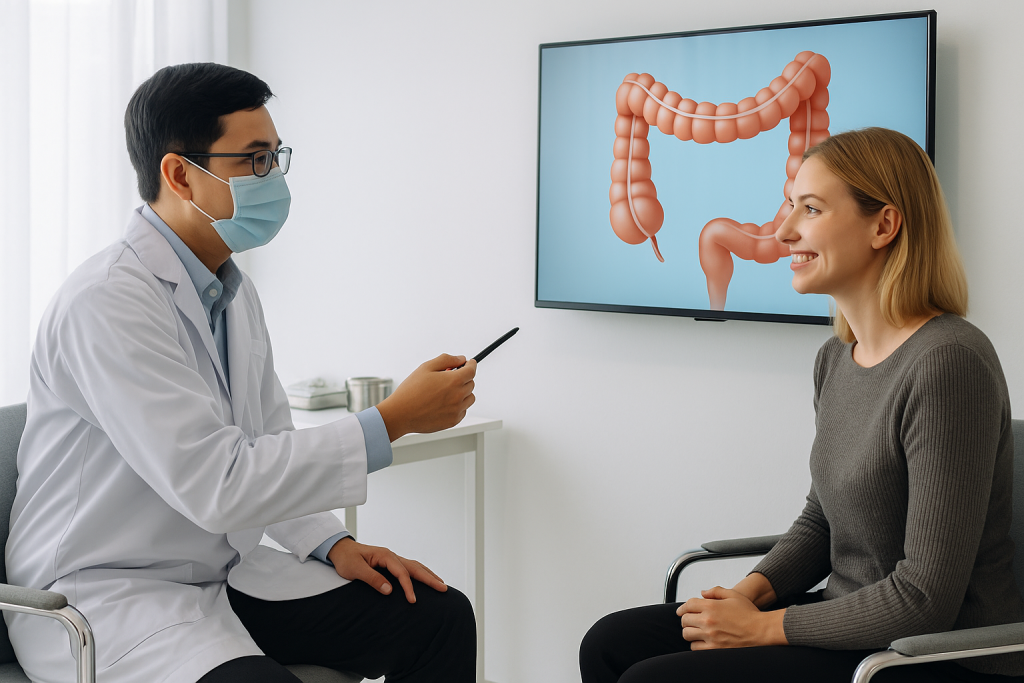
A Vietnamese gastroenterologist reviews colonoscopy findings with an international patient at a modern hospital in Vietnam.
Safety, Infection Control, and Sterilization Sovereignty
For international patients evaluating globalized medicine, safety standards are non-negotiable. Leading endoscopic suites across Vietnam mitigate cross-contamination risks by enforcing strict sterilization rules mandated by global entities like the Society of Gastroenterology Nurses and Associates (SGNA) and the Centers for Disease Control and Prevention (CDC).
Every single endoscope undergoes a meticulous, multi-stage automated re-processing cycle after every procedure:
-
Manual Bedside Pre-Cleaning: Immediate mechanical flushing of all internal air and water channels with specialized enzymatic detergents to break down organic bio-films.
-
Leak Testing: Rigorous structural pressure testing to verify the complete waterproof integrity of the scope’s internal matrices before immersion.
-
Automated Endoscope Reprocessors (AER): High-level disinfection inside advanced automated wash chambers utilizing specialized, medical-grade chemical sterilants at validated temperatures.
-
Traceable Documentation: Every endoscope is barcoded, tracked, and digitally logged to confirm it has successfully cleared all automated sterilization cycles before touching the next patient.
The Value of Dedicated Medical Tourism Agencies
Navigating foreign medical administrative systems, matching clinical needs with board-certified specialists, and coordinating travel logistics can introduce unneeded stress into a medical itinerary. Engaging a premium, local medical tourism facilitator streamlines the entire healthcare journey.
A professional healthcare agency acts as your bilingual advocate, operational manager, and personal concierge throughout your trip:
-
Clinical Matchmaking: Reviewing your family medical history prior to departure to match your needs directly with the absolute highest-rated, Western-trained gastroenterology chiefs in Hanoi or Ho Chi Minh City.
-
Logistical Optimization: Booking medical-friendly luxury hotel accommodations, managing private airport vehicle transfers, and scheduling procedures efficiently to protect your holiday time.
-
Transparent All-Inclusive Packaging: Bundling clinical facility fees, specialized anesthesiology overhead, pre-procedure laboratory blood screenings, and local translator services into a single, fully transparent package price with zero hidden fees.
By transferring logistical coordination to a trusted local agency, global citizens eliminate administrative friction and can focus entirely on what matters most: their preventative health, physical recovery, and a relaxing travel experience.
Summary
Securing a preventative colonoscopy in Vietnam represents a smart, proactive choice for the modern healthcare consumer. By combining international JCI clinical safety standards and advanced Narrow Band Imaging technology with transparent, highly affordable pricing, Vietnam empowers global citizens to take absolute control of their long-term gastrointestinal health without the financial stress or prolonged administrative delays common in Western medical systems.
Need a Colonoscopy in Vietnam?
Get clear prices and a fast screening plan before you travel.