
Bunions, medically known as hallux valgus, are one of the most common foot deformities affecting adults worldwide. They cause pain, swelling, difficulty walking, and aesthetic concerns that can significantly impact daily activities. When conservative treatments fail, bunion surgery—a corrective procedure designed to realign the big toe and relieve pain—offers long-lasting relief.
In recent years, Vietnam has rapidly become an attractive destination for international patients seeking affordable, high-quality bunion surgery. With its modern hospitals, experienced orthopedic surgeons, advanced minimally invasive techniques, and lower cost of care, Vietnam delivers excellent outcomes comparable to those found in Western countries.
This comprehensive guide explains everything you need to know about Bunion Surgery in Vietnam—from indications, techniques, and recovery to cost comparisons, hospital recommendations, and what to expect during your medical tourism journey.
What Is Bunion Surgery?
Bunion surgery is a corrective foot procedure that realigns the bones, ligaments, and tendons around the base of the big toe. A bunion forms when the big toe shifts inward toward the other toes, causing the metatarsal bone to protrude outward and form a painful bump.
The goals of bunion surgery are to:
-
Reduce or eliminate pain
-
Restore proper toe alignment
-
Improve walking ability
-
Enhance foot function and balance
-
Improve cosmetic appearance
Because bunions do not reverse on their own, surgery is often the best long-term solution for moderate to severe cases.
Why Choose Vietnam for Bunion Surgery?
International patients increasingly choose Vietnam as a medical destination thanks to its strong combination of medical expertise, affordability, and modern care. Here are the top reasons:
1. Skilled Orthopedic Surgeons
Orthopedic surgeons in Vietnam perform thousands of bunion surgeries each year. Many have trained in countries such as France, Japan, South Korea, and Singapore. Their experience includes both traditional open procedures and the latest minimally invasive bunion surgery (MIS) techniques.
2. Advanced Technology and Modern Hospitals
Leading private hospitals offer:
-
High-definition X-rays and CT scans
-
Fluoroscopy-guided MIS bunion correction
-
Titanium screws and fixation materials
-
Modern operating theatres
-
International-standard sterilization
These technologies ensure accurate bone correction and fast recovery.
3. Significantly Lower Costs
Bunion surgery in Vietnam costs 60–80% less than the same procedure in the US, Australia, or Europe—without compromising quality.
Estimated price comparison:
-
Vietnam: USD 1,500–3,500
-
Thailand: USD 3,000–5,000
-
Singapore: USD 5,000–8,500
-
USA: USD 7,000–15,000+
4. Fast Scheduling, No Long Wait Times
Unlike many Western countries, Vietnam’s private hospitals offer immediate appointments and flexible surgery dates.
5. Excellent Patient Care and Hospitality
International patients benefit from:
-
English-speaking coordinators
-
Smooth logistics and airport pickup
-
Clear treatment plans and price transparency
-
Comfortable private rooms
-
Personalized follow-up care
Symptoms That May Require Bunion Surgery
You may be a candidate for bunion surgery if you experience:
-
Chronic foot pain while walking or wearing shoes
-
A large, painful bump at the base of the big toe
-
Swelling and inflammation around the joint
-
Overlapping toes
-
Difficulty finding comfortable footwear
-
Limited mobility in the big toe
-
Significant cosmetic concerns
-
Toe deformity unresponsive to conservative treatments
When bunions progress, they can also lead to hammertoes, calluses, nerve compression, and arthritis of the big toe joint.
Types of Bunion Surgery in Vietnam
Vietnamese hospitals offer a full range of corrective techniques, selected based on the severity of your deformity.
1. Minimally Invasive Bunion Surgery (MIS)
A modern technique using small incisions and specialized burrs to correct bone alignment.
Benefits:
-
Minimal scarring
-
Less pain
-
Faster recovery
-
Shorter surgery time
-
Immediate weight-bearing in many cases
Many international patients specifically request MIS due to its superior cosmetic and functional outcomes.
2. Osteotomy (Bone Cutting and Realignment)
The most common bunion surgery worldwide.
Types include:
-
Chevron osteotomy
-
Scarf osteotomy
-
Akin osteotomy
Surgeons cut and shift the bone into the correct position, then fix it with screws.
3. Exostectomy
Removal of the bony bump only.
Usually combined with osteotomy for lasting correction.
4. Arthrodesis (Joint Fusion)
Recommended for severe deformity or arthritis.
The surgeon fuses the big toe joint to eliminate pain and prevent further misalignment.
5. Lapidus Procedure
Fusion of the first metatarsal joint to correct hypermobility.
A strong option for severe, recurrent, or unstable bunions.
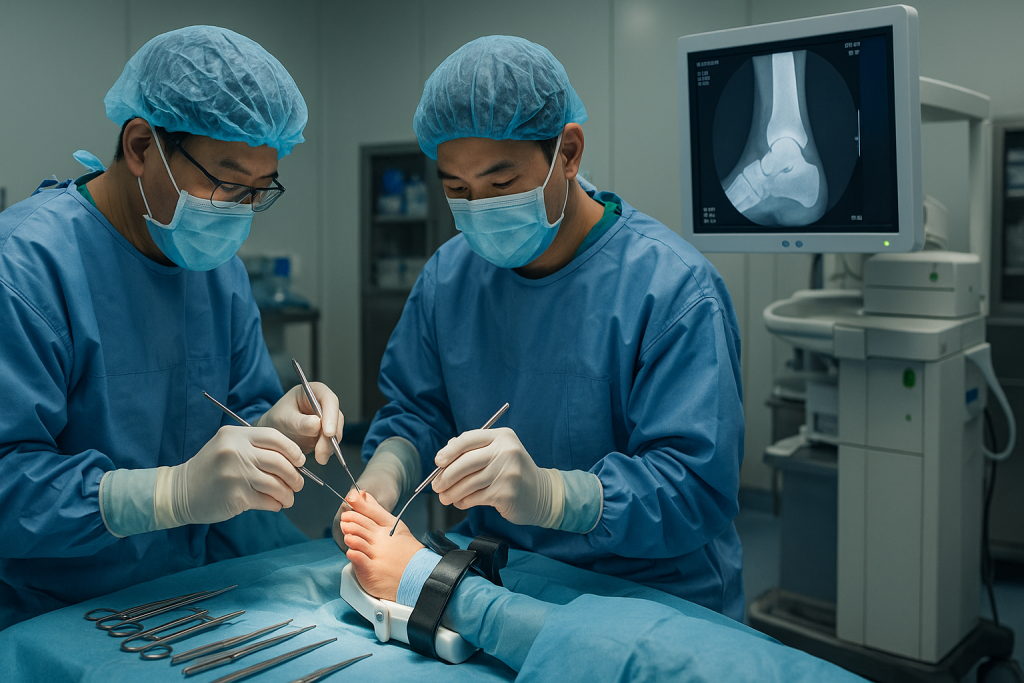
A Vietnamese orthopedic surgery team performing precise bunion correction with minimally invasive tools and real-time X-ray imaging in a modern operating theatre.
How Bunion Surgery Is Performed in Vietnam
1. Preoperative Evaluation
Patients undergo:
-
X-rays
-
Foot and gait assessment
-
Review of medical history
-
Discussion of expectations and cosmetic concerns
Your surgeon will choose the technique that offers the best alignment, stability, and long-term results.
2. During the Procedure
Depending on the method chosen:
-
Local, spinal, or general anesthesia may be used
-
Small or medium incisions are made
-
The bone is cut, realigned, or shaved
-
Screws or plates are placed for fixation
-
Soft tissues are balanced for proper toe alignment
Surgery usually lasts 30–90 minutes.
3. After the Surgery
Patients typically:
-
Walk immediately with a special post-surgery shoe
-
Go home the same day or after one night in the hospital
-
Begin gentle mobility exercises shortly after surgery
Benefits of Having Bunion Surgery
-
Long-lasting pain relief
-
Better foot shape and alignment
-
Improved walking ability
-
Easier shoe fitting
-
Prevents progression of deformity
-
Improved confidence and mobility
For many patients, bunion surgery restores the freedom to walk without pain for the first time in years.
Recovery Timeline After Bunion Surgery
Recovery varies by technique but generally follows this timeline:
Weeks 1–2
-
Walking in a protective shoe
-
Swelling begins to decrease
-
Stitches removed (if applicable)
Weeks 3–6
-
Gradual return to weight-bearing
-
Continued strengthening and mobility exercises
-
Transition to wider shoes
Months 2–3
-
Resume low-impact activities
-
Swelling significantly reduced
-
Improved gait and comfort
Months 4–6
-
Return to normal footwear
-
Begin sports and higher-impact activities (if cleared)
Full bone healing may take 3–6 months, depending on the technique.
Possible Risks and Complications
Although bunion surgery is safe, risks can include:
-
Infection
-
Nerve irritation
-
Over-correction or under-correction
-
Non-union of the bone
-
Persistent swelling
-
Recurrence of the bunion
Choosing an experienced surgeon and modern technique greatly reduces complications.
Cost of Bunion Surgery in Vietnam
Costs depend on:
-
Surgical technique (MIS vs. open surgery)
-
Hospital chosen
-
Surgeon experience
-
Use of titanium screws or plates
-
Length of hospital stay
Typical range:
-
Minimally Invasive Bunion Surgery: USD 1,500–2,800
-
Scarf/Chevron Osteotomy: USD 1,800–3,500
-
Lapidus Procedure: USD 2,500–4,000
-
Arthrodesis (Fusion): USD 3,000–5,000
Packages generally include:
-
Surgeon and anesthesia fees
-
Implants (screws/plates)
-
Hospital room
-
X-rays
-
Post-treatment care
Best Hospitals for Bunion Surgery in Vietnam
🏥 Vinmec International Hospital
Modern MIS and advanced orthopedic services.
🏥 FV Hospital (Ho Chi Minh City)
JCI-accredited with European-trained foot & ankle specialists.
🏥 Tam Anh Hospital (Hanoi & HCMC)
Strong expertise in minimally invasive foot surgery.
🏥 City International Hospital (HCMC)
Affordable, high-quality orthopedic care.
🏥 Orthopedics & Traumatology Hospital (HCMC)
High-volume center specializing in foot deformities.
The Medical Tourism Journey: From Consultation to Recovery
1. Initial Inquiry
Patients send foot X-rays or photos for remote evaluation.
2. Personalized Treatment Plan
A surgeon reviews your case and recommends the most appropriate surgical method.
3. Travel & Logistics
Hospitals or medical tourism providers assist with:
-
Flight and visa support
-
Airport pickup
-
Hotel recommendations
-
Translation services
4. Surgery & Hospital Stay
Most bunion surgeries are same-day procedures.
5. Rehabilitation & Follow-Up
You receive:
-
A personalized recovery plan
-
Online follow-up consultations
-
Guidance on returning to work, sports, and activities
Conclusion
Bunion surgery in Vietnam offers world-class outcomes, advanced minimally invasive options, affordable pricing, and a seamless patient journey for international travelers. Whether you require cosmetic correction, pain relief, or improved walking stability, Vietnam’s highly skilled orthopedic surgeons and modern healthcare system make it an excellent destination for bunion correction.
With the right combination of expertise, technology, and patient support, Vietnam provides high-value medical care that rivals top hospitals around the world.